Kentucky Rules for Riding Private Property
Riding an ATV or UTV on private property in Kentucky can seem simpler than using a trail park, but “private” does not mean rules-free. You still need permission from someone with authority over the land, and that permission does not automatically cover roads, leased acreage, or safety requirements. Here’s how to sort out access, permits, and common edge cases before you ride.
What riding on private property means in Kentucky
If you have permission to ride on private land, you generally do not need a public trail park’s permit just to ride there. That is different from saying any land that looks open is fair game. A field, logging road, coal bench, utility corridor, or trail beside a public road may have an owner or manager who has not agreed to let riders in.
The first question is not whether the ground looks private. It is whether the person granting access has the right to grant it, and whether the route you plan to use stays within the area they control. Permission for one field may not include the woods beyond it, a neighboring parcel, or a road crossing.
Private property also does not make every activity on it private in the legal sense. Public access, a business operation, a managed recreation area, or an event can bring different rules or obligations into play. If you are unsure who controls the land or what kind of access is allowed, pause and confirm before unloading.
Permission should match the place and the ride
A landowner’s permission can be verbal, but written permission is often more useful. It can prevent misunderstandings about the date, route, riders, machines, and any limits on access. For a group ride, get the landowner’s approval for the group rather than assuming one rider can invite everyone else.
A clear permission agreement should answer practical questions such as:
- Which parcels, trails, roads, or staging areas may be used?
- What dates and hours are allowed?
- Are passengers, children, guests, or additional machines permitted?
- Are there speed, noise, fire, parking, or trail-direction restrictions?
- Can riders cross a road or use a particular gate?
- Who should be contacted if a gate is locked, a trail is blocked, or damage occurs?
Use Written Permission From a Kentucky Landowner as a checklist for putting access terms in writing. A written note is not a substitute for legal advice or a complete land-use agreement, but it can make the boundaries and expectations easier to understand.
Permission is not unlimited simply because a landowner says “you can ride here.” The landowner may have authorized only a specific part of the property or may be acting for someone else. On leased land, for example, the person who owns the surface may not hold the rights to authorize every kind of recreation. Coal, timber, utility, and other agreements can divide control among different parties. Check Who Holds Riding Rights on Leased Coal Land when the property is leased or used by a company.
Private roads are not automatically open roads
A road that runs through private property is not necessarily available to every rider. It may be a private access road, a company road, a road with public access rights, or a route subject to a specific agreement. The owner’s permission to ride a trail does not necessarily include permission to use a road.
Likewise, a landowner’s permission does not turn a public road into a private riding area. If your route reaches a county road or state highway, treat the road portion and any crossing as a separate legal question. Don’t assume that a short connection between two parts of a property is allowed just because the same person owns both sides.
For boundaries that are unclear, ask the landowner to identify the approved route on a map or in person. Avoid using a gate, path, or road as evidence of permission; it may be there for farm, work, or emergency access.
Permission, permits, and out-of-state documents
A private landowner’s permission and a trail permit do different jobs. Permission is about access to that property. A park permit is issued under the rules of a particular riding area. One does not replace the other.
For a ride entirely on private land, a public riding park’s permit is generally not the relevant authorization. But if you enter a managed park, forest riding area, or other designated recreation site, its access rules may apply even if a private parcel is part of your route. Check the rules for the actual land manager, not just the person who invited you.
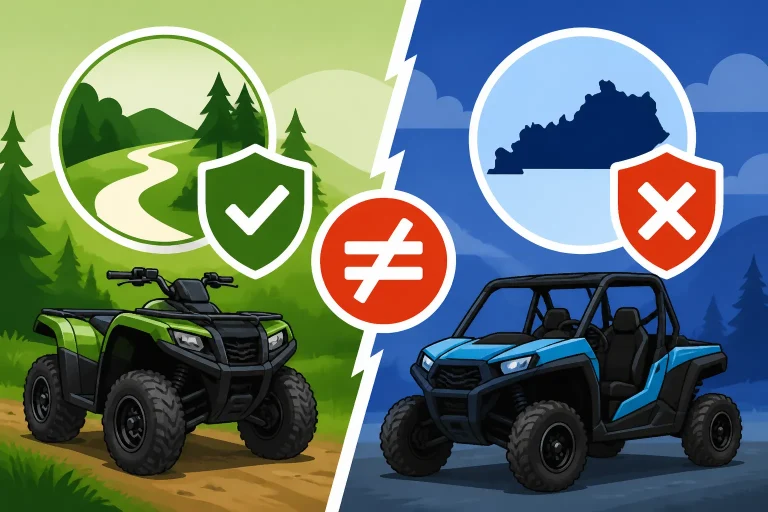
Kentucky does not have one statewide trail sticker that gives a rider permission to use every trail. The distinction is explained in Why Kentucky Has No Statewide Trail Sticker. A private landowner can set access conditions for their own land, while a park or public land manager can require its own permit or pass. See Do You Need a Permit for Kentucky Trails? for how permit requirements differ among riding areas.
| Where you plan to ride | What to confirm before riding |
|---|---|
| Private land used by the owner | The owner or authorized occupant has allowed your ride and identified the approved area |
| Leased or company-managed land | The person granting access has the necessary recreation rights and the route is within the approved area |
| A commercial off-road park | Current park admission, permit, machine, passenger, and operating rules |
| Public land or a managed recreation area | The land manager’s current access rules, permits, closures, and machine restrictions |
| A route that reaches a public road | Whether the road use or crossing is allowed under the rules for that road |
Out-of-state registration does not grant access
A registration card, permit, or sticker from another state does not give you permission to ride on a Kentucky landowner’s property. It also does not automatically satisfy the rules of a Kentucky park or public riding area. Access is controlled by the person or agency managing the land.
That distinction matters for visitors bringing a machine from another state. Carrying out-of-state documents may help identify the machine or show that it is recognized where you are from, but it does not override a landowner’s decision, a park’s permit requirement, or a trail closure. For the registration question, see Does Kentucky Honor Out-of-State Registration?. For park-specific rules, check the operator directly; Why One Park’s Permit Does Not Travel explains why one riding area’s authorization should not be treated as a pass for another.
A private-property ride may also involve a rental business, guide, club, or organized group. In that case, ask who is responsible for securing land access and whether the agreement covers your specific machine and group. Do not assume a rental booking or club membership includes permission for every nearby road or parcel.
Safety rules and responsibilities still matter
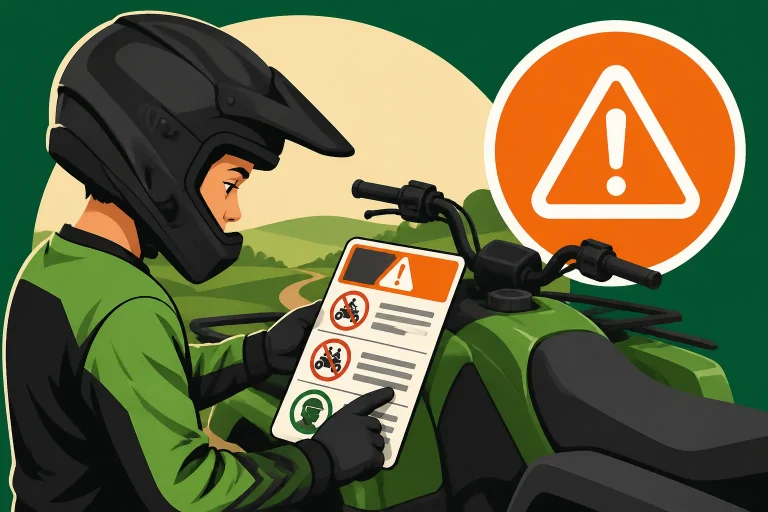
Private property is not a reason to ignore basic safety rules. Kentucky has rules relevant to younger ATV riders, and a property owner cannot simply waive state requirements. Age limits and supervision requirements can depend on the rider, machine, and circumstances. Review Kentucky Rules for a Rider Under 16 before allowing a child to ride, and check the machine’s manufacturer age label. The label is important when assessing whether a machine is appropriate for a young rider.
Helmet use also deserves attention. Do not assume that a private driveway or family-owned field automatically removes safety obligations. Check Kentucky Helmet Law for ATV Riders for the rules that apply to the rider and situation. Even where a specific rule does not require a helmet, a properly fitted helmet and suitable protective gear are sensible precautions, especially on uneven ground, wooded trails, and routes with steep grades.
The landowner may set stricter conditions than the minimum state requirements. For example, an owner can require helmets for every rider, limit machine size, prohibit passengers, set a lower speed, or close a trail during wet conditions. Treat those conditions as part of the permission you received. If you cannot meet them, do not ride there.
Riders also need to respect other people and uses of the property. A trail may cross livestock pasture, working land, a hunting area, or a driveway used by residents and equipment. Close gates only as instructed, keep clear of active work, avoid disturbing animals, and do not leave trash or damage vegetation. A permission agreement can be withdrawn if riders ignore the conditions or create a safety problem.
Stay on the approved route
Riding beyond the authorized area can become a trespass issue even if you entered the property lawfully. A landowner may allow access to one marked trail while keeping other areas closed. Follow signs and barriers, and don’t treat an unmarked route as an invitation.
If another owner’s parcel lies between two sections of the property, get separate permission before crossing it. Do not rely on a neighbor’s permission to speak for the next landowner unless that authority is clear. More detail is available in Kentucky Trespass Law and Off-Road Riders and Kentucky Landowner Permission Requirements.
A rider who has permission to use a trail also does not automatically have permission to cut a new route, move a gate, use a work road, or bring additional people. Ask first. If the landowner’s instructions are unclear, stop and clarify rather than guessing.
Road crossings need separate attention
A private-property ride can still intersect with public roads. Permission to ride on both sides of a road does not by itself authorize travel along the road or a crossing at any point. Road use is subject to separate rules, and the status of a road can be less obvious than it appears.
Plan a route that avoids public roads unless you have confirmed that the specific use is lawful. Do not ride along a public road merely to connect two trails, and do not assume a landowner can authorize a crossing wherever convenient. Kentucky Rules for Crossing a Highway covers the separate issue of road crossings.
If a landowner identifies a private road as part of the route, confirm that the road is actually included in the permission and that no company, neighbor, or public-access restriction applies. A road’s appearance is not enough to establish who controls it.
A practical check before you start
Before riding on private property in Kentucky, confirm the following:
- Identify who controls the land. Ask the owner or authorized manager, especially if the property is leased or used by a business.
- Get permission for the exact area. Confirm trails, roads, parking, gates, dates, and any limits on riders or machines.
- Check whether the route leaves the property. A public road, neighboring parcel, or managed recreation area may have separate rules.
- Confirm age and safety requirements. Check the rider’s age, the machine’s age label, supervision needs, and helmet rules.
- Ask about special conditions. Look for speed limits, wet-weather closures, work activity, fire restrictions, or other landowner rules.
- Keep the permission details accessible. A written message or agreement can help resolve confusion about where you were authorized to ride.
The safest assumption is that permission applies only to what the landowner clearly approved. A private-property invitation is valuable, but it is not a statewide riding pass, a trail permit, or permission to use every road nearby. When access, land control, or road status is uncertain, verify it before the ride rather than trying to sort it out at a gate or roadside stop.
Disclaimer
This article is for general informational purposes only and does not constitute professional advice. Laws, prices and regulations vary by location and change over time. Consult a qualified professional for guidance on your specific situation.