Kentucky Rules for a Rider Under 16
It’s a common scenario for families in Kentucky: you’ve got a spirited kid eager to hop on an ATV or UTV, but you’re completely swamped by the conflicting information about who can ride what, and where. The worry about doing something wrong, or worse, putting your child at risk, is real. This guide is here to clear up the confusion, walking you through the specific Kentucky rules regarding riders under 16, so you can make informed, safe choices for your young adventure-seekers.
The Core Rule: Kentucky's Reliance on the Manufacturer's Age Label
Kentucky has a pretty clear, if sometimes frustratingly vague, primary rule when it comes to underage ATV and UTV riders: the law points directly to the manufacturer's age label on the machine itself. This isn't just a suggestion; it's the standard. Many parents assume there's a blanket minimum age, but Kentucky statute hinges on what the machine's maker recommends.
Understanding the Manufacturer's Age Label in Kentucky Law
When you look at an ATV or UTV, particularly a new one, you'll almost always find a sticker or a molded-in label from the manufacturer stating a recommended minimum age for operation. This is often based on the machine's size, weight, power, and handling characteristics. For example, a small 50cc youth ATV might recommend riders 6 years and older, while a larger 90cc model might be 10 or 12+, and a full-size machine typically states 16 and older. Kentucky law adopts these labels as its legal standard. This means if a machine is labeled for 16 and up, a 15-year-old legally should not be operating it, even with parental consent. Ignoring this label isn't just a suggestion; it can have significant legal repercussions, particularly if an accident occurs. It’s important to remember that this isn't about skill level, but about a legal standard set by the machine's creators and adopted by the state. You can find more details on this topic in [The Manufacturer's Age Label in Kentucky Law].
Why Kentucky Uses This Standard
You might wonder why Kentucky doesn't just set a hard age limit, like "no one under 12." The state's approach reflects a recognition that ATVs and UTVs vary wildly in their design and capability. A tiny electric youth quad for a 6-year-old is a completely different beast than a 700cc utility ATV. By deferring to the manufacturer, Kentucky places the onus on the party best equipped to assess the safety parameters of their specific product. This also subtly shifts some liability to the parents or guardians who allow a child to operate a machine outside of these recommendations. The intent is clearly safety-driven, aiming to prevent children from operating machines that are simply too powerful, too heavy, or too complex for their physical and mental development. This framework means that if a machine is designed for youth, it will have a corresponding age recommendation, allowing for younger riders to participate safely on appropriate equipment.
Implications for Parents and Guardians
For parents and guardians, this manufacturer's age label rule means you need to be diligent. Before purchasing or allowing a child to ride any ATV or UTV, locate and understand that specific machine's age recommendation. If you remove the label, or if it's faded and unreadable, you're essentially removing a critical piece of information that Kentucky law relies on. Allowing a child to ride a machine labeled for older operators isn't just risky; it could be seen as negligence. Imagine a situation where your 14-year-old, riding a machine clearly marked for ages 16+, is involved in an incident. Legally, you could be held responsible for allowing them to operate a machine they were not legally permitted to ride, regardless of their personal skill. This is a crucial distinction that often catches people off guard. It underscores the importance of not just supervising, but supervising appropriately sized and rated machines. For a deeper dive into the potential liabilities, you might want to read [What a Parent Risks Letting a 6-Year-Old Ride].
Supervision and Training for Young Riders
Beyond the age label, Kentucky's rules also touch on how younger riders should be supervised and what's expected in terms of training, even if it's not a formal state requirement. Direct adult involvement is key to keeping kids safe on the trails and private property.
Direct Parental Supervision
While the Kentucky Revised Statutes don't provide a hyper-specific definition of "direct parental supervision," the spirit of the law implies that an adult must be actively present and overseeing the minor's operation of the ATV or UTV. This generally means the supervising adult should be:
- Within sight and hearing distance: Able to immediately intervene if a problem arises.
- Knowledgeable about the machine and terrain: Capable of offering guidance and identifying potential hazards.
- Responsible for the minor's actions: Ready to take accountability for any rule violations or unsafe behavior.
Think of it this way: letting your 10-year-old ride a youth ATV on a distant part of your farm while you're inside watching TV probably doesn't count as "direct supervision." You need to be out there with them, guiding, instructing, and ensuring they ride safely and responsibly. This hands-on approach is critical, especially when they're learning how to handle uneven terrain or unexpected obstacles. For more on this, check out [Kentucky Supervision Rules for Minors].
The Lack of a State-Mandated Safety Course
Unlike some other states that require minors to complete an ATV safety course before riding, Kentucky does not currently have such a statewide mandate. This can be a double-edged sword. On one hand, it offers more flexibility for parents to teach their children. On the other, it means there's no inherent baseline of formal safety education required by the state.
However, the absence of a state mandate doesn't diminish the importance of proper training. Many organizations, such as the ATV Safety Institute (ASI), offer excellent hands-on courses that teach critical riding techniques, risk assessment, and responsible operation. Even if it's not legally required, investing in such a course for your young rider is a highly recommended step. It provides structured learning that many parents may not be equipped to deliver themselves and can instill lifelong safe riding habits. Remember, simply having a powerful machine doesn't make a rider safe; knowledge and practice do.
Private Land vs. Public Trails
The rules for underage riders can also subtly shift depending on where they are riding.
- Private Land: On your own private property, with explicit permission from the landowner, the primary legal constraint for minors remains the manufacturer's age label and the requirement for direct adult supervision. You have more leeway regarding general operations, but the fundamental safety guidelines are still paramount. Brands like SuperATV often promote accessories that enhance safety, which are beneficial no matter where you ride, but especially on private land where personal responsibility is at its highest.
- Designated Public Trails/Parks: When riding in a state park, national forest (like parts of the Daniel Boone National Forest that allow OHVs), or a private off-road park (such as Black Mountain Off-Road Adventure Area), specific park rules often come into play in addition to state law. These parks may have their own age limits, supervision requirements, or helmet mandates that could be stricter than the general state law. For instance, some parks might require all riders under a certain age to wear a helmet, regardless of other exemptions. Always check the specific rules of any public or private trail system before you go. [Kentucky Rules for Riding Private Land] offers more context on the distinctions.
Here's a quick overview of typical age recommendations:
| ATV/UTV Type | Typical Engine Size | Manufacturer Age Recommendation | Primary Use Case |
|---|---|---|---|
| Youth ATV | 50-90cc | 6-12 years old | Learning, recreational riding, light trails |
| Mid-Size ATV | 125-250cc | 14-16 years old | Recreational riding, intermediate trails |
| Full-Size ATV | 250cc+ | 16 years old and older | Sport, utility, advanced trails |
| Youth UTV | 150-250cc | 10-14 years old | Recreational, basic utility, controlled environments |
| Full-Size UTV | 300cc+ | 16 years old and older | Utility, recreation, demanding terrain |
Note: These are general guidelines; always check the specific manufacturer's label on your machine.
Public Road Use for Underage Riders: A Strict No-Go
This is one area where there is very little wiggle room. Kentucky law is overwhelmingly restrictive about ATVs and UTVs on public roads, and these restrictions are even more stringent when it comes to underage operators.
Kentucky's Stance on ATVs on Public Roads
Generally speaking, ATVs and UTVs are not street legal in Kentucky. The roads are designed for vehicles that meet specific safety and registration standards, which most off-highway vehicles (OHVs) simply don't. For any rider, regardless of age, operating an ATV on a public highway or road is typically illegal. This means paved roads, gravel county roads, and even the shoulders of state routes are off-limits. If it's maintained by the state, county, or city for public vehicular travel, an ATV likely doesn't belong there. This restriction applies in full force to riders under 16, who often lack the judgment, experience, and physical presence to safely navigate shared roadways. You can dive deeper into this broad prohibition in [Kentucky Rules for ATVs on Public Roads].
Exceptions and Misconceptions
There are a few very limited exceptions where an ATV might legally touch a public road, but these almost never apply to minors, especially for recreational riding.
- Farm Use Exemption: Farmers can often operate ATVs on public roads for agricultural purposes. However, this is a very narrow exemption tied to the activity (bona fide farm work), not the rider's age. An underage rider performing farm duties would still need to meet the manufacturer's age label requirement for the machine and be directly supervised. This exemption is not an invitation for kids to joyride on country roads.
- 0.2-Mile Crossing Rule: Kentucky law allows for very short crossings of public roads (up to 0.2 miles) at a ninety-degree angle, primarily to get from one private property to another. Again, while this rule exists, it does not override the manufacturer's age label for the operator. It's also a highly risky maneuver, and not one typically recommended for inexperienced or underage riders without extremely close supervision.
It’s a common misconception that if a road is rarely used or "just a holler road," it's okay for kids to ride their ATVs on it. Unless it's explicitly private land, it's considered a public road under Kentucky law, and the restrictions apply.
Penalties and Risks for Non-Compliance
The penalties for operating an ATV illegally on a public road can be significant, ranging from fines to impoundment of the machine. When a minor is involved, the consequences can extend to the parents or guardians. Beyond legal trouble, the safety risks are enormous. ATVs are not designed for pavement; they handle poorly, have limited visibility, and offer no protection in a collision with a car or truck. A child on an ATV on a public road is extremely vulnerable. It's a situation that local law enforcement, particularly in areas like Harlan County, take very seriously due to the severe injury potential. Keeping underage riders off public roads is not just about avoiding a ticket; it's about protecting lives. [Getting Ticketed at Black Mountain for an Untitled Quad] might cover some enforcement aspects, though typically related to trails, it gives an idea of citations.
Specific Scenarios and Practical Advice
Understanding the general rules is one thing, but how do they play out in real-world situations? Let's look at some specific considerations for young riders.
Riding a Youth Machine
Youth ATVs and UTVs are specifically designed with smaller frames, lower power outputs, and features tailored for younger, less experienced riders. These machines are the best option for introducing children to off-road riding safely. When considering a youth machine, always:
- Match the rider to the machine: Ensure the child can comfortably reach all controls (handlebars, footpegs, brakes) and can operate them with confidence. A child too small for even a youth machine can lose control easily.
- Adhere to the age label: If the machine says 6+, don't let a 4-year-old ride it, even if they seem capable.
- Start small: Begin with the lowest power and smallest size appropriate for their age and skill, gradually moving up as they gain experience. Brands like SuperATV also offer various safety accessories that can be installed on youth machines to make them even safer, such as speed limiters or additional protective guards.
The Role of Engine Size
Engine size is a common indicator of a machine's power and, consequently, its recommended age range. While the manufacturer's label is the ultimate legal authority, engine size is a practical guide:
- Under 90cc: Typically youth models, designed for beginners and younger children (often 6-12 years).
- 90cc-125cc: Often designated for older youth (10-14 years), bridging the gap to full-size machines.
- 150cc+: Generally considered full-size or adult machines, almost universally recommended for riders 16 and older.
Always cross-reference the engine size with the specific manufacturer's age label, but use it as a quick benchmark. You can read more about this in [Kentucky Engine Size Rules for Young Riders].
Gearing Up for Safety
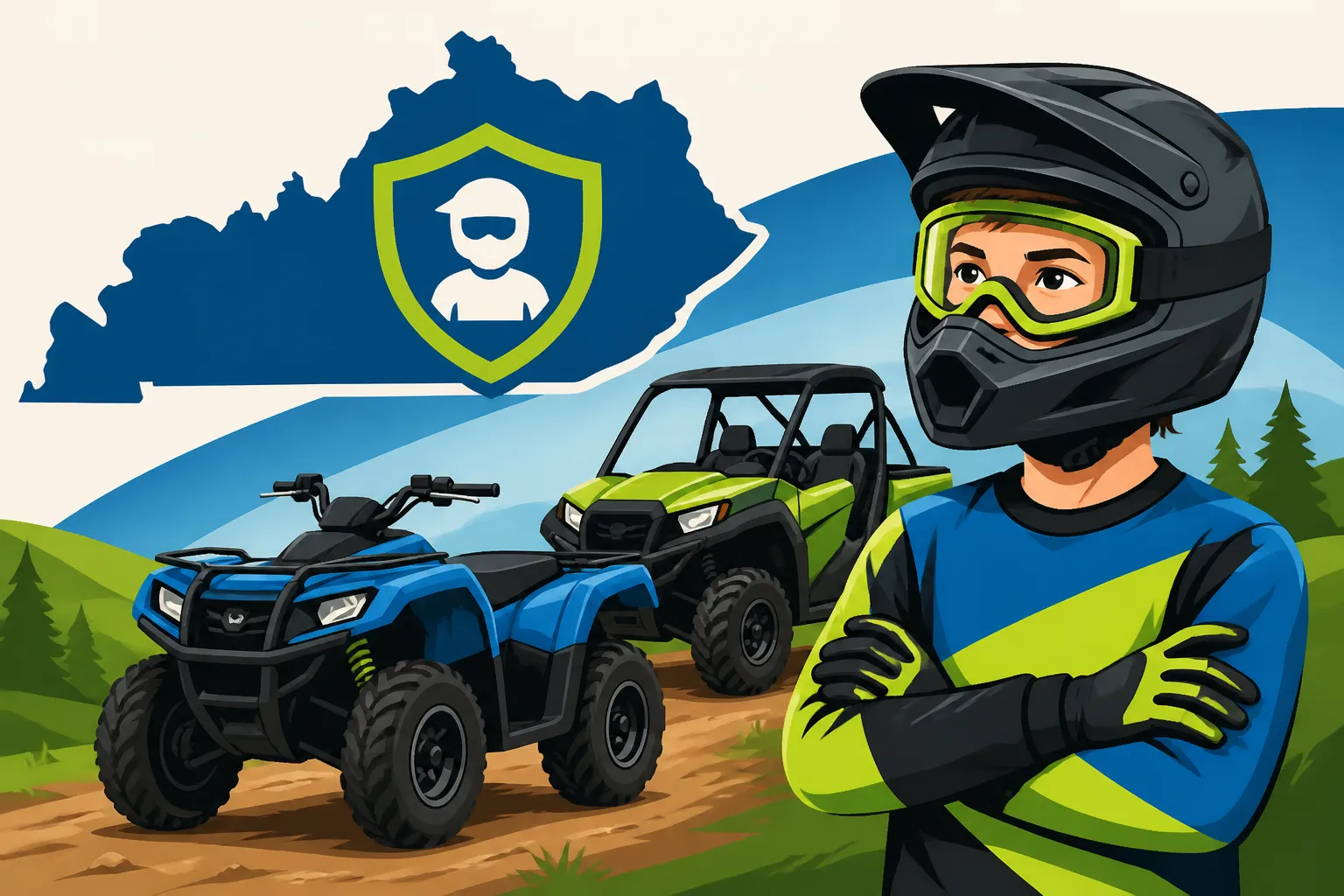
Beyond the machine itself, proper safety gear is non-negotiable for young riders. While Kentucky's general helmet laws for ATVs can be a bit nuanced depending on location and use (e.g., farm exemptions), for riders under 16, a helmet is almost always a critical piece of safety equipment, and often legally required on public lands.
- Helmets: A DOT-compliant helmet is essential. It should fit snugly and be worn correctly.
- Eye Protection: Goggles or a helmet with a face shield protect against dust, debris, and branches.
- Long Sleeves and Pants: Protect against scrapes, abrasions, and sun exposure.
- Gloves: Improve grip and protect hands.
- Over-the-Ankle Boots: Provide ankle support and foot protection.
Even if a specific law doesn't mandate a helmet for every riding scenario for a minor, any responsible parent will ensure their child is fully geared up. An accident can happen anywhere, and proper gear can literally be a lifesaver. This is especially true when riding on trails like those at Leatherwood Off-Road Park where terrain can be unpredictable. [Kentucky Helmet Rules on Public Property at 16] provides a deeper look into the specifics of helmet requirements for minors.
Disclaimer
This article is for general informational purposes only and does not constitute professional advice. Laws, prices and regulations vary by location and change over time. Consult a qualified professional for guidance on your specific situation.