A Deputy at a Kentucky Roadside Stop
You're out enjoying a ride, maybe heading from one trail section to another, or just doing a quick hop across a county road for a farm chore. The sun is shining, the engine is humming, and then you see it: those flashing blue lights in your rearview mirror. Your stomach drops. A deputy at a Kentucky roadside stop can be an unsettling experience, especially when you're not sure if you're even supposed to be on that stretch of pavement. This guide is here to walk you through what to expect, what Kentucky law says about ATVs and UTVs on public roads, and how to best prepare yourself for such an encounter.
What Happens When the Lights Flash: Your Initial Interaction
That sudden sight of flashing lights can really make your heart pound. Whether you're in a remote holler of Perry County or just crossing a paved section near a small town, a law enforcement stop on an ATV or UTV often comes with a unique set of questions and concerns. Knowing what to do in those first moments can make a world of difference.
Pulling Over Safely and Respectfully
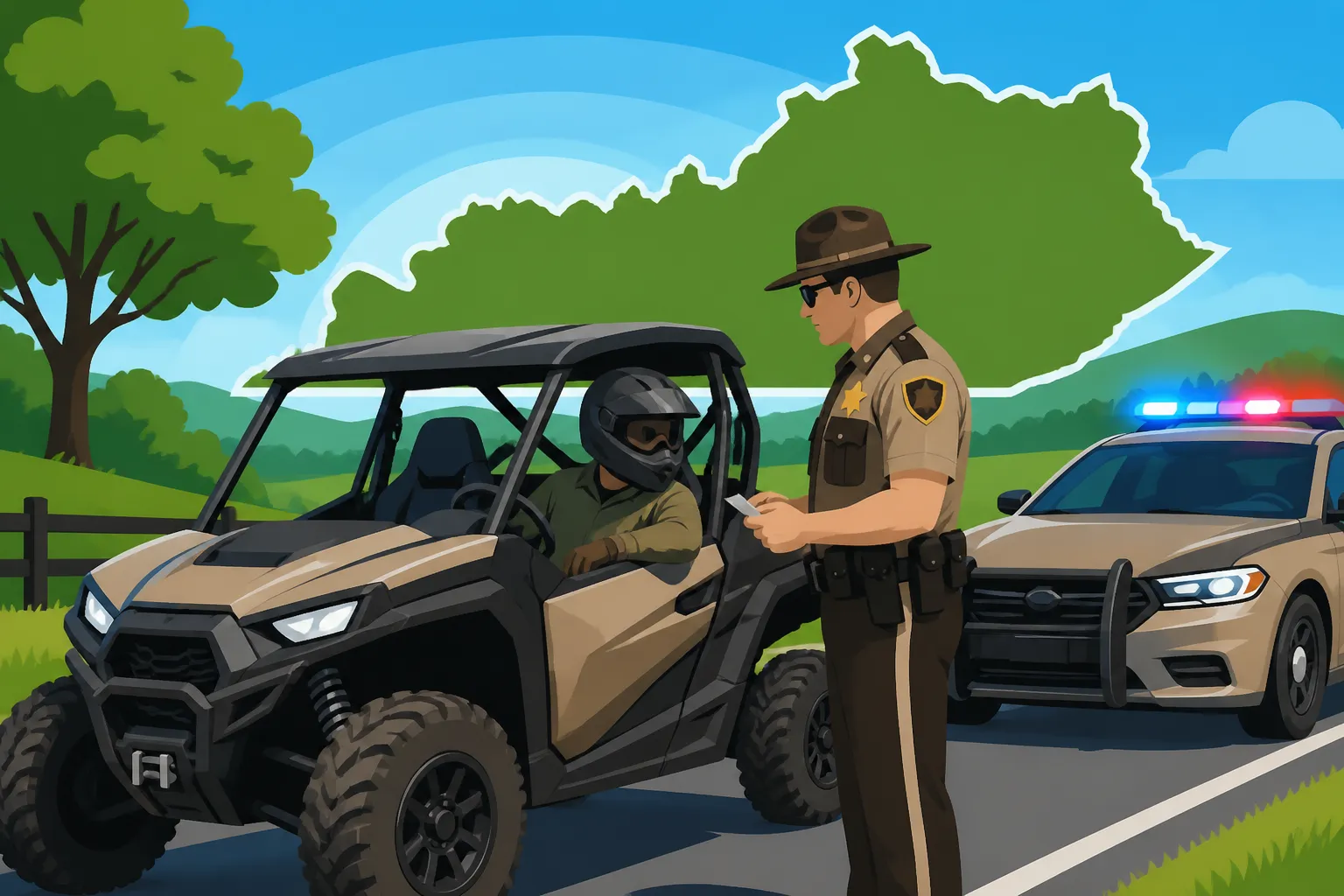
When you see those lights, your first and most important step is to respond safely and clearly. It’s crucial to pull over in a safe location, off the main travel lane if possible, and signal your intent to stop. Turn off your engine, keep your hands visible, and avoid any sudden movements. Think about it: a deputy approaching an ATV on the side of the road doesn't know your intentions or whether you're legally supposed to be there. Your calm, cooperative demeanor helps set a positive tone for the interaction.
Imagine you're making a short hop on a country road in Pike County, maybe going from one section of your hunting lease to another. You see the lights, and your first thought might be, "Oh no, did I do something wrong?" Instead of panicking, slowly pull over to the shoulder, away from traffic. Turn your machine off. Remove your helmet and glasses if you're wearing them, so the officer can see your face clearly. This simple act of readiness and respect can help de-escalate any potential tension and show that you're prepared to cooperate.
Common Questions and Concerns a Deputy Might Have
Once the deputy approaches, they'll likely have a few standard questions. They'll want to know who you are, where you're coming from, where you're headed, and why you're operating an ATV or UTV on a public road. This isn't just curiosity; they're trying to quickly assess if you're violating [Kentucky Rules for ATVs on Public Roads] or if you fall under one of the specific exceptions.
You might be asked about the ownership of your machine, so it's wise to have proof readily available. They might inquire if you have a title, a bill of sale, or any form of registration. While Kentucky generally doesn't register ATVs, having clear documentation of ownership is always a good idea. They'll also be observing your machine: Are its lights working? Does it appear to be modified for road use? If you're running aftermarket parts like a full light kit or turn signals from, say, SuperATV, it might prompt questions about whether you're trying to operate a fully street-legal machine, which is a different category of compliance. Be prepared to explain your purpose for being on the road and to present any requested documentation without hesitation.
Understanding Kentucky's ATV and UTV Road Laws
One of the biggest sources of confusion and frustration for riders in Kentucky is the patchwork of rules regarding ATVs and UTVs on public roads. It often feels like a minefield, with different rules for different situations. Deputies are enforcing these nuanced laws, and understanding them is your best defense.
The Default Rule: Off-Road Only
Let's get this out of the way upfront: in Kentucky, the general rule is that ATVs and UTVs are not designed or permitted for operation on public highways or roads. This is the baseline understanding that most law enforcement officers operate under. It's frustrating, we know, especially when you have to trailer your machine just to cross a short stretch of pavement. The law sees these machines primarily as off-road recreational or utility vehicles, not as traditional road-going transportation.
This default prohibition is why any roadside stop quickly turns into an inquiry about why you're on the road. If you're just joyriding on a state route, you're likely going to receive a citation. The goal of a deputy is to ensure public safety and adherence to these regulations. They're not necessarily out to ruin your day, but they are obligated to enforce the law. It's a common misconception that if a road is rarely used, it's fair game. Unfortunately, Kentucky law doesn't make that distinction; if it's a public road, the default rule applies.
Specific Exceptions to the Rule
Thankfully, Kentucky law does provide some specific, albeit narrow, exceptions where ATVs and UTVs can legally be operated on public roads. These exceptions are critical to understand if you find yourself stopped.
-
Crossing a Road: You are generally allowed to cross a two-lane public road at a ninety-degree angle, provided it's done safely and quickly. This isn't for cruising; it's strictly for getting from one side to the other. There's even a specific mention of [Crossing a Two-Lane at Ninety Degrees in Kentucky] in the statutes. This typically applies to situations where a trail or private property is bisected by a road.
-
Farm Use: Perhaps the most common exception, Kentucky law allows ATVs and UTVs to be operated on public roads for agricultural purposes. This includes hauling feed down a holler road in Knott County or moving equipment between fields. Critically, [Why Kentucky's Farm Exception Has No Limit] on mileage means you can cover a significant distance if you are actively engaged in farming activities. This exemption is tied to the purpose of the ride.
-
Construction, Maintenance, and Snow Removal: Machines can be used for these specific tasks on public roads. If you're clearing snow from a neighbor's lane in January or assisting with a construction project, you generally fall under this.
-
Special Purpose Vehicles (SPVs): This is where things get more complex. Kentucky has a pathway for UTVs (and some ATVs, though less common) to become "street legal" by registering as an SPV. This involves meeting stringent equipment requirements (like turn signals, specific lighting, mirrors, seat belts, and an illuminated speedometer – parts often sourced from aftermarket providers like SuperATV), passing an inspection, and carrying motorcycle-level insurance. If you've gone through this process, you're operating under [Kentucky Street Legal UTV Requirements], but even then, cities and counties must "opt-in" to allow SPVs on their roads, and there are speed limits and time-of-day restrictions.
Exception Type Typical Use Case Road Type Allowed Mileage/Time Limit Specific Equipment Required for Exception Crossing Getting from one side of a road to another Any public road (two-lane) 0.2 Mile (max) Basic lights, brakes Farm Use Moving between fields, hauling feed, chores Any public road No mileage limit Basic lights, brakes Emergencies Responding to an emergency Any public road As needed Basic lights, brakes SPV General road use (if city/county opted-in) Designated public roads 20-mile radius (SPV) Full SPV equipment package, insurance, inspection, plates
Equipment and Licensure for Road Use
Even if you fall under an exception, your machine needs to meet certain basic requirements. For simply crossing a road or using it for farm work during daylight hours, you'll still need functional headlights and taillights. The law states [One Headlight and Two Taillights in Kentucky] must be burning if you're operating during hours of darkness or in conditions of reduced visibility.
For SPVs, the list is much more extensive. You're essentially outfitting your UTV to near-motorcycle standards, including turn signals, brake lights, mirrors, a horn, and an illuminated speedometer. This is where many riders turn to brands like SuperATV for reliable, compliant aftermarket parts. Furthermore, operating an SPV requires a valid driver's license. While you don't need a driver's license just to cross a road on a non-SPV, if you're driving a street-legal SPV, [Do You Need a Driver's License to Cross Pavement?] becomes a resounding yes for the full duration of your road travel. Understand these distinctions to avoid unnecessary citations.
Essential Documentation and Machine Readiness
When a deputy pulls you over, they're looking for quick answers and concrete proof. Having your ducks in a row with your documentation and making sure your machine is in proper working order can significantly smooth out the interaction. Don't underestimate the power of being prepared.
Proof of Ownership and Identity
The first thing any law enforcement officer will ask for is your identification and proof that the machine you're operating belongs to you. This is non-negotiable. You absolutely need to have [A Kentucky Photo ID at the Clerk's Counter] – or rather, in your possession, ready to present. This proves who you are. Beyond that, the ownership of the ATV or UTV itself is paramount.
Kentucky titles ATVs bought after July 2010. If your machine falls into this category, you should have its title. If you bought it privately, ideally you have [A Signed-Over Title for a Kentucky Purchase]. If you’re riding an older machine that pre-dates Kentucky’s titling law, you might only have a bill of sale. Regardless, always have some form of paperwork proving ownership, such as a bill of sale, especially if you have [A Machine With No Papers]. This is critical for avoiding a situation where a deputy might suspect the machine is stolen or illegally acquired. Presenting these documents promptly and clearly, as if you were at the clerk's counter, helps the deputy quickly verify legitimate ownership.
Machine Equipment for Legal Road Use
While many riders focus on performance upgrades, ensuring your machine is legally equipped for the brief moments it might spend on a public road is crucial. As mentioned, basic lighting is key. Your headlights and taillights must be functional. These aren't just for seeing the trail; they're for being seen by others on the road, even during a quick crossing. For SPVs, the list expands dramatically. You'll need working turn signals, brake lights, dual mirrors, a horn, and an illuminated speedometer. Companies like SuperATV offer kits designed to help UTV owners meet these specific SPV requirements, ensuring you have the right components to pass inspection and comply with the law.
Beyond the specific legal requirements for road use, a deputy will also likely perform a quick visual inspection of your machine. Are the tires in good condition? Do the brakes appear functional? Is the exhaust excessively loud (though not strictly a KY road law for ATVs, it can draw unwanted attention)? While not always direct causes for a citation, these factors contribute to the overall impression of safe operation. Ensuring your machine is well-maintained and appears ready for the conditions, whether on or off-road, is always a good practice.
Insurance (or Lack Thereof)
Insurance is another area where confusion often reigns. For most off-road riding, Kentucky does not mandate ATV or UTV insurance. This is a common point of contention and often surprises riders from other states. So, if you're riding a standard ATV on a trail and then briefly use a road under one of the exceptions, you typically won't be ticketed for not having insurance. However, this changes drastically if you've gone through the SPV process.
If your UTV is registered as a Special Purpose Vehicle, then yes, [Kentucky SPV Insurance Requirement] kicks in. You'll need to carry motorcycle-level liability insurance, and you must have proof of that insurance with you, just like you would in a car. Failure to produce valid insurance for an SPV on a public road will result in a citation. So, while [Kentucky ATV Insurance Requirement] is usually absent for trail riding, be absolutely clear about your machine's status and whether it's subject to the SPV rules. It's a key distinction that a deputy will want to verify during a roadside stop.
What Happens Next: Compliance and Consequences
So, you've pulled over, presented your documents, and explained your situation. What's the outcome? It could go several ways, from a simple conversation to a stern warning, or even a ticket. Understanding these potential outcomes will help you react appropriately.
When You're Riding Legally
The best-case scenario, of course, is that you are indeed riding within the confines of Kentucky law. Perhaps you were making a legitimate [0.2 Mile and Not a Yard More] crossing, or you were performing essential farm duties under [Why Kentucky's Farm Exception Has No Limit]. In such cases, after a brief conversation and verification of your documents, the deputy will likely thank you for your cooperation and send you on your way. You might even get a friendly reminder about the limits of the exceptions.
Imagine you're on your way to haul feed for your livestock, traveling a few miles down a county road in Christian County to the next pasture. You have your photo ID, your bill of sale (since your machine is an older model), and you can clearly articulate your purpose. The deputy, after a quick check, sees that you are indeed using the ATV for agricultural purposes. They might remind you to stay safe and then let you continue. This is the ideal outcome, proving that being informed and prepared truly pays off.
Facing a Citation
Unfortunately, not every roadside stop ends with a friendly wave goodbye. If you're found to be operating an ATV or UTV illegally on a public road—perhaps joyriding on a state highway, failing to meet SPV requirements, or not falling under any of the valid exceptions—you will likely receive a citation. [Kentucky Fines for Illegal ATV Road Use] can vary depending on the specific violation and the county, but they can be significant. This could include fines for improper road use, lack of proper equipment (if an SPV), or even operating an unregistered vehicle if the circumstances are severe.
The deputy will explain the violation and issue the ticket. While it's tempting to argue, it's generally best to accept the citation calmly and address any disagreements through the proper legal channels, such as [Appealing a Kentucky ATV Citation]. Trying to debate the law on the side of the road rarely changes the outcome and can sometimes lead to additional charges if the interaction escalates. Be polite, ask clear questions about the next steps (like where and when to pay the fine or appear in court), and get all the information you need. Understanding [What a Harlan County Road Ticket Costs a Rider] can give you a heads-up on the financial implications, which can be a real sting.
Securing Your Machine and Next Steps
In more severe cases, particularly if the machine is believed to be stolen, heavily modified to be unsafe, or if the operator is impaired, a deputy might decide to impound the ATV or UTV. This is a rare occurrence for a simple road use violation but is a possibility in extreme circumstances. If your machine is impounded, the deputy will provide you with information on where it's being taken and the steps required to retrieve it. This process can be costly, involving impound fees, daily storage charges, and any fines you incur.
After receiving a citation, your next steps will typically involve deciding whether to pay the fine or contest it in court. If you choose to contest, you'll need to appear on the date specified on the ticket. Gathering any evidence that supports your case—like photos of your machine's equipment, proof of farm ownership, or documentation of where you were going—can be helpful. Even if you believe you were riding legally, the onus is often on you to prove it. Therefore, maintaining clear records and being knowledgeable about the specific statutes can be invaluable after a roadside stop.
Disclaimer
This article is for general informational purposes only and does not constitute professional advice. Laws, prices and regulations vary by location and change over time. Consult a qualified professional for guidance on your specific situation.