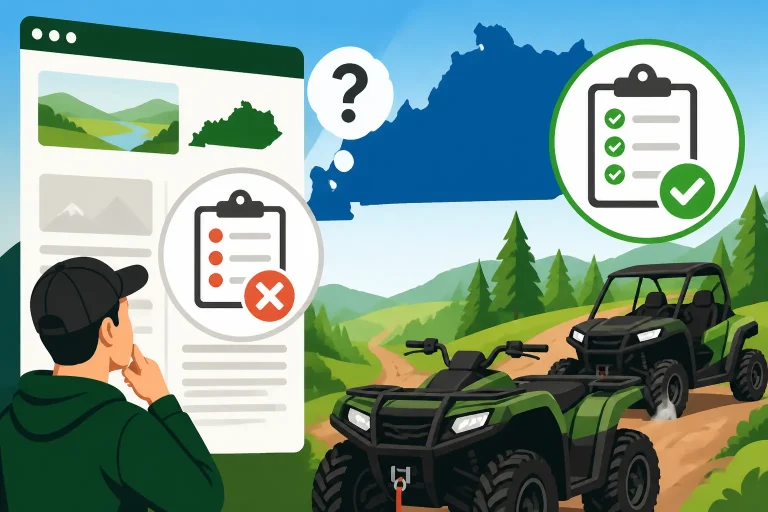
Why Kentucky Cannot Reciprocate Anything
Kentucky riders often ask whether a permit or registration from another state lets them ride here, or whether a Kentucky permit works at every local trail system. The short answer is that there is no single statewide trail permit to exchange. Understanding who manages a riding area—and what that area requires—helps prevent a wasted trip to the gate.
What “reciprocity” would mean for a Kentucky trail permit
Reciprocity is an agreement between authorities to recognize one another’s permits or credentials. For example, a statewide off-highway vehicle program might issue one permit and agree with another state that its permit satisfies a similar requirement there.
That is not how Kentucky’s trail access is generally organized. A rider may encounter public land, a federally managed riding area, a county-operated system, or a privately operated park. Each has its own rules and its own authority to grant access. A permit issued by one operator does not automatically give permission to ride on land managed by another.
This distinction matters because “permit” can describe several different things:
- A riding pass for a specific trail system
- A federal or land-manager pass for designated routes
- A park admission or access permit
- A vehicle registration or title document
- A local authorization for a particular use
These documents solve different problems. A title proves ownership; it is not trail permission. A vehicle registration may establish that a machine is registered in another jurisdiction, but it does not necessarily grant access to a trail. And a park permit is usually tied to the place that issued it, not to every riding area in Kentucky.
For background on why there is no universal sticker that covers state trail riding, see Why Kentucky Has No Statewide Trail Sticker. The practical takeaway is simple: do not assume that a permit from home, or a pass purchased at one Kentucky riding area, transfers to a different place.
The difference between a permit and a registration
Out-of-state riders sometimes use “registration,” “permit,” and “sticker” as if they mean the same thing. They do not. A state registration program and a riding-area permit can have different purposes and different issuing authorities.
A registration may identify a machine under a state’s vehicle rules. A trail permit is generally about permission to use a particular set of trails or land. One document might be relevant to operating or identifying a vehicle, while the other is what the land manager requires for access.
This means an out-of-state registration is not automatically a Kentucky trail pass. It also means buying a Kentucky trail permit does not necessarily satisfy the laws that apply to your machine where you live. Check each question separately: whether the machine is properly documented for its circumstances, whether the riding area requires a permit, and whether the planned route is open to that machine.
For a related distinction, see Does Kentucky Honor Out-of-State Registration?. That question is not the same as whether a local trail operator accepts an out-of-state riding permit.
Why Kentucky has no single permit to reciprocate
A statewide reciprocity system needs a statewide credential, or at least a coordinated program that defines what a credential covers. Kentucky does not have one universal trail permit that grants access across its separate riding areas. Instead, permissions are made at the level of the relevant land manager or operator.
That arrangement reflects how trails are managed. One site may be on federal land, another may be run by a county authority, and another may be a privately operated park. Their operating costs, access rules, permit categories, seasons, and trail conditions are not necessarily alike. A statewide office cannot make a pass valid on land it does not control.
The result is a collection of local requirements rather than a single transferable document. A rider planning a trip across more than one area may need to check several permit systems, even if all the riding takes place in Kentucky.
This is why the phrase “Kentucky permit” can be misleading. It may mean a permit sold by a particular Kentucky riding area, not a permit issued by the state for every trail. Why a Kentucky Park Permit Is Not a State Permit explains that distinction in more detail.
The authority belongs to the land manager
A permit is meaningful because a land manager or operator recognizes it. If one operator issues a pass, that operator can set the conditions for using its own land or trails. It generally cannot grant access to a separate site owned or managed by someone else.
For example, a permit for Black Mountain Off-Road Adventure Area should be treated as permission for that riding area under its own current rules. It should not be treated as a pass for Turkey Bay OHV Area, a Daniel Boone National Forest route, Leatherwood Off-Road Park, Rush Off-Road, or another destination. Those places have separate operating arrangements and may set separate requirements.
Likewise, a pass from an out-of-state riding park is not a general credential for Kentucky. Its value depends on the agreement, if any, between the issuing organization and the place where you plan to ride. Do not assume such an agreement exists just because both places use the word “permit.”
Different systems can require different things
Even if two riding areas both sell a permit, their rules may not line up. One may issue a pass per machine; another may charge or authorize access by rider. Some places may distinguish between a day visit and a longer period of access. A public land manager may have a defined pass for specific routes, while a private park may have its own entrance process and conditions.
The name on the permit is not enough to tell you what it covers. Check the site, area, dates, people, and machines included. Also look for limits on trail types, operating hours, season, noise, machine size, or other conditions. A valid permit does not override a trail closure or make an otherwise prohibited route available.
When rules change or an operator adjusts its permit process, an old pass or an old description may no longer be useful. Confirm current requirements directly with the managing agency or park before traveling. That is especially important if the ride depends on a narrow opening window, a specific route, or a permit purchased in advance.
How permits differ across Kentucky riding areas
Kentucky offers several kinds of riding destinations, but there is no reason to expect them to share one permit system. The examples below show why riders should identify the operator first and then follow that operator’s directions.
| Riding area or system | Who to check with | Why a separate check matters |
|---|---|---|
| Black Mountain Off-Road Adventure Area | The area’s current operator or permit office | Its permit applies under that area’s own rules, not automatically at other parks |
| Turkey Bay OHV Area | The managing agency for Land Between the Lakes and Turkey Bay | Access and permit details belong to that specific OHV area |
| Daniel Boone National Forest OHV routes | The responsible forest or pass-issuing authority | A forest pass relates to eligible routes and land-manager requirements, not all Kentucky trails |
| Leatherwood Off-Road Park | The park’s current operator | The park has its own access and permit terms |
| Rush Off-Road | The park’s current operator | A pass for Rush should not be treated as a pass for a different system |
| Other private or local riding areas | The site operator or land manager | Ownership, opening status, and permit conditions may differ |
These examples are not a promise that every site is open, that every machine is allowed, or that a particular permit is currently required. Availability and rules can change. Check the relevant official source before loading your machine.
Public land and private parks are not interchangeable
A public-land pass and a private-park pass are not two versions of the same statewide credential. Public land managers set access rules for the land and routes under their authority. Private operators set conditions for their own property or leased land. A pass can be useful only within the scope set by its issuer.
This is also why a permit from a public land system should not be assumed to cover a nearby private park, even if the trails appear connected on a map. The same caution applies in reverse: a private park pass does not authorize access to public routes beyond the park boundary.
Maps and trail names can make separate systems appear connected. Before a ride, confirm the legal route and the boundary, not just the visual connection. Kentucky Trail Permits Explained provides broader context on the different kinds of riding passes and permissions.
A permit does not guarantee that every trail is open
A permit typically grants access subject to current rules; it does not promise that every trail will be available. Wet ground, maintenance, seasonal closures, safety concerns, or land-management decisions can restrict riding. A permit that remains valid for a time period may still be subject to closures and route limits.
For trip planning, check both the permit requirement and the current operating notice. If rain or other conditions could affect access, confirm before hauling. Kentucky Trail Closures to Check First and Kentucky Trail Conditions Before You Ride can help you plan that part of the trip.
What visiting riders should do before hauling to Kentucky
The safest approach is to plan around each destination, not around a permit you already own. If you are visiting from another state, treat your home-state registration, trail sticker, or club membership as separate from the Kentucky area’s access requirements unless the operator explicitly confirms otherwise.
Use this process before the trip:
- Name the exact riding area. “Riding in Kentucky” is too broad to identify a permit. Pick the park, public land system, or trail network you intend to use.
- Identify its manager or operator. Use the official source for that specific location, rather than relying only on a general tourism page or an old forum post.
- Ask what the permit covers. Confirm whether it applies to each rider, each machine, a group, or some other unit. Ask whether passengers need their own authorization.
- Check how to obtain it. Find out whether the pass is bought online, at a gate, at an office, or through another authorized seller. Do not assume the process is the same from one area to another.
- Confirm the allowed dates and routes. Ask whether the permit is valid for the planned days and whether the intended trails are open to your machine.
- Check machine and rider rules separately. A permit does not necessarily settle age, safety equipment, passenger, width, or road-use requirements.
- Save the instructions and proof of purchase. Follow the operator’s directions about carrying or displaying the permit. A screenshot or receipt is useful for reference, but it is not a substitute if the operator requires another form.
If your trip includes several destinations, repeat the process for each one. A weekend itinerary that includes two parks and a public-land route may involve several different systems. Budget both time and money for separate permit steps, and do not count on one location’s pass to cover the next.
Questions worth asking the operator
When a rule is unclear, a short call or message can prevent a long detour. Ask direct questions rather than asking only whether the operator accepts “out-of-state permits.” That phrase may refer to vehicle registration, a trail pass, or a different document.
Useful questions include:
- Does this location require its own riding permit?
- Does a permit from another state or park satisfy any part of that requirement?
- Is the pass issued per rider, per machine, or another way?
- Does the permit cover passengers?
- Where can it be purchased, and must it be purchased before arrival?
- Which trails are open to my type and size of machine?
- Are there current closures or weather restrictions?
- What proof should I carry while riding?
Keep the answer specific to the destination and the planned ride. If an employee confirms that a permit is accepted, clarify what it covers and whether the confirmation applies to all riders and machines in your group. A vague statement that “your registration is fine” may address vehicle documentation without answering the trail-access question.
For visitors, Kentucky Rules for a Visiting Rider is also useful because trail access is only one part of preparing for a ride. If you are going to more than one system, Carrying Four Permits for Four Parks offers a practical way to think about separate credentials.
Common assumptions that lead riders astray
The main mistake is assuming that a permit is portable because it looks similar to another permit. A sticker, card, receipt, or digital pass may all serve as proof of access, but their appearance does not determine where they are valid. The issuing authority and its rules do.
“My state issued a registration, so I can ride”
Registration and riding permission are different questions. Your registration may matter for the machine under the rules that apply to it, but a trail operator can still require its own permit. Check both rather than relying on one document to answer both.
“A Kentucky park permit should work at another Kentucky park”
The location of the parks within the same state does not create a shared permit. Their operators can have separate systems. Check each destination individually, even if you bought a pass at a Kentucky gate earlier in the trip.
“The trail network looks connected”
A map can show nearby trails without proving a legal or open connection. There may be a boundary, road, private parcel, closed segment, or separate permit requirement between them. Confirm the route with the relevant land manager.
“A permit means I can ride anywhere inside the area”
Permits are subject to site rules. A machine may be restricted from some routes, a trail may be closed, or a specific use may require additional permission. Read the conditions and signs; do not treat the permit as an exemption from them.
“A national or state pass is automatically a riding pass”
A general recreation pass and an off-highway vehicle authorization may serve different purposes. Check the actual pass terms and the land manager’s directions. Do not assume that a pass that covers entry or recreation costs also authorizes motorized trail use.
That distinction is a good reason to check the issuing authority rather than relying on a pass name. Why Kentucky Cannot Reciprocate Anything is the broader issue: without a shared Kentucky credential and a matching agreement, there is no general pass for another authority to recognize across unrelated riding areas.
“A permit from home has to be honored”
There is no automatic obligation for a Kentucky park or land manager to accept an out-of-state pass. Reciprocity requires an agreement or a specific rule. If the destination does not confirm acceptance, plan to obtain the local permit.
A simple planning rule for multi-area trips
For every riding day, write down the exact place you plan to ride and the authority that controls it. Beside each, record the permit or pass required, the purchase method, the dates it covers, and any machine or rider limits. This small checklist is more reliable than trying to find one document that covers the whole trip.
If a destination does recognize another credential, keep the confirmation with your trip information and follow any limits attached to it. If it does not, buy the required local permit or choose a different riding area. Do not attempt to treat a permit as transferable just because it was purchased in Kentucky or issued by another state.
It can also help to separate the trip’s paperwork into three questions:
- Ownership and vehicle documents: Does the machine have the documents required for its situation?
- Access: Does this exact riding area require a permit or pass?
- Use: Are the machine, rider, route, and planned activity allowed under the site’s rules?
The answer to one question does not answer the others. A title does not grant trail access. A permit does not establish ownership. And neither one makes a closed route legal to ride.
Kentucky’s fragmented permit landscape can feel inconvenient, especially when a visitor is used to a statewide sticker or an agreement between nearby states. The trade-off is that each land manager controls its own access rules. Once you plan around that structure, the process is manageable: identify the destination, verify its current requirements, and carry the credential that destination actually accepts.
Frequently Asked Questions
Does Kentucky have one ATV permit that works statewide?
No single statewide trail permit covers all Kentucky riding areas. Requirements depend on the specific park, public-land system, or trail operator.
Will an out-of-state ATV permit be accepted at a Kentucky park?
Not automatically. Ask the specific park or land manager whether it accepts that permit. Out-of-state vehicle registration and trail access are separate matters.
Can one Kentucky park permit cover another park?
Do not assume so. A permit is generally limited to the site or system that issued it unless the operators explicitly say otherwise.
Is a trail permit the same as an ATV title or registration?
No. A title relates to ownership, and registration relates to vehicle rules. A trail permit concerns access under the rules of a riding area.
Disclaimer
This article is for general informational purposes only and does not constitute professional advice. Laws, prices and regulations vary by location and change over time. Consult a qualified professional for guidance on your specific situation.