Does Kentucky Honor Out-of-State Registration?
If you’re bringing an ATV or UTV into Kentucky, an out-of-state registration can look like the pass you need. It usually isn’t. Kentucky does not have a statewide ATV registration system that grants trail access, so the key question is where you plan to ride and what that land manager requires.
What “honor out-of-state registration” means in Kentucky
For ordinary trail riding, Kentucky does not treat another state’s ATV registration as a substitute for a Kentucky-wide registration or trail permit. Kentucky generally does not register ATVs in the way states with registration stickers do. Instead, riding permission and permit requirements depend on the place you are visiting. That distinction is covered in Does Kentucky Register ATVs? and Why Kentucky Has No Statewide Trail Sticker.
An out-of-state registration may show that a machine is recognized under another state’s system, but it does not automatically authorize riding on a Kentucky trail, forest route, park property, or public road. It is also not the same thing as proof of ownership in every situation. Keep the registration paperwork with you if you have it, but don’t assume it replaces a title, bill of sale, permit, or other document a particular authority asks for.
| What you have | What it may help establish | What it does not automatically provide |
|---|---|---|
| Another state’s ATV registration | That the machine is registered in that state | Permission to ride a Kentucky trail or public road |
| A title or bill of sale | Evidence of ownership, depending on the circumstances | A trail permit or landowner permission |
| A park or forest permit | Access under that land manager’s rules | Permission at a different park or riding area |
| An out-of-state license plate | The machine’s status under another state’s system | Kentucky road legality or statewide trail access |
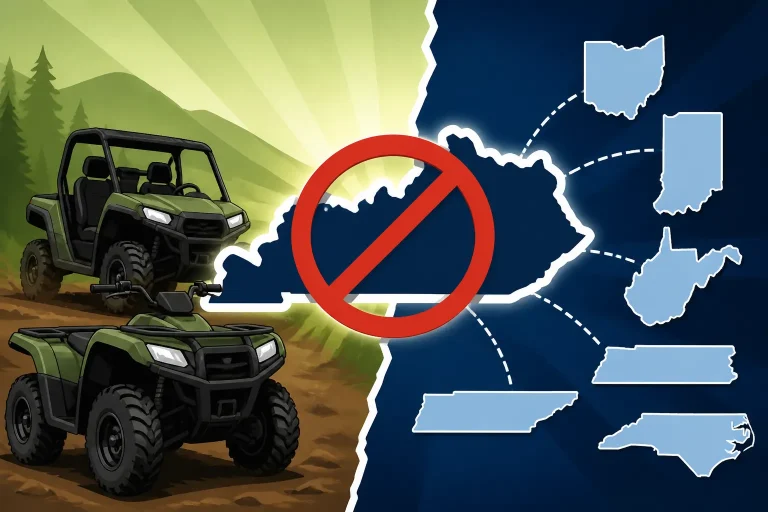
The simplest answer is: Kentucky does not offer general ATV-registration reciprocity that makes an out-of-state registration valid as a statewide riding permit. But that does not mean a visitor cannot ride in Kentucky. It means the rules come from the specific place, and you need to check that place’s requirements before unloading.
Registration, title, and access are separate issues. If you are also trying to confirm whether your machine needs Kentucky ownership paperwork, see Kentucky’s ATV Title Rule Explained. A title is about ownership records; it is not a trail pass.
Where permits and access rules come from
Kentucky riding areas are not all operated under one permit system. A public forest, a federal recreation area, and a privately operated off-road park can each set different conditions. A permit issued by one operator generally should not be assumed to work somewhere else. Kentucky Trail Permits Explained describes why riders need to treat each area’s requirements separately.
For example, Turkey Bay OHV Area is within Land Between the Lakes and has its own access and permit process. A visitor should check the current requirements for Turkey Bay before traveling, rather than assuming an out-of-state registration or another Kentucky pass will cover the visit. The same practical approach applies to designated off-highway vehicle routes in a national forest: confirm which routes are open to your type of machine and what pass, if any, is required. See How the Turkey Bay OHV Permit Works and [Kentucky Rules for Riding a National Forest].
Privately operated parks can set their own entry terms, too. A park permit may cover only that park, a specified time, or the people and machines identified by the operator. A permit is not automatically transferable between parks just because both are in Kentucky. This is why Why a Kentucky Park Permit Is Not a State Permit matters for visitors comparing riding areas.
Before you go, check with the exact park, forest office, or land manager. Ask whether the permit is required for every machine, every rider, or both; whether passengers need separate credentials; and whether an out-of-state document is relevant to their check-in process. Confirm trail closures and machine restrictions at the same time. A registration card may be useful to have on hand, but the land manager’s current rules determine access.
Examples of different riding situations
- A designated OHV area: Follow that area’s permit, operating, and route rules. Registration from another state is not a substitute unless the operator specifically says so.
- A national forest route: Check the forest’s current designated-route information and pass requirements. A forest pass is not a blanket authorization to ride anywhere in the forest.
- A privately operated off-road park: Ask the park about its own entry permit, vehicle eligibility, and rider requirements.
- Private land: Get permission from the landowner or the person who controls riding access. Registration does not grant permission to cross or ride private property.
- A public road: Trail access rules do not answer whether an ATV or UTV may legally travel on a road. Road use has separate requirements and restrictions.
That last distinction is easy to miss. A machine that is allowed on a trail is not automatically legal on a nearby road, and a registration from another state does not by itself make a machine street legal in Kentucky. For road-use questions, review Are ATVs Street Legal in Kentucky? and check the rules that apply to the particular road and vehicle.
What visitors should carry and confirm
For a smoother visit, bring the documents you have and verify the riding area’s requirements before setting out. The goal is not to collect paperwork for its own sake; it is to avoid finding out at the gate that your machine, pass, or paperwork does not meet the operator’s rules.
A useful pre-trip checklist is:
- Identify the exact riding area. “Riding in Kentucky” is too broad to determine what permit applies. Name the park, forest, or property you plan to use.
- Check the official operator’s current rules. Look for permit requirements, opening status, designated routes, machine restrictions, and any special conditions for visitors.
- Ask whether out-of-state registration is relevant. It may not be required for trail entry, but an operator could ask for identifying or ownership information under its own process.
- Bring ownership and vehicle documents you have. Carry a title, registration card, or bill of sale as appropriate. Do not treat one as a replacement for another.
- Confirm who needs a permit. Some systems may charge or issue permits by machine, rider, or another unit. Check what applies to your group, including passengers.
- Save the confirmation and permit details. Keep any required permit or proof of purchase accessible, and follow the operator’s instructions about display or check-in.
- Recheck shortly before departure. Closures, access conditions, and permit procedures can change. Verify them with the organization that manages the riding area.
Visitors coming from neighboring states may find it helpful to start with Kentucky Rules for a Visiting Rider. If you are traveling from Tennessee or Ohio, the practical point remains the same: your home-state paperwork does not automatically become a Kentucky trail permit. The relevant local requirements still apply. A Tennessee Rider Buying a Kentucky Permit and An Ohio Rider Buying a Kentucky Permit offer related visitor-focused information.
Keep the machine’s identification details readable and consistent with your documents. If the paperwork and the vehicle’s identification number do not match, contact the relevant agency or seller before relying on the documents for a trip. If the question is specifically about ownership proof for a Kentucky title application, registration may be treated differently from trail access; see An Out-of-State Registration as Kentucky Proof.
A practical answer before you load the trailer
For Kentucky trail riding, assume that out-of-state ATV registration does not function as a statewide permit or grant general access. It may be useful as supporting paperwork, but it does not replace the requirements set by the riding area, and it does not make a machine legal on public roads.
The practical decision is made one destination at a time. Check the specific land manager’s rules, obtain any required permit, and confirm that your type of ATV or UTV may use the routes you intend to ride. If you plan to cross or travel on a road, check that question separately rather than relying on a trail permit or another state’s registration.
When in doubt, contact the place where you intend to ride before you travel. Ask directly whether the out-of-state registration matters, what documentation to carry, and which permits your group needs. That quick check is more reliable than assuming another state’s system carries over.
Disclaimer
This article is for general informational purposes only and does not constitute professional advice. Laws, prices and regulations vary by location and change over time. Consult a qualified professional for guidance on your specific situation.