Crossing a Fifty-Five Road Bareheaded
Let's face it, we've all been there: you're out riding your ATV or UTV, enjoying the trails or working on the farm, and suddenly you need to get from one side of a 55 mph highway to the other. Your helmet is probably stashed away, or maybe you never even thought you'd need it for a quick dash across the asphalt. The thought of crossing a busy road, especially a high-speed one, bareheaded can be a real point of anxiety for many riders. This guide is here to untangle the confusion surrounding Kentucky's helmet laws and road-use rules, specifically when you're considering a bareheaded dash across a 55 mph thoroughfare.
The Bareheaded Truth: Kentucky's Helmet Law on Roads
It's a common misconception, especially in rural areas, that if you're just "popping across" a road, the usual safety rules don't apply. But when it comes to riding your ATV or UTV on a public road in Kentucky, even for a moment, the law doesn't always distinguish between a short crossing and a long journey. The risks on a 55 mph highway are inherently high, and the state takes safety seriously.
General Helmet Requirements in Kentucky
Kentucky's primary focus regarding ATV helmet use often centers on youth riders. The law states that riders under the age of 16 must wear a helmet at all times when operating an ATV, regardless of whether they are on private land or a designated trail system. While there isn't a blanket "all ATV riders must wear a helmet on public roads" statute that applies to adults in every single scenario, the moment you bring an ATV onto a public road, even briefly, you're entering a different legal landscape. The default expectation for safe operation, particularly on higher-speed roads, leans heavily towards wearing appropriate safety gear.
Consider the context: a 55 mph road is designed for cars and trucks traveling at significant speeds. An ATV, by its very nature, offers minimal protection in a collision. Law enforcement personnel are trained to prioritize safety, and seeing a rider without a helmet on such a road would instantly raise concerns about reckless endangerment or violation of general safe operation principles, even if a specific helmet statute for an adult isn't immediately applicable to that exact scenario. It's about minimizing risk in a high-risk environment. Even if you're not legally required to wear a helmet as an adult for a specific 0.2-mile crossing, it's a decision that dramatically impacts your personal safety and could influence how a citation is handled if anything goes wrong. This is why when you're considering [Crossing a Fifty-Five Road Without a Helmet], the safety implications far outweigh any perceived convenience.
When You Might See an Exception (and when you won't on a 55 mph road)
Kentucky does have specific exemptions for helmet use, but it's crucial to understand their limitations. These often apply in very specific, work-related contexts, not for general recreational riding or casual road crossings. For instance, there are statutory exemptions for individuals operating ATVs or UTVs for agricultural purposes on a farm, or those engaged in mining or logging operations. These exemptions typically acknowledge that helmets might interfere with certain work functions or that the riding is taking place in a controlled, low-speed environment primarily on private property or within a specific work site.
However, these exemptions are almost always tied directly to the purpose of the ride and the location. If you're using your ATV to haul feed from one field to another, [Why Farm Work Exempts a Kentucky Helmet] might apply on the farm itself, and possibly for very limited, low-speed travel on contiguous public roads to access another part of your property. But this rarely, if ever, extends to casually crossing a high-speed, 55 mph public highway for non-work-related reasons, or even for work if it's outside the strict interpretation of the farm exemption. A quick dart across a four-lane highway is vastly different from moving equipment slowly down a gravel service road adjacent to a field. For adults, while [Kentucky Helmet Rules on Public Property at 16] specifically address minors, the spirit of safety for any rider on public roads, especially high-speed ones, still strongly suggests wearing a helmet.
Navigating Kentucky's Road Crossing Rules for ATVs
Kentucky's rules for ATVs and UTVs on public roads are notoriously restrictive. The default stance is that these machines are not street legal. There are very few exceptions, and these exceptions come with strict limitations designed to minimize interaction between off-highway vehicles and conventional traffic. Understanding these nuances is critical before you ever consider putting a tire on a paved public roadway.
The Strict 0.2-Mile Crossing Limit
One of the most talked-about and often misunderstood rules is Kentucky's 0.2-mile crossing limit. This provision allows an ATV or UTV to cross a two-lane public highway at a ninety-degree angle, or to travel along a highway for no more than two-tenths of a mile, solely for the purpose of getting from one area of private property to another. It sounds straightforward, but it's incredibly precise and unforgiving. The moment you exceed that 0.2-mile mark, even by a few feet, you are in violation of the law.
Imagine you're trying to get from your hunting land on one side of a state route to another parcel on the opposite side. You might think, "It's just a short distance." But two-tenths of a mile is approximately 1,056 feet, or about the length of three-and-a-half football fields. On a road with a 55 mph speed limit, this distance can be covered by a car in mere seconds. This brief window, combined with the need to travel at a ninety-degree angle or for such a limited distance, means you have to be acutely aware of traffic and the precise route. Deviate, travel further, or fail to cross directly, and you're inviting trouble. The strictness of [0.2 Mile and Not a Yard More] means there's almost no margin for error, and law enforcement is well aware of these specific parameters. This rule is one of the most significant aspects of [Kentucky Rules for Crossing a Highway].
Farm Use: A Different Kind of Road Access
While the 0.2-mile rule covers general crossings, Kentucky law carves out a specific, but limited, exception for agricultural use. An ATV or UTV can be operated on public roads for agricultural purposes. This isn't a free pass to drive your UTV to the grocery store, but rather allows farmers to use their machines to perform tasks related to their farming operations. This might include moving from one field to another, checking fences, or transporting equipment or feed within their farming enterprise. Crucially, this exemption usually allows for travel without the stringent 0.2-mile limit, so long as the travel is directly related to agricultural work. This is the essence of [Kentucky's Farm Exception With No Mileage Cap].
However, even with the farm use exemption, there are still expectations for safe operation. You're still sharing the road with vehicles traveling at much higher speeds. While the farm exemption focuses on purpose and distance, it doesn't automatically waive all other safety considerations, such as lighting, visibility, or the general prudence of wearing a helmet, especially on a 55 mph road. A farmer hauling supplies might prioritize utility, but they are still expected to operate their machine safely and with due regard for other traffic. Some farmers, even with this exemption, choose to upgrade their machines with enhanced lighting, mirrors, or other safety accessories from brands like SuperATV to make their work-related road use as safe and visible as possible.
Equipment Beyond the Helmet for Road Use
Beyond the helmet discussion, any time you take an ATV or UTV onto a public road in Kentucky, even for a brief crossing, you must adhere to certain equipment requirements. The most critical among these is the "daylight only" rule. Generally, ATVs are only permitted to be on public roads during daylight hours. This means no crossing after dusk or before dawn, no matter how quick you think it might be. [Daylight Only Under the Statute] is a non-negotiable aspect of Kentucky law for ATVs on public roads.
Furthermore, your machine should have at least one headlight and two taillights that are functional, even if you are riding during daylight hours. While many stock ATVs and UTVs come with basic lighting, for those who anticipate even minimal road interaction, or for enhanced visibility during daytime, investing in brighter LED lights or additional marker lights can be a wise choice. Companies like SuperATV offer a wide range of lighting solutions that can significantly improve your visibility to other motorists, which is paramount on a high-speed road. Even for a short crossing, being seen is your first line of defense. Remember, the road environment is unforgiving, and a small, relatively slow-moving ATV can be hard to spot by fast-approaching traffic, especially if your machine isn't adequately lit.
Here's a quick overview of some key considerations for ATV/UTV road use in Kentucky:
| Scenario | Helmet Required (Adult) | Max Distance | Purpose | Lighting Rule | Notes |
|---|---|---|---|---|---|
| 0.2-Mile Crossing | No (but highly advised) | 0.2 miles (exact) | Private property access | Daylight Only | Must be 90-degree angle if crossing, or along for 0.2 miles. |
| Farm Use | No (but highly advised) | No mileage cap | Agricultural purposes | Daylight Only | Must be actively engaged in farm work. |
| Emergency Use | No (but highly advised) | No mileage cap | Emergency services/rescue | Daylight Only | Specific to authorized personnel/situations. |
| Construction/Maintenance | No (but highly advised) | No mileage cap | Road construction/maintenance | Daylight Only | Specific to authorized personnel/situations. |
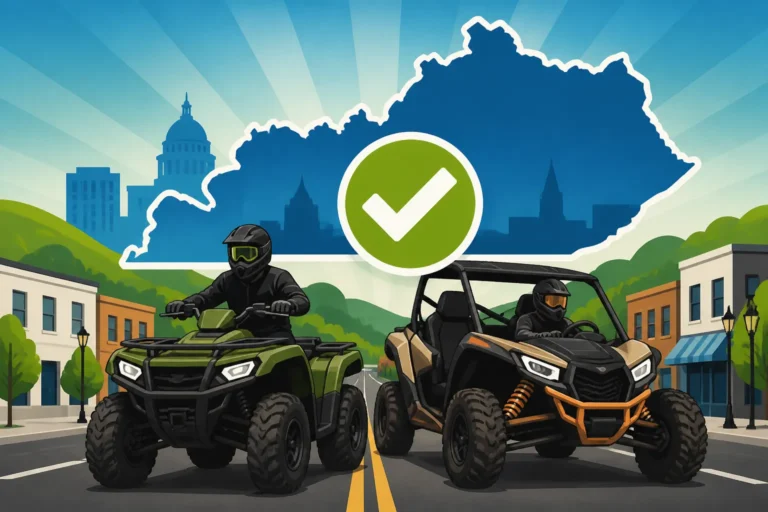
| Street Legal SPV (UTV) | Yes | 20 miles (capped) | General travel (city opts-in) | Full lighting | Requires specific conversion, inspection, registration. |
The Reality of Enforcement and Rider Responsibility
Understanding the law is one thing; living with its implications and the practical realities of riding is another. The desire for convenience is understandable, but the potential consequences of ignoring Kentucky's strict rules, especially on high-speed roads, are significant, ranging from hefty fines to catastrophic accidents.
Why "Bareheaded" is a Risk, Not a Right, on Public Roads
Let's be unequivocally clear: choosing to cross a 55 mph road bareheaded in Kentucky, even if a specific statute doesn't explicitly mandate a helmet for an adult in that precise moment, is a profound personal safety risk. The human body is incredibly vulnerable in an ATV-versus-car collision, particularly at highway speeds. A helmet is designed to protect your most vital organ. While the law might not always be as explicit for adult helmet use on roads as it is for youth riders or dedicated [Kentucky Street Legal UTV Requirements] (which do require helmets), the safety imperative remains.
Beyond personal safety, there are legal ramifications. Law enforcement officers, observing an ATV or UTV on a 55 mph public road without a helmet, may issue citations based on other statutes, such as reckless operation, or operating an unregistered or improperly equipped vehicle. Even if you're meticulously adhering to the 0.2-mile rule, an officer might see the lack of a helmet as an indicator of unsafe operation, leading to scrutiny of other compliance points. The penalties for [Kentucky Fines for Illegal ATV Road Use] can quickly add up, and could even lead to your machine being impounded. It's simply not worth the gamble.
Planning Your Route to Minimize Road Exposure
Given Kentucky's restrictive laws, the best approach for ATV and UTV riders is to minimize public road exposure as much as possible. When planning your ride, always look for alternatives to crossing or riding on paved public roads, especially high-speed ones. This might mean exploring trail systems that don't require road crossings, or finding private access points to different sections of land. If a crossing is absolutely unavoidable, meticulous planning is essential.
Before you even load up your machine, consult local maps. Can you find an underpass or an overpass? Is there a designated lower-speed [Kentucky Rules for Riding a County Road] or [Kentucky Rules for Riding a Holler Road] that provides a safer, albeit longer, alternative to a busy state highway? Sometimes, a slightly longer route on a less-traveled road, or even a different type of crossing (like a gravel lane instead of pavement), can make all the difference in safety and legal compliance. Many riders who frequently operate in areas with unavoidable road sections will often install aftermarket safety accessories, such as turn signals, brighter headlights, and mirrors, available from retailers like SuperATV, to make their presence known to other drivers. While these don't make your ATV street legal for general use, they significantly improve visibility for those very brief, statutory road interactions. Remember, the underlying principle of [Why Kentucky Roads Are Closed by Default] for ATVs and UTVs means any exception must be treated with extreme caution and respect for traffic laws.
Disclaimer
This article is for general informational purposes only and does not constitute professional advice. Laws, prices and regulations vary by location and change over time. Consult a qualified professional for guidance on your specific situation.