20 Miles on a Centerline Road
It's a familiar scenario for so many of us in Kentucky who own an ATV or UTV: you're just trying to get from your driveway to the local gas station, or perhaps across the road to a neighbor's property, and you wonder if you can legally drive your machine on the pavement. The rules around riding off-road vehicles on Kentucky roads can feel like a tangled mess of exceptions and special conditions, leaving many riders scratching their heads and fearing a costly ticket. This guide aims to clear up that confusion, especially focusing on the critical 20-mile limit for Special Purpose Vehicles (SPVs) and the broader legal landscape of operating your machine on public roads here in the Bluegrass State.
Understanding Kentucky's Default Road Rules for ATVs
Let's be honest, the roar of an ATV engine on a blacktop road just feels different than it does on a dirt trail. There's a reason for that, and it's rooted in the core design and legal classification of these machines. For the most part, Kentucky, like many states, draws a very clear line between vehicles designed for highways and those built for the wild.
The General Rule: Why Roads Are Closed by Default
Kentucky law starts with a pretty firm "no" when it comes to riding your standard ATV or UTV on public roads. The general stance is that these machines are intended for off-road use only. Think about it: an ATV or UTV typically lacks many of the safety features you'd find on a car or even a motorcycle. They often don't have turn signals, rearview mirrors, proper headlights and taillights for highway visibility, or even the same braking capabilities. Their suspension is designed for bumps and dips, not smooth pavement, and their tires are made to grip dirt and mud, not asphalt.
This isn't just about being a buzzkill; it's about safety for everyone on the road. Mixing vehicles with vastly different handling characteristics, speeds, and visibility can lead to dangerous situations. Imagine trying to stop your ATV quickly on wet pavement when a car in front of you slams on its brakes – it's a recipe for disaster. The state's primary concern is preventing accidents and ensuring that all vehicles sharing public thoroughfares meet a certain standard of safety. So, while it might be tempting to just hop on your quad and head down the street, the law is generally stacked against it for good reason. For a deeper dive into what qualifies as an ATV, you might want to read [What Kentucky Counts as an ATV].
Limited Exceptions: Crossing and Farm Use
Now, like many rules, there are a few very specific, narrow exceptions to Kentucky's general prohibition on ATVs and UTVs on public roads. These aren't free passes to joyride; they're designed for practical, essential purposes.
One of the most common exceptions allows you to cross a two-lane public road. This means if your property is bisected by a road, or if you need to get from one section of a trail to another that's directly across the street, you can do so. However, there are strict conditions. You must cross the road at a ninety-degree angle, making it the most direct and quick crossing possible. You can't just drive down the middle of the road for a block before turning; it has to be a quick, perpendicular movement. And crucially, this exception applies to a maximum distance of 0.2 miles. That's right, two-tenths of a mile – not a yard more. It's a very short distance, intended for immediate passage, not for traveling any significant length. It's truly about minimizing exposure to highway traffic. For more on this, check out [Crossing a Two-Lane at Ninety Degrees in Kentucky] or [0.2 Mile and Not a Yard More].
Another significant exception is for agricultural purposes. If you're using your ATV or UTV for farm work, Kentucky law provides a bit more leeway. You can operate these machines on public roads strictly for agricultural purposes. This could mean moving between fields, hauling feed to livestock, or checking fences along a property line that abuts a road. The critical distinction here is the purpose of the ride. You're not heading to the store for snacks; you're performing a legitimate farm task. Interestingly, the farm exception doesn't come with the same mileage cap as the crossing rule, but it is still implicitly limited to the immediate needs of the farm operation. It's not a license to cruise the countryside. If you're interested in the specifics of this, [Why Kentucky's Farm Exception Has No Limit] details this further, and you might also find [Hauling Feed Down a Holler Road] helpful for a real-world scenario. These exceptions highlight that the law is willing to bend for necessity, but not for recreation on public roads.
The "Special Purpose Vehicle" (SPV) Option: Making Your UTV Street Legal
For many UTV owners, the desire to legally ride on public roads goes beyond just crossing or farm use. You might want to access trails, visit a local diner, or simply connect properties without having to trailer your machine everywhere. This is where Kentucky's Special Purpose Vehicle (SPV) designation comes into play, offering a pathway to limited street legality for UTVs. It's a specific, rigorous process, but it does open up new possibilities.
What Qualifies as a Kentucky SPV?
First and foremost, it’s important to understand that the SPV designation in Kentucky primarily applies to UTVs, or side-by-sides, and not typical quad ATVs. The law defines these vehicles, and while the exact wording can be complex, the spirit is that they are machines capable of being modified to meet certain safety standards for road use.
To qualify as an SPV, your UTV must undergo significant modifications and meet a stringent list of equipment requirements. This isn't just slapping on a blinker; it's about bringing the vehicle up to a standard that makes it reasonably safe to share the road with other traffic. These requirements often include:
- Headlights and Taillights: Not just any lights, but those meeting specific brightness and visibility standards, similar to motorcycles. You'll need at least one headlight and two taillights that are clearly visible. [One Headlight and Two Taillights in Kentucky]
- Turn Signals: Both front and rear, to clearly indicate your intentions to other drivers.
- Brake Lights: Functioning brake lights are crucial for safety.
- Horn: An audible warning device.
- Rearview Mirrors: Typically, at least two, allowing you to see traffic behind you without turning your head excessively. [Turn Signals and Dual Mirrors on a Kentucky SPV]
- Windshield: A protective barrier.
- Wiper Blades: To maintain visibility in inclement weather, especially if your windshield is permanently affixed.
- Tires: Must be DOT-approved, meaning they are designed and rated for highway use, and have adequate tread depth. [Two Thirty-Seconds of Tread in Kentucky]
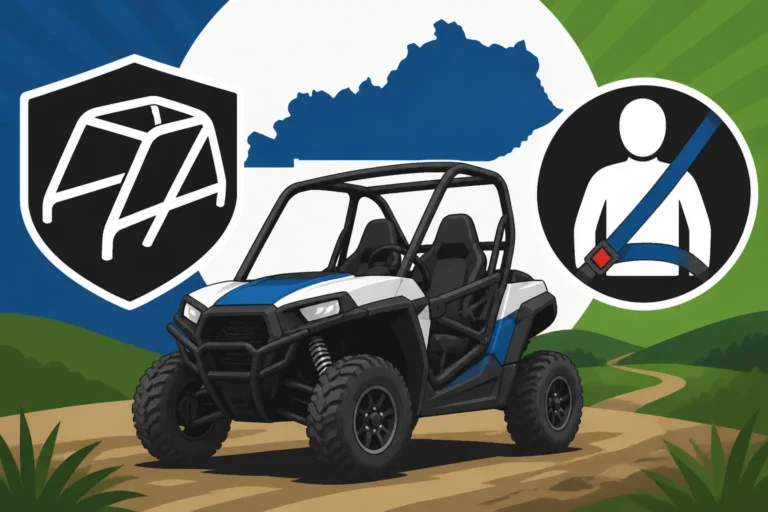
- Roll Bar or Roll Cage: A factory-installed roll cage is generally expected to provide occupant protection. [A Factory Cage on a Kentucky SPV]
- Seatbelts: For all occupants.
- Speedometer: An illuminated speedometer, so you can monitor your speed day or night. [An Illuminated Speedometer on a Kentucky SPV]
Many UTV owners turn to aftermarket suppliers like SuperATV for the necessary components to achieve SPV compliance. Whether it's a full street-legal kit, DOT-approved tires, or specific lighting and mirror setups, companies like SuperATV specialize in these types of conversions, helping riders navigate the often-complex world of vehicle modification.
The SPV Registration and Inspection Process
Once your UTV is equipped to meet all the requirements, the next step is the registration and inspection process. This happens at your local Kentucky County Clerk's office, the same place you'd title a car or truck.
The process typically involves:
- Application: You'll need to fill out the appropriate forms, providing details about your UTV and certifying that it meets the SPV equipment standards.
- Inspection: Your UTV must pass a visual inspection by a certified inspector, often associated with the County Clerk's office or a state police branch. This inspection verifies that all the required equipment is present and functioning correctly. There is usually a fee for this inspection. [The $25 Kentucky Inspection]
- Title and Registration: If it passes inspection, you can then proceed to title and register your UTV as an SPV. This involves paying titling fees, registration fees, and sales tax if applicable. The registration must be renewed annually. [Kentucky SPV Registration Cost]
- Insurance: You'll also need to provide proof of insurance. Kentucky law requires SPVs to carry insurance coverage comparable to what's mandated for motorcycles. [Motorcycle-Level Insurance for a Kentucky SPV]
It's crucial to remember that this process requires diligence. Missing a single piece of equipment or failing to properly fill out paperwork can lead to delays and frustration. Bringing all your documentation, including proof of ownership and a valid Kentucky photo ID, will make the visit smoother. For general titling information, consider reading [Titling at a Kentucky County Clerk].
Specific SPV Road Use Limitations
Even after going through the trouble of converting your UTV into an SPV and getting it registered, you still can't just drive it anywhere you please. The "Special Purpose" in SPV truly means special, not universal.
The most significant limitation, and the one that often confuses riders, is the 20-mile rule. An SPV can only be operated on roads within a 20-mile radius of the owner's residence. This means your street-legal UTV is generally limited to local travel, not cross-county journeys. [20 Miles on a Centerline Road] This radius is typically measured from the address listed on your registration.
Beyond the mileage radius, there are other crucial restrictions:
- Local Opt-In: Even within your 20-mile zone, not all roads are automatically open to SPVs. Individual cities and counties in Kentucky must "opt-in" to allow SPV usage on their roads. This means a town or county council has to pass an ordinance specifically permitting SPVs. [Why a Kentucky City Must Opt In] If your local area hasn't opted in, your SPV cannot be legally ridden on those roads, regardless of your registration. It's vital to check with your local municipal and county governments before riding. You might find some cities set maximum speed limits for SPVs on their roads, sometimes capping them at 45 mph. [Kentucky Cities That Cap SPV Roads at 45 mph]
- Daylight Only: SPVs are generally restricted to daylight hours of operation. You cannot ride them on public roads after dark, unless specifically allowed by local ordinance for emergency or utility work. [Daylight Only Under the Statute]
- Speed Limits: SPVs are not designed for high-speed highway travel. While the state might not specify a hard top speed, local ordinances often impose lower speed limits than those for regular vehicles, or restrict SPVs to roads with lower speed limits.
- Driver's License: Anyone operating an SPV on a public road must possess a valid Kentucky driver's license. [A License for Kentucky Highway Operation]
- Helmet Rules: While not universally required for all SPV occupants, Kentucky does have specific helmet laws for riders under 16, even on private property. On public roads, it's generally a wise and often legally mandated practice for all occupants, especially given the motorcycle-level insurance requirements. [Kentucky Helmet Rules on Public Property at 16]
These limitations illustrate that an SPV isn't a replacement for a car or truck, but rather a specialized vehicle for specific local transportation needs. It's a great option for trail access or short errands, but always with a keen awareness of where you are and what the local rules dictate. Companies like SuperATV understand these regulations and can often guide you toward the right components to meet Kentucky's unique SPV requirements.
Navigating Local Ordinances and Other Considerations
Kentucky's approach to ATVs and UTVs on public roads is a patchwork, making local research absolutely essential. What's legal in one county or city might be strictly prohibited just a few miles down the road. This can be incredibly frustrating for riders who just want consistent rules.
The Crucial Role of Local City and County Decisions
The biggest hurdle for SPV owners, even after outfitting their UTV with all the right gear from places like SuperATV and getting it registered, is the local "opt-in" clause. Kentucky's state law empowers local governments – cities and counties – to decide whether or not to allow SPVs on their public roads. This means that even if you're within your 20-mile radius, you still need to verify that the specific roads you plan to use are part of an opted-in jurisdiction.
Imagine this scenario: you live in County A, which has passed an ordinance allowing SPVs on certain roads. You get your UTV registered as an SPV and diligently add all the required street-legal accessories. You want to ride a few miles to a popular trailhead that happens to be just across the county line in County B. If County B has not passed an opt-in ordinance for SPVs, then driving your perfectly legal SPV on their roads becomes illegal. This inconsistency is a major source of confusion and potential fines for riders.
Some cities and counties might allow SPVs on all their roads, while others might restrict them to only roads with speed limits below a certain threshold (e.g., 35 mph or 45 mph). [Kentucky Cities That Allow UTVs on Streets] Still others might have very specific routes designated for SPV use. It's not enough to assume; you literally need to call the city clerk or county attorney's office in every jurisdiction you plan to ride through. This diligent research is critical to avoid legal trouble. [How a Kentucky City Opens Its Roads]
Insurance, Licenses, and Helmets for Street Use
Operating an SPV on public roads isn't like riding on private property; it comes with the full weight of motor vehicle laws for public thoroughfares.
- Insurance: As mentioned, your SPV must be insured at the same level as a motorcycle in Kentucky. This isn't just a suggestion; it's a legal requirement. Proof of this insurance must be carried with you at all times when operating the SPV on public roads. This protects you and others in case of an accident. [Kentucky SPV Insurance Requirement]
- Driver's License: You absolutely need a valid Kentucky driver's license to operate an SPV on public roads. A learner's permit or simply a photo ID won't cut it. This ensures that anyone behind the wheel has demonstrated basic driving competence. [A License for Kentucky Highway Operation]
- Helmet Rules: While there's the broad Kentucky helmet law for riders under 16 on public property, including trails, the rules get a bit more nuanced for SPVs on opted-in roads. For any driver or passenger under the age of 16, a helmet is mandatory when operating an SPV on public roads, just as it is on any public land. For adults, while not universally mandated for all SPV occupants, it's still highly recommended. Remember, the SPV is still an open-air vehicle, and the risks of head injury in a collision are significant. Always prioritize safety. [Kentucky Helmet Rules on Public Property at 16] It's a good idea to always wear one, regardless of age, especially given the motorcycle-level insurance requirements which acknowledge the higher risk profile of these machines.
The Practical Realities and What to Expect
Converting a UTV into an SPV and navigating Kentucky's road laws is a significant commitment. It involves:
- Cost: The cost of modifications (lights, mirrors, windshield, DOT tires, etc.), inspection fees, titling, registration, and annual insurance can add up. While aftermarket suppliers like SuperATV make it easier to source compliant parts, it’s still an investment.
- Effort: The time spent researching local ordinances, making appointments for inspection, and dealing with paperwork is considerable.
- Vigilance: You need to remain constantly aware of your location and the specific rules of that city or county. Relying on outdated information or making assumptions can lead to tickets and fines. [Kentucky Fines for Illegal ATV Road Use] Law enforcement in different jurisdictions may have varying levels of familiarity with SPV laws, so carrying all your documentation is key.
While it offers a degree of freedom, the SPV designation in Kentucky is not a blanket "street legal" stamp. It's a carefully circumscribed privilege, designed to allow limited road use under strict conditions. For many, it's worth the effort to unlock local riding opportunities, but it requires a thorough understanding and adherence to the nuances of the law.
Here's a quick comparison of general ATV/UTV road use versus SPV road use in Kentucky:
| Feature | General ATV/UTV Road Use (Non-SPV) | Special Purpose Vehicle (SPV) Road Use |
|---|---|---|
| Primary Use | Off-road recreation, farm work | Primarily off-road, with limited public road access |
| Legality on Public Roads | Generally prohibited, with narrow exceptions | Conditional legality on public roads |
| Crossing Roads | Limited to 0.2 miles, 90-degree crossing | Allowed within designated 20-mile radius (if opted-in) |
| Farm Use on Roads | Allowed for agricultural purposes, no mileage cap | Allowed for agricultural purposes; also under SPV rules if applicable |
| Required Equipment | Basic lights (often for off-road visibility) | Extensive street-legal equipment (head/taillights, signals, mirrors, horn, windshield, DOT tires, etc.) |
| Inspection | Not required for road use | Mandatory state inspection for SPV compliance |
| Registration/Plates | Off-road title (if post-2010), no road registration | Specific SPV title and annual road registration plate |
| Insurance | Not required for off-road use | Mandatory, typically motorcycle-level insurance |
| Driver's License | Not required for off-road use | Mandatory valid Kentucky driver's license |
| Helmet Requirement | Under 16 on public land | Under 16 on public roads; highly recommended for all |
| Mileage/Radius Limit | 0.2 miles for crossings; farm use implicitly local | 20-mile radius from owner's residence |
| Local "Opt-In" | N/A | Crucially required by cities/counties for road access |
| Daylight Operation | N/A (though recommended off-road) | Generally restricted to daylight hours |
| Speed Restrictions | N/A | Often lower speed limits, or restricted to lower-speed roads |
Disclaimer
This article is for general informational purposes only and does not constitute professional advice. Laws, prices and regulations vary by location and change over time. Consult a qualified professional for guidance on your specific situation.