Kentucky Cities That Opted Into Street Riding
It’s a common scenario across Kentucky: you’ve got your trusty ATV or UTV, you’re ready to hit a local trail, but you need to cross a short stretch of pavement or grab a bite in town. The question of whether you can legally ride your machine on city streets is one of the most frustrating and confusing topics for off-road enthusiasts. This guide aims to cut through the confusion and explain exactly which Kentucky cities have taken the steps to allow ATVs and UTVs on their public roads, and what that truly entails for you as a rider.
The Complex Web of Kentucky's Street Legal Laws for ATVs and UTVs
Kentucky’s relationship with ATVs and UTVs on public roads is, frankly, a bit of a head-scratcher for many riders. You might hear one person swear they can ride theirs to the gas station in their small town, while another recounts a story of a friend getting a hefty ticket for doing the same thing in a different county. This isn't just hearsay; it's a reflection of a legal framework that tries to balance recreational freedom with public safety, often leaving riders in a murky gray area.
Why the Confusion Exists for Riders
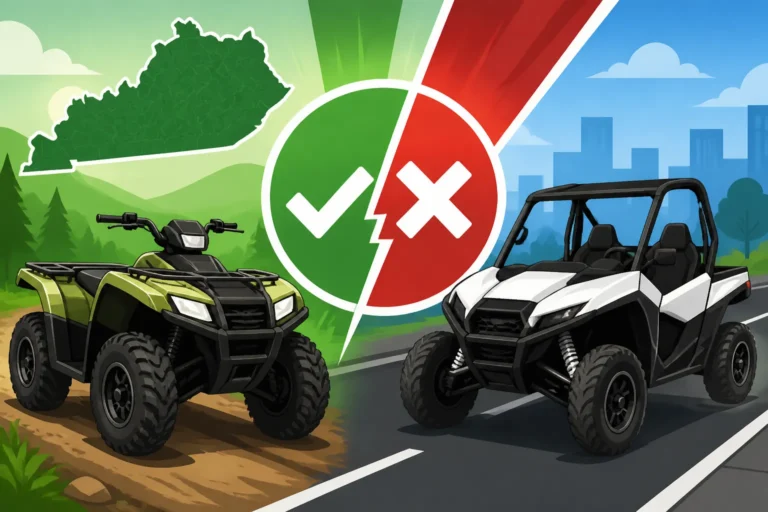
The root of the confusion often lies in Kentucky's default position: generally speaking, ATVs and UTVs are not permitted on public roads. This blanket prohibition is meant to keep off-road vehicles in their intended environment – the trails, farms, and private lands. However, the world isn't always that neat. People need to cross roads to get to trailheads, or use their machines for practical purposes, like farming, which necessitates some road use. The state laws offer very narrow exceptions, such as the famous [Kentucky's 0.2-Mile Crossing Rule] which allows you to cross a paved road at a ninety-degree angle for a very short distance. But let's be honest, two-tenths of a mile doesn't get you very far when you're trying to reach a different section of trail or run a quick errand.
These limited state-level exceptions simply aren't enough for the vast majority of riders who want to responsibly use their machines on public thoroughfares. This creates a vacuum, and into that vacuum step local municipalities, who often see the potential for tourism or simply want to accommodate their residents. The frustration then mounts because what's permissible in one town might be strictly illegal just a few miles down the road, leading to a constant need to verify local statutes, which can be an absolute pain. It's like trying to navigate a patchwork quilt of rules, where every square has a different pattern, and you're never quite sure if you're standing on the right one.
The Role of Local Ordinances in Opening Roads
Here’s where it gets interesting and offers a glimmer of hope for riders: while the state sets the general framework, Kentucky law explicitly grants individual cities and counties the authority to pass their own ordinances allowing the operation of ATVs and UTVs on public roads within their specific jurisdictions. This is what we mean by a city "opting-in." It's not the state giving a blanket green light; it's a local government making a specific, often very detailed, decision for its own community.
When a city or county "opts-in," they are essentially creating a carve-out within the broader state prohibition. This means they've gone through their own legislative process – often involving public meetings, community input, and votes by local councils – to determine that it's safe and beneficial for their area to allow these machines on certain roads. This decentralization of control can be a blessing and a curse. It allows communities to tailor rules to their unique needs, perhaps opening up roads near popular trail systems or within small towns where traffic is minimal. However, it also means that you, as the rider, bear the responsibility of knowing the specific rules for every single city or county you plan to ride in. You can't assume that because your buddy rides his UTV to the grocery store in Hazard, you can do the same in Lexington. It requires diligence, but it’s the only way to stay on the right side of the law and avoid an unwanted conversation with local law enforcement.
What "Opting-In" Really Means for a Kentucky City
So, a city decides to "opt-in" and allow ATVs and UTVs on its streets. Sounds great, right? But it's rarely as simple as a giant "go for it!" sign at the city limits. Local municipalities typically approach this with a good deal of caution, implementing specific processes and restrictions to ensure safety and maintain order. It’s not about throwing open every road; it's about carefully designating where, when, and under what conditions these machines can operate.
The Process of a City Opening Its Roads
For a Kentucky city to "opt-in," it generally requires a formal legislative process. This isn't just a casual decision made by a city manager; it usually involves the city council or fiscal court taking official action. Often, this starts with discussions spurred by local residents, business owners, or tourism groups who see a benefit in allowing off-road vehicles on specific roads. They might highlight the economic boost from visiting riders, or the convenience for residents who use their machines for daily tasks.
Following initial discussions, the city council will typically draft a proposed ordinance. This draft often goes through several readings and public hearings, allowing community members to voice their support or concerns. Think of it as a small-town version of what happens at the state capital. These hearings are crucial because they allow for direct input from everyone affected—residents worried about noise or safety, business owners excited about new customers, and riders eager for more access. Once the draft is finalized and debated, the council will vote on it. If it passes, it becomes a local law, a specific and often highly detailed local ordinance dictating where and how ATVs and UTVs can be operated. This process ensures that the decision is transparent, community-driven, and legally sound, even if it feels like a slow roll for riders eager to hit the pavement.
Restrictions a City Can Impose (and Often Does)
One of the most important things to understand is that even when a city opts in, they almost always impose significant restrictions. This isn't just opening the floodgates; it's a carefully managed allowance. These restrictions are designed to mitigate concerns about safety, noise, and traffic flow, ensuring that ATVs and UTVs can integrate without causing undue disruption.
Common restrictions often include designated speed limits that are lower than the posted limit for cars, usually around 25 or 35 miles per hour, or sometimes even more specifically, a cap of [Kentucky Cities That Cap SPV Roads at 45 mph] for certain roads. Cities might also limit where you can ride, specifying certain roads or areas rather than opening up every street. For example, they might allow access on collector roads leading to a trail system but prohibit machines on main state highways that pass through town. Some ordinances even restrict the hours of operation, perhaps banning riding after dark or before certain morning hours, unless your machine meets specific lighting requirements. Additionally, cities might add their own equipment requirements beyond what the state mandates for a Special Purpose Vehicle (SPV), such as specific mirror sizes, additional lighting, or even stricter noise limits. It's crucial not to assume that just because a city allows street riding, all roads are open with no strings attached. Always, always check the specific local ordinance, because the devil is truly in the details.
Understanding the "Special Purpose Vehicle" (SPV) Designation
Even if a Kentucky city has opened its roads, you can't just slap a license plate on your weekend trail rig and hit the pavement. Kentucky has a specific classification for off-road vehicles that are permitted on public roads under certain conditions: the Special Purpose Vehicle, or SPV. This designation comes with a whole host of requirements, and meeting them is absolutely essential for legal street use. Without an SPV designation, even in an opt-in city, your ATV or UTV remains an off-road vehicle in the eyes of the law, subject to those strict "no public road" rules.
When an ATV or UTV Becomes an SPV
Transforming your ATV or UTV from an off-road warrior into a street-legal SPV in Kentucky isn't just about wishing it so; it’s a specific process with clear steps. First and foremost, your machine must physically meet a defined set of equipment standards. This isn't optional; it's the foundation of the SPV classification. Once your vehicle is properly outfitted, it must undergo an inspection conducted by the Kentucky State Police. This isn't a quick once-over; it's a thorough check to ensure every single required piece of equipment is present and functional. They're looking to make sure your machine is as safe as possible for public road use.
After successfully passing the inspection, you'll receive the necessary documentation, which then allows you to proceed with registering and plating your SPV at your local county clerk's office. This registration is distinct from a standard ATV title. It's what officially labels your machine as an SPV, granting it the legal standing to operate on designated public roads. Neglecting any of these steps—the equipment, the inspection, or the proper registration—means your machine, no matter how capable or accessorized, is not a legal SPV and cannot be ridden on public streets, even in a city that has opted in. It's a comprehensive process, but a necessary one to ensure your peace of mind and compliance with Kentucky law.
Key Equipment Required for an SPV
The specific list of equipment required to qualify as an SPV in Kentucky is extensive and aims to bring the safety standards of your ATV or UTV closer to that of a conventional motor vehicle. You can't just wing it; you need to systematically ensure your machine has every single item on the [Kentucky SPV Equipment List]. This often means adding aftermarket parts, which many riders source from reputable accessory providers like SuperATV, known for their wide range of UTV and ATV upgrades that meet or exceed these kinds of requirements.
Let's break down some of the non-negotiables:
- Lighting: Your machine needs proper headlights, taillights, and brake lights that are fully functional. Crucially, it must also have dedicated turn signals on both the front and rear, something many ATVs and UTVs don't come with from the factory. [One Headlight and Two Taillights in Kentucky] is the bare minimum, but an SPV requires more.
- Mirrors: You’ll need at least two rearview mirrors—one on the left side and one on the right—to provide adequate visibility of traffic behind you. These are often easy to add aftermarket.
- Windshield and Wipers: A windshield is mandatory, and it must be equipped with a functional wiper system to ensure clear visibility in adverse weather.
- Safety Belts and Roll Cage: For UTVs, the factory-installed roll cage is generally sufficient, but it must be accompanied by working safety belts for all occupants. ATVs, by their design, don't typically have these, which is why the SPV designation is more commonly achieved by UTVs.
- Tires: Your tires must have a minimum tread depth, typically [Two Thirty-Seconds of Tread in Kentucky], similar to what’s required for cars. This ensures adequate grip on paved surfaces.
- Speedometer: An illuminated speedometer is required, visible to the driver, ensuring you can monitor your speed and comply with local limits.
- Horn: A working horn is also essential for signaling and safety.
This list transforms an off-road machine into something capable of sharing the road more safely with other traffic. It’s not just about compliance; it’s about making your machine visible and controllable on asphalt. Many of these components are available from aftermarket manufacturers, and it's a good idea to check out companies like SuperATV for high-quality, durable options that will pass inspection.
Navigating Specific Cities and Their Ordinances
The variability of local laws means that you cannot rely on general advice when it comes to riding your ATV or UTV on city streets. What might be perfectly legal in one small town in Eastern Kentucky could earn you a ticket in a suburban community just down the road. This section dives into how to approach researching specific cities and understanding their unique stances.
Examples of Cities That Have Opted-In
Pinpointing every single Kentucky city that has opted-in is a moving target, as ordinances can change. However, some larger urban areas and those close to major trail systems have either adopted or seriously considered such ordinances. Louisville Metro, for instance, has a comprehensive ordinance ([Reading Louisville Metro's Ordinance]) that allows for the operation of certain "Special Purpose Vehicles" on designated roads within its jurisdiction, provided they meet strict equipment and registration requirements. This ordinance often comes with specific speed limits and restrictions on where SPVs can operate within the expansive metro area.
Beyond the major cities, many smaller, tourism-dependent towns, especially in the state's popular trail riding regions like Eastern Kentucky, have explored or implemented similar measures. These communities often understand the economic boost that trail riders bring and want to make it easier for them to access local businesses. However, this is precisely why you must do your homework. Instead of listing every potential city (which would be outdated quickly), the best approach is to check the official municipal website for the specific city or county you intend to ride in. Look for sections on "ordinances," "vehicle codes," or "special purpose vehicles." If you can't find it online, a call to the city clerk's office is your next best bet. They are the keepers of the local laws and can direct you to the exact text of any relevant ordinance.
Cities That Haven't Opted-In (and Why)
It's important to recognize that the vast majority of Kentucky cities and counties have not opted into allowing ATVs and UTVs on their public roads, at least not beyond the narrow state-mandated exceptions. In these areas, the general state prohibition remains firmly in place. Riding your ATV or UTV on public streets in such a locale, even for a short distance, could result in fines, impoundment, and other legal troubles.
There are numerous reasons why a city might choose not to opt-in, or why the process might stall:
- Safety Concerns: This is often the primary objection. Local officials and residents may worry about the safety of ATVs and UTVs sharing roads with cars, citing concerns about stability, braking distances, and the lack of traditional safety features.
- Noise and Nuisance: Off-road vehicles can be louder than passenger cars, and residents may object to increased noise levels in residential areas.
- Traffic Congestion: In busier urban or suburban environments, adding another type of vehicle to already congested roads can be seen as an unnecessary complication.
- Infrastructure Issues: Some cities may argue that their road infrastructure isn't designed to safely accommodate ATVs and UTVs.
- Political Hurdles: Passing any local ordinance requires political will and can be a contentious process. If there's strong opposition from a segment of the community, or if council members prioritize other issues, an ordinance allowing ATVs on streets may never come to a vote or may fail to pass.
For riders in these areas, the message is clear: stick to designated off-road trails and private property. Don't assume that because your machine looks like it could be street legal, or because you've seen others do it, that it's allowed. It’s always safer and smarter to assume public roads are off-limits unless you have definitively confirmed an enabling local ordinance.
Practical Considerations Before Riding on City Streets
So, you've done your homework, confirmed that a specific city allows SPVs on its roads, and your machine meets all the equipment requirements. You're almost ready to roll! But before you hit the pavement, there are still a few critical practical considerations to address. These aren't just about legal compliance; they're about your safety, financial protection, and ensuring a smooth, hassle-free ride.
Essential Paperwork and Preparations
Riding an SPV on public roads in Kentucky isn't like riding an ATV on private land. The rules of the road apply, and that means you need to carry specific documentation, just like you would in a car.
- Driver's License: You absolutely must possess a valid [A License for Kentucky Highway Operation]. This isn't a leisure activity that allows you to bypass standard driving laws. If you're operating a motor vehicle on a public road, you need a driver's license.
- Insurance: This is non-negotiable. Kentucky law requires [Motorcycle-Level Insurance for a Kentucky SPV]. This means liability coverage at the very least, to protect you and others in case of an accident. Do not skimp on this. Without proper insurance, you could face severe financial consequences if you're involved in a collision, not to mention legal penalties.
- SPV Registration and Plate: As discussed, your machine needs to be properly registered as an SPV and display a valid license plate. You should carry the registration document with you as proof.
- Proof of Inspection: While not always a separate document to carry after the initial registration, it's good practice to have some record that your machine passed the required Kentucky State Police inspection. This proves your vehicle met the necessary safety standards to be classified as an SPV.
Before every ride, just like checking your tire pressure and fuel, do a quick mental checklist of your documents. A quick roadside stop for a burnt-out taillight shouldn't turn into a much larger problem because you left your insurance card at home.
Safety Best Practices and Gear
Even with all the proper paperwork and an SPV-certified machine, safety should always be your top priority when riding on paved roads. While SPV laws often align with general vehicle codes, meaning helmets aren't always strictly mandated for adults on public roads, it is always a wise decision to wear one. The [Kentucky Helmet Law for ATV Riders] specifically applies to off-road riding, but the physics of a collision on asphalt are unforgiving, regardless of what the statute says.
Here are some safety best practices:
- Wear a Helmet, Always: A DOT-approved helmet could literally save your life. It's a small inconvenience for immense protection.
- Protective Gear: Long sleeves, pants, gloves, and sturdy over-the-ankle boots provide crucial protection against road rash and impacts, even in low-speed incidents.
- Defensive Driving: Assume other drivers don't see you. ATVs and UTVs are smaller and less conspicuous than cars. Drive defensively, be predictable, and use your signals generously.
- Road Etiquette: Follow all traffic laws: stop at lights and signs, yield the right-of-way, and maintain appropriate following distances. Remember, you're sharing the road with vehicles that might be much larger and faster.
- Machine Condition: Regularly check your brakes, lights, tires, and steering. Paved roads demand different performance characteristics than dirt trails. For instance, good quality tires, perhaps even specifically designed for mixed-terrain use like those offered by SuperATV, will provide better grip and handling on asphalt than knobby off-road-only tires.
- Passenger Rules: If carrying passengers, ensure they also have appropriate safety gear and that your machine is designed to safely carry them. Follow any manufacturer's recommendations for passenger limits and age restrictions.
By taking these precautions, you're not just complying with the spirit of the law, you're protecting yourself and ensuring that your street-legal riding experience is as safe and enjoyable as possible.
The Future of Street Legal ATVs and UTVs in Kentucky
The landscape of ATV and UTV laws in Kentucky is not static. What's true today may evolve tomorrow, influenced by everything from legislative sessions in Frankfort to community meetings in small towns. As the popularity of these machines continues to grow, so does the discussion around where and how they can be legally operated, particularly on public roads.
Evolving Laws and Local Advocacy
The desire for more street-legal access is a common thread among riders, and this interest often translates into local advocacy. Rider groups, trail organizations, and even local businesses actively lobby their city councils and state legislators to consider expanding opportunities for street-legal ATV and UTV use. We’ve seen instances where pilot programs have been initiated, tested, and sometimes, like [Why Kentucky's Pilot Program Sunset in 2024], eventually ended or allowed to expire. This doesn't mean the idea is dead, but rather that the process of finding solutions that work for everyone—riders, residents, and lawmakers—is complex and ongoing.
New bills are frequently introduced in the state legislature that aim to either clarify existing laws, expand definitions, or grant more flexibility to local governments. It’s a constant push and pull, with safety advocates often urging caution and rider groups pushing for more freedom. The economic impact of ATV/UTV tourism, particularly in Eastern Kentucky's coal country, is a powerful argument for opening up more roads. Communities that embrace off-road tourism often see significant boosts to their local economies, which can incentivize local governments to make their streets more accessible for properly equipped machines. Keeping an eye on these developments, and even participating in local discussions, is how riders can help shape the future of ATV and UTV access in Kentucky.
Checking for Updates and Staying Informed
Given the dynamic nature of these laws, your responsibility as a rider extends beyond simply knowing the current rules; you need to commit to staying informed. This isn't a "set it and forget it" situation.
Here’s how you can keep up with changes:
- City and County Websites: Regularly check the official websites of the cities and counties where you plan to ride. Look for sections on "ordinances," "code enforcement," or "meeting minutes" for city council or fiscal court sessions. Proposed changes are usually discussed publicly before they are voted on.
- Kentucky Transportation Cabinet (KYTC): The KYTC website is the authoritative source for state-level vehicle laws. While they focus on the broader framework, any changes at the state level that impact SPV definitions or requirements will be found here.
- Local News and Media: Local newspapers, TV stations, and online news outlets often report on proposed ordinances or debates within city councils regarding ATV and UTV access. These can be excellent early warning systems for upcoming changes.
- Rider Forums and Groups: While not official sources, online forums and local rider groups can be great places to hear about discussions happening in various communities. Just remember to always verify information you hear through official channels.
- Contact Your County Clerk's Office: Your local county clerk's office is an invaluable resource. They handle vehicle registrations and often have direct access to information regarding state and local ordinances. A friendly call to their office can often clarify specific rules for your area.
By actively monitoring these sources, you ensure that you’re always operating your machine legally and safely, wherever your Kentucky adventures take you. The effort is worth it for the peace of mind and the continued enjoyment of Kentucky's diverse riding opportunities.
ATV/UTV Off-Road vs. Street Legal SPV (Kentucky)
To help clarify the differences between a typical off-road ATV/UTV and a Kentucky Special Purpose Vehicle (SPV) designated for street use, here's a comparison:
| Feature/Requirement | Typical Off-Road ATV/UTV (Trail Use) | Kentucky Special Purpose Vehicle (SPV) (Street Legal) |
|---|---|---|
| Primary Use | Trails, private land, farms | Public roads (where permitted by local ordinance), trails, private land |
| State Road Legality | Generally prohibited (except for 0.2-mile crossings, farm use) | Permitted on designated roads in "opt-in" cities/counties |
| Registration | [Titling an ATV in Kentucky] (for machines post-2010) | Specific SPV registration (distinct from ATV title) and license plate |
| Inspection Required | No | Yes, by Kentucky State Police ([The $25 Kentucky Inspection]) |
| Driver's License | Not generally required for off-road use | Required ([A License for Kentucky Highway Operation]) |
| Insurance Required | Not generally for off-road use | Yes, [Motorcycle-Level Insurance for a Kentucky SPV] |
| Headlights/Taillights | Often present, sometimes limited or for off-road visibility | Required, fully functional, always on during operation |
| Brake Lights | Often present | Required, fully functional |
| Turn Signals | Optional or not present | Required (front and rear) ([Turn Signals and Dual Mirrors on a Kentucky SPV]) |
| Rearview Mirrors | Optional or 1 | Required (two, left and right) |
| Windshield/Wipers | Optional or not present | Required |
| Speedometer | Optional or basic | Required, illuminated |
| Horn | Optional or basic | Required |
| Roll Cage/Seatbelts | UTVs usually have, ATVs do not | UTVs require a factory-installed roll cage and seatbelts for all occupants; ATVs typically cannot meet this |
| Tires | Knobby, off-road focused | Must have legal tread depth ([Two Thirty-Seconds of Tread in Kentucky]), suitable for pavement |
| Helmet Requirement | [Kentucky Helmet Law for ATV Riders] (for riders under 16, or on public land trails) | Not strictly mandated for adults on public roads (but highly recommended for safety) |
| Local Ordinance | Not applicable for road use | Absolutely critical to check for permission and specific rules |
Disclaimer
This article is for general informational purposes only and does not constitute professional advice. Laws, prices and regulations vary by location and change over time. Consult a qualified professional for guidance on your specific situation.