Why Kentucky Roads Are Closed by Default
It's incredibly frustrating, isn't it? You've got your ATV or UTV, a perfectly capable machine for traversing all sorts of terrain, and yet the moment you hit that paved public road in Kentucky, it feels like you've stumbled into a legal minefield. Many riders just want to understand why they can't simply take their machine from point A to point B on a paved surface, or why the rules seem so confusing. This guide is here to untangle that knot and explain in plain language why Kentucky's roads are generally off-limits to your off-road vehicles.
The Foundational "No": Kentucky's Default Stance on ATVs on Public Roads
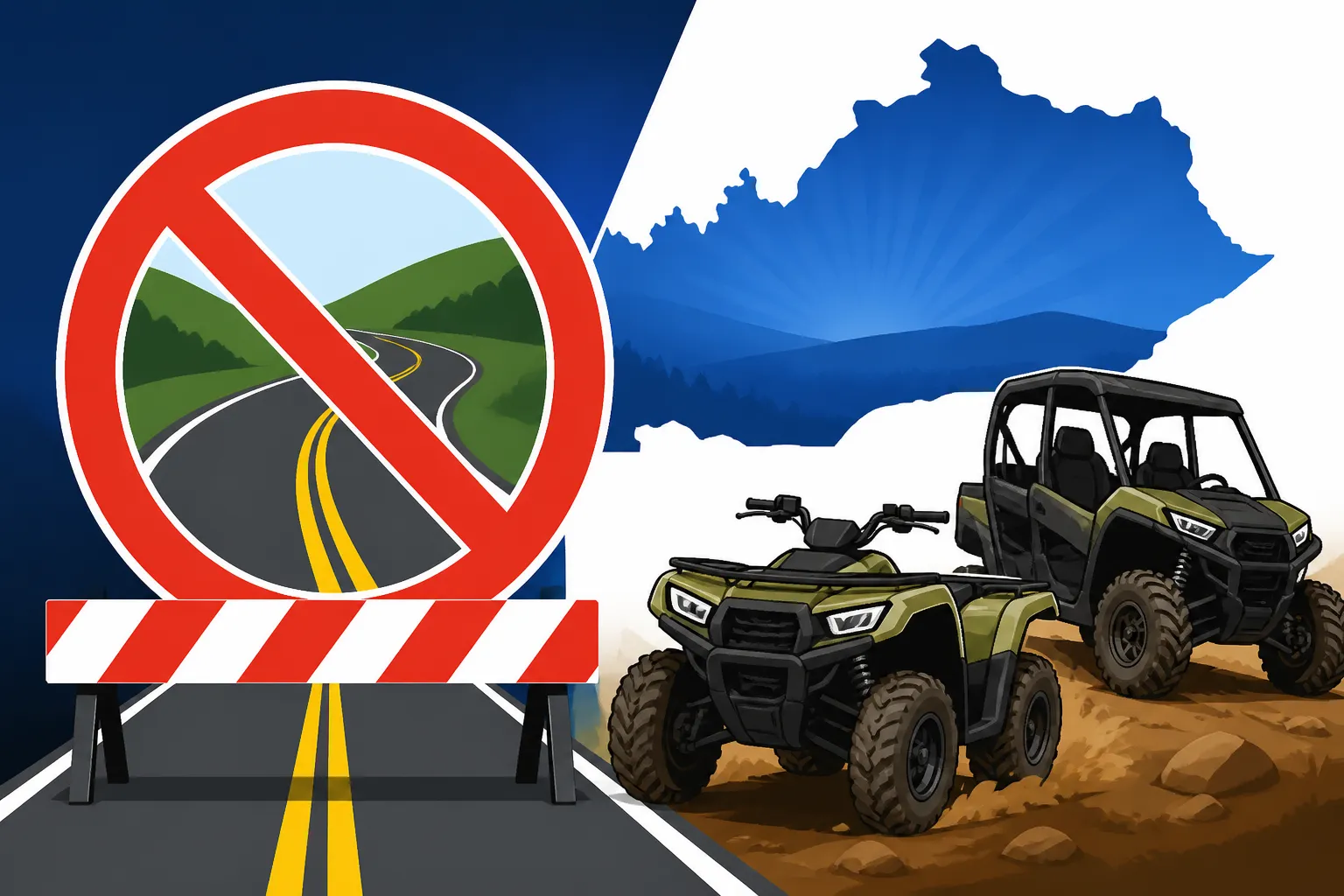
Let's start with the hard truth that often catches new and even seasoned riders off guard: by default, Kentucky law considers ATVs and UTVs not street legal. This isn't a suggestion or a guideline; it's the baseline legal reality that governs these machines on any road maintained by the state, county, or municipality. For many, it feels counterintuitive, especially if they've ridden in other states with more lenient regulations, or if they see similar vehicles on the road elsewhere. But in Kentucky, unless a very specific exception applies, your off-road machine belongs off-road.
This default prohibition stems from how these vehicles are classified under state law. ATVs, for instance, are primarily defined by their off-highway design, their straddle seat, and their low-pressure tires. They aren't built to meet the same safety and equipment standards as a typical car, truck, or even a motorcycle. This distinction is crucial because public roads are designed for vehicles that adhere to those higher standards, ensuring a predictable level of safety for all users. The absence of turn signals, proper mirrors, or even specific brake light configurations on a standard ATV means it simply doesn't fit the mold of a highway-legal vehicle.
What this means in practical terms is that you cannot simply hop on your quad and drive down a county road to get to a friend's house or to a local store. Doing so can quickly lead to a citation, a fine, and potentially even your machine being impounded. The law doesn't care if you're "just going a short distance" or if "there's no traffic." The default is a blanket "no," and exceptions are carved out with extreme precision. It’s a bitter pill to swallow for many who see their machine as a versatile tool, but understanding this fundamental legal position is the first step toward riding responsibly in the Commonwealth. If you're pondering whether your machine qualifies, it helps to understand [What Kentucky Counts as an ATV].
Understanding Vehicle Classifications in Kentucky
Kentucky law draws clear lines between different types of vehicles, and this is where ATVs and UTVs often get caught in a legal limbo on public roads. A traditional passenger car, truck, or motorcycle undergoes rigorous testing and must meet specific federal and state safety standards regarding headlights, taillights, turn signals, braking systems, and more. These are vehicles designed and certified for highway use.
All-terrain vehicles (ATVs) and utility task vehicles (UTVs), on the other hand, are classified primarily as off-highway vehicles. Their design priority is navigating challenging terrain, not sharing asphalt with cars and semi-trucks. Think about the wide, low-pressure tires designed for traction in mud or over rocks, not for stable high-speed travel on pavement. Or the lack of enclosed cabins, roll-up windows, and windshield wipers that are standard on road vehicles. These differences aren't just cosmetic; they impact everything from handling characteristics to crash safety. A side-by-side, for example, shares some characteristics with a small car but is still fundamentally different from a street-legal vehicle, which is why [Why a Side-by-Side Sits Awkwardly in Kentucky Law] is a common point of confusion.
This distinction isn't arbitrary; it's rooted in safety. The risks associated with an ATV or UTV on a public road, especially one with higher speed limits or significant traffic, are considerably greater than for a purpose-built road vehicle. They handle differently, are less visible, and offer less protection to their occupants in a collision. Because of these inherent design differences and the resulting safety implications, Kentucky's default position is to keep them off public roadways to protect both the riders and other motorists.
The Role of the Kentucky Transportation Cabinet
While your local county clerk's office handles the titling of your ATV, the broader regulations governing vehicle use on public roads originate from state statutes, often interpreted and enforced by agencies like the Kentucky Transportation Cabinet (KYTC) and state law enforcement. The KYTC is responsible for maintaining the state's highway system and establishing rules for its safe use. They view the entire public road network—from bustling interstates to quiet rural lanes—through the lens of vehicular safety and established highway codes.
When it comes to off-road vehicles, the KYTC's stance aligns with the general principle that vehicles not specifically designed and equipped for highway travel should not be on those highways. This isn't about singling out ATV and UTV riders; it's about maintaining a consistent standard for all vehicles operating on public thoroughfares. You might think, "But it's just a little dirt road connecting two farms!" And while that logic makes sense to a rural rider, the legal framework often doesn't differentiate between a major state highway and a sparsely traveled county road when it comes to the fundamental classification of a vehicle. For a deeper dive into the specific roles, consider [The Kentucky Transportation Cabinet and ATVs].
Ultimately, the KYTC's position helps enforce the uniformity of road rules across the state. Without clear definitions and default prohibitions, every road segment could become a patchwork of different regulations, creating chaos and increasing the risk of accidents. So, while it might feel restrictive to you as a rider, it's part of a larger system designed to manage vehicle traffic safely and consistently across the Commonwealth.
Why This Default Exists: Safety, Vehicle Classifications, and Historical Context
The blanket prohibition against ATVs and UTVs on most Kentucky roads isn't designed to be punitive; it's a measure rooted deeply in safety concerns, how vehicles are legally defined, and even a bit of historical precedence. When you look at the characteristics of these machines versus a standard road vehicle, the reasons for this default become clearer.
Think about the sheer disparity in design: an ATV's narrow track width, high center of gravity, and lack of seatbelts (on many models) make it inherently less stable than a car, especially at road speeds or when interacting with sudden obstacles. Similarly, many UTVs, while offering more stability, often lack the crumple zones, advanced braking systems, and comprehensive lighting found in street-legal cars. These aren't minor differences; they directly impact how a vehicle performs in traffic and what happens in a collision.
Furthermore, the legal framework for "street legal" vehicles has evolved over decades, long before ATVs and UTVs became widespread. These laws were crafted around specific vehicle types (cars, trucks, motorcycles) and their corresponding safety features. When ATVs surged in popularity, they didn't neatly fit into these existing categories. Rather than creating a free-for-all, states like Kentucky opted for a conservative approach, placing the burden of proof on exceptions rather than allowing broad road use. This ensures that any deviation from the default "off-road" status for these machines is carefully considered and regulated.
Safety Concerns and Design Limitations
The primary reason Kentucky, like many other states, defaults to prohibiting ATVs and UTVs on public roads is safety. These machines are engineered for off-road environments, which present vastly different challenges than paved highways.
Consider an ATV: it's designed with a straddle seat, handlebars for steering, and often a narrow wheelbase. These features are fantastic for agility on trails, traversing uneven terrain, and navigating tight spaces. However, on pavement, these same characteristics can become liabilities. ATVs are more prone to rollovers, especially during sharp turns or sudden maneuvers at higher speeds common on roads. Their braking systems might be perfectly adequate for dirt trails but can struggle to provide the same stopping power and stability as a car's ABS system on slick asphalt. Moreover, the rider is largely unprotected, making them highly vulnerable in any collision with another vehicle.
UTVs, or side-by-sides, offer a bit more stability due to their wider stance and often include seatbelts and roll cages. However, they still fall short of passenger vehicle safety standards. Their visibility to other motorists can be poor, especially smaller models. The tires, while perhaps more robust than an ATV's, are still designed for traction off-road, not for optimal grip and longevity on pavement. Many UTVs lack federally mandated safety features like proper turn signals, reflective markers, or even a windshield that meets automotive safety glass standards. Some riders try to adapt their machines, adding lights and mirrors, but the fundamental design for off-road rather than on-road use remains. This is where products from companies like SuperATV can enhance visibility and protection for off-road use, but they don't fundamentally change the vehicle's legal classification for street purposes in Kentucky.
The Problem of Speed and Traffic Flow
Another significant safety concern revolves around speed differentials and traffic flow. Public roads often have speed limits that range from 35 mph to 65 mph or even higher on certain state routes. Most ATVs and many UTVs are not designed to comfortably, safely, or legally maintain these speeds for extended periods.
Imagine a busy two-lane county road with a 55 mph speed limit. An ATV traveling at 30-40 mph (if it can even safely reach and maintain that) becomes a significant hazard. The difference in speed between the ATV and an oncoming or overtaking vehicle creates a dangerous situation, increasing the risk of rear-end collisions or unsafe passing maneuvers. Even on quieter roads, the presence of a slower-moving, less visible off-road vehicle can disrupt the natural flow of traffic and increase the likelihood of an accident.
Furthermore, ATVs and UTVs typically don't offer the same level of driver visibility or control response as road-legal vehicles. Their turning radius, acceleration, and braking are all optimized for off-road conditions, not for quick reactions in highway traffic. This makes them less predictable for other drivers and less capable of responding to sudden changes in road conditions or traffic patterns. The combination of design limitations and speed disparities simply makes them incompatible with the intended use and safety standards of Kentucky's public road network.
Limited Exceptions: When You Can Ride on Kentucky Roads
While the default is a firm "no," Kentucky law does provide very narrow, specific exceptions where ATVs and UTVs can legally operate on public roads. These exceptions are critical for certain groups, particularly farmers and those needing to cross a road to access another section of private land. However, it's vital to understand that these are exceptions and not loopholes for general road use. They come with strict conditions and limitations.
The most common exceptions generally fall into categories like agricultural use, utility work, and very short road crossings to access adjacent private property. These allowances recognize the practical needs of residents, particularly in rural areas, where an ATV or UTV might be the most efficient tool for a specific task. However, even with these exceptions, riders must remain vigilant about safety, visibility, and adhering precisely to the letter of the law. Ignoring these conditions can quickly negate the exception and land a rider in trouble. It's not a free pass to ride; it's a tightly controlled privilege.
The Brief Road Crossing Rule
One of the most frequently cited, and often misunderstood, exceptions is the brief road crossing rule. Kentucky law allows an ATV or UTV to cross a two-lane public road at a ninety-degree angle to access another portion of private property, provided the crossing occurs during daylight hours. This sounds simple, but the devil is in the details.
First, it explicitly states "a two-lane public road." This means multi-lane highways, interstates, or even four-lane state routes are typically off-limits, even for a quick dash across. Second, the crossing must be "at a ninety-degree angle." This isn't just a suggestion; it's a legal requirement to minimize the time the vehicle spends in the roadway and to make its intention clear to other motorists. You can't parallel a road for a hundred yards and then turn across. Third, it must be for the purpose of accessing "another portion of private property." This isn't for going to the gas station or visiting a neighbor down the road; it's strictly for continuity of your own property. Finally, and crucially, it's "during daylight hours." No dawn, no dusk, and certainly no night crossings are permitted under this exception. Understanding [Crossing a Two-Lane at Ninety Degrees in Kentucky] is paramount.
The distance limit for such crossings is also extremely narrow: 0.2 miles. That's just over 1,000 feet – not very far at all. This strict limitation reinforces that the intent is not for travel along the road, but merely across it. Any deviation from these precise conditions, such as riding along the shoulder for even a short distance before turning, can easily lead to a citation. This exception is truly for minimal, unavoidable road interaction. Many riders find that [How Far 0.2 Mile Really Gets You] is far less than they imagine.
Agricultural and Utility Use Exemptions
For those working the land or maintaining essential services, Kentucky law offers another set of specific exemptions. Farmers can use their ATVs or UTVs on public roads for agricultural purposes, and utility workers can use them for maintaining utility services. These are pragmatic exemptions acknowledging that these machines are often integral tools for these specific industries.
For farmers, this means they can use their ATV to transport tools, check fences, move livestock, or get from one field to another that's separated by a public road. Unlike the general public, farmers typically don't have the 0.2-mile crossing limit imposed on them for these specific agricultural tasks. [Why Kentucky's Farm Exception Has No Limit] highlights this key difference. However, even with this broader allowance, the use must be genuinely for "agricultural purposes." Taking the quad into town for groceries, even if you're a farmer, generally wouldn't qualify. The spirit of the law is to facilitate farm work, not provide general transportation. For these machines, especially UTVs, durability is key, and components from manufacturers like SuperATV can help ensure they stand up to the rigors of farm life.
Similarly, those involved in utility maintenance, such as checking power lines, servicing pipelines, or maintaining communication infrastructure, can operate ATVs and UTVs on public roads as necessary for their work. These are often vehicles equipped for the job, making them essential for reaching remote locations or areas inaccessible by standard trucks. Like the agricultural exemption, this is tied directly to the nature of the work being performed. Both agricultural and utility use exemptions generally still require adherence to basic safety principles, such as maintaining visibility and exercising caution, even if the strict equipment rules of street-legal vehicles don't fully apply.
The "Special Purpose Vehicle" SPV Pilot Program: A Glimmer, Now Gone
For a brief period, Kentucky offered a glimmer of hope for UTV owners who wished to make their machines street-legal through a "Special Purpose Vehicle" (SPV) pilot program. This program was an attempt to address the growing demand for UTVs on local roads, recognizing that these machines, with some modifications, could potentially meet a set of specific safety criteria. It was an exciting development for many, suggesting a pathway to broader road access.
Under this program, UTVs could be inspected to ensure they met a defined list of equipment requirements, such as turn signals, brake lights, mirrors, and specific tire tread depths. If they passed this inspection, they could then be registered and issued a special SPV license plate, effectively making them street-legal on certain public roads. For a time, it seemed like a progressive step that could offer a realistic avenue for riders to enjoy their side-by-sides on the pavement.
However, the SPV pilot program was exactly that—a pilot program. It had a finite lifespan, designed to gather data and assess its effectiveness and safety implications. Unfortunately for UTV enthusiasts, this program eventually sunsetted, meaning the window to register new SPVs under those specific rules closed. This left many riders who hadn't participated or who acquired machines after the cutoff date without that particular avenue for street legality. The story of [Kentucky's 2025 Special Purpose Vehicle Law] offers historical context to this program's evolution and eventual conclusion, showing how legislative efforts in this area can shift.
What the SPV Pilot Program Required
When the Special Purpose Vehicle (SPV) pilot program was active, it laid out a clear set of requirements for UTVs to be considered street-legal. This wasn't a simple rubber stamp; it involved a thorough inspection process to ensure the machines were equipped for safe road operation.
Key requirements included installing proper lighting: working headlights, taillights, brake lights, and crucially, turn signals. For a UTV that comes from the factory primarily for off-road use, adding these components often meant aftermarket installations. Good visibility was paramount, so the rules also mandated dual mirrors, allowing the driver to see traffic behind and to the sides. An illuminated speedometer was also required, ensuring drivers could monitor their speed accurately on public roads. Many riders looked to reputable aftermarket parts suppliers like SuperATV for these kinds of specific upgrades, as they often specialized in robust, off-road-capable lighting and mirrors that could also meet basic road requirements.
Beyond lighting and mirrors, there were mechanical checks. Tires had to have a minimum tread depth (usually 2/32 of an inch), and the braking system needed to be fully functional. Safety equipment like a roll cage and seat belts were also scrutinized, ensuring occupants had basic protection. Once a UTV passed this inspection, it could be registered and titled as an SPV, allowing it to be driven on public roads within participating municipalities, subject to local ordinances. This comprehensive list of requirements demonstrated the state's attempt to bridge the gap between off-road design and on-road safety.
The Sunset of the Pilot Program
The Special Purpose Vehicle (SPV) pilot program in Kentucky was introduced with good intentions, aiming to provide a legal pathway for UTVs on public roads. However, like many pilot programs, it was designed with a specific timeframe, and for many riders, its conclusion has been a source of significant disappointment. [Why Kentucky's Pilot Program Sunset in 2024] helps shed light on the legislative journey of this initiative.
When the program sunsetted, it meant that no new UTVs could be registered as SPVs under those specific rules. Machines that had already gone through the process and received their SPV designation were generally allowed to continue operating under the terms they were registered, provided they maintained their compliant equipment and followed local ordinances. However, for anyone buying a new UTV or wanting to convert an existing one after the program's conclusion, that particular door to street legality closed.
The sunsetting of the pilot program highlights the cautious approach Kentucky takes with off-road vehicle road use. While there was an effort to accommodate UTVs, the state ultimately moved away from a broad, statewide program. This places even greater emphasis on the default prohibition and means riders must rely on the very narrow original exceptions or hope for future legislative changes at either the state or local level. It's a reminder that rules around off-road vehicles on roads are constantly evolving, and what might be possible one year may not be the next.
Navigating Local Ordinances: When Cities Opt In (and Out)
Even with the statewide default prohibition and the sunset of the SPV pilot program, there's still a layer of complexity: local control. Kentucky law allows individual cities and counties to pass ordinances that can either permit or prohibit the use of ATVs and UTVs on roads within their specific jurisdictions. This means that rules can vary significantly from one town to the next, making it incredibly important for riders to do their homework before venturing onto any paved surface.
This local option reflects the diverse nature of Kentucky's communities. What works in a sparsely populated rural county with miles of farm roads might not be suitable for a bustling urban center. Therefore, the state allows local governments to make decisions that best fit their community's infrastructure, traffic patterns, and safety concerns. This system, however, puts the onus squarely on the rider to know the specific rules of the road in every locale they plan to operate their machine. It’s not enough to know the state law; you must also be aware of any local caveats. Many riders find themselves asking [Why a Kentucky City Must Opt In] before they can even consider street riding.
Cities That Have Allowed Limited Road Use
Despite the statewide default, some Kentucky cities and counties have taken steps to allow limited ATV and UTV use on their local roads. These decisions are often driven by local needs, such as supporting tourism in off-road riding areas, facilitating agricultural commerce, or simply responding to resident demand in communities where off-road vehicles are common.
For example, communities near popular trail systems like those around Black Mountain Off-Road Adventure Area in Harlan County might have different ordinances than a city like Lexington or Louisville. These local ordinances often come with their own set of rules, which can include specific hours of operation, designated roads, speed limits, and even additional equipment requirements beyond what state law might imply for its narrow exceptions. For instance, a city might require specific lighting or flags even for simple crossings within city limits. You'll need to check the specific municipal code for the area you're interested in.
It's crucial to remember that even if a city "opts in," it's rarely a free-for-all. Often, these ordinances are very restrictive, limiting ATVs and UTVs to certain non-arterial roads, establishing lower speed limits, or even requiring additional local permits. The intent is usually to provide practical access, not to turn every side-by-side into a daily commuter vehicle. Always check with the local city hall or county clerk's office for the most current and specific information for that particular area. A good starting point is understanding [How a Kentucky City Opens Its Roads].
Checking Local Ordinances Before You Ride
Given the patchwork of local rules, performing due diligence before riding your ATV or UTV on any public road in Kentucky is non-negotiable. What's legal in one county could lead to a citation just a few miles down the road in another.
The best way to get accurate information is to contact the city clerk's office or the county judge-executive's office for the specific jurisdiction where you plan to ride. Explain your intentions clearly—for instance, "I plan to ride my UTV on County Road XYZ, are there any local ordinances regarding this?" They can direct you to the relevant sections of their local code or provide specific guidance. Don't rely on hearsay, old forum posts, or general assumptions. Laws change, and what was true last year might not be true today.
It's also wise to remember that even if a local ordinance permits road use, state law enforcement (like Kentucky State Police) can still enforce state statutes. So, if a local rule contradicts a more restrictive state law, the state law usually takes precedence unless the local ordinance is explicitly authorized by a state statute as an exception. This layered legal landscape makes careful research all the more important. Table 1 below outlines some common differences you might encounter.
Table 1: General ATV/UTV Road Rules in Kentucky
| Rule Category | Default State Law (General) | Local Ordinance (If Applicable) |
|---|---|---|
| Road Use | Prohibited on public roads. | May allow limited use on specific roads or within zones. |
| Crossing Roads | Allowed for 0.2 miles, 90-degree, 2-lane, daylight only. | May specify additional local conditions or limitations. |
| Farm/Utility Use | Generally allowed for official duties. | May have specific requirements for signage or permits. |
| Equipment | Not required for street-legal status by default. | May require specific lighting, mirrors, or other upgrades. |
| SPV Registration | Pilot program sunsetted; no new registrations. | N/A (localities cannot create SPV registration). |
| Penalties | Fines, impoundment for illegal road use. | Fines, impoundment, may include local administrative fees. |
The Future of Kentucky Road Riding: What Riders Can Hope For
The current landscape for ATVs and UTVs on Kentucky roads can feel restrictive, even disheartening, for riders who simply want more flexibility. The default prohibition, coupled with narrow state exceptions and the sunsetting of the SPV pilot program, means that extensive road use for off-road vehicles isn't broadly available. However, this doesn't mean the situation is static forever. Laws evolve, often driven by public demand, technological advancements, and advocacy efforts.
For the passionate off-road community in Kentucky, understanding the current limitations is just the first step. The next is to engage constructively in conversations about potential future changes. This might involve supporting new legislative proposals, participating in local government meetings, or joining rider organizations that advocate for responsible and expanded off-road vehicle access. The push for more street-legal options for UTVs, for example, often comes from a place of practicality and economic benefit for rural communities and tourism, not just recreational desire.
While there are no immediate guarantees, continued dialogue and informed advocacy are key. The goal for many riders isn't to turn every ATV into a highway cruiser, but to find reasonable pathways for limited, safe, and legal road use that acknowledges the versatility of these machines and the needs of their owners.
Advocacy and Legislative Efforts
Change in state law doesn't happen overnight; it's often the result of sustained advocacy and legislative efforts. Riders who are frustrated by Kentucky's current road rules for ATVs and UTVs have avenues to express their concerns and push for reform. This typically involves engaging with local and state representatives, joining organized rider groups, and supporting proposals that aim to update existing statutes.
One common approach is to advocate for new legislation that could establish a more permanent and comprehensive framework for street-legal UTVs, learning from the lessons of the previous pilot program. This might include defining a specific class of "recreational off-highway vehicles" (ROVs) that, with certain factory or aftermarket modifications (like those offered by SuperATV for enhancing off-road performance and safety), could qualify for limited road use under clear statewide standards. Such proposals often aim to strike a balance between rider access and public safety, ensuring that any machines on the road meet a robust set of equipment and operational requirements.
Another aspect of advocacy involves educating policymakers about the practical needs of riders, particularly in rural and agricultural communities where ATVs and UTVs are essential tools. Highlighting the economic benefits of increased off-road tourism and responsible machine use can also sway legislative opinion. While the process can be slow, a unified voice from the riding community can certainly influence the direction of future laws governing [Kentucky Rules for ATVs on Public Roads].
What Riders Can Do Now
While we wait for potential legislative changes, there are concrete steps every ATV and UTV rider in Kentucky can take right now to stay informed and ride responsibly within the current legal framework.
First and foremost, stay educated. Regularly check the Kentucky Revised Statutes (KRS) related to ATVs and UTVs, as well as any relevant local ordinances in your riding areas. Don't rely on outdated information or assumptions. Understanding laws like [Kentucky's 0.2-Mile Crossing Rule] is crucial. Being knowledgeable helps you avoid fines and ensures your safety. Second, if you utilize one of the narrow exceptions, such as for agricultural work or a brief road crossing, adhere to the conditions with absolute precision. That means strictly observing the 0.2-mile limit, the 90-degree crossing, and daylight-only rules.
Third, focus on where these machines are designed to be ridden: dedicated off-road trails and private property. Kentucky boasts fantastic riding opportunities at places like Black Mountain Off-Road Adventure Area, Leatherwood Off-Road Park, and Turkey Bay OHV Area. These locations provide the thrill and challenge off-road vehicles are built for, without the legal complexities and safety concerns of public roads. Supporting these parks and advocating for more designated off-road areas can also be a productive path forward. Remember, responsible riding starts with knowing and respecting the rules, wherever you choose to ride.
Disclaimer
This article is for general informational purposes only and does not constitute professional advice. Laws, prices and regulations vary by location and change over time. Consult a qualified professional for guidance on your specific situation.