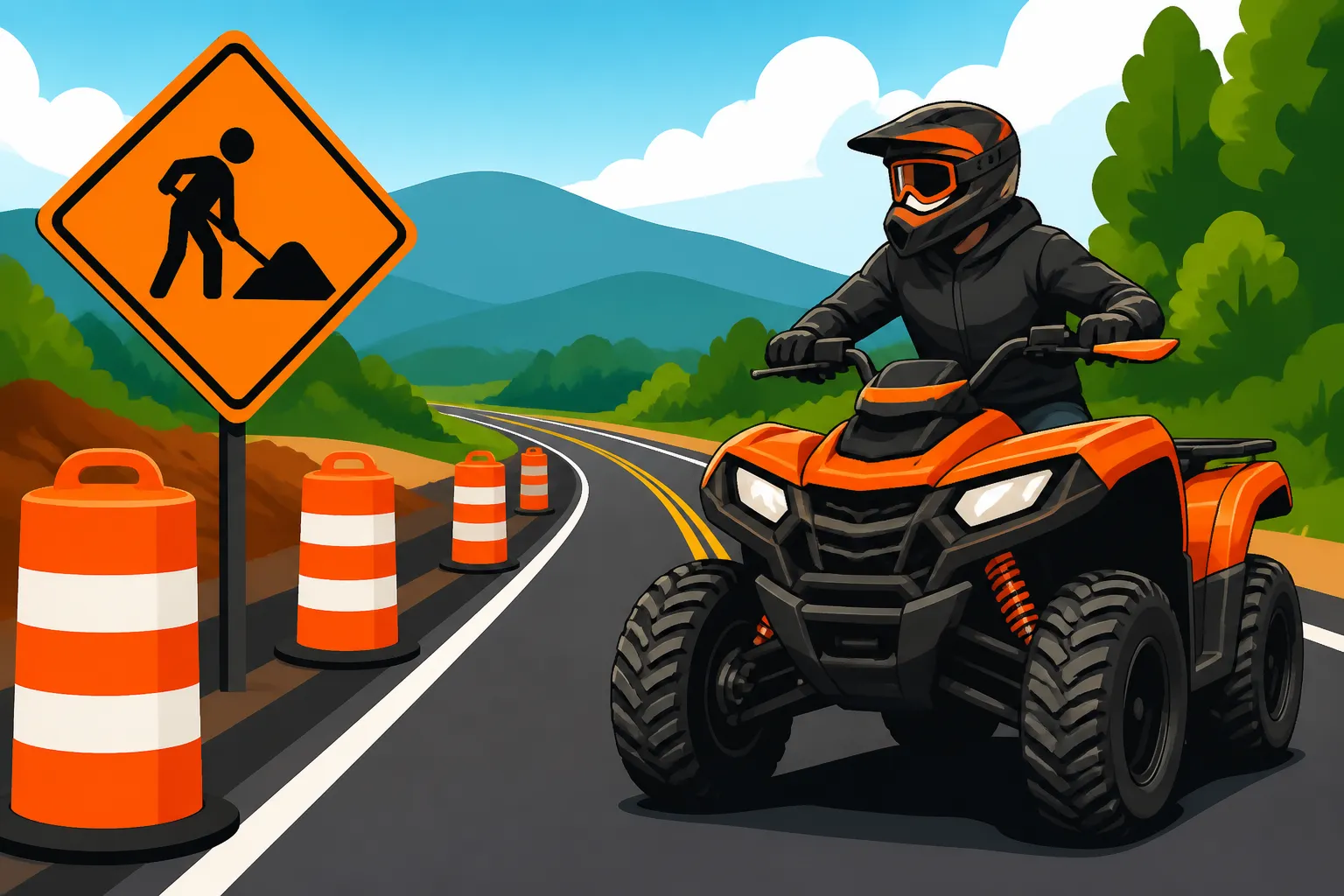
When Emergency Road Work Lets an ATV on Pavement
It’s a common frustration for anyone who loves their ATV or UTV in Kentucky: the pavement is often off-limits. You invest in a machine built for rugged terrain, but suddenly a paved road is the only way to get from Point A to Point B, and you’re left wondering if you’re breaking the law. This guide dives deep into one specific, albeit rare, exception: using your ATV or UTV on public roads for emergency road work.
The General Rule: ATVs Off Kentucky Pavement
Let's be real, Kentucky isn't exactly a free-for-all when it comes to riding your ATV or UTV on public roads. Many riders get their machines home from the dealership, or from a private sale, only to realize that navigating paved public roads with their off-road vehicle is a legal minefield. It’s a bitter pill to swallow when you just want to get to the trailhead or a friend’s house a few miles down the road.
Why ATVs Are Restricted on Public Roads
The core reason ATVs and UTVs are generally kept off Kentucky’s paved roads boils down to safety and vehicle design. These machines are built for dirt, gravel, mud, and rocks, not high-speed asphalt. Their suspension, tires, and steering are optimized for uneven terrain, which makes them handle very differently on hard, flat surfaces. They can be less stable, have longer braking distances, and offer less protection in a collision compared to street-legal vehicles. From the state's perspective, this means a higher risk for both the rider and other motorists. It’s not about stifling your fun, but about public safety as determined by lawmakers who look at the big picture. This is why you'll often hear about [Why Kentucky Roads Are Closed by Default].
Most states, including Kentucky, classify ATVs and UTVs as off-highway vehicles (OHVs). This classification immediately puts them in a different category from cars, trucks, and motorcycles, which are specifically designed and regulated for on-road use. The laws reflect this distinction, aiming to keep these powerful, yet specialized, machines in their intended environment. It can be a real headache, especially if you live in a rural area where a short stretch of pavement is unavoidable to get to your favorite riding spot.
Limited Exceptions for Road Crossings and Farm Use
Now, it's not all doom and gloom. Kentucky law does recognize that there are practical situations where an ATV or UTV might need to briefly touch pavement. The most common exception you'll hear about is the "0.2-mile crossing rule." This allows you to cross a paved public road at a ninety-degree angle, or travel on it for a maximum of two-tenths of a mile, specifically to get from one section of your property to another, or to access an adjacent trail. It’s a blink-and-you’ll-miss-it kind of allowance, hardly enough for a leisurely cruise, and comes with its own set of rules, like requiring daylight operation. For more details on this, check out [Kentucky's 0.2-Mile Crossing Rule].
Beyond short crossings, there’s also a significant exception for agricultural use. If you’re genuinely using your ATV or UTV for farming purposes – hauling feed, checking fences, or moving equipment from one field to another – you might be able to operate it on public roads without the stringent mileage caps. This exception acknowledges the essential role these machines play in Kentucky’s agricultural communities. However, it's not a blanket pass for any ride that might eventually involve farm work; the primary purpose of your travel must be directly related to agricultural operations. This flexibility is a lifesaver for many rural Kentuckians. You can learn more about [Kentucky's Farm Exception With No Mileage Cap] if that applies to your situation.
Understanding "Emergency Road Work" in Kentucky Law
The idea of "emergency road work" as an exception to general ATV road restrictions is where things get a bit more nuanced. It’s not a permission slip you can grab for personal errands, but a specific allowance designed to facilitate crucial tasks when the unexpected happens. This isn't about routine maintenance or just getting a jump start on your morning commute; it's about addressing immediate, critical situations on public infrastructure.
Defining "Emergency Road Work" for ATVs
So, what exactly counts as "emergency road work" in the eyes of Kentucky law? Generally, it refers to activities necessary to restore public roads or utility services following unforeseen events like natural disasters, accidents, or sudden infrastructure failures. Think about a massive tree falling across a county road after a severe storm, rendering it impassable. Or a major water line break that floods a section of highway. These are situations where immediate action is required to ensure public safety, restore access, or prevent further damage. It's about responding to a crisis, not pre-planned projects.
This exception is distinct from general [Construction and Road Maintenance in Kentucky]. While construction and maintenance are vital, they are typically scheduled, planned, and performed by vehicles designed for road use. Emergency road work, on the other hand, implies an urgent, often unexpected, need where standard equipment might not be immediately available or suitable for the terrain involved. An ATV’s agility and off-road capability can make it invaluable for reaching damaged areas that a standard truck might struggle with, especially if a bridge is out or the road is heavily obstructed.
Who Qualifies to Perform Emergency Road Work
This is a critical distinction: it's not just anyone who can decide to use their ATV for "emergency road work." The exception is typically granted to authorized personnel or entities. This primarily includes public employees from state, county, or city road departments, utility companies (electric, water, gas, telecom), or contractors officially hired by these entities to perform the work. For example, if a severe ice storm brings down power lines, a local utility crew might dispatch workers on ATVs to survey the damage in remote, inaccessible areas.
While well-meaning citizens often want to help their communities, using your personal ATV to clear a downed tree from a public road, even with the best intentions, could still put you in a legal grey area if you haven't been officially authorized by the relevant authorities. The safest bet is always to contact your local county road department or law enforcement if you believe your ATV could genuinely assist in an emergency, and only proceed if you receive explicit permission and guidance. This ensures you're operating within the bounds of the law and not inadvertently creating a liability for yourself or the county.
Conditions and Limitations for ATV Use During Emergency Road Work
Even when the "emergency road work" exception applies, it’s not an invitation to operate your ATV with complete abandon. There are still crucial conditions and limitations that you must adhere to. Think of it as a highly specific tool for a specific job, used under specific circumstances.
Specific Operating Requirements
When an ATV is legitimately used for emergency road work, the operator is still expected to exercise extreme caution and follow common-sense safety practices. While the statute might not explicitly detail every single operating requirement for this specific scenario, the general rules of safe ATV operation still apply, and in many cases, state law dictates certain minimums for any road use. For instance, [Daylight Only Under the Statute] is a common stipulation for ATV road crossings, and while emergency work might sometimes extend into dusk or darkness, any such operation would likely require specialized lighting and highly visible gear. For utility companies, their vehicles often have amber warning lights that make them stand out.
Safety equipment is paramount. While Kentucky doesn't mandate a helmet for adults on private land, if you’re operating your ATV on a public road, even for emergency work, you should absolutely be wearing a helmet and other protective gear. [Helmet Rules for Kentucky Riders] generally apply more broadly, and when you’re interacting with public infrastructure, the expectation for safety is even higher. Furthermore, your ATV should be in good working order, with functional brakes and tires. Many of the accessories from brands like SuperATV, such as heavy-duty winches, upgraded lighting, or robust tires, could be invaluable for ensuring safe and effective operation during emergency scenarios.
Geographic and Time Restrictions
The "emergency road work" exception is not a carte blanche to ride your ATV anywhere you want. The use of the ATV is strictly limited to the geographical area where the emergency work is being conducted. If a tree is down on County Road 123, you can use your ATV on County Road 123 to address that specific issue. You can't then take a detour for ten miles on State Route 456 just because you're "working." The intent is to facilitate the emergency, not provide general transportation. This means your travel should be directly to the site, within the site, and then directly away from the site once the emergency task is completed.
Similarly, the time restriction is implied by the very nature of "emergency." Once the immediate emergency has passed and the road has been cleared or made safe, the exception no longer applies. You can't continue to use your ATV on the pavement days after the crisis has been resolved. This is different from the general [0.2 Mile and Not a Yard More] rule, which has a specific distance, but the emergency rule's "distance" is defined by the extent of the emergency itself. It's a temporary allowance, and you should always be prepared to explain your presence and the nature of the emergency if questioned by law enforcement.
Practical Scenarios and Local Examples
Let’s bring this down to earth with some real-world hypotheticals. While the "emergency road work" exception isn't something most casual riders will ever encounter, it’s a vital allowance for those who need it. These scenarios highlight when and how an ATV or UTV might become an indispensable tool.
Clearing Debris After a Storm
Imagine a powerful windstorm sweeps through a rural area in Letcher County, bringing down numerous trees and snapping utility poles. Access roads to several homes are completely blocked, and traditional heavy equipment can't navigate the narrow, muddy tracks that are now impassable. In such a situation, the county road department or a utility company might authorize workers to use ATVs or UTVs. An employee could attach a small trailer to their UTV, load it with chainsaws and hand tools, and navigate around smaller downed branches or through soft ground that would bog down a pickup truck.
Their mission would be specific: clear enough debris to allow larger vehicles through, or to access damaged power lines. An ATV, perhaps equipped with a winch from SuperATV, could be used to pull smaller logs off the road, helping to create a path for emergency services or line crews. This isn't recreational riding; it's a focused effort to restore public access and safety, often coordinated directly with local emergency management. The workers would be operating directly within the affected zone, making their movements efficient and targeted.
Utility Companies Restoring Services
Utility companies are perhaps the most common users of ATVs and UTVs for emergency road work. When a severe ice storm hits, say, the hills of Pike County, and brings down power lines in remote, mountainous areas, reaching those sites quickly is paramount. Often, the easiest, or even the only, way to get personnel and equipment to these locations is via an off-road vehicle. A utility worker might be dispatched on a rugged ATV, carrying diagnostic equipment and basic repair tools. They would use paved county roads briefly to access service rights-of-way that branch off into the wilderness.
Their presence on the pavement would be limited to the shortest practical distance necessary to get to their work area. Once off the pavement, they'd navigate through fields, dense woods, or up steep access trails. This use is clearly tied to the emergency of power outage and the critical task of restoring electricity to residents. Their vehicles are usually clearly marked, and their work is part of an organized effort to restore essential services. This isn't about personal [Riding a Holler Road in Perry County] for fun, but getting the lights back on.
Assisting with Local Flood Response
Kentucky, especially its eastern regions, is no stranger to flash flooding. When heavy rains cause rivers and creeks to overflow, roads can become submerged, cutting off communities or making traditional vehicle access impossible. In these scenarios, local emergency services, like the fire department or search and rescue teams, might employ ATVs or UTVs to reach stranded residents or deliver essential supplies. Imagine a situation in Clay County where a rural road is flooded but still passable by a high-clearance UTV.
Emergency personnel could use these machines to evacuate individuals, check on vulnerable residents, or transport crucial items like food and medical supplies to isolated areas. The ATV or UTV's ability to navigate through shallow floodwaters or muddy, debris-strewn roads makes it uniquely suited for these conditions. Again, this use would be sanctioned by local authorities, focused on life safety and public welfare, and confined to the specific areas affected by the flood.
Avoiding Misuse and Penalties
While the emergency road work exception is a genuine provision, it's crucial to understand its limitations and avoid any perception of misuse. Kentucky law is generally quite strict on ATV road use, and misunderstanding an exception can lead to significant problems.
What "Emergency Road Work" Does Not Cover
Let's be very clear: the "emergency road work" exception is not a loophole for general riding or personal convenience. It does not mean you can use your ATV to run to the grocery store if your truck breaks down, or to simply bypass traffic because a road is temporarily closed for something non-emergency related. It absolutely does not cover casual jaunts on the pavement because it’s a "faster" way to get to your favorite fishing spot after a rainstorm, even if the trail is muddy. That kind of behavior falls squarely under illegal road use, regardless of how much you might wish it were different.
The core principle is the public nature of the emergency and the necessity of the ATV for that specific task. If you're not an authorized worker, or if your activity isn't directly addressing an immediate threat to public safety or infrastructure, you're likely outside the bounds of this exception. Don't try to stretch the definition to fit your personal agenda, because that's when you run the risk of attracting unwanted attention from law enforcement. Remember, [Kentucky Fines for Illegal ATV Road Use] can be steep, and ignorance of the law is rarely an acceptable excuse.
Proving Legitimate Emergency Use
If you are legitimately operating an ATV on a public road under the emergency road work exception, communication and documentation are your best friends. If you're a public employee or a contractor, carry your official identification and any work orders or dispatch information that clearly states the nature of the emergency and your role in addressing it. If you're a private citizen assisting under specific authorization from local authorities, make sure you have a clear understanding of that authorization and perhaps even a contact number for the official who gave you permission.
Should you be stopped by law enforcement, politely explain the situation, present your credentials or authorization, and clearly articulate how your ATV is being used for emergency road work. Having a clear, concise explanation will go a long way. Without such proof, a law enforcement officer might reasonably assume you are engaging in illegal ATV road use, which can lead to citations, fines, or even your machine being impounded. Being prepared means you can focus on the important emergency task at hand without added legal stress.
Comparing ATV Road Use Rules
Here's a quick comparison of general ATV road use regulations versus the specific conditions that apply during emergency road work in Kentucky:
| Feature | General Road Use (Limited Exceptions) | Emergency Road Work Exception |
|---|---|---|
| Purpose | Crossing roads (0.2 mile), farm use (no mileage cap) | Restoring public safety/infrastructure post-unforeseen event |
| Operator | Any qualified rider (age/license may apply for farm use) | Authorized personnel (public employees, utility workers, official contractors) |
| Pavement Travel | Limited to 0.2 miles for crossings, or directly related to farm work | Within the immediate scope and location of the emergency work |
| Speed Limits | Adhere to posted speed limits, or lower for safety | Adhere to posted speed limits; prioritize safety given conditions |
| Daylight Only | Generally required | Often required; may be overridden by operational necessity with proper lighting/visibility |
| Safety Gear | Helmet recommended; generally not mandated for adults on private land, but wise on roads | Highly recommended; often required by employer/authority for public work |
| Authorization | Not required beyond meeting legal criteria for farm/crossing | Explicit authorization from local/state authorities or employer is key |
| Documentation | N/A | Official ID, work orders, explicit permission from authority figures |
| Penalties for Misuse | Fines, potential impoundment of machine | Fines, potential impoundment, job-related consequences if an employee |
Disclaimer
This article is for general informational purposes only and does not constitute professional advice. Laws, prices and regulations vary by location and change over time. Consult a qualified professional for guidance on your specific situation.