How Far 0.2 Mile Really Gets You
One of the most common head-scratchers for ATV and UTV owners in Kentucky revolves around those brief moments you absolutely must touch a public road. We all know the general rule: off-road machines don't belong on the pavement. But then you hear whispers of an exception, a tiny window of opportunity, specifically the "0.2-mile rule." This often leads to more confusion than clarity, leaving riders wondering exactly what they can and cannot do. This guide is going to strip away the guesswork and lay out precisely what Kentucky's two-tenths of a mile road crossing rule means for you and your machine, and more importantly, how far it really gets you.
Understanding Kentucky's 0.2-Mile Road Crossing Rule
Kentucky law, in its effort to be somewhat practical for off-road enthusiasts and landowners, provides a very narrow exception to the general prohibition against operating ATVs and UTVs on public roads. This exception allows for a brief crossing of a roadway, but it comes with strict conditions and a very precise distance limit: 0.2 miles. It's a provision designed for necessity, not convenience, and understanding its nuances is key to staying out of trouble.
The Statute's Intent: Bridging Gaps, Not Cruising Roads
Let's break down what 0.2 miles actually translates to in real-world terms. We're talking about approximately 1,056 feet. To put that in perspective, a standard football field is 360 feet long, including the end zones. So, you're looking at a distance just shy of three football fields. It sounds like a lot when you're thinking about walking it, but when you're on a machine, especially one built for speed and agility, that distance vanishes in a flash.
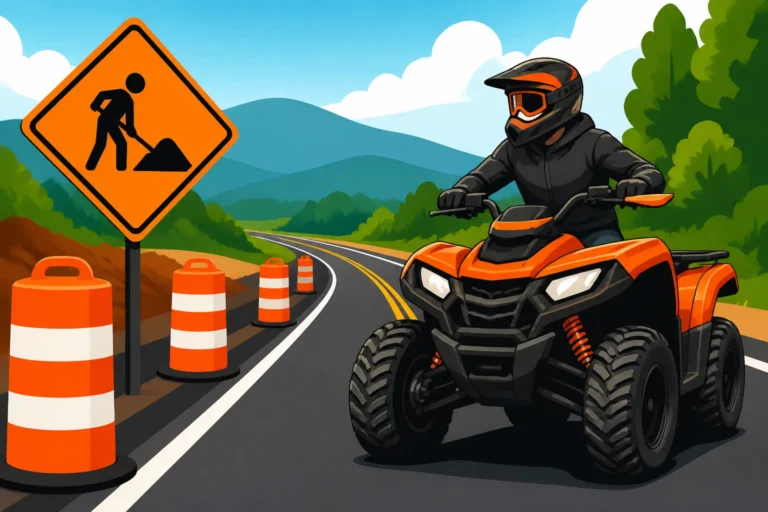
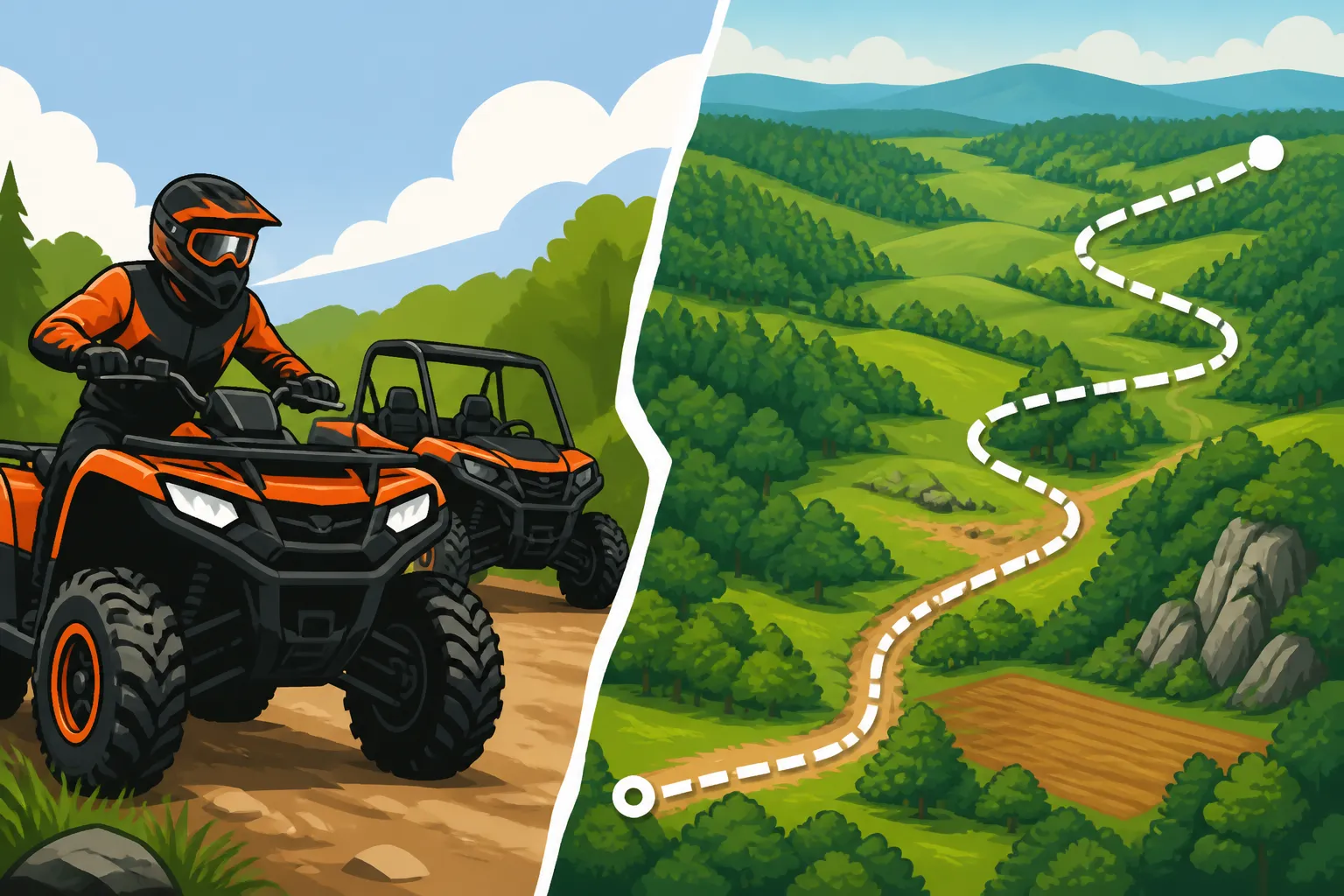
The entire purpose of this rule is not to grant you limited road access, but to allow you to bridge necessary gaps. Imagine your favorite trail system is cut in half by a two-lane county road. Or perhaps you own property that's split by a small blacktop, and you need to move your ATV from one field to another to tend to chores. Maybe you're at a [Kentucky Trail Park] and a short section of road connects two larger trail networks. This rule exists for those very specific, unavoidable situations where an ATV or UTV must briefly traverse a public thoroughfare to continue its intended off-road journey or complete a farm task. It's an acknowledgment that sometimes, a few feet of pavement are unavoidable, but it's emphatically not an invitation to cruise.
Practical Limitations of Two-Tenths of a Mile
Now, let's talk about what 1,056 feet feels like when you're behind the handlebars. It's really short. Even at a crawling pace of 10-15 mph, you'll cover that distance in under a minute. If you're riding a bit faster, it's a matter of seconds. This means you have practically no time for error, no room for wandering, and certainly no opportunity to enjoy the scenery. Your entire focus for that brief span must be on traversing the road quickly and safely.
Consider these real-world scenarios:
- Crossing a main highway to reach another section of a trail: You identify your entry and exit points, ensure clear traffic, and make a direct, quick crossing. The instant your tires hit the other shoulder, your legal allowance for road use is over.
- Moving from a private driveway to an adjacent field entrance: This is often a matter of pulling out, going straight for a hundred feet or so, and immediately turning into the next access point. If that access point is further than 1,056 feet, you're already breaking the law.
- Connecting two small trail spurs: Sometimes, you'll find a brief stretch of road that links two otherwise isolated trail segments. This rule is perfect for that, but again, it's about connecting, not prolonging the road ride.
The challenge, both for riders and for law enforcement, is the precise measurement. How does an officer know you went 0.21 miles instead of 0.2 miles? The truth is, they don't have a laser-accurate rangefinder. They rely on common sense, visual estimation, and whether your actions clearly indicate you're using the road rather than merely crossing it. If you're on the pavement for what seems like more than a very quick hop, or if you're taking turns and riding along the shoulder, you've likely exceeded the spirit, if not the letter, of the law. This is where a little caution goes a long way.
"Ninety Degrees" and Other Crossing Conditions
Beyond the strict distance limit, Kentucky law often specifies how these crossings must be executed. While the language can vary slightly by statute, a common understanding for safe and legal crossing is "at a ninety-degree angle."
What does this mean in practice? It means you shouldn't be riding along the road, even for a short distance. You're expected to cross directly perpendicular to the flow of traffic, getting off the pavement as quickly and safely as possible. Think of it like this: if you're standing on the shoulder, you point your machine straight across to the opposite shoulder and go. You don't ride down one shoulder for 500 feet, then cross, then ride down the other shoulder for another 500 feet. That would clearly violate the spirit of the "crossing" rule.
Additional implied conditions, though not always explicitly stated for the 0.2-mile rule, are rooted in common sense and general traffic laws:
- Yield to traffic: You must always yield the right-of-way to oncoming vehicles. Your ATV or UTV is not entitled to road priority.
- Visibility: Ensure you can clearly see and be seen by other drivers. Daylight operation is generally assumed for such crossings, as [Kentucky Rules for Riding After Dark] on public roads are much stricter, if allowed at all.
- Operational safety: Your machine should be in good working order, and you should be sober and attentive.
Failing to meet these conditions, even within the 0.2-mile limit, can still lead to citations for reckless operation or other traffic infractions. The rule is a limited privilege, not a blanket permission.
Common Misconceptions and Legal Pitfalls
Despite the clear language of the 0.2-mile rule, it's astonishing how often riders misinterpret it, leading to unfortunate encounters with law enforcement. The allure of convenience often overrides a careful reading of the law, turning a quick hop into a costly mistake.
The "Quick Hop" That Turns into a Ticket
This is perhaps the most frequent pitfall. A rider needs to get from point A to point B. Point A is a trail, point B is another trail, but between them is a mile of state highway. The rider thinks, "Well, the law says 0.2 miles, and I can just ride a bit, then pull off, then get back on for another 0.2 miles, and so on." This is a recipe for disaster. That's not how the law works. The 0.2-mile limit is for a single, continuous crossing event. It's not a cumulative allowance for a multi-segment journey down a road.
Imagine you're trying to reach a different section of the [Black Mountain Off-Road Adventure Area in Kentucky]. You come off a trail, cross a short section of county road for 0.15 miles, and then realize the next trail entrance is another 0.5 miles down the pavement. If you continue, you're not making another "0.2-mile crossing"; you are now illegally operating your ATV on a public road.
The consequences for extending that "quick hop" can be severe. You could face fines for operating an unregistered or illegal vehicle on a public roadway. In some cases, your machine could even be impounded, leaving you with towing and storage fees on top of the legal penalties. It's a hard lesson to learn, and one that many riders discover the hard way. It’s a completely different scenario from legitimate uses like [Kentucky's Farm Exception With No Mileage Cap], which allows for much broader use on public roads for agricultural purposes without a mileage restriction, but only under very specific conditions.
No "Street Legal" Status from This Rule
This is a crucial point that cannot be overstated: the 0.2-mile crossing rule absolutely does not confer "street legal" status upon your ATV or UTV. Many riders mistakenly believe that because they can legally touch the pavement for a short distance, their machine has some form of limited street legality. This is false.
The 0.2-mile rule is a very narrow exception to a general prohibition. It's like a temporary, emergency pass, not a license to operate on roads. If you want to legally operate a UTV (and some ATVs, though less common) on public roads in Kentucky for more than just a crossing, you need to go through the proper channels to have it designated as a Special Purpose Vehicle (SPV). This is a completely different set of requirements and involves significant modifications and registration.
To qualify as an SPV, your UTV (typically, as ATVs rarely meet the criteria) must meet a host of safety and equipment standards, including:
- Proper head and taillights (e.g., [One Headlight and Two Taillights in Kentucky]).
- Brake lights and turn signals (e.g., [Turn Signals and Dual Mirrors on a Kentucky SPV]). You might even consider quality aftermarket options from a brand like SuperATV to ensure your lighting and signaling are up to par for any required road use.
- Rearview mirrors.
- A horn.
- A windshield.
- Seat belts for all occupants.
- An illuminated speedometer.
- Adequate tire tread (e.g., [Two Thirty-Seconds of Tread in Kentucky]).
Beyond the equipment, an SPV also requires a special registration, inspection (e.g., [The $25 Kentucky Inspection]), and appropriate insurance, not to mention a driver's license for the operator (e.g., [A License for Kentucky Highway Operation]). Furthermore, even with SPV status, you can only operate on roads in cities or counties that have specifically "opted in" to allow SPVs on their streets (e.g., [Kentucky Cities That Allow UTVs on Streets]), and often with speed restrictions (e.g., [Kentucky Cities That Cap SPV Roads at 45 Mph]).
The 0.2-mile rule is a quick, momentary transition. SPV designation is a comprehensive, conditional permission for limited road use. Don't confuse the two; they are distinct legal pathways with vastly different implications.
Navigating Kentucky Roads Legally with Your ATV/UTV
So, you understand the strict limits of the 0.2-mile rule. Now, how do you ensure you're using it correctly, and what are your other options for traversing longer distances if you need to? It's all about responsible planning and knowing the law.
When a 0.2-Mile Crossing is Appropriate (and When It Isn't)
Let's get crystal clear on appropriate versus inappropriate uses of the 0.2-mile crossing rule.
Appropriate Scenarios:
- Connecting trail segments: You're riding on a designated trail, encounter a public road, and immediately see the continuation of the trail directly across or just a few hundred feet down the opposite shoulder. This is exactly what the rule is for.
- Accessing private property: Your property is bisected by a public road, and you need to move your machine from one side to the other. Or perhaps your driveway connects directly to a field entrance a short distance away on a public road.
- Emergency maneuvering: In a rare and unforeseen emergency where a very brief and direct movement on a road is the only safe option to avoid an immediate hazard (though this is more of a judgment call in the moment than a planned use).
Inappropriate Scenarios (and common mistakes):
- Going to the gas station or store: Even if the store is "just down the road" and you think it's 0.2 miles, don't do it. This is considered using the road for general travel, not crossing it.
- Taking a "shortcut" through a town or between neighborhoods: The rule is not meant to bypass traffic or connect residential areas.
- Riding along the shoulder to "warm up" your machine: Any prolonged travel along the shoulder, even if you intend to turn off quickly, is generally seen as illegal road use.
- Recreational cruising on country roads: This is the absolute opposite of the rule's intent and will almost certainly lead to a citation.
- Making multiple "micro-crossings" to cover a longer distance: As discussed, you can't daisy-chain 0.2-mile segments.
Ultimately, it comes down to intent. Is your machine on the road out of absolute necessity for a direct, minimal crossing, or are you trying to use the public road system for convenience or recreation? Law enforcement officers are trained to discern the difference. When in doubt, err on the side of caution.
Alternatives for Longer Road Distances
If your journey requires more than a quick, direct 0.2-mile hop, you have limited, but important, legal alternatives:
- Trailering: This is, by far, the safest, most legal, and most practical option for transporting your ATV or UTV any significant distance on public roads. Load it up on a trailer, hook it to your truck, and drive legally to your destination, whether it's a new trail system, a repair shop, or a friend's house. It eliminates all ambiguity and keeps you fully compliant with road laws.
- Special Purpose Vehicle (SPV) Registration (for UTVs): As previously mentioned, if you own a UTV and your local city or county has "opted in" to allow SPVs on specific roads, and you've gone through all the necessary modifications, inspections, and registrations, you may be able to use it on those designated roads. Remember, this is a very specific, conditional allowance and requires a significant investment in time and money (e.g., [Kentucky SPV Registration Cost]). Always check local ordinances first (e.g., [Kentucky Rules for Riding a City Street] or [Kentucky Rules for Riding a County Road]).
- Private Property Access with Permission: If you're on private land, you can operate your ATV or UTV as the landowner permits. This often includes private roads, farm roads (e.g., [Kentucky Rules for Riding a Farm Road]), or haul roads (e.g., [Kentucky Rules for Riding a Mine Haul Road]). Make sure you always have explicit permission from the landowner before riding, and that you clearly understand the boundaries of that permission (e.g., [Kentucky Landowner Permission Rules]).
| Rule Type | Purpose | Distance Allowed | Equipment Required | Status on Roads | Applicability |
|---|---|---|---|---|---|
| 0.2-Mile Crossing | Bridge unavoidable gaps between off-road areas | Max 1,056 feet (0.2 miles) | Basic ATV/UTV safety gear, headlights/taillights recommended for visibility | Temporary, direct crossing only | All ATVs/UTVs |
| SPV Operation | Limited road use in specific jurisdictions | Varies by local ordinance | Full street-legal equipment (lights, signals, mirrors, horn, windshield, seatbelts, illuminated speedometer, etc.) | Limited, conditional road use | UTVs (primarily) in opted-in cities/counties |
| Farm Exception | Agricultural duties | Unlimited, for farm work | Basic ATV/UTV safety gear, headlights/taillights recommended for visibility | Operational use for farming | ATVs/UTVs used exclusively for farm work |
| General Prohibition | No road use | 0 miles | N/A | Illegal | All ATVs/UTVs not under an exception |
Staying Compliant and Safe
No matter how short your venture onto a public road, safety and legal compliance should be paramount.
- Know Your Local Laws: State laws provide a baseline, but local county and city ordinances can add further restrictions. Always check with your local county clerk or sheriff's office for specific rules in your riding area (e.g., [Which Kentucky County Clerk Handles Your ATV Title]).
- Be Highly Visible: Even for a quick crossing, make yourself as visible as possible. Wear bright clothing, ensure your headlights and taillights are on (even during the day), and consider adding aftermarket lights or reflective tape from a brand like SuperATV for extra conspicuity.
- Carry Your Paperwork: Always have your [Kentucky ATV Title] or other proof of ownership, and any relevant permits or licenses, with you when riding. If stopped, this demonstrates responsible ownership.
- Wear Safety Gear: A helmet (e.g., [Kentucky Helmet Law for ATV Riders]) is a non-negotiable piece of safety equipment, regardless of whether you're on a trail or making a quick road crossing. Accidents can happen anywhere.
- Exercise Extreme Caution: Public roads are designed for cars and trucks, not ATVs. Other drivers may not expect to see you. Be extra vigilant, anticipate potential hazards, and always ride defensively.
The 0.2-mile rule is a small allowance to make off-road life in Kentucky a little more practical, but it's not a loophole for widespread road use. Respect its limits, understand its purpose, and prioritize safety above all else.
Disclaimer
This article is for general informational purposes only and does not constitute professional advice. Laws, prices and regulations vary by location and change over time. Consult a qualified professional for guidance on your specific situation.