Clearing Snow From a Neighbor’s Lane
Winter storms in Kentucky can be absolutely brutal, leaving folks stranded with snow-choked driveways and lanes. If you own an ATV or UTV, the thought probably crosses your mind: "I could easily clear my neighbor's lane with this!" It feels like the perfect solution – you've got the power, the traction, and a desire to help. But before you fire up that engine and head out to be a snow-clearing hero, let's talk about the tricky maze of Kentucky's laws, especially when it comes to riding your machine on or even near public roads. This guide will walk you through the legal nuances, practical considerations, and safety tips for using your ATV or UTV to help clear snow, ensuring your good intentions don't land you in hot water.
The Heart of a Helper: Why We Want to Clear a Neighbor's Lane
There's something uniquely satisfying about being able to help out a neighbor, especially when they're truly stuck. When a heavy blanket of snow falls across Kentucky, blocking access to homes, the spirit of community often shines brightest. For ATV and UTV owners, that powerful machine sitting in the garage suddenly looks like the ultimate tool for immediate relief, far more agile and often quicker to deploy than a heavy truck or tractor.
The Power and Practicality of Your Machine
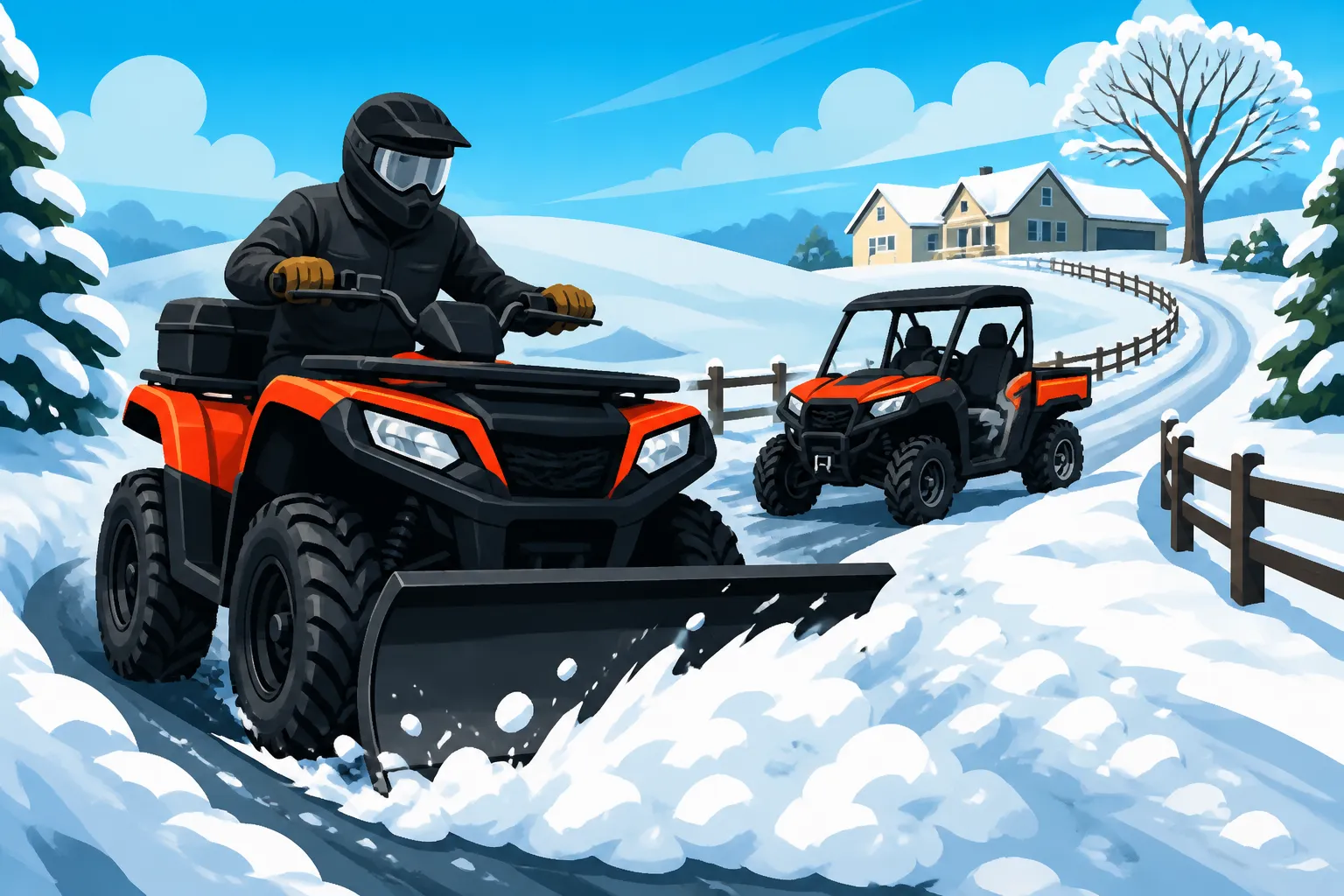
Let's be honest, your ATV or UTV is a workhorse. It's designed to tackle tough terrain, brave the elements, and often comes equipped with (or can easily be fitted for) attachments like plows. When you're staring at a foot of snow that's bringing life to a halt, the idea of hooking up a plow to your side-by-side seems like an elegant solution. These machines offer incredible maneuverability, allowing you to navigate tight turns and clear areas that a large truck might struggle with. They're often started faster, warmed up quicker, and can get to the problem area with less fuss, especially if your neighbor lives just down a shared lane or a short distance away. The sheer capability of these machines makes them incredibly appealing for such a task, turning a challenging chore into a manageable (and maybe even a little fun) operation.
The Community Spirit and Urgent Need
In many parts of Kentucky, especially in our more rural and mountainous regions, neighbors truly depend on one another. When snow isolates an elderly resident, prevents someone from getting to work, or blocks access for essential services, an ATV or UTV owner with a plow can be a real lifesaver. There’s an innate human desire to lend a hand, and when you have the tools to make a real difference, it's hard not to act. The urgency of deep snow can also override initial thoughts about legality or practicality for some, as the immediate need to restore access takes precedence. This is where the challenge lies – balancing that wonderful community spirit with the specific, often restrictive, rules Kentucky has for off-highway vehicles. You want to help, but you absolutely don't want to create a new problem by breaking the law in the process.
Kentucky's Tricky Road Rules: Can You Even Get There?
This is where the rubber meets the snowy road, or more accurately, where your tires can't legally meet the snowy road in most cases. Kentucky's laws regarding ATVs and UTVs on public roads are generally quite strict. It's a common frustration for riders who see their machines as perfectly capable vehicles for short trips or specific tasks, only to find the statutes say otherwise.
The Strict Default: ATVs and UTVs on Public Roads
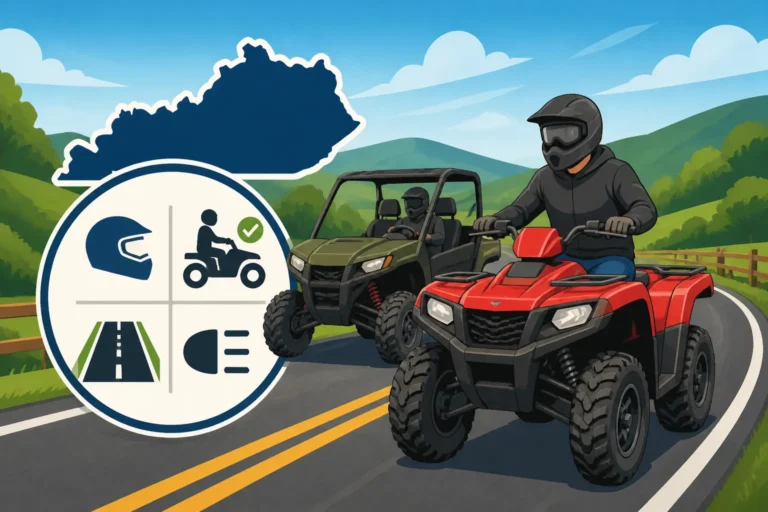
The plain truth in Kentucky is that ATVs and UTVs are classified as off-road vehicles. This means they are generally prohibited from operating on public highways, streets, and rights-of-way. It doesn't matter if the road is covered in snow, if traffic is light, or if you're only going a short distance. The default position of the law is "no." This can be a huge hurdle when your neighbor's lane isn't directly accessible from your property without traversing a public road, even a small county road or a short stretch of blacktop.
Many riders, especially those new to the state or new to ATV ownership, are often surprised by just how restrictive these laws are. It's not like getting into your truck and driving to the next driveway. You could be facing citations for illegal operation, even if your intentions are purely altruistic. This is why understanding [Why Kentucky Roads Are Closed by Default] is so important. Ignorance of the law, even when you're being a good Samaritan, isn't usually a valid defense.
Understanding the 0.2-Mile Crossing Exception
Now, there is a very specific, limited exception that often comes up in these discussions: the 0.2-mile crossing rule. Kentucky law allows ATVs and UTVs to cross a two-lane public highway at a ninety-degree angle, provided the crossing doesn't exceed 0.2 miles. This is not permission to ride on the road, but merely to cross it from one off-road property to another.
Think about it this way: if your property is on one side of a two-lane road and your neighbor's property (with their lane entrance) is directly opposite you, and you can cross in a straight line without traveling down the road, this rule might apply. However, it's a very narrow window.
- It must be a two-lane highway: No four-lane roads, no state routes with more lanes.
- Ninety-degree angle: You can't angle down the road to get to their driveway. It has to be a straight shot across.
- 0.2 miles maximum: That's roughly 1,056 feet. If your neighbor's lane is even a little further down the road, you've exceeded the limit.
- No continuous travel: This rule is strictly for crossing, not for traveling any distance along the road.
As you can see, this exception offers very little leeway for actually reaching a neighbor's lane that's not immediately across the street. For most scenarios where you'd be clearing snow, you'd likely need to travel along a public road, which this exception does not permit. Understanding [0.2 Mile and Not a Yard More] is critical here, as even a slight misjudgment can put you outside the legal bounds.
Does the "Farm Exception" Plow the Way for You?
The "farm exception" is another area that often brings confusion and hope for ATV/UTV owners looking to use their machines for practical tasks, including snow removal. It's a significant carve-out in Kentucky law, but like many exceptions, it comes with specific conditions and interpretations. This is particularly relevant in our state, given its strong agricultural roots.
Defining "Farm Work" Under Kentucky Law
Kentucky law permits ATVs and UTVs to be operated on public roads when used for "bona fide agricultural purposes" or "farm work." This exception is broad in its duration—there's [Why Kentucky's Farm Exception Has No Limit] on how far you can travel if it's truly for farm work—but specific in its purpose. The machine must be directly involved in an activity related to the operation, maintenance, or harvesting of a farm.
Examples of bona fide agricultural purposes often include:
- Hauling feed to livestock.
- Checking fences on property that might be bisected by a road.
- Transporting tools or equipment for field work.
- Moving between different parcels of a single farming operation.
When it comes to snow removal, the key question becomes: Is clearing a neighbor's lane considered "farm work"? If your neighbor's lane leads directly to a working farm where agricultural activities are actively taking place, and clearing that snow is essential for those activities (e.g., getting feed to animals, accessing barns, or moving farm equipment), then you might have a strong argument. For instance, [Hauling Feed Down a Holler Road] in winter would clearly fall under this exception.
However, if your neighbor's lane leads to a residential home with no agricultural activity, or if the "farm" is just a hobby plot, the argument becomes significantly weaker. The law isn't designed to permit general public road use for ATVs, even for helpful tasks, outside of these specific contexts.
The Gray Area of Neighborly Farm Assistance
Here's where it gets murky. What if your neighbor does have a working farm, but you're clearing their lane as a gesture of goodwill, not because you are directly involved in their farming operation? The letter of the law typically applies the exception to the operator using the machine for their farm work, or work they are employed to do on a farm.
Some might interpret "bona fide agricultural purposes" more broadly to include assisting a fellow farmer, especially if it's a mutual exchange of help. However, without a clear, direct link to agricultural production or maintenance on the neighbor's property, you could still be at risk. For instance, Clearing Snow From a Neighbor's Lane for purely residential access, even if the neighbor owns some farmland elsewhere, might not qualify.
The safest approach is to ensure that if you're using the farm exception, the snow removal is demonstrably and directly tied to an active, legitimate agricultural purpose on the property you are accessing. If it's a residential driveway, even if it's next to a field, you're likely stepping outside the bounds of the exception. When in doubt, it's always better to transport your ATV on a trailer to your neighbor's property rather than riding it on public roads.
Practical Considerations and Safe Snow Removal with Your ATV/UTV
Beyond the legal hurdles, using your ATV or UTV for snow removal comes with its own set of practical and safety considerations. Clearing snow, especially deep or wet snow, is demanding work for both rider and machine. Preparing properly can make the difference between a successful, helpful endeavor and a frustrating, even dangerous, experience.
Equipping Your Machine for Winter Battle
To effectively clear snow, your ATV or UTV needs to be properly equipped. A basic machine might handle light dustings, but for serious snow, you'll need some specific gear:
- Plow System: This is the obvious starting point. Look for a durable, heavy-duty plow blade and a robust mounting system. Many manufacturers, like SuperATV, offer a range of plow setups designed for various ATV and UTV models, from straight blades to V-plows, which can be incredibly efficient in different snow conditions. Ensure the plow is easy to attach and detach, and that it has an effective lift mechanism, usually a winch.
- Winch: A powerful winch is almost essential, not just for lifting the plow, but also for self-recovery if you get stuck in a drift. It's a lifesaver when you push too much snow or encounter hidden obstacles.
- Tires: Standard ATV/UTV tires might struggle in deep snow. Consider specialized snow tires or, for the ultimate traction, a track system. Tracks can transform your machine into a snow-going beast, providing flotation and grip that wheels simply can't match. SuperATV is one of many companies offering accessories like plows and tracks that can significantly enhance your machine's winter capabilities.
- Lighting: Snow often falls or needs to be cleared in low light conditions, or even after dark. Ensure your machine has bright, working headlights and taillights. Adding auxiliary LED lights can vastly improve visibility, both for you to see what you're doing and for others to see you.
- Heater/Cab Enclosure (for UTVs): If you're tackling a big job, a cab enclosure with a heater in a UTV can make a world of difference for your comfort and endurance. Frostbite is no joke.
- Warm Clothing: Dress in layers, wear waterproof outer gear, insulated boots, gloves, and a warm hat. Even with a heated cab, you'll be exposed to the cold, especially when getting in and out of the machine.
Safety First: Operating Your Machine in Snowy Conditions
Snow removal isn't just about raw power; it's about careful operation to prevent damage to property or injury to yourself.
- Pre-Clearance Survey: Before you start plowing, walk the entire area you plan to clear. Note any obstacles that might be hidden under the snow: garden hoses, landscaping timbers, decorative rocks, curbs, drain covers, or even uneven pavement. Striking one of these with your plow can cause serious damage to your machine or the property.
- Visibility: Snow can greatly reduce visibility. If it's still snowing heavily, consider waiting for a lull. Ensure your helmet visor (for ATVs) or windshield (for UTVs) is clear. Keep an eye out for pedestrians, children, or pets, especially if they are playing in the snow.
- Plow Slowly and Systematically: Don't try to clear too much snow at once. Take smaller passes, especially with wet, heavy snow. Overloading your machine can strain the engine, transmission, and plow system. Clear snow in manageable sections, pushing it to designated areas where it won't block other access points or future snowfall. Pushing snow downhill is generally easier than uphill.
- Watch for Ice: Snow often hides a layer of ice underneath. Be mindful of traction, especially on slopes or curves. Drive slower and avoid sudden turns or braking.
- Fuel and Maintenance: Ensure your machine is in good working order before heading out. Check oil, coolant, and tire pressure. Always start with a full tank of fuel; you don't want to run out in the middle of a big job in freezing temperatures.
- Personal Safety: Always wear appropriate safety gear, including a helmet, even if you're just on private property. The risk of rollover or impact is still present. Carry a cell phone, tell someone where you're going, and consider carrying a small emergency kit with blankets, a flashlight, and a first-aid kit, especially if you're going to a more isolated location.
By carefully considering both the legal framework and these practical safety tips, you can ensure that your act of neighborly kindness doesn't turn into an unfortunate incident.
Disclaimer
This article is for general informational purposes only and does not constitute professional advice. Laws, prices and regulations vary by location and change over time. Consult a qualified professional for guidance on your specific situation.