Why One Park’s Permit Does Not Travel
A permit bought for one Kentucky riding area can feel like a pass for the whole region, especially when several trail systems sit within one trip. Usually, it is not. Each park or land manager sets its own access terms, so a permit may not work beyond the property or trail system that issued it. Knowing who manages each stop helps prevent a wasted trip or an avoidable citation.
Why a Kentucky trail permit does not automatically transfer
Kentucky does not issue one statewide ATV or UTV trail permit that provides access to every off-road area. Access is controlled by the organization or agency responsible for the particular land. That might be a private park operator, a local authority, or a public land manager. Each can set its own permit requirements, operating rules, closures, and check-in procedures.
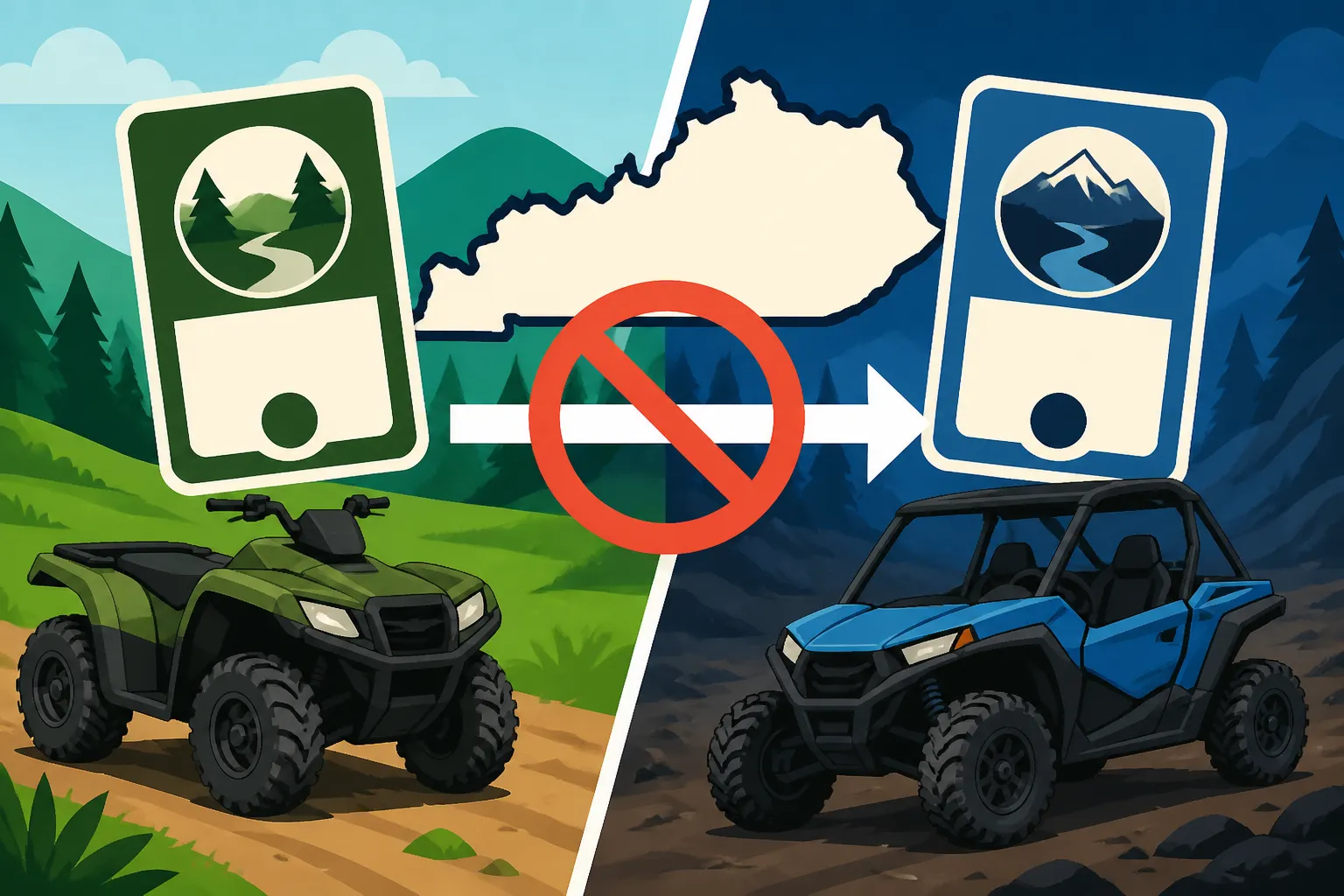
That is why a permit is best understood as permission to use a particular riding area under that area’s terms, not as a transferable credential for the state. A pass from one park generally does not grant access to another park, even if both are in the same county, offer similar trails, or are part of the same weekend itinerary.
The difference matters because trail systems can be close together while having separate owners and operating arrangements. A rider might plan to spend one day at one park and the next day somewhere else, then assume the first permit carries over. Unless the second area explicitly says it accepts that permit, plan on meeting its requirements separately.
A trail permit is also not the same thing as a title, registration, or proof that a machine is legal to operate on a public road. Those are separate questions. For an overview of the distinction between permits and statewide requirements, see Kentucky Trail Permits Explained and Why Kentucky Has No Statewide Trail Sticker. For public-road rules, a park permit does not replace the requirements explained in Kentucky Rules for ATVs on Public Roads.
In practice, the key question is not simply, “Do I have a permit?” It is: “Does this land manager accept this permit for this machine, this rider, and this riding area, on the date I plan to visit?”
What permits cover at different Kentucky riding areas
The details vary. One area may charge or issue access by machine, another may have conditions tied to each rider, and a public-land pass may have a different scope from a private park permit. The table below is a planning aid, not a substitute for checking each operator’s current instructions.
| Riding area or permit type | What to expect | What not to assume |
|---|---|---|
| Black Mountain Off-Road Adventure Area | A permit is associated with riding at Black Mountain under the area’s rules. Check the current purchase and display instructions before arrival. | That it covers Leatherwood, Rush Off-Road, or another nearby system. |
| Leatherwood Off-Road Park | Check how the park handles permits for riders and passengers, and confirm which trails and services are included. | That a permit bought at another park is accepted at Leatherwood. |
| Turkey Bay OHV Area | Follow the current permit and access instructions for Turkey Bay and its designated riding area. | That a Turkey Bay permit grants access to other Land Between the Lakes facilities or other Kentucky parks. |
| Daniel Boone National Forest OHV pass | Confirm which designated trails and riding areas the pass applies to, and whether separate site rules also apply. | That a forest pass covers private parks or all roads and trails in the forest. |
| Other private or local trail systems | Ask the operator or land manager which permit is required and what access it provides. | That a county location, shared trail name, or nearby entrance means the same permit applies. |
The names in the table do not imply that all areas use the same permit structure. The terms can differ in whether a permit is attached to a machine, a person, a date range, or a particular riding area. Check details directly before you buy or travel. For the individual systems, see How the Turkey Bay OHV Permit Works, Buying and Using the Daniel Boone Forest OHV Pass, and Black Mountain Permit Cost.
Private parks and public riding areas are not interchangeable
A privately operated park sets terms for its own property. A public-land manager sets requirements for the designated riding opportunities it administers. A pass for one type of land does not normally substitute for the other. For example, a pass associated with a national forest does not automatically authorize riding at a private park, and a private park permit does not grant general permission to ride public land.
Even within a large public area, the pass may apply only to designated OHV trails or specific facilities. It should not be treated as permission to ride anywhere that looks like a road or open track. Verify the allowed routes, closures, vehicle restrictions, and other conditions with the land manager. Kentucky Rules for Riding a National Forest and Kentucky Rules on Land Between the Lakes explain why the location and applicable rules matter.
A permit may have rider or vehicle conditions
Some permits are issued or administered in a way that takes account of the rider as well as the machine. If a passenger is riding, do not assume the driver’s permit covers that person. If a group brings several machines, do not assume one permit covers the entire group. Confirm what the operator requires for each rider, passenger, and vehicle before completing the purchase.
Likewise, a permit does not guarantee that every vehicle can use every trail. Width limits, machine type, trail closures, and other restrictions may apply. A large side-by-side might be allowed on some routes but not others. A permit is permission subject to the area’s rules, not blanket access to every trail on the property.
How to plan a trip that visits more than one area
A multi-park trip is easier to organize if you treat each riding area as a separate stop with its own access check. Do not rely on a pass from the first destination to solve the paperwork for the next one.
-
Write down every riding area on the itinerary. Use the name of the actual park or managed area, not just the town or region. Nearby trail systems can have different owners, entrances, and permit arrangements.
-
Identify who manages each place. Check whether the land is operated by a private park, a public agency, or another authority. Contact the manager responsible for the specific trails you intend to ride.
-
Ask what permit applies to each person and machine. Be clear about passengers, multiple vehicles, rented machines, and the dates you plan to ride. Ask whether a permit must be purchased in advance or in person, and what proof you need to carry.
-
Confirm the permit’s limits. Ask which trails it covers, whether it is valid for one visit or a defined period, and whether it works at any other location. If the answer does not explicitly say that another area accepts it, plan to get that area’s own permit.
-
Check operating conditions close to departure. A valid permit does not override a closure or temporary restriction. Weather, saturated ground, maintenance, seasonal schedules, or other conditions can affect access. Review Kentucky Trail Conditions Before You Ride and Kentucky Trail Closures to Check First when planning.
-
Keep confirmation and permit details accessible. Follow the area’s instructions on whether you need a printed document, a physical permit, a receipt, or another form of proof. Do not assume a phone screenshot is enough if the operator requires a different form.
This approach is especially useful when a trip crosses between eastern Kentucky parks or combines a private park with a public-land riding area. A route through the same region does not make the land-management rules the same. The trip can still be straightforward: just budget time and money for the access process at each location.
Check the whole group, not only the lead rider
A common planning mistake is to check the permit only for the person driving the lead machine. Ask about every participant. This includes passengers, children, and anyone operating a separate machine. The rules for who must hold a permit can vary by site, so a family or group should not infer coverage from how another park handled permits.
If someone in the group is renting, ask both the rental company and the trail operator who handles the permit. A rental may include some access arrangements, but that is not automatic. Confirm whether the rental covers the relevant park, whether it covers each rider or passenger, and whether anything must be arranged separately. Which Rentals Include the Park Permit in the Price and Does a Rental Cover a Passenger Permit? are useful questions to raise before booking.
Common assumptions that cause permit problems
“The parks are close, so the same pass should work”
Proximity does not establish reciprocity. A park permit is not necessarily valid at another location just because the areas share a county, a road, or a tourism region. Only rely on cross-acceptance when the receiving land manager clearly confirms it.
“A permit lasts for the whole trip”
A permit may have a defined validity period or may apply only to a particular visit or place. Even if its dates cover the whole trip, that does not mean its geographic coverage does. Check both: when the permit is valid and where it is accepted.
“A state document means I can ride any trail”
A title or other ownership document can help establish that a machine belongs to you, but it does not grant access to a trail system. Similarly, a park permit does not title the vehicle or authorize it on public roads. Keep those issues separate when preparing for a ride.
If the machine’s paperwork is unclear, start with Proving Kentucky ATV Ownership. If you are unsure whether a particular riding area requires its own authorization, contact that area’s manager rather than treating vehicle paperwork as a substitute.
“A neighboring park will honor the first park’s permit”
Do not assume one operator will honor another operator’s pass. A park may have its own entry process, permit type, waiver, rules, or check-in requirements. Even when two areas cooperate in some way, confirm the exact arrangement and its limits before relying on it.
“I can sort it out at the gate”
Sometimes a permit can be purchased on arrival; sometimes the process or hours make that inconvenient, and access may be limited by capacity or conditions. Before loading the trailer, confirm where and when permits are sold, whether the office or gate is open, and whether advance arrangements are needed. Calling a Kentucky Park Before You Load can help avoid a long drive to a closed entrance or an unavailable permit.
If you arrive without the right authorization, do not ride first and ask later. Stop at the designated office or contact the responsible manager. Riding without a required permit can lead to being turned away or cited, depending on the applicable rules. A different park’s permit is unlikely to solve the issue unless the site has confirmed that it accepts it.
A reliable way to think about reciprocity
For Kentucky ATV and UTV trips, assume permits are site-specific unless the receiving park or land manager says otherwise. The agency or operator that issued a permit decides what access it grants; a separate land manager does not have to honor it. That simple assumption makes trip planning more reliable than trying to infer reciprocity from distance, branding, or a shared county.
Before each ride, confirm four things: the exact area covered, who in your group needs a permit, which machines are allowed, and whether the trails are open. Keep the answers for every destination separate. If the trip includes two parks, verify two sets of requirements. If it includes a public riding area and a private park, verify each separately.
This does not mean every visit requires complicated paperwork. It means a permit should be treated as an access agreement with a specific manager, not as a statewide pass. Ask the operator directly if you are unsure, and check again if your itinerary, group, or riding date changes. That small check is far easier than discovering at the trailhead that your permit does not travel.
Disclaimer
This article is for general informational purposes only and does not constitute professional advice. Laws, prices and regulations vary by location and change over time. Consult a qualified professional for guidance on your specific situation.