Proving Kentucky ATV Ownership
The frustration of owning an ATV in Kentucky, only to find yourself struggling to prove it’s actually yours, is incredibly common. Maybe you bought it years ago before the state started titling them, or perhaps you inherited it, and the paperwork is a mess. Whatever your situation, navigating the nuances of proving ownership can feel like an uphill climb, especially with Kentucky's specific rules. This comprehensive guide is here to unravel the complexities, offering clear steps and insights into how you can firmly establish and prove your ATV ownership in the Bluegrass State, saving you headaches down the line.
The Cornerstone: Your Kentucky ATV Title
When it comes to proving ATV ownership in Kentucky, a clear, valid title is almost always the gold standard. It’s the official document that the state issues, declaring legal ownership, and for many machines, it's an absolute requirement.
When a Title is Your Best Bet for Proof
If your ATV was purchased after July 2010, the expectation is that it came with a Kentucky title. This is because [Why Kentucky Titles Machines Bought After July 2010] became law, requiring all new ATVs sold by dealers and many private sales to be titled. When you buy a used machine that already has a Kentucky title, the previous owner should sign it over directly to you. This signed-over title, along with your valid photo identification, is usually all you need to present to your local county clerk's office to initiate the transfer into your name. It’s a straightforward process that establishes an undeniable paper trail of ownership, linking you directly to the machine in the state's official records. This legal document is a clear declaration, recognized by law enforcement, insurance companies, and future buyers, making it the most robust form of proof you can possess.
What to Do If Your Kentucky Title is Missing
It happens to the best of us: you buy a machine, maybe even title it, and then the physical title document vanishes. Perhaps it got lost in a move, damaged, or simply misplaced. Don't panic. If your ATV was previously titled in Kentucky, you can obtain a duplicate title. This process generally involves visiting your local county clerk's office, filling out the necessary forms, and paying a fee. It’s essentially asking the state to re-issue official proof that you are, in fact, the owner on record. While you’re waiting for the duplicate to arrive, which can take some time, the clerk can often provide you with a temporary receipt or a printout from their system that confirms your ownership is being processed. This can serve as interim proof if you need to quickly show that the machine belongs to you, perhaps for transport or for an insurance query. For more details, refer to [Replacing a Lost Kentucky ATV Title] and [Ordering a Duplicate at the Clerk].
Navigating Older Machines Without a Title
Kentucky's titling law for ATVs only came into effect in July 2010. This means that if you own a machine bought before that date, it's very likely it never received an official state title. This can be a source of significant confusion and frustration for owners. For these older machines, often referred to in Kentucky as pre-July 2010 machines, establishing ownership requires a different approach. The county clerk's office won't have a title record for these vehicles, and therefore, you can't just apply for a duplicate. However, there are exceptions. If an older machine had a lien placed on it at the time of purchase, a title would have been issued to document that security interest, even before the 2010 law. In such cases, the lender would hold the title until the loan was paid off, and then it would be released to the owner. Understanding these nuances is crucial for owners of [Machines Bought Before July 2010 in Kentucky] to know what kind of paperwork to gather.
Building Your Case: Alternative Proofs of Ownership
For ATVs without a clear title, or when buying privately, relying on other documents becomes essential. These alternative proofs can help establish a chain of custody and bolster your claim of ownership.
The Power of a Comprehensive Bill of Sale
A well-drafted bill of sale is incredibly important, especially for those older machines that predate Kentucky's titling requirement or for any private sale where an official title transfer isn't happening immediately. It serves as a contract between the buyer and seller, detailing the transaction and identifying the machine. A truly comprehensive bill of sale should include the full names and addresses of both parties, the date of sale, the purchase price, and a detailed description of the ATV, including its make, model, year, and crucially, its full 17-character Vehicle Identification Number (VIN). The absence of a VIN or a truncated one can cause issues down the line. Both the buyer and seller should sign and date the document, and ideally, it should be notarized for added legal weight, although notarization isn't always strictly required by the state for ownership purposes. If you're looking for a reliable template to ensure all the necessary information is captured, resources like LawDepot offer customizable bill of sale forms that can be tailored to your specific transaction. This helps prevent misunderstandings and provides a solid record for both parties. [A Kentucky Bill of Sale for an ATV] is an essential piece of this puzzle.
Out-of-State Documents and Kentucky Expectations
Sometimes, you might buy an ATV from a neighboring state that has different titling or registration laws than Kentucky. Some states, for instance, don't issue titles for ATVs at all, or they might only issue a registration certificate. When bringing such a machine into Kentucky, proving ownership requires understanding what the Kentucky county clerk will accept. If you purchased the ATV from a non-titling state, a detailed bill of sale, often accompanied by the previous owner's out-of-state registration card or a manufacturer's certificate of origin, can be used as proof. The clerk will closely examine these documents to ensure they are legitimate and contain all the pertinent information, especially the full VIN. It's crucial to ensure that the bill of sale clearly states that the selling state does not issue titles for ATVs, which can be confirmed by an official statement or by demonstrating common practice in that state. Using a strong, detailed bill of sale, perhaps drafted with the assistance of a reputable service like LawDepot, can be immensely helpful in these cross-state transactions. For more on this, see [Using a Bill of Sale From a Non-Titling State] and [An Out-of-State Registration as Kentucky Proof].
Supplementary Evidence: Receipts and Affidavits
While a title or a robust bill of sale are the primary forms of ownership proof, other documents can provide supplementary evidence, especially in situations where the main documents are less clear or entirely absent. For example, old purchase receipts, cancelled checks showing payment to a previous owner, or even bank statements indicating a transfer of funds for the ATV can all help create a paper trail. In situations where original documents are lost and a new one cannot be readily generated, a notarized affidavit of ownership can sometimes be accepted. This is a sworn statement, signed in front of a notary public, where you declare under oath that you are the rightful owner of the ATV, providing all known details about its acquisition. While these supplementary documents might not stand alone as irrefutable proof, they can significantly strengthen your case when presented alongside other forms of evidence, painting a more complete picture of the machine's ownership history. Combining these pieces of evidence can be particularly important when trying to [Titling an ATV in Kentucky] that has an unclear past.
Special Circumstances: Inheritance, Gifts, and Liens
Life throws curveballs, and sometimes an ATV comes into your possession through less conventional means than a direct purchase. Whether it's a family heirloom or a machine with a financial history, specific documentation is required to establish your rightful ownership.
Proving Ownership for an Inherited ATV
Inheriting an ATV can be a wonderful, albeit sometimes complicated, experience. When an ATV is part of an estate, proving your ownership to the Kentucky county clerk typically requires a specific set of documents that confirm your legal right to the asset. This usually includes a copy of the deceased owner's will, if one exists, clearly indicating that the ATV is bequeathed to you. If there is no will, or if the will does not explicitly mention the ATV, you'll need official probate court documents, such as letters of administration or an affidavit of heirship, which legally designate you as the rightful inheritor of the estate's assets. An executor or administrator of the estate will also need to sign any necessary transfer documents, effectively releasing the ATV from the estate to you. This process ensures that the transfer of ownership is legally sound and prevents any future disputes among heirs. For more detailed steps, refer to [Titling an Inherited Machine in Kentucky].
Documenting a Gifted ATV
Receiving an ATV as a gift might seem simple, but even a gift requires proper documentation to establish legal ownership in Kentucky. You can't just show up at the clerk's office saying "it was a gift." The most common way to document a gifted ATV is through a gift affidavit or a bill of sale that specifies a "zero-dollar" transaction. This document should clearly state that the ATV is being transferred as a gift, including the full names and addresses of both the giver and the recipient, the date of the gift, and a detailed description of the ATV, including its VIN. Both parties should sign this document, and having it notarized adds a significant layer of authenticity and legal weight. This establishes a clear paper trail of the ownership transfer, making it easier for you to title the machine in your name and prove that it was not merely lent to you. Reputable legal document services, such as LawDepot, can provide templates for gift affidavits that ensure all necessary legal requirements are met.
Navigating Liens and Security Interests
An ATV that has been used as collateral for a loan will have a lien or security interest noted on its title. This means that while you might possess the machine, the lender technically has a legal claim to it until the loan is fully repaid. Proving full, unencumbered ownership of such an ATV in Kentucky requires more than just the title itself; you need documentation that confirms the lien has been satisfied. The most crucial document here is a [Kentucky ATV Lien Release] from the financial institution that held the lien. This is an official statement, often stamped and signed, indicating that the loan has been paid in full and the lender no longer has any claim on the ATV. Without this release, even if you have the physical title, the county clerk will not transfer ownership solely into your name. If you are buying a machine with an existing lien, it is absolutely critical to ensure the seller provides this release at the time of sale, or that arrangements are made to obtain it directly from the lender. For those dealing with existing liens, [Titling a Machine With a Lien in Kentucky] provides further guidance.
The County Clerk's Scrutiny: What They Need to See
When you finally walk into the county clerk's office to title your ATV or formally prove ownership, the process isn't just a rubber stamp. The clerks are tasked with ensuring everything is in order, and they have specific criteria they look for to validate your claim.
The All-Important VIN and ID Verification
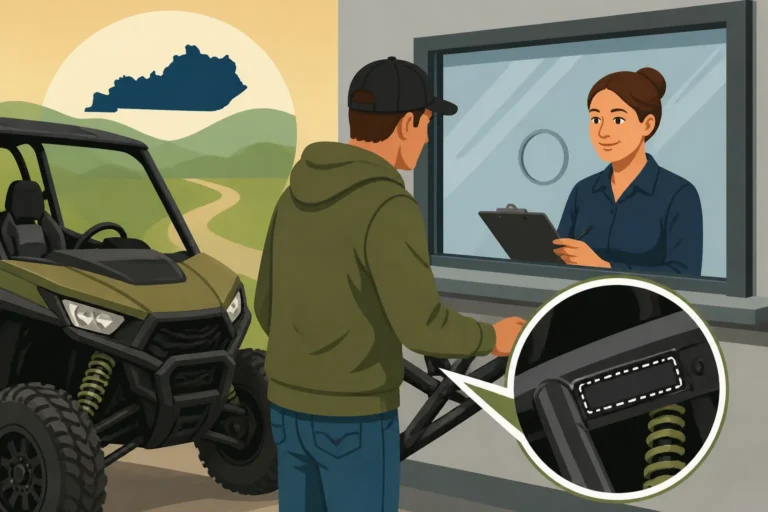
At the core of proving ownership for any vehicle, including an ATV, is its unique Vehicle Identification Number (VIN). Kentucky law specifically requires a 17-character VIN for titling purposes, as outlined in [Kentucky's Seventeen-Character VIN Rule]. This VIN must be clearly visible on the ATV's frame and must match exactly on all your submitted documentation – the title, bill of sale, or any other proof. A short VIN, one that's missing characters, or one that appears to have been tampered with, will immediately raise red flags and likely result in your application being rejected. Furthermore, the county clerk will require your physical presence and a valid [A Kentucky Photo ID at the Clerk's Counter] to confirm your identity. They need to ensure that the person applying for the title transfer is indeed the individual named on the ownership documents. This dual verification – matching the machine to its documents and matching you to your identity – is a critical step in preventing fraud and ensuring legitimate ownership. It's also important to understand that engine numbers, while unique to the engine, are not acceptable as primary identifiers for titling. For a clearer understanding of this, see [Why a Kentucky Clerk Rejects an Engine Number].
Avoiding Common Pitfalls at the Counter
Dealing with official paperwork can be daunting, and it's easy to overlook a small detail that could cause a big delay. One of the most common reasons a county clerk might reject your ownership proof is incomplete paperwork. This could mean a missing signature on the bill of sale, an un-notarized affidavit when one is required, or a lien release that hasn't been properly filled out by the lender. Another significant pitfall is having discrepancies in the information across different documents, such as a slightly different spelling of a name or an incorrect VIN. The clerk is looking for consistency and accuracy. To avoid these issues, it's always a good idea to thoroughly review all your documents before you head to the clerk's office. Make a checklist of everything you need, and double-check every name, date, and number. If you have any doubts about what's required, call your county clerk's office beforehand. They can often clarify specific requirements and save you a return trip. Taking the time to prepare your [Kentucky ATV Title Paperwork] meticulously can prevent significant frustration.
The Role of Timeliness and Completeness
Kentucky has a relatively strict timeline for titling a newly acquired ATV: you generally have [Kentucky's Fifteen-Day Titling Deadline] from the date of purchase. While this might seem like ample time, unforeseen delays can quickly eat into that window. Submitting a complete and accurate packet of documents within this timeframe is crucial. When you present all the necessary papers – the signed-over title (if applicable), a comprehensive bill of sale, proof of identity, and any other supporting documentation – the clerk can process your request efficiently. Conversely, missing documents, unsigned forms, or errors will lead to delays, potentially pushing you past the deadline and creating additional complications. It shows the clerk you are serious and organized, and it allows them to move forward with the titling process without needing to chase down missing information or verify unclear details. A complete package makes their job easier and ensures your ownership is officially recorded promptly.
Here's a quick overview of common ownership documents and their typical use:
| Document Type | Primary Use Case | Key Information Required | Strength as Proof |
|---|---|---|---|
| Kentucky ATV Title | Primary proof for machines titled post-2010 | Owner name, VIN, make, model, year, lien details | Highest |
| Bill of Sale | Private sales, pre-2010 machines, non-titling states | Buyer/seller info, VIN, price, date, machine details | High (especially if notarized) |
| Manufacturer's Cert. of Origin | New machines, never titled | Original owner, VIN, make, model, year, specs | High (first titling) |
| Out-of-State Registration | Machines from non-titling states | Owner name, VIN, registration period | Medium (supplementary) |
| Lien Release Document | Proving loan satisfaction on titled machines | Lender info, VIN, confirmation of payment | Essential (with title) |
| Notarized Affidavit | Lost documents, unusual ownership transfers | Declarant name, VIN, ownership history, circumstances | Medium (supplementary) |
| Will/Probate Documents | Inherited machines | Estate details, beneficiary, machine description | High (for inherited) |
Why Solid Ownership Proof is Non-Negotiable in Kentucky
Having clear, verifiable proof of ATV ownership in Kentucky isn't just about satisfying a bureaucratic requirement; it's about protecting your investment, avoiding legal complications, and ensuring peace of mind every time you hit the trails.
Safeguarding Against Legal Troubles and Theft
Operating an ATV without proper proof of ownership in Kentucky can lead to a host of legal troubles. If you're stopped by law enforcement on public roads (even for permitted crossings) or even at a trail park, and you can't readily demonstrate that the ATV belongs to you, you could face questions, delays, and potentially even fines. In the worst-case scenario, if the machine has a convoluted history or a VIN that appears altered, it could be impounded while its true ownership is investigated. Imagine the frustration of [Getting Ticketed at Black Mountain for an Untitled Quad] simply because you couldn't prove it was yours. Beyond legal enforcement, having clear documentation is your strongest defense against theft. If your ATV is stolen, providing police with a title or comprehensive bill of sale, complete with the VIN, is crucial for tracking it down and proving your claim when it's recovered. Without this, proving the machine is yours can become an incredibly difficult and prolonged process, often resulting in permanent loss.
Ensuring Smooth Resale and Future Transfers
Sooner or later, you might decide to sell your ATV or pass it on to a family member. When that time comes, having impeccable proof of ownership will make the process infinitely smoother and more attractive to potential buyers. Buyers are, rightly, wary of purchasing an ATV without a clear title or other verifiable ownership documents. A clean title or a detailed, properly executed bill of sale inspires confidence, ensuring the buyer knows they're getting a legitimate machine and won't face their own ownership issues down the road. It also helps maintain the machine's resale value; an ATV with a clear paper trail is always worth more than one with questionable or missing documents. Trying to sell a machine without proper paperwork can severely limit your market, forcing you to accept a lower price or making the sale impossible. For anyone looking to buy a used machine, it's paramount to be diligent and know [Reading a Kentucky Title Before You Pay] to avoid inheriting someone else's ownership headaches.
Peace of Mind for the Kentucky Rider
Ultimately, having solid proof of ownership for your ATV brings an invaluable sense of peace of mind. You'll know that your investment is secure, your legal standing is clear, and you won't encounter unexpected roadblocks when interacting with law enforcement, insurance companies, or future buyers. This allows you to focus on what matters most: enjoying the incredible riding opportunities that Kentucky offers, from the winding trails of Black Mountain to the expansive terrain of Leatherwood. Whether you're navigating the process of titling an older machine or ensuring all your documents are in order for a new purchase, resources like LawDepot can assist in generating accurate and legally sound documents, further solidifying your ownership. Knowing that your ATV is officially yours, recognized by the state, means you can ride with confidence and without the nagging worry of potential disputes or complications.
Disclaimer
This article is for general informational purposes only and does not constitute professional advice. Laws, prices and regulations vary by location and change over time. Consult a qualified professional for guidance on your specific situation.