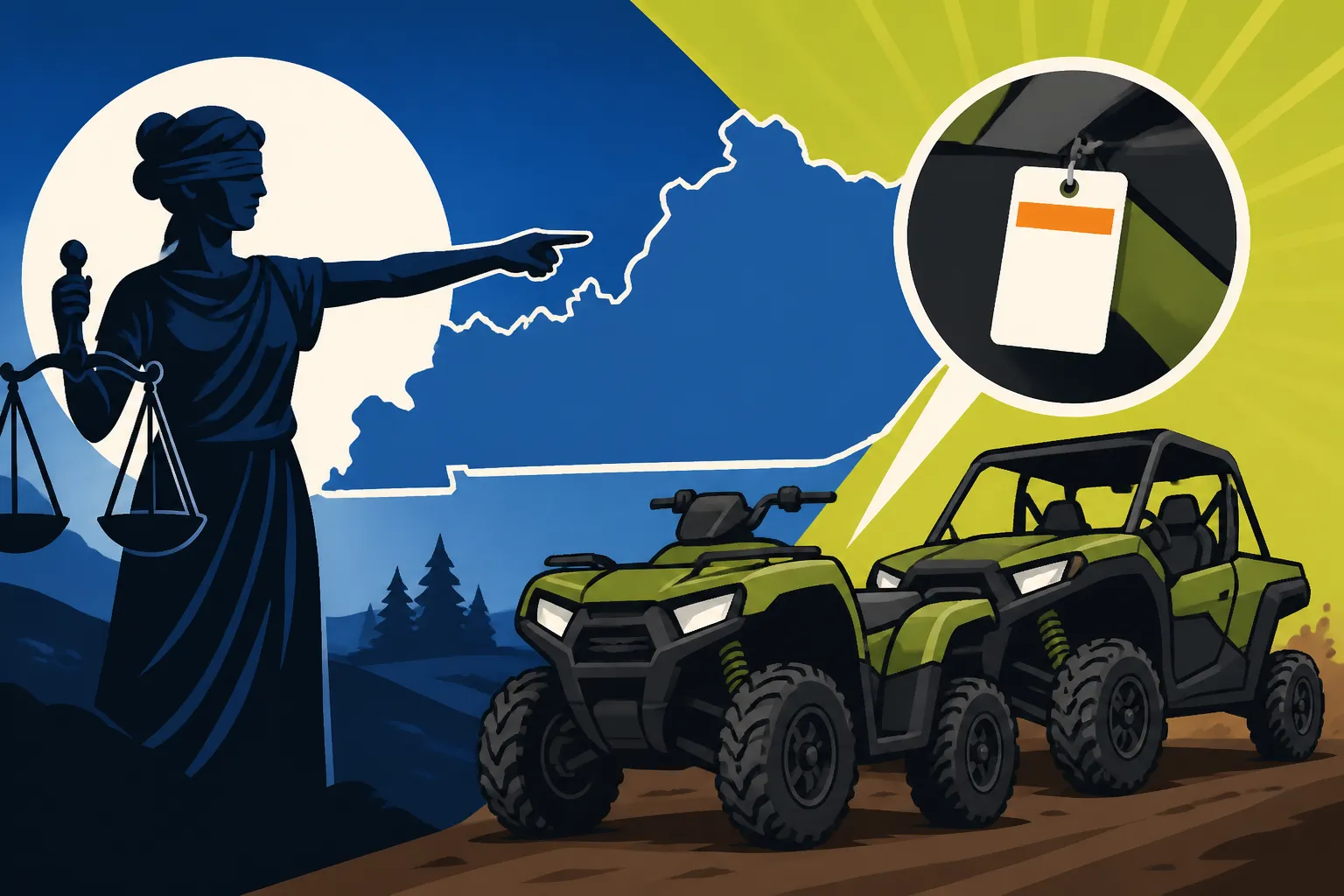
Why the Statute Points at the Label
A warning label on an ATV can look like routine product information, but in Kentucky it has legal weight. Parents and guardians may not knowingly let a child ride in violation of the machine’s age warning, and removing the required label is unlawful. Understanding why the statute relies on that warning helps families choose an appropriate machine and avoid treating the label as optional.
Why Kentucky law points to the manufacturer’s label
ATVs are not all alike. A small youth model and a larger adult machine can differ in size, controls, power, and handling. A single age rule for every machine would not reflect those differences. Kentucky law instead uses the age-restriction warning attached to the particular ATV as a legal boundary for minors.
The Legislative Research Commission says parents and guardians may not knowingly allow a minor under sixteen to operate an ATV contrary to the manufacturer’s age-restriction warning label. The law also makes it unlawful for anyone to remove the required warning labels. In practical terms, the label is not just advice from the manufacturer: Kentucky law gives it a role in deciding whether a young rider may use that machine.
That approach makes the rule specific to the vehicle. A child’s age alone does not answer whether a particular ATV is appropriate under the statute. The machine’s own warning matters too. If its label restricts use to riders above the child’s age, a parent or guardian should not allow the child to ride it.
There is also a separate minimum-age prohibition. The Legislative Research Commission says children under six are strictly prohibited from operating an ATV. That rule applies independently of the manufacturer’s label: a label cannot authorize a child under six to ride.
| Question | What the rule means |
|---|---|
| What does the label do? | It supplies the manufacturer’s age restriction for that specific ATV, which Kentucky law uses when regulating minors’ operation. |
| Can a parent let a minor ride despite a higher age on the label? | No. The Legislative Research Commission says parents and guardians may not knowingly allow a minor under sixteen to ride contrary to the warning. |
| Can someone remove the label? | No. The Legislative Research Commission says removing required warning labels is unlawful. |
| Is there an age floor separate from the label? | Yes. The Legislative Research Commission says children under six may not operate an ATV. |
The label-based rule also helps clarify who has a responsibility. It does not place the entire burden on a child to interpret the warning or decide whether to ride. The law specifically addresses parents and guardians who knowingly allow a minor under sixteen to operate contrary to the label. That makes checking the machine part of an adult’s decision before handing over the controls.
For a closer look at the practical meaning of the warning, see Reading a Manufacturer’s Age Label. The label may be easy to overlook when buying a used machine, but it should be checked before a child rides, not after a disagreement about what the warning said.
How to read and use the warning
Look for the manufacturer’s required warning label on the ATV and read the age restriction on the actual machine. Do not assume that a similar-looking ATV has the same restriction. Models can differ, and the relevant warning is the one attached to the vehicle the child would operate.
When reviewing it, make sure the text is readable and appears to be the required label rather than an informal note or a sticker added by a previous owner. If it is damaged, missing, obscured, or difficult to understand, do not guess at the restriction. Ask the manufacturer or a qualified dealer how to identify the correct warning for that model. Do not remove the label or treat an aftermarket replacement as legally sufficient without confirmation.
A careful check is especially useful when buying a used ATV. A seller’s description, a child’s riding experience, or a claim that the machine is “small” does not replace the age warning. If the label is missing, that is a reason to pause and resolve the issue before allowing a minor to ride. It is also a useful point to inspect when assessing a machine’s condition and paperwork; Buying a Used ATV in Kentucky covers other checks to make before completing a purchase.
A practical pre-ride process can keep the rule from becoming an afterthought:
- Find and read the age-restriction warning on the ATV itself.
- Compare the warning with the age of the intended rider.
- If the warning excludes that rider, do not allow the ride, even if the child has ridden other machines.
- If the label is absent or unreadable, get reliable guidance on the correct warning rather than guessing or removing what remains.
- Check any separate riding-area rules before setting out.
The label is not a substitute for adult judgment. A child who falls within the label’s age range may still lack the size, coordination, attention, or experience needed to operate safely. The label sets a limit; it does not guarantee that a child is ready to ride.
Nor does a parent’s permission override the warning. If the label sets an age restriction that excludes a minor, allowing that child to operate anyway conflicts with the rule described by the Legislative Research Commission. For more on the adult’s role, see Kentucky Parental Supervision Rules Explained and Kentucky Rules for a Rider Under 16.
What parents and guardians should avoid
The most important mistake is treating the warning as a suggestion that can be set aside after a child has gained experience. Kentucky law connects the manufacturer’s age restriction to the legal responsibility of parents and guardians. A child’s confidence, previous rides, or ability to reach the controls does not erase the label.
Another mistake is relying on the label from a different ATV. A family may own several machines or borrow one from a relative, and the warnings may not match. Check each machine separately. The controlling question is not simply whether the child has ridden an ATV before, but whether the child may operate this specific ATV under its warning and the applicable law.
Do not try to make a machine seem compliant by peeling off a warning, covering it, or swapping it for a different sticker. The Legislative Research Commission says removing required warning labels is unlawful. The label is tied to the machine, so keeping it intact helps preserve information needed by later owners and riders as well as the person currently making the riding decision. See Removing a Label and Breaking the Law for more on that issue.
A label also should not be confused with a general age recommendation found in an advertisement, online listing, or conversation with a seller. Ask to inspect the actual warning before purchase. If a used ATV has no visible label, do not accept “the last owner took it off” as a reason to ignore the problem. The safe, practical response is to verify what label applies and whether it can be properly restored before a minor operates the vehicle.
The under-six prohibition deserves particular care because it is not a question that can be settled by finding a more permissive label. The Legislative Research Commission says a child under six is prohibited from operating an ATV. Separately, for minors under sixteen, parents and guardians must follow the manufacturer’s age restriction. These rules work together: the statutory age floor is one limit, and the machine-specific warning may impose a stricter one.
The safest approach is therefore to apply whichever restriction prevents the ride. If the child is below the legal minimum, the answer is no. If the child is old enough to meet that minimum but falls below the age printed on the machine, the answer is still no. If the child meets both, adults still need to assess whether the machine and riding conditions are suitable.
The label is one rule, not the whole permit or safety picture
The manufacturer’s label addresses who may operate a particular ATV. It does not function as a trail permit, title, registration, safety course, or general authorization to ride wherever the machine can travel. Each requirement serves a different purpose, so satisfying the label rule does not automatically satisfy other rules.
For example, the Kentucky Transportation Cabinet says ATVs purchased on or after July 1, 2010, must be titled, with the title application submitted within 15 days of purchase. The Cabinet also says an ATV intended for public-road operation must be registered. Those ownership and road-use requirements are separate from the age warning. For the paperwork side, see Titling an ATV in Kentucky.
Likewise, public-land access can involve a separate pass. The USDA Forest Service says an official off-highway vehicle recreation pass sticker or rider wristband must be displayed or worn for operation on specific public lands such as the Daniel Boone National Forest. An ATV title does not replace that access requirement, and an age label does not either. Kentucky Trail Permits Explained gives a broader overview of the difference between park or land passes and state paperwork.
Other equipment and operating rules may apply depending on where and how the machine is used. For instance, the Legislative Research Commission says an off-highway vehicle on covered public off-highway vehicle trail systems must have a spark arrestor. And if a trip involves a public roadway, rules may differ from those for off-road riding. The age label is important, but it is only one part of planning a lawful ride.
Safety education can help a young rider build skills, but a course or an adult’s supervision does not cancel a manufacturer’s age restriction. The U.S. Consumer Product Safety Commission references Kentucky’s ATV safety program through state resources compiled under the state’s transportation administration. That is a separate safety resource, not permission to disregard the label. For context, see Why Kentucky Uses No Rider Certificate and Does Kentucky Require an ATV Safety Course?.
A useful decision sequence is to check the machine’s warning first, then confirm that the rider is legally eligible, and then review the rules for the specific riding area. If the label excludes the child, stop there: a permit, safety course, or experienced adult cannot make that ATV appropriate under the age-label rule. If the label allows the rider, continue checking supervision, equipment, access permissions, and any location-specific restrictions before riding.
For families, this division of responsibilities is straightforward. The label helps answer whether a minor may operate that ATV. State and land-manager rules address other matters, such as title, roadway operation, equipment, and access. Keeping those questions separate makes it less likely that a family mistakes one piece of permission for permission to ride everywhere.
Sources
- Legislative Research Commission — Kentucky Revised Statutes § 189.281 (checked November 2, 2026)
- Kentucky Transportation Cabinet — Vehicle Titling – Drive KY (checked November 2, 2026)
- Legislative Research Commission — 189.515 Restrictions on operation of all-terrain vehicles (checked November 2, 2026)
Disclaimer
This article is for general informational purposes only and does not constitute professional advice. Laws, prices and regulations vary by location and change over time. Consult a qualified professional for guidance on your specific situation.