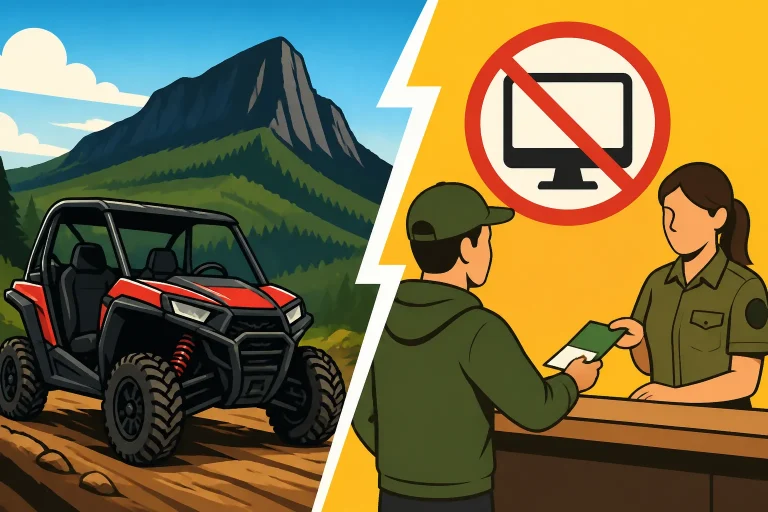
Who Holds Riding Rights on Leased Coal Land
A coal company’s name on a gate or map does not always tell you who can authorize ATV or UTV riding. In Kentucky, riding rights on leased coal land depend on the land’s ownership, the lease terms, and any permission granted by the person or organization that controls access. Knowing whom to ask can prevent a costly mistake before you unload.
Who controls riding access on leased coal land
“Leased coal land” can describe several different arrangements. A company may own the land, lease mineral rights beneath someone else’s property, lease surface rights, or operate under an agreement that grants it access for mining. Those arrangements do not all give the same person control over recreational riding.
The key question is not simply who mines the coal. It is who has authority over the surface where you plan to ride and whether that authority includes permission for recreation. Surface ownership and mineral rights may be separate. A coal lease can give a company rights related to mining without making every part of the property an open riding area.
That distinction matters because an ATV or UTV travels on the surface. Permission to ride may come from the surface owner, a leaseholder with authority to manage access, a land manager, or an authorized trail operator. The answer depends on the property documents and the arrangements in place. A company logo, mine sign, unlocked gate, or visible trail is not enough by itself to establish that you may ride there.
| Situation | Who may control access | What to confirm |
|---|---|---|
| A company owns the surface | The company or its authorized manager | Whether recreation is allowed and where |
| A landowner owns the surface and a company leases minerals | The surface owner may control ordinary access, subject to lease rights | Whether mining agreements affect the route or access |
| A company leases or manages the surface | The company or person authorized under the lease | Whether the lease permits recreational use or delegation |
| A trail park operates on leased property | The park operator may manage designated routes under its agreement | Which trails are open, what permit is required, and where the permit applies |
| A road crosses leased or privately managed land | The owner, operator, or another authorized party may control access | Whether riders may use that specific road, not just pass nearby |
This is a practical framework, not a way to interpret a particular lease. The actual documents and any current access rules determine who can grant permission. If the surface owner and coal operator are different parties, ask which one handles recreational access. If neither can clearly confirm it, do not assume the other has approved your ride.
You can read more about the distinction between permission and access rules in Kentucky Rules for Riding a Leased Coal Property and Kentucky Landowner Permission Requirements. For a broader look at riding on nonpublic land, see Riding Private Ground in Kentucky.
Why a coal lease does not automatically mean riding is allowed
A lease gives its holder certain rights described by the agreement. Those rights may concern mining, access for operations, roads, equipment, or other defined activities. They should not be treated as a general invitation for the public to use the property for recreation.
The lease might give a company the ability to control some roads or exclude people from an active work area. It might also place limits on the landowner’s ability to allow certain activities. In other cases, recreational use may be managed separately by a landowner, a club, or a trail operator. Without seeing the relevant agreement, an outside rider usually cannot tell which arrangement applies.
Mining activity can also change what is safe or available. A route that appears to be an established trail could be an access road, haul route, work area, or temporary route. Gates, signs, traffic, blasting notices, construction, and restricted zones can change what is open. Riding there without authorization can create safety risks as well as a trespass problem.
A familiar local route is not necessarily an authorized route. Permission from one person may apply only to a particular parcel, season, group, or purpose. It may not extend to adjacent property, roads across another owner’s land, or a trail that crosses a boundary. Likewise, permission to hunt, fish, or retrieve equipment does not necessarily include permission to ride an ATV or UTV.
Do not rely on these common assumptions:
- “The gate is open, so the road must be open to riders.”
- “The coal company uses this road, so its employees must allow recreational traffic.”
- “Someone rode here last year, so it is still permitted.”
- “The property is posted only in one spot, so the rest is open.”
- “My friend has permission, so I have it too.”
- “My trail permit lets me ride any route on coal property.”
Treat each of those as a reason to verify access, not as proof of it. Kentucky’s trespass rules and the facts of a particular property matter, so riders should not use a route unless they have a clear basis to believe access is allowed. Kentucky Trespass Law and Off-Road Riders covers the broader issue of permission and trespass.
What a trail permit does and does not authorize
A permit is permission under the rules of the organization or riding area that issued it. Its scope is limited to that area and its terms. It does not automatically create a statewide right to ride, grant access across unrelated private property, or override a landowner’s restrictions.
Some Kentucky riding areas operate on leased or managed land. In that setting, the park or trail operator may be authorized to admit riders on designated routes. The operator’s permit can be the right way to access those routes, but riders still need to follow the posted boundaries, hours, closures, vehicle rules, and other conditions. A permit should not be treated as permission to leave the managed trail system and continue onto neighboring land.
Before paying for a permit, confirm:
- Who issued it. Identify the park, land manager, or other organization responsible for the riding area.
- Where it applies. Check the map or description for the exact property or trail network covered.
- Which routes are open. A permit may not authorize riding on every road or spur in the area.
- Whether access is current. Closures, work activity, weather, or changed agreements can affect availability.
- What it covers. Check whether the permit applies to a rider, a machine, a passenger, or a particular type of use.
- Whether any separate rules apply. The operator may have its own requirements for helmets, age, safety gear, staging, and hours.
For more on the scope of local riding permissions, see Kentucky Trail Permits Explained. Because conditions can change, checking Kentucky Trail Closures to Check First before hauling is also sensible. If the operator cannot confirm that a route is included, stay within the routes it identifies as open.
A park permit also does not replace permission for the trip to and from the riding area. A rider may have authorization inside a managed trail system but still need to use a trailer or another lawful route to reach it. Do not assume you can ride a short distance along a public road or private access road just because it connects to the trailhead. Road-use rules and land-access permission are separate questions.
How to verify permission before you ride
When ownership or lease arrangements are unclear, a short call or written message before the trip can save trouble. Start with the trail operator if you are visiting a managed riding area. If it does not control the property or cannot confirm the route, ask who does. For unmanaged land, contact the surface owner or the person the owner identifies as responsible for access.
Be specific. “Can I ride on the coal land?” may be too broad to get a useful answer. Give the property name, road or trail name if known, access point, date, vehicle type, and number of riders. Ask whether permission covers the exact route and whether it extends to passengers or other members of your group.
Written permission is useful because it can reduce misunderstandings about the route and conditions. It need not be complicated, but it should come from someone authorized to grant access. Save the message and carry a copy if appropriate. If permission is given by phone, write down the person’s name, role, date, and the limits they described. A vague “you should be fine” is not a clear answer about a specific route.
Use this process:
- Identify the exact property and route. Pinpoint the access road, trail, or parcel rather than relying on a broad local name.
- Find the party responsible for surface access. Ask the landowner, operator, or trail manager who can approve recreation there.
- Describe your planned use. State whether you are riding an ATV or UTV, when you plan to go, and who will be with you.
- Ask about boundaries and conditions. Confirm which trails are allowed, any closed areas, and whether you need a permit, escort, or check-in.
- Keep proof of permission. Save written approval and any map or rules the manager provides.
- Check again before departing. Confirm that access has not changed because of mining activity, weather, maintenance, or a closure.
If permission is denied, unclear, or limited to another person, do not ride there. Find a designated riding area or another property where access is explicit. Organizers planning a group ride should make sure the authorization covers the whole group and the event, rather than assuming one rider’s approval applies to everyone. See Kentucky Rules for an Organized Ride for related considerations.
For a visit to a managed trail park, follow the operator’s directions even if a local rider suggests a shortcut or alternate route. Do not bypass gates, ride around closure signs, or cross onto neighboring property to reconnect with a trail. When in doubt, stop and ask the manager rather than trying to resolve the boundary question while riding.
The safest rule is straightforward: a coal lease, a visible road, or a trail permit does not by itself prove that a particular rider can use a particular route. Confirm who controls the surface access, get permission for the exact area, and stay within the boundaries and conditions you were given.
Disclaimer
This article is for general informational purposes only and does not constitute professional advice. Laws, prices and regulations vary by location and change over time. Consult a qualified professional for guidance on your specific situation.