What Direct Parental Supervision Actually Means on a Trail
A parent’s permission is not the same as direct supervision. On a Kentucky ATV trail, adults need to understand what staying responsible for a young rider looks like in practice—and how that duty fits alongside trail permits, posted rules and the machine’s age label. The safest approach is to remain close enough to observe the ride and act promptly, rather than relying on a phone or a meeting point.
What direct parental supervision means in practice
Kentucky has a supervision requirement for young ATV riders in circumstances covered by state law. The phrase matters: an adult’s presence somewhere at the park, or permission given before the ride, does not by itself amount to active supervision. The adult needs to be involved while the child is operating the machine.
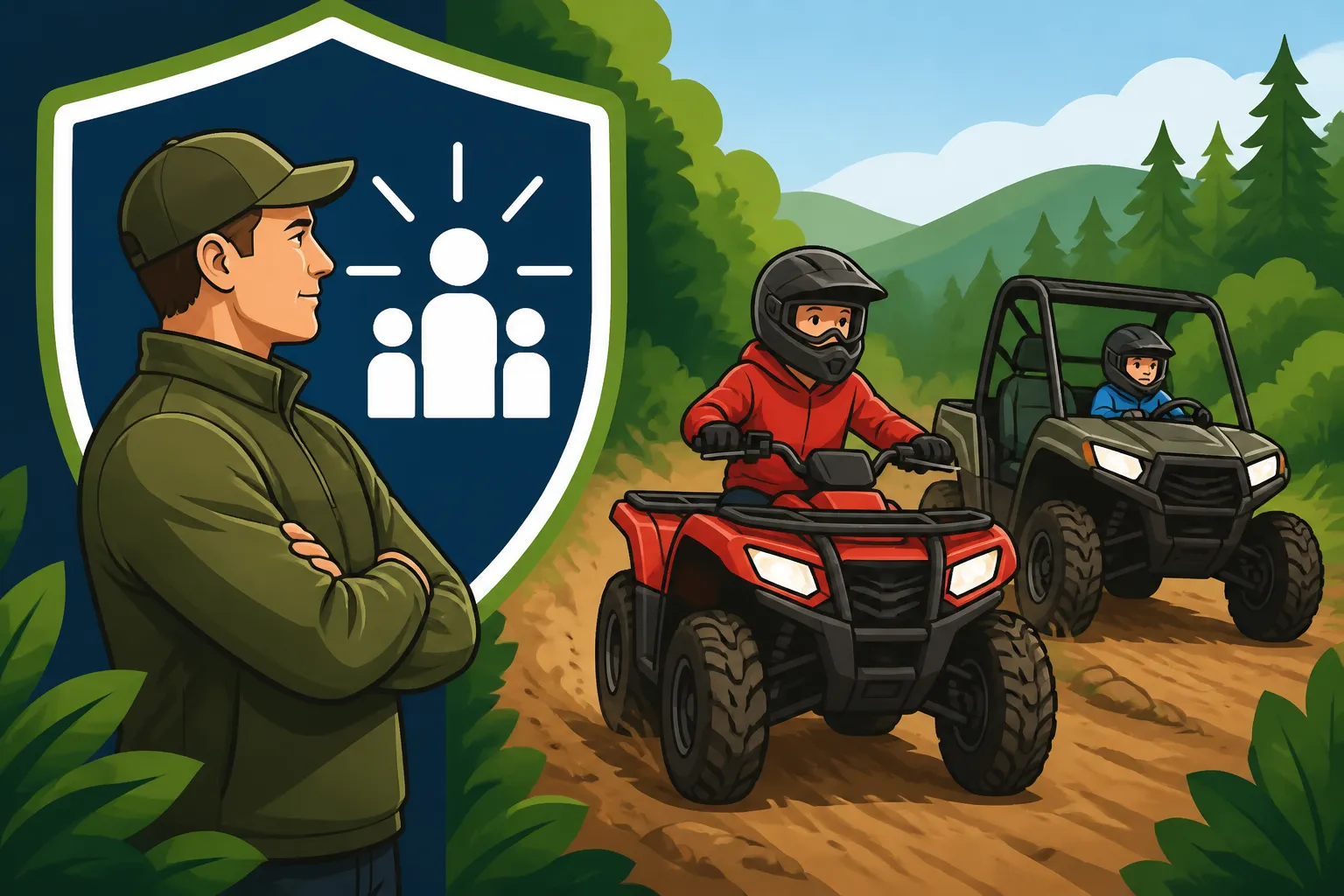
A cautious, practical interpretation is to stay near enough to see what the young rider is doing, monitor changing trail conditions and respond quickly if something goes wrong. On a moving ride, that generally means accompanying the child on the trail, not waiting at the parking area while the child rides out of sight.
The state requirement and a trail operator’s rules are not necessarily identical. A trail park, public-land manager or organized event may set additional requirements for age, adult accompaniment, machine type or riding areas. Follow the rule that applies at the place where you are riding, even if you believe you meet the general state standard. For a broader overview, see Kentucky Parental Supervision Rules Explained and Kentucky Rules for Riders Under 16.
Supervision is active, not just available
Direct supervision is best understood as ongoing attention. The responsible adult should be able to keep track of the child’s location and riding, notice when the child is struggling, and intervene before a manageable problem becomes an emergency.
That can mean riding on the same trail and keeping the child within sight, stopping when the child stops, and choosing routes that allow the adult to stay close without pressuring the child to ride faster. It also means not becoming so absorbed in another task, another rider or a phone that the child is effectively riding alone.
A radio or phone can help a group communicate, but it is not a substitute for being present. Signals may fail in a hollow, behind a ridge or amid engine noise. A child may also be unable to explain where they are or what has happened. If the adult cannot reach the child promptly, a communication device alone is a weak supervision plan.
There is no useful one-size-fits-all distance
Trail conditions change what “close enough” means. On a wide, level route, an adult may be able to observe a child from a short distance behind. On a steep climb, a blind turn, a narrow bench road or a creek crossing, even a small gap may prevent the adult from seeing a hazard or responding in time.
Do not treat a fixed number of feet, a particular riding position or a radio check-in schedule as a guaranteed legal safe harbor. The practical question is whether the adult can observe the child and respond to the conditions on that specific trail. When that is not possible, slow down, regroup or choose a different route.
The group should also avoid splitting up in a way that leaves a young rider between adults who cannot see them. If the terrain makes it difficult to keep everyone together, stop at a safe location and adjust the plan before continuing.
Plan the ride around the child, not the other way around
Supervision works only if the child and machine are suited to the terrain. A parent riding close behind cannot make an oversized, poorly maintained or unfamiliar machine safe. Before leaving the staging area, match the route, pace and vehicle to the young rider’s ability.
Check the age label and machine fit
Look at the manufacturer’s age recommendation or warning label on the ATV. Kentucky’s rules for young riders can involve age-related requirements, and the label is important when deciding whether a particular machine is appropriate. Do not remove or disregard it because the child is confident, tall for their age or has ridden a smaller machine before. See Reading a Manufacturer’s Age Label and Kentucky Minimum Age to Ride a Trail for related details.
A child should be able to reach and use the controls properly, maintain a stable riding position and operate the machine without stretching or losing balance. If they cannot comfortably brake, steer or reach the controls, the machine is not a good fit. An adult’s supervision does not correct a mismatch between rider and vehicle.
Before the ride, check that the controls work, tires are in suitable condition, and the machine is appropriate for the route. If the child is new to riding, begin on a simple, permitted area where they can practice starting, stopping, turning and responding to signals. Do not use a difficult trail as a training ground.
Choose terrain that leaves room to react
A young rider may be able to manage a smooth section and still be unprepared for a sudden climb, loose rock, deep mud, a narrow edge or an oncoming vehicle. Consider the hardest feature on the planned route, not just the easy sections at the beginning.
A useful pre-ride discussion covers:
- Where the group will stop and regroup.
- What signal means stop immediately.
- What the child should do if they cannot see the adult.
- How to handle an oncoming rider or vehicle.
- Which areas are off-limits, including closed trails and private property.
- What to do if the machine stalls or the child feels uncomfortable.
Keep instructions short enough to remember. A child who is overwhelmed by a long briefing may not retain the one signal that matters most. Repeat essential instructions at trail junctions and before a more challenging section.
Keep the adult’s attention available
One adult supervising several children may have difficulty keeping each rider in view, particularly if they are at different skill levels or riding different routes. Consider how many riders can genuinely be watched at once. If the adult must manage another task, ride far ahead or repeatedly leave one child behind, the group needs a different arrangement.
For a group ride, agree beforehand which adult is responsible for each child. Do not assume another parent is watching simply because they are nearby. Make the handoff explicit if an adult takes over supervision, and keep the child with that adult until the handoff is clear.
State supervision rules do not replace trail rules or permits
Supervision is only one part of riding legally and responsibly. A parent can accompany a young rider and still violate a trail operator’s age restriction, permit condition, helmet requirement or route closure. Before loading the machines, confirm the rules for the exact property and activity.
| Question | What to check | Why it matters |
|---|---|---|
| Is the child allowed to ride here? | State requirements and the trail or land manager’s age rules | A site may impose conditions beyond the general state rule |
| Is the adult supervising directly? | Whether the adult can observe and respond during the ride | Permission or presence at the trailhead may not be enough |
| Does the machine suit the rider? | Manufacturer label, fit, controls and condition | Supervision does not make an unsuitable machine appropriate |
| Is a permit required? | Permit rules for the park, forest or event | A state rule does not automatically grant access |
| Are there equipment or conduct rules? | Helmets, marked routes, closures and posted notices | Site rules can apply independently of supervision |
Permits are separate from parental supervision
A parent riding with a child does not automatically cover the child’s permit requirement. Some riding areas issue access permits by rider, while others use different arrangements. Do not assume that one adult’s permit covers the whole family or that a rental or event entry includes every permit needed.
Check the current terms with the land manager or park before the trip. Kentucky Trail Permits Explained outlines why access requirements can differ from one riding area to another. A permit for one property should not be assumed to work at another; Kentucky does not have a single statewide trail pass that substitutes for every local requirement.
Also verify whether the planned trail is open to the machine you intend to ride. A trail’s general availability does not mean every vehicle type or rider may use every route. Where public land is involved, check the land manager’s current rules and notices. For forest riding, Kentucky Rules for Riding a National Forest is a useful related topic.
Site rules can be stricter
A private off-road park, public-land manager, rental business or event organizer may require additional adult participation or set limits on who may operate a machine. Those rules can address matters not fully answered by the general state supervision requirement, such as minimum rider age, passenger restrictions, required safety gear or which trails are appropriate for a child.
Ask the operator specific questions rather than asking only whether children are allowed. For example:
- Does the child need a separate permit?
- Must the supervising adult ride on the same machine, or may the adult ride separately?
- Are there age restrictions for particular machines or trails?
- Does a rental agreement impose a stricter age or supervision condition?
- Are helmets or other protective equipment required on the property?
Get the answer from the operator responsible for the trail, and follow posted instructions once there. If a park’s written rule is unclear, ask before paying or unloading. A parent’s interpretation of state law does not override the operator’s access conditions.
A practical supervision plan for the trail
A simple plan reduces confusion once engines are running. It does not need to be complicated, but everyone should know who is responsible, where the group is going and what happens if riders become separated.
- Confirm the rules before the trip. Check the child’s eligibility, adult-supervision conditions, permit requirements, equipment rules and current trail closures with the relevant operator.
- Assign responsibility. Name the adult who is supervising each child. If more than one adult is present, agree on who takes the lead and who stays behind the young rider.
- Match the route to the least experienced rider. Choose a trail that the child can handle at a controlled pace, including its steepest, narrowest or most technical sections.
- Review a few clear signals. Decide how the group will communicate a stop, a problem or the need to regroup. Do not rely on a signal the child has not practiced.
- Ride within observation range. Keep the child close enough to monitor. If terrain blocks the adult’s view, stop or move together rather than continuing on the assumption that the child will catch up.
- Regroup at junctions and hazards. Stop before confusing intersections, difficult obstacles and any point where the group could separate. Make sure the child knows which route the group is taking.
- Stop when the plan stops working. Fatigue, fear, mechanical trouble, worsening weather or repeated loss of sight are reasons to end or change the ride—not reasons to ask a child to push through.
What to do if you lose sight of the child
If the child disappears around a turn or is no longer visible, do not continue farther into unfamiliar terrain. Stop the rest of the group in a safe place and use the agreed signal or communication method. If another adult is present, have that person remain with the group while the responsible adult checks the last known location, following the park’s emergency procedures.
Before riding, identify how to contact staff or emergency services at the site and where to report a missing or injured rider. Some areas have limited phone coverage, so know the park’s communication process rather than assuming a call will connect. If the child is injured, missing for more than a brief moment, or the situation is unsafe, seek help promptly.
Avoid sending another child to search alone. Keep the remaining riders together, and do not create a second separation while trying to resolve the first. Once everyone is safe, reconsider whether the ride should continue.
If the child is not ready for the trail
Stopping is a reasonable outcome. A child who is tired, frightened, unable to follow signals or uncomfortable with the terrain may not be ready for that route on that day. Turn back where safe, take a break or choose a permitted, easier area.
Do not use the group’s schedule, the cost of a permit or other riders’ pace as a reason to continue beyond the child’s ability. Direct supervision is not just following the young rider; it includes making good decisions about whether they should keep riding at all.
When the rules are unclear, contact the relevant trail operator or land manager before riding, and consult the current official requirements that apply to the property. For more on the broader age provisions, see Kentucky Trail Rules for Riders Under 16. A clear plan—an eligible rider, a suitable machine, an adult who stays engaged and permission to use the trail—makes supervision meaningful rather than merely nominal.
Disclaimer
This article is for general informational purposes only and does not constitute professional advice. Laws, prices and regulations vary by location and change over time. Consult a qualified professional for guidance on your specific situation.