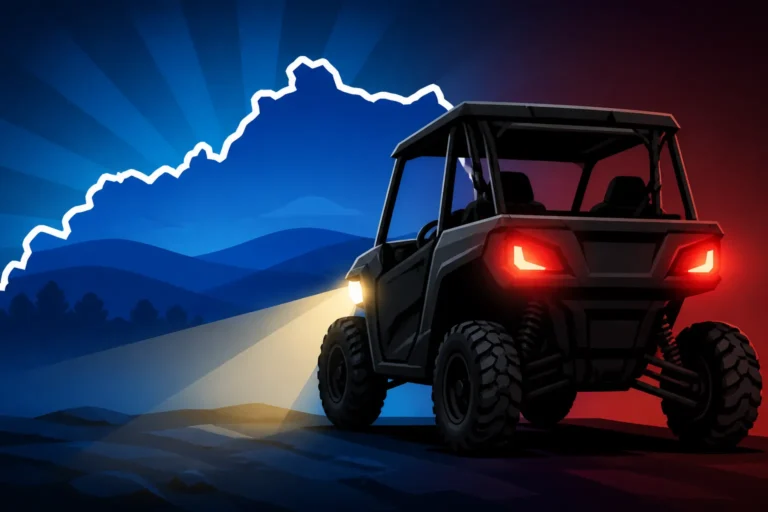
Kentucky Rules for Riding After Dark
It's frustrating when you want to make the most of your time on the trails or tending to tasks on your property, and sometimes that means riding your ATV or UTV when the sun isn't shining. Kentucky's rules around operating these machines after dark can feel like a confusing maze, leaving riders wondering exactly what's allowed and what could land them in hot water. This guide will cut through the confusion, explaining Kentucky's specific regulations for riding your ATV or UTV once dusk settles, and offering practical advice to keep you safe and legal.
The Default Rule: Riding During Daylight Hours Only
Let's start with the hard truth that catches many riders off guard: for most ATVs and UTVs in Kentucky, the law generally dictates that you stick to daylight hours. This isn't just a suggestion; it's embedded in the state's statutes regarding off-road vehicles. While it might seem overly restrictive, especially if you're used to other states or just want to cruise back to camp after a long day, this rule is primarily a safety measure designed to prevent accidents and ensure visibility.
Imagine you're out on a family ride, and the sun starts dipping below the ridgeline earlier than you expected. You might think, "I'm almost back to the truck, surely a few minutes won't hurt." But that's exactly the kind of situation where the law draws a hard line. Unless you fall into very specific exceptions, which we'll get into shortly, that fading light means it's time to park it. Trying to navigate trails or even private land in low light without proper legal authorization and equipment significantly increases your risk of an accident, not to mention a potential citation. This is a crucial distinction from street-legal vehicles, which are obviously designed for 24/7 operation.
Why the Daylight-Only Rule Exists
The primary reason Kentucky has this blanket "daylight only" rule for most ATV and UTV operation is simple: safety. Off-road machines, by their nature, often operate in environments with uneven terrain, hidden obstacles, and limited visibility even during the day. When darkness descends, these challenges are magnified exponentially. Without adequate lighting and the ability to clearly see where you're going, the risk of rollovers, collisions with natural features like trees or rocks, or even encountering other riders unexpectedly skyrockets.
Beyond the immediate physical dangers, there's also the element of public safety and potential nuisance. When ATVs and UTVs are ridden after dark, especially near residential areas or sensitive natural habitats, they can generate noise that disturbs residents or wildlife. The bright lights of machines can also be disorienting to others. While many riders are responsible, the law often paints with a broad brush to cover all possibilities and ensure a baseline level of safety and order across the state. This is why you'll often see regulations like [Kentucky Rules for Riding After Dark] reiterated so clearly.
What "Daylight Hours" Actually Mean
Defining "daylight hours" might seem straightforward, but it can actually be a bit of a gray area, much like that twilight hour when you're wondering if you should still be riding. Generally, legal interpretation often aligns with official sunrise and sunset times. However, it’s rarely as simple as an on/off switch. Most law enforcement agencies will consider "daylight hours" to be the period between a half-hour before sunrise and a half-hour after sunset. This grace period accounts for civil twilight, where there’s still enough natural light for visibility.
Think about it this way: if you need your headlights to see clearly, you're likely past daylight hours. While your machine might have factory headlights, they are often not designed for navigating challenging off-road terrain in complete darkness. The spirit of the law, as highlighted in [Daylight Only Under the Statute], is to ensure clear visibility for the rider and for anyone else who might be in the vicinity. Playing it safe means planning your rides so you're off the trails or done with your tasks well before sunset and definitely not starting a ride before the sun has fully risen. Err on the side of caution; a clear view is your best defense against an accident or a ticket.
Exceptions to the Daylight-Only Rule in Kentucky
While the general rule is "daylight only," Kentucky law does carve out specific exceptions. These exceptions aren't carte blanche for all-night trail rides, but rather carefully defined scenarios where the operation of an ATV or UTV after dark is deemed necessary or permissible, often with specific conditions attached. Understanding these nuances is crucial, as attempting to apply an exception to a situation where it doesn't fit can lead to legal trouble.
It’s easy to misunderstand these exceptions and assume they offer more flexibility than they do. Riders sometimes think "since I have headlights, I'm good," but that's a dangerous oversimplification. The exceptions are tied to the purpose of the ride and the type of machine or location, not just whether your lights work. Always remember that even within these exceptions, safety and responsible operation remain paramount.
Farm, Mining, and Logging Operations
Kentucky recognizes the practical necessity of using ATVs and UTVs for work purposes that don't always adhere to a 9-to-5, daylight-only schedule. This is where the exceptions for farm, mining, and logging operations come into play. If you're using your ATV or UTV strictly for legitimate work related to one of these industries, you are generally permitted to operate it after dark. This exemption is not about recreation; it's about livelihood and essential tasks.
For instance, a farmer might need to check on livestock in a back pasture after sunset, especially during calving season, or haul feed to remote areas on the farm. Likewise, those involved in mining or logging might have operations that extend into the night, requiring the use of these machines for transportation, equipment checks, or supervisory roles. However, there's a critical caveat: the machine must be equipped with at least one headlight and two taillights that are functional and visible. This ensures that even under the working exemption, the machine is still visible to others. You can find more detail about these specific exemptions in resources like [Kentucky Helmet Exemption for Farm Work] or [Kentucky Helmet Exemption for Mining], which often touch on related operational rules.
Emergency and Road Maintenance Personnel
Another vital exception to the daylight-only rule applies to those performing essential public services: emergency and road maintenance personnel. When lives are at stake or critical infrastructure needs immediate attention, the time of day simply isn't a factor. First responders, search and rescue teams, utility workers, and road crews often utilize ATVs and UTVs to reach remote areas that traditional vehicles cannot access. Their work frequently extends into the night, and the law allows for this necessary operation.
Think about a sudden ice storm that brings down power lines in a rural Kentucky county, or a search party looking for a lost hiker after dark. In these scenarios, ATVs and UTVs equipped with appropriate lighting, often enhanced with flashing emergency lights, become indispensable tools. These vehicles are considered exempt from the daylight-only rule because their operation is directly tied to public safety and infrastructure maintenance. Just like with farm, mining, and logging, adequate lighting, as outlined in [Kentucky Lighting Requirements for ATVs], is a non-negotiable part of this exception to ensure visibility for everyone involved, including the operators themselves.
Special Purpose Vehicles (SPVs) on Opt-In Roads
This is perhaps the most complex exception and often the source of confusion for many riders: the Special Purpose Vehicle (SPV) designation. Kentucky law allows UTVs (and certain other vehicles) to be registered as SPVs, making them street-legal on a limited basis, but only in specific cities or counties that have "opted in" to allow their use on public roads. Even then, there are strict conditions, and night riding is one of them. If you register your UTV as an SPV, you might be able to ride it on approved public roads after dark, provided it meets rigorous equipment standards.
To qualify as an SPV for night riding, your UTV needs more than just basic headlights. It must have at least one headlight (displaying a white light visible from 500 feet), two taillights (displaying a red light visible from 500 feet), turn signals, brake lights, dual mirrors, a horn, a windshield, an illuminated speedometer, and tires with at least 2/32 inch tread depth. Essentially, it needs to meet many of the same equipment requirements as a motorcycle to ensure it's visible and safe for road use, day or night. [One Headlight and Two Taillights Burning] only scratches the surface of what an SPV truly needs. Before even thinking about an evening cruise, you must confirm that the specific city or county you're in has an ordinance allowing SPVs and that your vehicle meets all the very strict state and local equipment requirements for night operation.
Navigating Limited Night Riding Opportunities Safely
Even when you are legally permitted to ride your ATV or UTV after dark in Kentucky—whether through an exception for work, emergency services, or as a properly equipped SPV on an approved road—safety becomes an even greater concern. Night riding introduces a whole new set of challenges that demand extra vigilance, specialized equipment, and a heightened sense of caution. This isn't just about avoiding a ticket; it's about preventing serious accidents.
It's easy to underestimate the difference between day and night riding. What seems like a familiar trail by day can become a maze of shadows and deceptive obstacles in the dark. Your depth perception changes, peripheral vision is reduced, and reaction times can slow. Therefore, simply having legal permission isn't enough; you need to proactively prepare your machine and yourself for the unique demands of riding in low-light conditions. Companies like SuperATV offer a range of products specifically designed to enhance night riding safety and visibility.
Essential Lighting and Equipment for Night Riding
If you're operating under an exception that permits night riding, equipping your machine with proper, robust lighting is absolutely non-negotiable. Your factory headlights, while functional for basic visibility, are often insufficient for truly effective night navigation, especially off-road. You'll want to seriously consider upgrading or adding auxiliary lighting. High-quality LED light bars and floodlights can dramatically improve your forward visibility, illuminating obstacles and terrain features that factory lights might miss.
Beyond sheer illumination, consider rear-facing lights (not just taillights) to help others see you, especially if you're working in a convoy or in dusty conditions. Auxiliary brake lights and turn signals are also crucial for SPVs on public roads. Don't forget about helmet-mounted lights, which can be invaluable for looking around corners or seeing what's directly in front of your machine as you turn your head. Think about a durable, all-weather construction for any aftermarket lighting, ensuring it can withstand the rigors of off-road environments. For robust upgrades, many riders look to brands like SuperATV for their wide selection of lighting solutions, ranging from powerful LED light bars to rock lights that can help illuminate tricky terrain directly around your tires.
Here's a quick look at essential night riding equipment:
| Equipment Type | Purpose | Key Features to Look For |
|---|---|---|
| Headlights | Primary forward illumination | Bright (LED recommended), wide beam pattern, durable housing |
| Taillights/Brake Lights | Rear visibility, signaling stops | Clearly visible from 500+ feet, robust construction |
| Auxiliary Light Bars | Enhanced forward visibility off-road | High lumen output, spot/flood combo, waterproof, shock-resistant |
| Rock/Area Lights | Illuminating immediate surroundings | Wide angle, low profile, waterproof for under-machine mounting |
| Turn Signals | Signaling turns (mandatory for SPVs) | Bright, amber color, visible from front and rear |
| Mirrors | Rearward visibility (mandatory for SPVs) | Dual mirrors, sturdy mounting, wide field of view |
| Reflective Gear | Personal visibility | High-visibility vest or jacket, reflective strips on helmet |
| Helmet-Mounted Light | Directable light source | Lightweight, good battery life, durable for headlamp use |
| Winch & Recovery Gear | Self-recovery in unforeseen situations | Appropriate pull rating, durable rope, tree saver, shackles |
| First-Aid Kit | Addressing minor injuries | Comprehensive, well-stocked, easily accessible |
The Importance of Local Ordinances and Permits
Kentucky's legal framework for ATVs and UTVs, particularly concerning road use and specific trail systems, often has a significant local component. This is especially true for SPVs. While state law sets the baseline, cities and counties have the power to "opt in" or create their own ordinances regarding the use of these machines within their jurisdictions. What might be legal on a county road in one part of Kentucky could be strictly prohibited just a few miles down the road in another county or city. This decentralization means that simply knowing the state law isn't enough; you must also check local regulations, particularly if you're planning on using an SPV after dark.
For example, a city might allow SPVs on roads during the day but restrict them entirely at night, or it might have specific hours of operation. Public trail systems, like those found at Black Mountain or Turkey Bay, might also have their own rules regarding night riding, often tied to specific events or permits. Ignoring these local nuances can lead to citations, fines, or even having your machine impounded. Always call ahead, check official county clerk websites, or consult with the local law enforcement agency or park authority to confirm what's allowed. Don't rely on word-of-mouth or outdated information from online forums; go directly to the source. You can often find information related to these details by looking up [Kentucky Rules for Riding a County Road] or [Kentucky Cities That Allow UTVs on Streets].
Best Practices for Night Riding
Even when you have all the necessary legal permissions and equipment, night riding requires a different mindset and approach. It's not just "riding in the dark"; it's about heightened awareness, slower speeds, and constant vigilance. Your own safety, and the safety of others, depends on it.
First and foremost, slow down. Your ability to see and react to obstacles is significantly reduced at night, even with excellent lighting. Speed amplifies risk. Ride at a pace that allows you to stop safely within the range of your headlights. Secondly, watch for wildlife. Animals are often more active at night and can be incredibly difficult to spot until it's too late. Deer, coyotes, and other creatures can dart out unexpectedly, posing a serious collision hazard. Thirdly, always ride with a buddy if possible. Having another person can be invaluable in case of a breakdown, getting lost, or an accident. Make sure someone knows your route and expected return time. Finally, dress appropriately. Even on a warm day, temperatures can drop significantly after dark, and you'll want layers to stay comfortable and focused. Ensure your helmet, which is mandatory for many riders in Kentucky as discussed in [Kentucky Helmet Law for ATV Riders], is clean and free of scratches that could impair your night vision. Remember, a well-prepared rider is a safe rider, especially when venturing out after sunset.
Consequences of Riding Illegally After Dark
Venturing out on your ATV or UTV after dark in Kentucky without adhering to the state's specific laws and exceptions can lead to a host of unpleasant consequences. It's not just a slap on the wrist; illegal night riding carries real legal and financial penalties, not to mention the significantly elevated safety risks for both the rider and anyone else in the vicinity. Many riders mistakenly believe that as long as they're on private land, they're completely immune from these rules, but that's not always the case, especially if property borders public access points or if noise ordinances are violated.
The goal of these regulations isn't to prevent fun, but to ensure public safety and mitigate potential conflicts. Ignoring them undermines that goal and puts everyone at a disadvantage. Understanding the potential repercussions can be a strong motivator to ensure you're always riding within legal parameters.
Fines and Legal Ramifications
Operating an ATV or UTV illegally after dark in Kentucky can result in a citation with associated fines. The specific amount can vary depending on the county and the discretion of the issuing officer, but these aren't minor traffic tickets. They can quickly add up, turning what was meant to be a relaxing ride into an expensive mistake. Beyond monetary fines, repeated violations or involvement in an accident while riding illegally after dark could potentially lead to more severe legal action.
For example, if you're riding an ATV on a public road after dark where it's not permitted, you could face charges for illegal road use, lack of proper equipment, and potentially reckless operation. Law enforcement officers, as you might encounter in situations like [Getting Ticketed at Black Mountain for an Untitled Quad] (though for a different reason), are vigilant about enforcing ATV laws, especially given the historical challenges of balancing recreation with safety. If your machine is unregistered or untitled (where required), those issues could also compound the problem. Furthermore, if you're involved in an accident, your insurance might deny coverage if you were operating the machine illegally at the time, leaving you personally liable for damages or medical bills.
Safety Hazards and Increased Risks
Beyond the legal penalties, the most immediate and severe consequence of illegal night riding is the exponential increase in safety hazards. As mentioned before, darkness fundamentally changes the riding environment. What was a minor rut during the day can become a wheel-swallowing hazard at night. The human eye struggles with depth perception and peripheral vision in low light, making it difficult to judge distances, identify obstacles, or react quickly to unexpected situations.
The increased risk isn't just for the rider. If you're operating on or near public roads, other vehicles may not see you, especially if your lighting is inadequate or your machine isn't legally equipped for road use. Off-road, you risk colliding with trees, rocks, fences, or even other riders or pedestrians who might also be in the area. The simple act of riding without sufficient visibility transforms a potentially enjoyable activity into a high-risk gamble. It's a fundamental reason why Kentucky, like many other states, has clear statutes on [Kentucky Rules for Riding After Dark] and [Kentucky Rules for Riding After Dark]. Prioritizing your safety and the safety of others by adhering to daylight hours or ensuring full compliance with exceptions is always the smartest choice.
Disclaimer
This article is for general informational purposes only and does not constitute professional advice. Laws, prices and regulations vary by location and change over time. Consult a qualified professional for guidance on your specific situation.