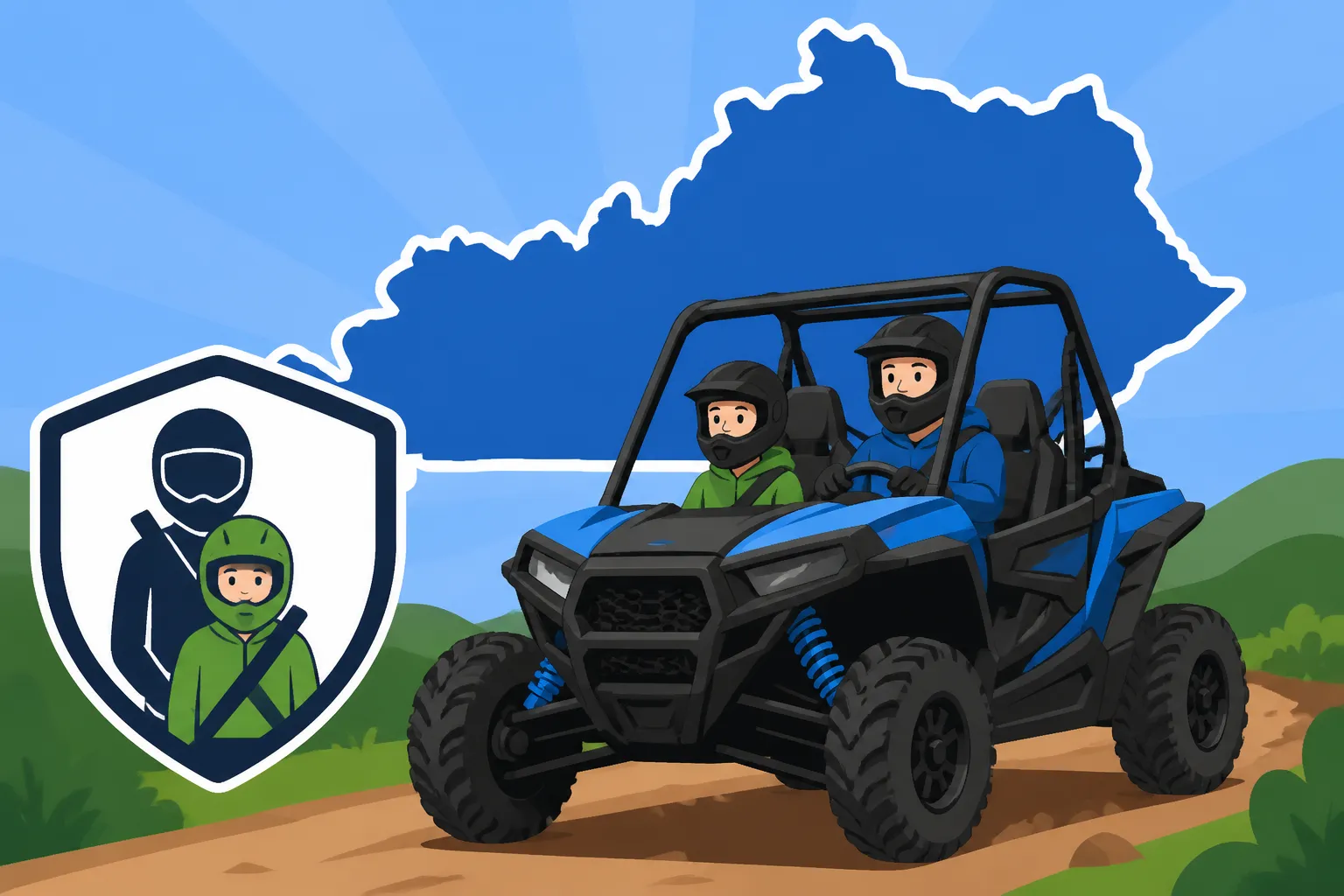
Kentucky Rules for a Passenger Under 16
Navigating the rules for ATV and UTV passengers, especially when they're under 16, can feel like trying to solve a Rubik's Cube blindfolded. Many parents and guardians in Kentucky want to share the thrill of off-road adventures with their kids, but the patchwork of regulations, manufacturer guidelines, and common-sense safety measures can be incredibly confusing and even intimidating. This guide aims to cut through the noise, offering clear, actionable insights into Kentucky's specific rules for ATV and UTV passengers under the age of 16, ensuring your family stays safe and compliant.
Understanding Kentucky's Basic ATV/UTV Passenger Laws
Before we even get to the specifics for youngsters, it’s crucial to grasp the fundamental differences in how Kentucky law views passengers on different types of off-road machines. It's not a one-size-fits-all situation, and misunderstanding this can lead to uncomfortable conversations with law enforcement or, worse, dangerous situations.
General Passenger Restrictions
Generally speaking, off-road vehicles like ATVs and UTVs are designed with specific seating capacities in mind. An ATV, by its very nature, is built for a single rider to straddle the seat, much like a motorcycle. Its balance, handling, and braking are all calibrated for one person. Adding a passenger, especially one not properly accommodated, fundamentally alters how the machine operates, often making it unstable and difficult to control. Even if there's a small pad behind the main seat, if the manufacturer didn't explicitly design it for a passenger with proper handholds and footrests, Kentucky law tends to err on the side of caution.
The law isn't just about what feels right; it's rooted in the machine's design intent. Trying to squeeze two people onto a single-rider ATV, even for a short hop down a gravel lane on private property, can be incredibly risky. The weight distribution changes, the steering becomes sluggish, and sudden bumps or turns can easily throw off the rider's and passenger's balance. This is why many states, Kentucky included, have strict rules about how many people can legally (and safely) ride a machine at one time. Always refer to your machine's owner's manual for its specific passenger capacity.
Distinction Between ATVs and UTVs for Passengers
This is where things diverge quite a bit. UTVs, or Side-by-Sides, are fundamentally different from ATVs when it comes to passengers. UTVs are designed with bench seats or bucket seats, seat belts, and roll cages, explicitly built to accommodate multiple passengers. Think of them as miniature off-road cars. The manufacturer specifies how many people can sit in a UTV, typically two, three, or four, sometimes even six, depending on the model. This design makes them inherently safer and more stable for carrying passengers, as long as everyone is buckled in and seated properly within the vehicle's protective frame.
ATVs, on the other hand, are often restricted to the operator only. While some larger, two-up ATV models are specifically designed to carry a single passenger safely with an extended seat, separate footrests, and handholds, these are the exception rather than the rule for standard ATVs. Kentucky law is generally very clear on this: if the machine isn't designed for it by the manufacturer, you shouldn't carry a passenger. Ignoring this distinction is one of the most common mistakes people make, and it's particularly relevant when considering younger passengers. For more on this, you might find [Kentucky Rules for a Passenger on an ATV] to be a helpful read.
The "Operator Only" Rule for Many ATVs
Most traditional, single-rider ATVs are clearly labeled by their manufacturer with a "rider only" warning. Kentucky law leans heavily on these manufacturer recommendations, often adopting them directly into statutes. This means that if your ATV was built for one person, carrying a passenger, regardless of age, can be a violation of the law. This rule isn't meant to spoil your fun; it's a critical safety measure. An ATV's suspension, braking, and turning radius are all tuned for a solo operator.
When a second person is added, especially a child who might shift their weight unexpectedly or struggle to hold on, the risk of a rollover or loss of control increases dramatically. Imagine trying to navigate a tricky trail or an uneven incline with an extra, shifting weight behind you. It becomes a completely different, and far more hazardous, experience. Therefore, if you're planning to take a child along, your best and safest bet is a UTV designed for multiple occupants, or a purpose-built two-up ATV.
Specific Rules for Passengers Under 16
When the passenger is a minor, the stakes, and the rules, become even more stringent. Kentucky law places a high priority on the safety of young riders, and this means there are specific age-related restrictions that every parent or guardian must understand and follow.
The Legal Age Threshold for Passengers
In Kentucky, the primary age threshold you need to remember for ATV and UTV passengers is 16. If a passenger is under 16 years old, they are subject to additional, specific safety regulations designed to protect them from harm. This threshold isn't arbitrary; it reflects a recognition that younger individuals may lack the physical development, judgment, and awareness to safely manage the dynamic environment of off-road riding, even as a passenger. This often means stricter requirements for helmet use, appropriate seating, and sometimes even the type of machine they can ride on.
For example, a child under 16 cannot operate an ATV at all, let alone carry a passenger. So, even if they are just a passenger, the vehicle's operator must be fully aware of the legal responsibilities that come with having a minor on board. This includes ensuring all safety gear is properly worn and that the machine itself is suitable for carrying a young person. The spirit of the law here is to minimize preventable injuries among Kentucky's youngest off-road enthusiasts.
Why the Under-16 Rule Exists in Kentucky
The rules for passengers under 16 exist for very practical, safety-driven reasons. Off-road environments are unpredictable. There are bumps, sudden stops, tight turns, and potential obstacles. A young child, with less muscle mass, shorter limbs, and still-developing reflexes, is simply more vulnerable to injury in these scenarios. They might not have the strength to hold on tightly, the height to keep their feet on footrests, or the judgment to anticipate a bump and brace themselves.
Furthermore, a child’s body is still growing, and impacts that might cause a bruise in an adult could lead to more severe injuries, like fractures or concussions, in a developing child. The law is designed to shield these vulnerable individuals from situations where the risks are disproportionately high. It’s a recognition that while off-road riding can be a wonderful family activity, it must be approached with the utmost caution and adherence to safety protocols, especially for those who depend on adults for their protection. Consider [Kentucky Helmet Law for Passengers] for vital information on mandatory head protection for children.
Parental Responsibility and Potential Liability
As a parent or guardian, you bear the primary responsibility for the safety and legal compliance of any minor you allow to ride as a passenger on an ATV or UTV. This isn't just a moral obligation; it carries legal weight. If a child is injured while riding as a passenger and the rules for their safety were not followed, the adult operator or owner of the machine could face significant legal consequences, ranging from fines to civil lawsuits. It’s a serious matter, and the courts and state agencies take the protection of minors very seriously.
This responsibility extends beyond just the moment of riding. It includes ensuring the child has the correct safety gear, that the machine is appropriate for carrying a passenger, and that the riding environment is as safe as possible. For instance, allowing a young child to ride on an ATV not designed for passengers, or without a helmet, isn't just unsafe; it's a direct violation of Kentucky law and could be seen as negligence. Parents often ask about [What a Parent Risks Letting a 6-Year-Old Ride] – this link provides a deeper dive into the legal implications.
Age and Supervision Requirements for Young Riders
Beyond just the passenger rules, Kentucky law also sets forth specific requirements for the age of operators and the level of supervision needed, which indirectly affects how and when a young person might be a passenger. Understanding these layers of regulation is key to staying within the bounds of the law and ensuring maximum safety.
Direct Parental Supervision Explained for Minors
For any ATV or UTV operation involving minors, Kentucky often emphasizes the need for "direct parental supervision." While this usually applies to a minor operating the machine, the spirit of strict adult oversight extends to minors riding as passengers too. Direct supervision generally means the adult is physically present, within sight and hearing distance, and actively monitoring the child's activity. It's not enough to simply send a child off with an older sibling or just be somewhere on the same property. The supervising adult must be capable of intervening immediately if a problem arises.
This supervision ensures that if a child passenger starts to struggle, gets scared, or inadvertently interferes with the operator, the supervising adult can quickly step in. It’s about proactive safety management, not just reactive damage control. Even on private land, where some state laws might be less strict, the principle of direct supervision for children's safety remains a best practice and is often implicitly expected under negligence laws. For more on this, check out [Kentucky Supervision Rules for Minors].
Engine Size and Corresponding Age Limitations
While engine size limitations primarily apply to children operating ATVs, they are worth noting because they influence what type of machine a family might own or use, and thus, what's available for passengers. Kentucky law specifies age limits for operating ATVs of certain engine sizes. For example, a child under 12 typically cannot operate an ATV with an engine larger than 70cc, and specific rules apply to those between 12 and 16. These rules exist to match a child's developmental stage and physical capabilities to the power and weight of a machine.
Even as a passenger, the overall size and power of the machine matter. A very small child on a very large, powerful UTV might feel overwhelmed or could be jostled more severely by the machine's movements. While there isn't a direct "engine size limit for passengers" rule, choosing a machine that is appropriate for the overall family's use, including any young passengers, is part of responsible off-road planning. Ensuring the machine is in good repair, perhaps with quality aftermarket parts from a company like SuperATV, also adds a layer of safety for everyone on board.
Manufacturer's Age Labels as Legal Guidance
Kentucky law, like many states, places significant weight on the manufacturer's age labels and warnings. These labels, typically found on the machine itself and in the owner's manual, are often directly incorporated into state statutes as legal requirements. This means if a manufacturer states that an ATV is intended for riders 16 years and older, or that it is a "rider only" machine, adhering to that label isn't just a suggestion—it's often a legal mandate in Kentucky. Ignoring these labels can put you in direct violation of the law.
The manufacturer's age label is determined through extensive research and testing, considering factors like the machine's weight, speed, handling characteristics, and the average physical and cognitive development of different age groups. Therefore, these labels are critical indicators of safety. For instance, if an ATV is labeled for single riders 16 and up, allowing a 10-year-old to ride as a passenger on it could be interpreted as disregarding the manufacturer's safety warnings, with potential legal ramifications. It's truly important to understand [The Manufacturer's Age Label in Kentucky Law].
Mandatory Safety Gear for Young Passengers
When a minor is on board an ATV or UTV in Kentucky, wearing the correct safety gear isn't just a suggestion; it's a legal requirement. This is one of the most straightforward and non-negotiable aspects of keeping young passengers safe.
Helmet Use: A Non-Negotiable Requirement for Minors
This cannot be stressed enough: any passenger under the age of 16 on an ATV or UTV in Kentucky MUST wear a helmet. This is a fundamental safety law designed to protect the most vulnerable part of a child's body – their head. Head injuries are among the most common and devastating injuries in off-road accidents, and a properly fitted, DOT-compliant helmet can significantly reduce the risk and severity of these injuries. It’s not about how slow you’re going or how short the ride is; accidents can happen at any speed, in any terrain, and helmets provide crucial protection.
Parents often feel tempted to let children go without a helmet for a quick ride around the yard, but this is precisely where many preventable injuries occur. The law makes no exceptions for ride length, speed, or location (unless on private farm land for agricultural purposes, though even then, a helmet is highly recommended). Ensuring your child has a helmet that fits correctly, is securely fastened, and meets safety standards (like DOT certification) is a paramount responsibility. For more detailed information, please see [Kentucky Helmet Rules for Riders Under 16].
Appropriate Clothing and Footwear for Safety
While not always explicitly legislated to the same degree as helmets, appropriate clothing and footwear are absolutely critical for any passenger, especially a child. Think about the environment: dust, rocks, branches, mud, and potential scrapes or impacts.
Clothing:
- Long pants and long-sleeved shirts: These provide a barrier against scrapes, cuts, and minor burns from hot engine parts. Denim or thick material is preferable to thin cotton.
- Gloves: Can protect hands from blisters, abrasions, and impacts.
- Eye protection: Goggles or a face shield on a helmet are essential to protect eyes from dust, debris, and insects. A company like SuperATV offers great options for windshields on UTVs which can also add an extra layer of protection from flying debris.
Footwear:
- Over-the-ankle boots: These are vital. Sneakers or sandals offer virtually no protection against impacts, crushing injuries, or simply losing a foot off the footrest and getting it caught under the machine. Boots with good tread also provide better grip on footrests.
It's about minimizing exposed skin and vulnerable areas. A scraped knee or a twisted ankle is far less likely when children are dressed for the occasion. Instilling these habits early teaches children the importance of personal safety in all outdoor activities.
Ensuring the Machine is Suitably Fitted for Passengers
Simply having a multi-passenger machine isn't always enough; you need to ensure it's suitably fitted for the specific passengers, especially young ones.
Seat Belts: All UTVs come equipped with seat belts, and these must be worn by all occupants, including children. Ensure the seat belt fits snugly across the child's lap and chest. If a child is too small for the seat belt to fit properly (i.e., the shoulder strap crosses their neck instead of their shoulder, or the lap belt sits on their stomach instead of their hips), they may be too small for that particular machine, even as a passenger. Some parents utilize booster seats or appropriate child restraints, though these should be secured carefully within the UTV.
Footrests and Handholds: For ATVs designed for two-up riding, ensure the passenger can comfortably reach and maintain their feet on the designated footrests. Their hands should be able to firmly grip the passenger handholds without straining. If a child's feet dangle or they cannot hold on securely, they are at a much higher risk of falling off or being thrown from the machine. In a UTV, ensuring that a child's feet are contained within the floorboard area and they can hold onto grab bars is equally important. Investing in accessories like grab handles or stronger door nets from a reputable brand can also enhance passenger safety and comfort.
Consequences and Enforcement of Passenger Rules
Ignoring Kentucky's rules for young passengers on ATVs and UTVs isn't just a matter of "bad luck" if something goes wrong. There are tangible legal and financial consequences for non-compliance, alongside the far more critical risk of injury to a child.
Fines and Penalties for Violating Passenger Regulations
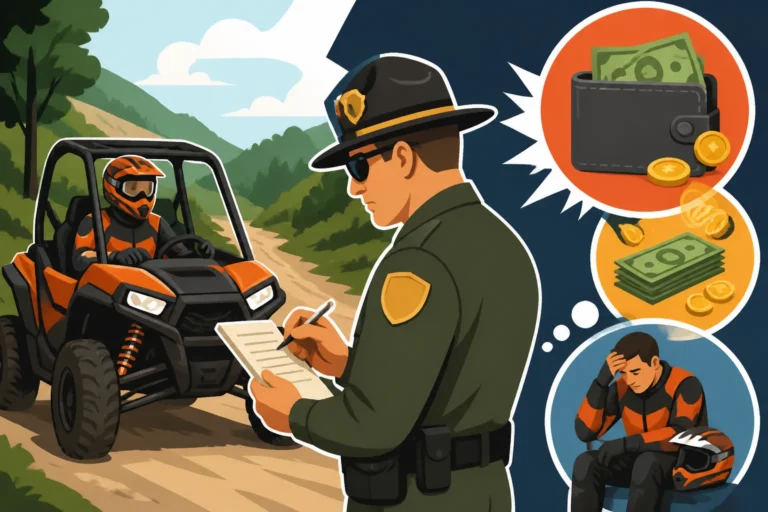
If you're caught violating Kentucky's ATV and UTV passenger regulations, especially concerning minors, you could face fines and other penalties. While specific amounts can vary by jurisdiction and the discretion of the enforcing officer, these aren't just slap-on-the-wrist tickets. Operating an ATV with an illegal passenger, particularly an unhelmeted minor, is taken seriously. These fines can quickly add up, and repeat offenses can lead to escalating penalties.
For instance, an officer might pull you over on a county road (where ATVs are generally not allowed anyway, as detailed in [Why Kentucky Roads Are Closed by Default]) and issue a citation not only for illegal road use but also for having an underage passenger without a helmet. Each violation can carry its own separate fine. This can quickly turn a fun family outing into a very expensive lesson, making a dent in your budget that could have been avoided by simply following the rules.
Broader Legal Ramifications for Guardians and Operators
Beyond immediate fines, there can be broader legal ramifications for parents, guardians, or operators who fail to adhere to passenger safety laws. In the unfortunate event of an accident where a minor passenger is injured, and it's found that safety rules (like helmet use or proper passenger seating) were violated, the adult responsible could face civil lawsuits for negligence. A child’s injury can lead to significant medical bills, long-term care costs, and pain and suffering, all of which could potentially be sought from the negligent party.
Furthermore, in severe cases of neglect or egregious disregard for safety, there could even be criminal charges, though these are less common and typically reserved for situations involving extreme recklessness. The core message here is that the law empowers authorities to ensure the safety of minors, and failure to meet these responsibilities can have serious and lasting consequences for the adults involved. Think about [Kentucky Fines for Illegal ATV Road Use] in conjunction with passenger violations; the penalties can compound.
Prioritizing Safety and Compliance Over Convenience
Ultimately, the intent behind all these rules isn't to make off-road riding difficult or less enjoyable. It's to ensure everyone, especially children, can participate safely and responsibly. It might feel inconvenient to ensure a child is perfectly outfitted with a helmet, goggles, boots, and appropriate clothing, or to make sure they are only riding in a UTV or a specially designed two-up ATV. It might be tempting to just hop on a single-rider ATV for a quick spin with your child on the seat in front of you.
However, these brief moments of perceived convenience are precisely when accidents are most likely to occur, often with the most severe outcomes. Prioritizing safety and compliance means taking the time to understand and adhere to every aspect of Kentucky law regarding young passengers. It means modeling responsible behavior for your children and teaching them the importance of safety gear and appropriate machine use. Investing in the right machine, the correct safety gear, and the knowledge to use them properly is an investment in your family's well-being and continued enjoyment of the great Kentucky outdoors.
| Passenger Type | ATV (Single-Rider) | ATV (Two-Up Model) | UTV (Side-by-Side) |
|---|---|---|---|
| Designed For Passengers? | No | Yes, one designated passenger | Yes, multiple designated passengers |
| Legal for Passengers Under 16? | Generally No (illegal) | Yes, if designed by manufacturer & rules followed | Yes, if designed by manufacturer & rules followed |
| Mandatory Helmet (Under 16)? | N/A (shouldn't be there) | YES | YES |
| Mandatory Seat Belt (Under 16)? | N/A | N/A | YES (if equipped, which all UTVs are) |
| Appropriate Footrests/Handholds? | N/A (shouldn't be there) | YES | Within passenger compartment |
| Manufacturer Label Importance | Critically important, often "Rider Only" | Critically important, check capacity & age | Critically important, check capacity & age |
Disclaimer
This article is for general informational purposes only and does not constitute professional advice. Laws, prices and regulations vary by location and change over time. Consult a qualified professional for guidance on your specific situation.