Checking a Kentucky Trail Notice First
A trail that was open last time may be closed, muddy or subject to a temporary restriction today. Before hauling your ATV or UTV, check the official notice for the riding area you plan to visit. A quick review helps you spot closures, understand which pass applies and catch equipment or safety requirements before they disrupt your trip.
Start With the Notice for Your Exact Riding Area
Trail rules and conditions are not always the same across Kentucky. A state rule, a forest pass requirement and a park’s current closure notice are separate things. Start with the official source for the place you intend to ride, and make sure the notice applies to your specific trail system rather than a nearby area.
For off-highway vehicle riding in Daniel Boone National Forest, the USDA Forest Service lists official trail alerts, advisories and temporary closures on its website. Check that information close to your departure, then look again before unloading if conditions may have changed. A notice you saw when planning a trip may not reflect a later closure or change.
Read the whole notice, not just its heading. Look for the affected trail or area, what restriction applies, and whether it is temporary or ongoing. A closure may apply to one segment rather than an entire riding area. Don’t assume that an open trail nearby is an approved detour: follow the notice and posted signs, and stay off closed routes.
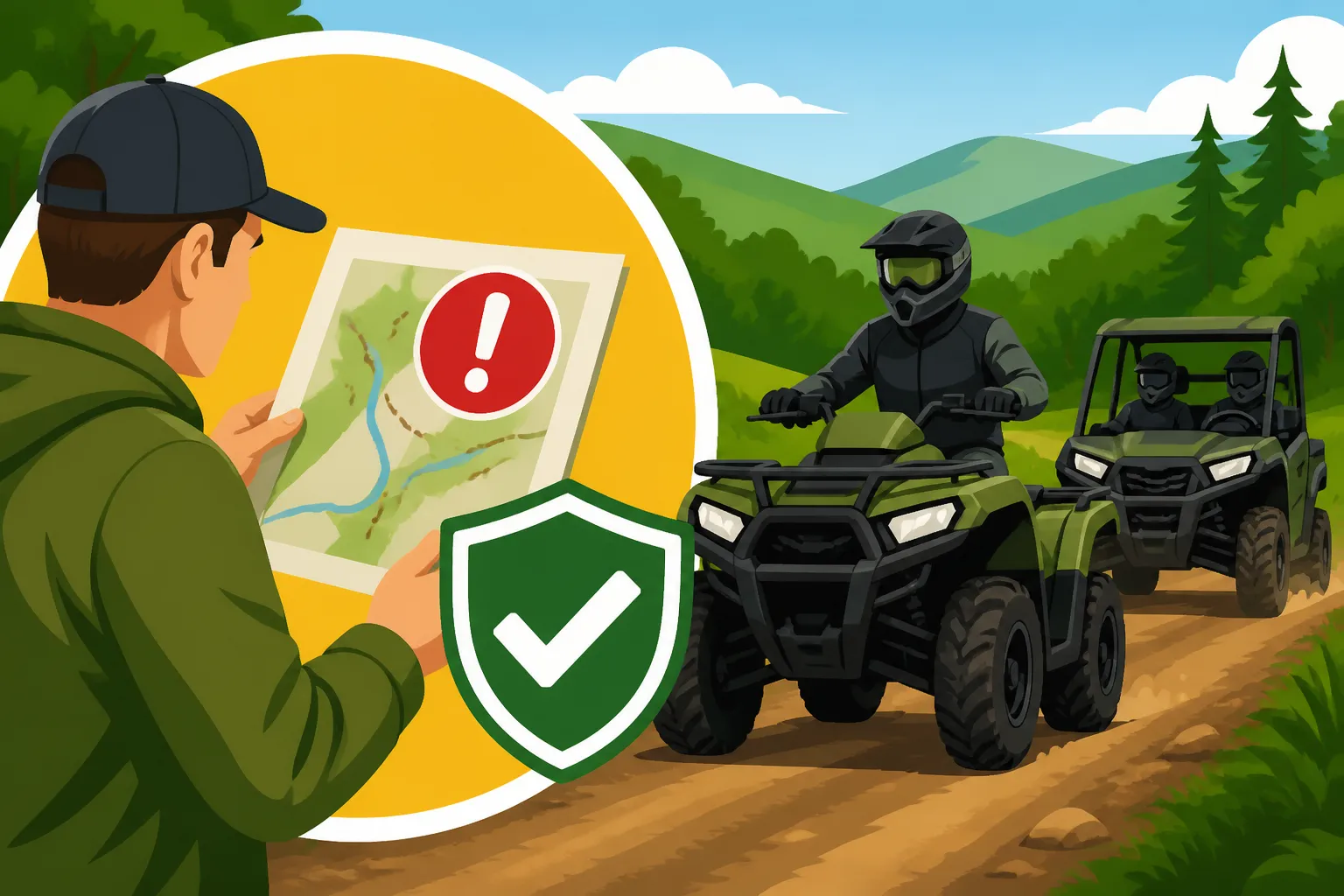
A useful check is to compare the official notice with the trail map you intend to carry. If the notice names a segment or access point, find it on the map before setting out. If you cannot tell whether your planned route is affected, contact the land manager or park before you haul. For broader planning help, see Kentucky Trail Closures to Check First and Kentucky Trail Conditions Before You Ride.
| What to check | What to confirm | Why it matters |
|---|---|---|
| Official alert or advisory | Whether it applies to your riding area and planned route | A notice for another trail system may not describe your destination |
| Closure details | Which route or access point is affected, and whether an alternative is identified | A nearby open trail is not automatically an authorized detour |
| Pass or permit information | Whether the land manager requires a pass for that location | A state title and a recreation pass serve different purposes |
| Equipment and safety rules | Whether your machine and riders meet the applicable requirements | A notice or posted rule may affect what you can operate or carry |
| Latest condition update | Whether anything changed after you first checked | Access and conditions can change between planning and arrival |
If your plans include a different riding area, check that area’s official information separately. A notice for Daniel Boone National Forest does not establish the status of trails elsewhere. Kentucky Trail Seasons and Closures can help with general planning, but the official notice for your destination should guide your final decision.
Separate a Trail Pass From Kentucky Title and Registration Rules
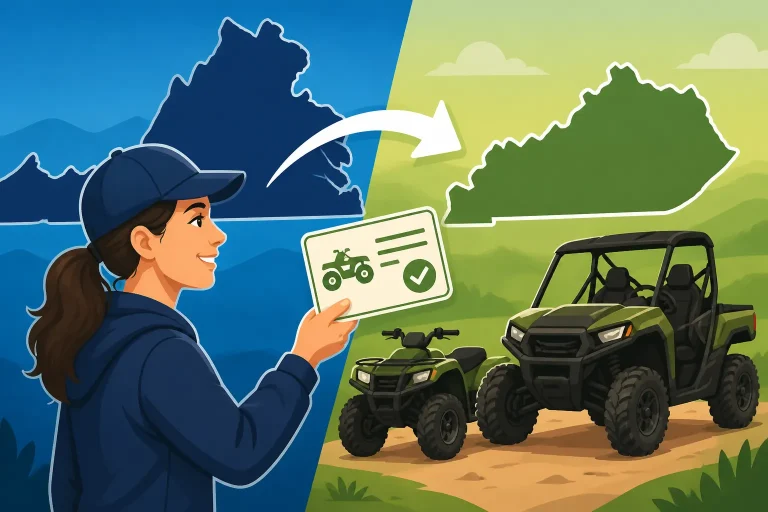
A common source of confusion is treating the machine’s paperwork as proof that a trail is open or that you have permission to ride there. Those are different questions. Kentucky requires qualifying ATVs to be titled, while land managers may impose their own access requirements for particular public riding areas.
For off-road use, Kentucky ATVs are titled rather than registered, and there is no annual state registration fee, according to the Commonwealth of Kentucky Transportation Cabinet. The Cabinet also says ATVs purchased on or after July 1, 2010, must be titled, with the title application submitted within 15 days of purchase. A title establishes the machine’s ownership paperwork; it does not replace a trail pass or override a closure.
For Daniel Boone National Forest, the USDA Forest Service requires the appropriate official off-highway vehicle recreation pass sticker or rider wristband to be displayed or worn. The Forest Service requirement is specific to that public land. It is not a general Kentucky registration plate for off-road use, and having a Kentucky title does not by itself satisfy a forest pass requirement.
Before leaving, verify what the pass applies to and how it must be carried or displayed. Don’t infer that a pass from one riding area works at another. A state title, an off-highway recreation pass and a trail notice each answer a different practical question:
- Title: Is the ATV’s ownership document in order?
- Pass: Have you met the access requirement for the land you plan to ride?
- Notice: Is your planned route currently open and subject to any restrictions?
For help with the pass side of planning, see Buying and Using the Daniel Boone Forest OHV Pass. For the broader distinction between local access requirements and state paperwork, see Why a Kentucky Park Permit Is Not a State Permit. If you’re unsure which office or land manager controls the trail, confirm that before relying on a pass or old trip information.
Keep the information easy to check on the road. Save or print the official notice and have your pass details available, especially if cell service may be limited. A screenshot can help with reference, but it does not make a closed trail open or substitute for any pass the land manager requires.
Use the Notice as a Pre-Ride Checklist
A trail notice is most useful when you turn it into decisions before loading. First, check whether your route is open. Then consider whether the conditions and rules are a good match for your machine, riders and plan for the day. If the notice is unclear, pause and ask the land manager rather than guessing at the gate.
Use this sequence:
- Identify your destination precisely. Confirm the name of the forest, park or trail system, along with the access point or route you intend to use.
- Open the official notice. For Daniel Boone National Forest, use the USDA Forest Service’s alerts, advisories and closure information.
- Match the notice to your route. Check whether it names the trail, section or access point in your plan. If you can’t match the wording to your map, ask before riding.
- Check access requirements separately. Confirm any required pass and whether it must be displayed or worn.
- Review machine and rider requirements. Make sure the vehicle and everyone riding meet the rules that apply to that land and activity.
- Recheck before unloading. If you hear of a new closure, see a posted warning or find conditions different from what you expected, stop and verify before proceeding.
A notice may not be a complete equipment checklist. Kentucky law separately requires an off-highway vehicle used on public OHV trail systems to have a spark arrestor, according to the Legislative Research Commission. Check that your machine has the required equipment rather than assuming the absence of a notice means there is no requirement.
Rider protection matters too. According to the Legislative Research Commission, people aged 16 or older operating an ATV on public property are generally required to wear approved protective headgear, with exceptions for specified activities such as farming, mining or logging. The same agency says children under six are prohibited from operating an ATV, and parents or guardians may not allow a minor under 16 to operate one in violation of the manufacturer’s age-restriction warning labels.
Check the machine’s intended seating before bringing a passenger. The Kentucky Department of Fish and Wildlife Resources says passengers are not allowed on single-rider ATVs; riders should follow the manufacturer’s recommendations. For more on age and supervision, see Kentucky Trail Rules for Riders Under 16 and Kentucky Rules for Riding a National Forest.
Know When a Trail Plan Involves a Public Road
A trail notice does not make road travel legal. If reaching a route involves a public highway, check the rules for that movement separately instead of treating a trail pass or open-trail status as permission to ride on pavement.
Kentucky law allows an ATV to cross a two-lane public highway only under stated conditions, according to the Legislative Research Commission. The crossing must be as close to a 90-degree angle as practical and safe, and the ATV must not travel on the highway for more than two-tenths of a mile. The operator must have a valid operator’s license, follow applicable traffic rules, use illuminated headlights and taillights, and cross during daylight hours. These conditions concern a limited crossing; they do not generally authorize riding along a prohibited highway.
For UTVs and similar off-highway vehicles operated on public roadways or highways, Kentucky law requires headlamps and tail lamps that remain illuminated or operational as required for public-road use, according to the Legislative Research Commission. Street-legal operation may involve additional requirements. For example, the Legislative Research Commission says multi-passenger UTVs classified as special purpose vehicles must have a roll bar or roll cage and a seatbelt assembly for each designated seating position; they must also have a windshield unless the operator wears eye protection.
If the plan depends on using a public road, confirm that the route and vehicle qualify for that use before setting out. Do not assume that equipment required for a trail is enough for road operation, or that road equipment changes a trail closure. Related information is available in Kentucky Rules for Crossing a Highway and Kentucky Rules for ATVs on Public Roads.
The practical rule is simple: treat the notice, access pass, title and road rules as separate checks. Confirm each one for the place and route you have planned. That small amount of preparation can prevent a long drive to a closed trail, a problem at the access point or a ride that depends on an assumption you could have checked at home.
Sources
- Legislative Research Commission — Kentucky Revised Statutes § 189.281 (checked November 2, 2026)
- Legislative Research Commission — 189.515 Restrictions on operation of all-terrain vehicles. (checked November 2, 2026)
- Kentucky Transportation Cabinet — Vehicle Titling – Drive KY (checked November 2, 2026)
Disclaimer
This article is for general informational purposes only and does not constitute professional advice. Laws, prices and regulations vary by location and change over time. Consult a qualified professional for guidance on your specific situation.