Where to Ride When a Kentucky Park Closes Wet
A rain closure can wreck a Kentucky riding weekend, especially after you have loaded the trailer, booked a cabin, and driven toward the mountains. The safest backup is not simply another trail on the map: it is a place confirmed open, suited to the ground conditions, and legally accessible. This guide explains how to find that option—or make a better call to reschedule.
Why a wet-weather closure matters
Closed trails are a safety and land-protection measure
When a park shuts trails after heavy rain, it is usually responding to conditions that make riding risky or damaging. Soft soil can rut under tires, while slick clay, loose rock, and steep grades can make climbs and descents harder to control. In narrow hollows, water may also rise quickly or wash debris across a route.
The closure is not just a suggestion to avoid the worst-looking trail. A park may close its entire riding area, selected loops, or access roads, and those distinctions matter. Do not assume that a trail is fair game because its entrance looks dry or because another rider says they made it through earlier. Conditions can change within a few hours, especially in Eastern Kentucky’s steep terrain.
Riding around a barrier or taking an unofficial route can create new problems. You could encounter unstable ground, damage a trail, trespass on property, or end up somewhere a recovery crew cannot easily reach. For a clearer picture of why conditions matter, see Kentucky Riding After Heavy Rain and Why Turkey Bay Closes on Saturated Ground.
A closure may apply to more than the muddy section
It is tempting to think a closure affects only the visibly wet parts. In reality, access roads, bridges, staging areas, or shared routes may also be unsafe or unavailable. A park operator may close an area to protect the trail system as a whole, even if some slopes appear rideable.
The same caution applies when looking for a backup. A nearby park may have different land, soil, and drainage conditions, but it can still be affected by the same storm. A second location is not automatically open just because it is farther away or sits in another county.
Before changing plans, check what is actually closed and what remains open. Start with Kentucky Trail Closures to Check and Kentucky Trail Conditions Before You Ride, then confirm directly with the park or land manager. Treat map information as a planning aid, not permission to ride.
How to find a legal backup in Kentucky
Check nearby managed parks, but verify conditions first
Depending on where you are staying, another managed riding area may be within reach. Riders around Harlan and Evarts may look at Black Mountain Off-Road Adventure Area; those near Hazard may consider Leatherwood Off-Road Park. Riders farther west might check Turkey Bay OHV Area in Land Between the Lakes, while Rush Off-Road and Hollerwood may be practical options for some trips in other parts of the state.
These are possibilities to investigate, not guaranteed rain-day substitutes. Each location has its own access rules, operating decisions, terrain, and condition updates. One park may close after rain while another remains open, but the second operator’s decision should guide you—not a guess based on the forecast or a social media post from the previous day.
Call or check the park’s official information before you hitch up and drive. Ask whether the riding area is open, whether any sections are closed, whether the access road is passable, and whether the conditions are suitable for your machine. The guide Where to Ride an ATV in Kentucky can help you identify areas to research, while Calling a Kentucky Park Before You Load is a useful reminder to confirm before departure.
| Backup option | What to confirm before leaving | Why it may not work as a substitute |
|---|---|---|
| Another managed riding park | Open status, trail closures, access conditions, and any rider requirements | It may have received the same storm or may also have closed |
| A designated public riding area | Current access rules, authorized routes, and any required permit | Public land does not mean every road or trail is open to ATVs |
| Private land with permission | Clear permission from the landowner and the specific area you may use | Permission for one property does not extend to neighboring land |
| Reschedule or switch activities | Lodging, rental, and reservation policies | It may cost time or require rearranging plans, but can avoid unsafe riding |
Use maps to plan, not to override closure notices
A mapping app such as onX Offroad can help you compare locations, understand where a route appears to go, and identify areas to investigate before you travel. That is especially helpful when a wet closure forces a last-minute change and you are trying to see whether another permitted riding area is realistically nearby.
But a mapped line is not proof that a route is open to ATVs, that you have permission to use it, or that it is safe after rain. Private boundaries, seasonal restrictions, park closures, and land-management rules still apply. Use onX Offroad as one planning reference, then confirm access and current conditions with the operator or responsible land manager.
If you are already near a park, avoid making a rushed detour based only on a phone map. Cell service can be unreliable in mountain hollows, and a route that looks short may lead to a locked gate or a road that is not open to recreational vehicles. Download or save the information you need before heading into an area with weak reception, and keep the official contact details available.
Choosing the right alternative for your group
Match the backup to the machine and the riders
A replacement trail should fit the whole group, not just the most experienced rider. A steep, rocky route might be appealing to an experienced ATV rider but stressful for a family in a side-by-side, a new rider, or someone traveling with children. Check trail difficulty, width, surface, and the type of riding the area allows before committing.
Think about the machine as well. A wide UTV may not be suitable for a narrow trail, and a route with tight turns or rough rock can be a poor choice for a larger vehicle. Ask the operator whether your machine type is allowed and whether any dimensions or other restrictions apply. Do not assume an ATV and a UTV can use every trail in the same way.
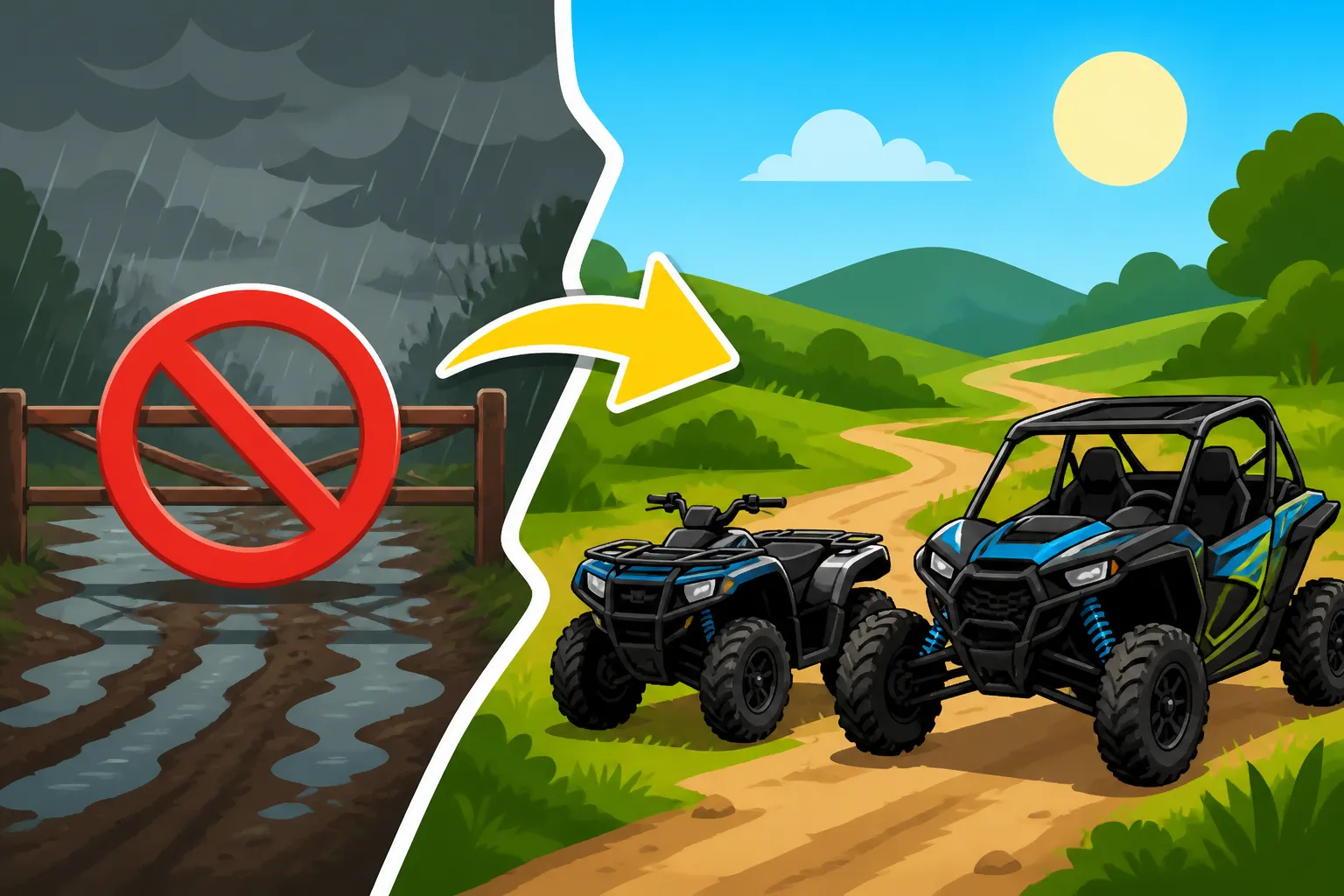
If rain is still falling, or the ground remains saturated, the best backup may be a non-riding day. That can feel frustrating after a long drive, but pushing ahead can turn a disappointing closure into a damaged machine, a recovery problem, or an injury. A clear decision made at the staging area is better than discovering halfway into a route that conditions are worse than expected.
Consider whether travel to another park is worth it
A backup park can look convenient on a map and still be a poor choice once you account for driving time, check-in requirements, fuel, and the possibility of another closure. Before leaving, calculate the practical cost of the detour: how long the drive takes, whether the park is accepting riders, and whether you will have enough daylight for a worthwhile ride.
If the trip is already underway, ask the group what matters most. If everyone came for several hours of riding, a substantial drive to a confirmed-open park may make sense. If the alternative leaves only a short window on the trails, changing the day’s plans may be more satisfying than rushing through a ride under pressure.
Use onX Offroad to help compare the general locations and plan the drive, but verify trail access separately. Recheck the destination’s status before departure, especially if rain continues or more showers are forecast. A second call can save you from hauling the trailer to a gate that has also closed.
A practical rain-closure plan
Make the call before unloading
When you arrive and see a closure notice, pause before unloading the machines. Read the posted information, confirm whether the closure applies to the entire park or only certain areas, and contact staff if the notice is unclear. Do not move a barrier, ride around a gate, or follow another group onto a closed trail.
If the park confirms that some routes remain open, ask which areas are authorized and whether the conditions are appropriate for your machine and experience level. Get specific directions rather than relying on “the back side should be fine” or similar informal advice. If no one can confirm that a route is open, treat it as unavailable.
This is also a good moment to check your group’s practical needs: remaining daylight, fuel, weather, and whether anyone is uncomfortable with the alternative. A shorter ride on an open, suitable trail is better than a longer route that leaves the group exposed to deteriorating conditions.
Have a backup plan before the trip
Before leaving home, identify one or two possible alternatives near your destination and save the official contact information. Check the park’s closure notices on the morning of the ride, then call again if the weather changes. Kentucky Trails Closed After Rain and Call Before You Haul at Turkey Bay offer useful reminders about building this check into the trip rather than treating it as an afterthought.
A simple plan can prevent a lot of frustration:
- Check the destination’s official status before loading.
- Confirm closures, access roads, and machine rules directly with the park.
- Identify a second managed area, but verify its status independently.
- Decide in advance whether the group will travel farther, switch activities, or reschedule.
- Keep maps and contact information available in case cell service drops.
If the destination is closed and no alternative is clearly open, do not improvise on an unmarked road, private property, or an unauthorized trail. The safest choice may be to head back, visit another local attraction, or return when the trails are ready. It is disappointing to lose a riding day, but protecting the trail system helps keep Kentucky’s riding areas available for future trips.
Disclaimer
This article is for general informational purposes only and does not constitute professional advice. Laws, prices and regulations vary by location and change over time. Consult a qualified professional for guidance on your specific situation.