Riding a Mountain Park in Fog
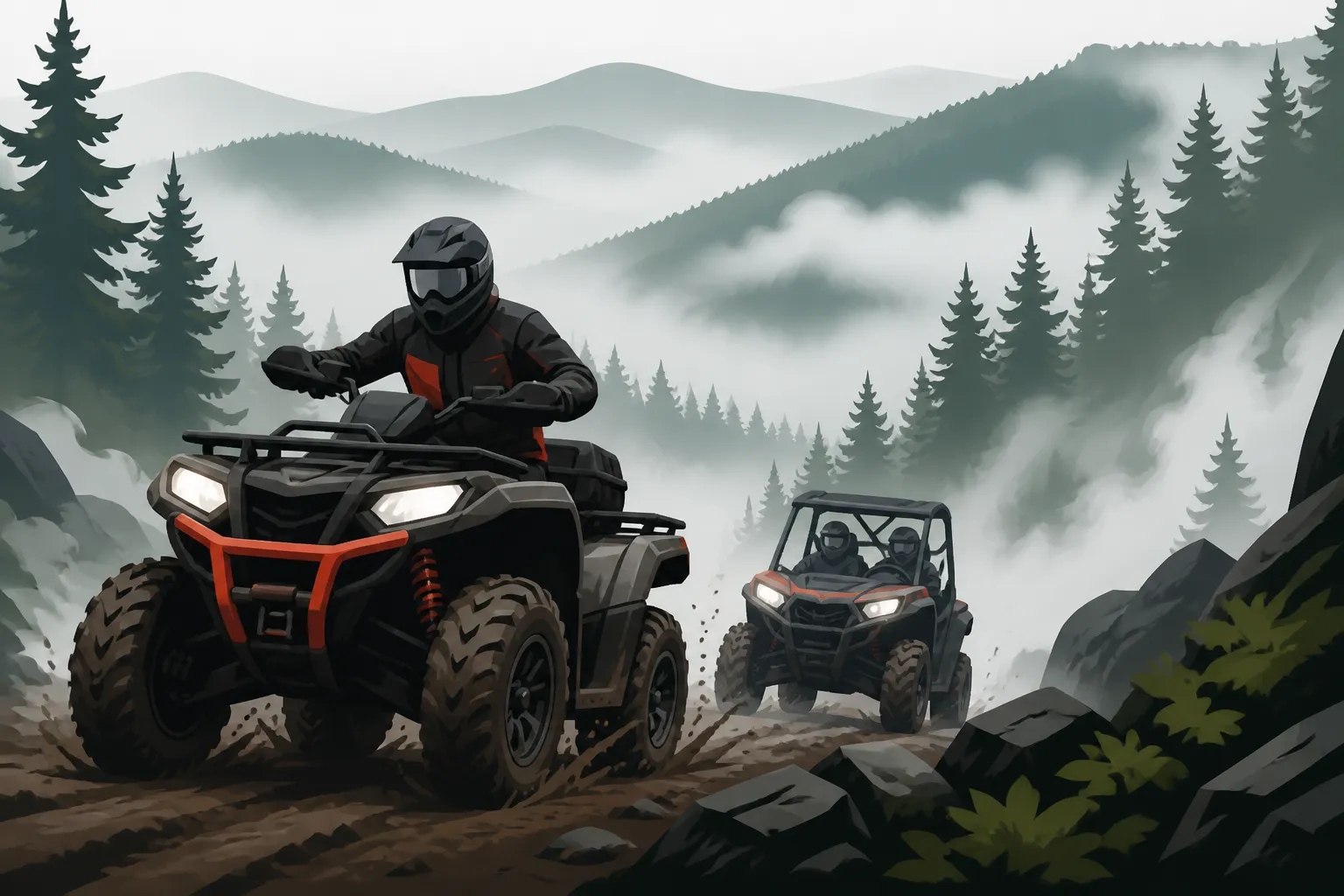
Fog can turn a familiar Kentucky mountain trail into a confusing mix of wet rock, disappearing landmarks, and unexpected drops. If you’re riding at Black Mountain, Leatherwood, Rush, or another mountain park, this guide explains how to decide whether to ride, prepare your machine and group, and respond safely when visibility worsens on the trail.
Decide Whether the Fog Is Rideable
Mountain fog isn’t just a visibility problem. It can come with damp surfaces, low cloud cover, changing temperatures, and fewer chances to spot a rider, obstacle, or turn ahead. The right call depends on what you can see, what the trail is like, and whether everyone in your group is comfortable slowing down or turning back.
Check the park and the conditions before unloading
A foggy drive into the mountains doesn’t always mean the trails will be foggy, too. Conditions can change with elevation and from one side of a ridge to the other. Before unloading, check the park’s current notices and ask staff whether the area you plan to ride has poor visibility, trail closures, or conditions that could make certain routes unsafe. A trail that seems manageable from the parking area may disappear into cloud or mist farther uphill.
Keep your plan flexible. At a place such as Black Mountain, steep climbs and exposed viewpoints can feel very different in fog than they do on a clear day. At a larger park such as Leatherwood, the distance between your starting point and a familiar landmark can make it harder to adjust quickly if conditions worsen. Thinking through your options before you leave the staging area is more useful than trying to make a rushed decision on a narrow trail.
Check the forecast and the park’s own updates, but treat those as planning tools rather than guarantees. Fog can form or thicken quickly in mountain hollows. If you’re headed out early, visibility may also change as temperatures shift and the sun warms the slopes. For a broader pre-ride checklist, see Kentucky Trail Conditions Before You Ride and Kentucky Trail Closures to Check.
Use a simple go-or-no-go test
Before you ride, ask whether you can clearly identify the trail immediately ahead, stay oriented without relying on distant views, and stop safely within the distance you can see. If the answer to any of those is no, wait, choose an easier route, or postpone the ride. A fog bank doesn’t need to cover the whole mountain to make a specific trail a poor choice.
Also consider who’s riding. A group of experienced adults on familiar terrain may be able to manage a slow, conservative route that would be a bad fit for new riders, children, or anyone who is already uneasy on steep or narrow trails. If someone feels pressured to keep going, that discomfort can lead to rushed decisions. Agree before starting that anyone can call for a stop or turn-around without being argued with.
| What you notice | Safer response |
|---|---|
| You can see the next section of trail and recognize turns | Ride only at a pace that lets the group stop within visible distance |
| Fog is thickening, but the trail remains wide and familiar | Pause, regroup, reassess, and consider returning by the route you know |
| You can’t identify trail edges, turns, or nearby riders | Stop in a safe place and do not continue into the fog |
| Visibility is poor near a steep edge, ledge, or narrow bench | Turn back if you can do so safely; don’t use a risky maneuver to keep the planned route |
| A rider is separated from the group | Stop the group and reunite before moving again |
| Park staff report a closure or unsafe conditions | Follow the park’s instructions and choose another day or route |
The table is a decision aid, not a substitute for the park’s rules or your judgment. Conditions can be unsafe even when you can still see a short distance ahead.
Match the route to the weather and the group
On a clear day, riders may use overlooks, exposed ridgelines, or unfamiliar connectors to explore. In fog, those same choices can reduce your margin for error. Consider an easier route that stays closer to the staging area, avoids exposed edges, and gives you clear options to return. If you don’t know the park well, don’t treat a map line as proof that a trail is suitable for today’s conditions.
A familiar route can be a better choice, but familiarity should not become overconfidence. Fog can hide a washout, fallen branch, stopped machine, or sharp turn that you’ve passed dozens of times. If you’re planning a weekend at a mountain park, build in the possibility that some routes may not be appropriate in poor visibility. Riding Black Mountain for a Weekend and Riding Leatherwood for Three Days can help you think through a trip plan that doesn’t depend on every riding hour going exactly as expected.
Prepare Your Machine and Group
When visibility drops, riders have less time to notice one another and react. Preparation won’t make a foggy ride risk-free, but it can reduce avoidable surprises. Before leaving the trailhead, make sure the machine is ready, the group has a clear plan, and everyone knows what to do if the line of sight gets worse.
Make yourself easier to see
Use the machine’s lights as allowed by the park and keep them clean. Mud, water, and dust can reduce how visible a lamp is, especially in dim conditions. A helmet, jacket, or other riding gear with bright or reflective details can also help other riders notice you sooner. Don’t assume that because you can see another vehicle, its driver can see yours.
Keep a greater gap between machines than you would on a clear day. Dust can make it tempting to ride close to the vehicle ahead so you don’t lose sight of it, but following too tightly gives you less room to react if that rider brakes or encounters an obstacle. Agree on a steady pace and use established hand signals or other communication methods your group already understands. Avoid relying on gestures that might be difficult to see through fog or from behind a helmet.
If you ride a side-by-side, make sure passengers understand that they should stay seated and secured according to the machine’s instructions. Don’t let someone lean out to look for a trail edge or stand in a place where they could be struck by another rider. On an ATV, maintain a position that lets you control the machine comfortably without stretching or turning away from the route to find the person behind you.
Set a route, regroup points, and a turnaround plan
Before setting off, tell the group which trail or area you intend to ride, where you’ll stop to regroup, and what conditions will make you turn around. Keep the plan simple. For example, agree that the lead rider will stop at each major junction and that nobody will continue through a turn unless they can see the rider behind them or have confirmed that the group is together.
A designated lead and sweep rider can help, but neither role makes it safe to push on through poor visibility. The lead should travel at a pace that allows the group to stay together, while the sweep rider watches for stragglers and reports concerns. If the group loses visual contact, stop in a safe place rather than having riders speed up to catch one another.
Carry a map and know how to use it before you need it. Kentucky Trail Maps Worth Carrying is a useful reminder that a phone should not be your only navigation plan. An app such as onX Offroad can help you review mapped routes before the ride; download or save what you need ahead of time and learn the controls while you still have good visibility and a reliable signal. Don’t stop in the middle of a trail to study a screen.
Plan for dead zones and a separated rider
Mountain terrain can make communication unreliable. A phone may have no usable service in a hollow, behind a ridge, or away from a developed area. Discuss what the group will do if someone gets separated: where you’ll stop, how long you’ll wait, and who will contact park staff if the group cannot reunite. Keep the plan practical and avoid splitting up further to search in worsening conditions.
Let someone outside the group know where you’re riding and when you expect to be back. That person should have the park name, your planned riding area, and a way to reach you. This is especially helpful if your group is staying in a place with limited reception or if the ride includes unfamiliar terrain. For more on planning around poor reception, read Cell Dead Zones in a Holler.
A second map option can be useful, but don’t count on a device to solve a visibility problem. onX Offroad may help you compare your location with a route when you can safely stop and check it. It cannot show whether the trail ahead is washed out, whether a machine is approaching around a bend, or whether fog has made a steep section too risky.
Ride Conservatively in Poor Visibility
If you decide conditions are acceptable for a short ride, treat fog as a reason to lower your pace and expectations. This isn’t the day to chase a long loop, test your limits, or follow a faster group into unfamiliar terrain. The goal is to keep enough control and visibility to stop safely.
Slow down and leave room to stop
Ride at a speed that lets you stop within the distance you can see. That may mean going much slower than you normally would, even on a familiar route. Avoid sudden acceleration or hard braking when traction is uncertain, and take extra care over wet rock, mud, roots, and loose gravel. The combination of hidden terrain and slick surfaces can make a routine turn more demanding.
Use caution at intersections and blind bends. Approach slowly enough to check for other riders before entering, and don’t assume that a machine you can’t see isn’t coming. If the trail narrows or crosses an exposed section, pause and assess whether each rider can pass safely without crowding the edge. Leave space between machines and avoid stopping where another rider might not see you in time.
Stay on designated routes and obey signs and staff instructions. Fog can make a trail marker hard to spot, so check the park map before leaving the staging area and watch for landmarks you can confirm at close range. If a junction is unclear, don’t guess. Stop somewhere safe, consult your map, and turn back if you can’t confidently identify the correct route. Kentucky Trail Etiquette on Narrow Benches is also worth reviewing before riding a narrow mountain route.
Avoid risky shortcuts and exposed stopping places
A foggy overlook may offer little view, and reaching it may require crossing an exposed or uneven section. Don’t ride to an edge just to see whether the cloud will lift. Park in a safe, designated spot if you need to stop, and keep the machine clear of the travel path so approaching riders have room.
If you need to turn around, look for a wide, stable area rather than attempting a tight pivot on a slope or near a drop. A narrow bench road or steep sidehill can leave little room to maneuver. If there is no safe place to turn, remain stopped in a position that does not block the trail and contact park staff or follow the park’s emergency guidance. Moving farther into an unknown section just to find a better view can make the situation worse.
Fog can also hide changes in trail conditions. A route that was firm on the way out may be slicker on the return, especially where water runs across the trail or where shade keeps the surface damp. Don’t let the desire to finish a planned loop outweigh what you can see and control. Turning back early is a reasonable outcome, not a failed ride.
Know when to stop riding altogether
Stop and reassess if you can no longer see enough of the route to choose a safe line, identify trail edges, or maintain contact with the group. Get out of the way of other traffic only if you can do so safely. Keep everyone together, check for injuries, and use your prepared route plan to decide whether you can return along known terrain or need help from park staff.
If someone falls, gets hurt, or becomes separated, don’t send multiple riders blindly into the fog. Keep the rest of the group in a safe location and use the park’s posted contact or emergency procedures. If a person may have a serious injury or is in immediate danger, seek emergency help. Share the clearest location information you have, such as the trail name or number, nearby junction, and direction of travel.
It can be frustrating to load up after traveling to a riding park, especially when the weather looked better on the drive in. But lost ride time is a much smaller problem than an injury, a damaged machine, or a group that becomes harder to locate. Check Kentucky Riding in Coal Country Weather before a mountain outing, and make your decision based on conditions at the park rather than on how far you traveled to get there.
Make Fog Part of the Trip Plan
Fog is easier to manage when the group has agreed in advance that the itinerary can change. Build extra time into the day, identify shorter route options, and avoid making a distant destination the only reason for riding. If visibility is poor at the trailhead, waiting for conditions to improve may be the safest and least stressful choice.
Keep navigation simple and use it safely
Review the park map before the ride and note the main junctions, trail names, and routes back to the staging area. If you use a digital map, check that it is ready before leaving a place with a dependable connection. Keep your phone protected and easy to reach, but don’t handle it while moving. Stop in a safe area before checking your location or changing a route.
onX Offroad can be one part of that preparation, especially when you want to review a route before arriving. Pair it with the park’s own map and instructions rather than treating any third-party map as the final word on open trails or current conditions. Your plan should still work if the phone battery runs low, the screen is difficult to see, or the map doesn’t answer what’s happening immediately ahead.
If your group uses a paper map, store it where it won’t become soaked or damaged. Make sure more than one person knows how to use the navigation tools. A single rider carrying the only map or knowing the only route back creates an unnecessary weak point in the plan.
Choose a satisfying ride that fits the day
If the fog lifts, reassess instead of assuming conditions have returned to normal. Check the route ahead, look for standing water or slick ground, and confirm that the group still has enough time and daylight for the planned trip. If fog returns, scale back again. You don’t have to choose between completing the whole itinerary and abandoning the day; a shorter, appropriate ride may still be worthwhile.
If the fog does not clear, consider another activity or come back when conditions are better. Park staff may have information about safer options, but don’t pressure them to recommend a route if they believe visibility is a concern. Respect closures, posted warnings, and the experience level of the least comfortable rider in your group.
A successful mountain ride isn’t measured by how many miles you cover. It’s one where everyone returns together, the machines are in good shape, and the group makes sensible choices when the mountain changes the plan.
Disclaimer
This article is for general informational purposes only and does not constitute professional advice. Laws, prices and regulations vary by location and change over time. Consult a qualified professional for guidance on your specific situation.