Sharing a Mountain With Deer Hunters
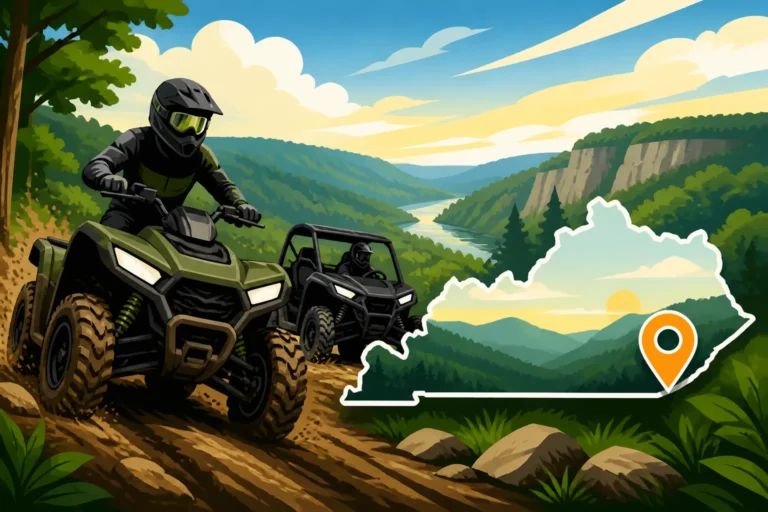
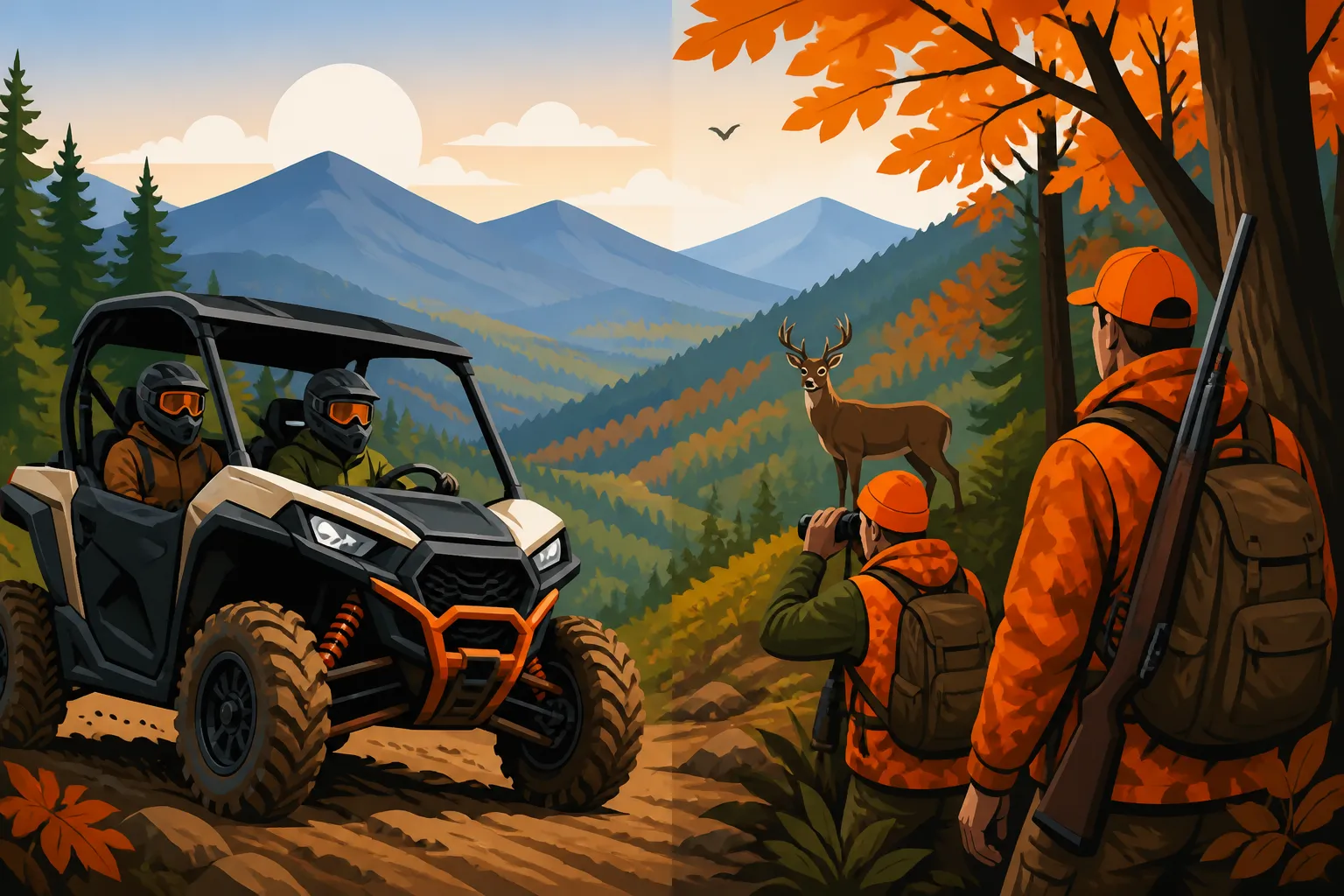
A fall ride in eastern Kentucky can put you on the same ridge, bench road, or trail network as deer hunters. That overlap can feel unsettling when visibility is poor or a machine rounds a blind corner. This guide explains how to check access, make your ATV or UTV easier to see, and share the mountain with care.
Plan your ride around hunting activity
Check access, closures, and local notices
Before loading your machine, find out whether the route is open to off-road riding and whether hunting activity affects access. A trail park, public forest, leased property, and private land can each have different rules. A route that appears on a map may be closed, restricted, or available only to certain users.
Check the land manager’s notices and the trail operator’s updates before you leave. If you are riding at a managed park, contact the park directly when a closure or event notice is unclear. For public land, confirm the current rules with the agency responsible for that area. Don’t assume that a trail remains open simply because you rode it last season.
This matters especially in coal country, where a route may cross land with changing access arrangements or active operations. A gate, sign, or posted notice takes precedence over what a map seems to show. For a broader planning checklist, see Kentucky Trail Closures to Check and Kentucky Trail Conditions Before You Ride.
Choose your timing and route thoughtfully
Hunting activity can be concentrated around particular parts of a mountain, especially during popular deer seasons. If you have flexibility, ask the trail operator whether certain areas are busier or whether riding hours change. You may decide to choose a different route, start later, or postpone the ride rather than enter an area where users are likely to be close together.
Keep your planned route conservative. A narrow bench road with steep drop-offs, tight turns, and limited places to pull over is a poor place to discover that riders and hunters are approaching from opposite directions. Look over your route before leaving and identify wider pullouts or staging areas where you could safely stop and let another group pass.
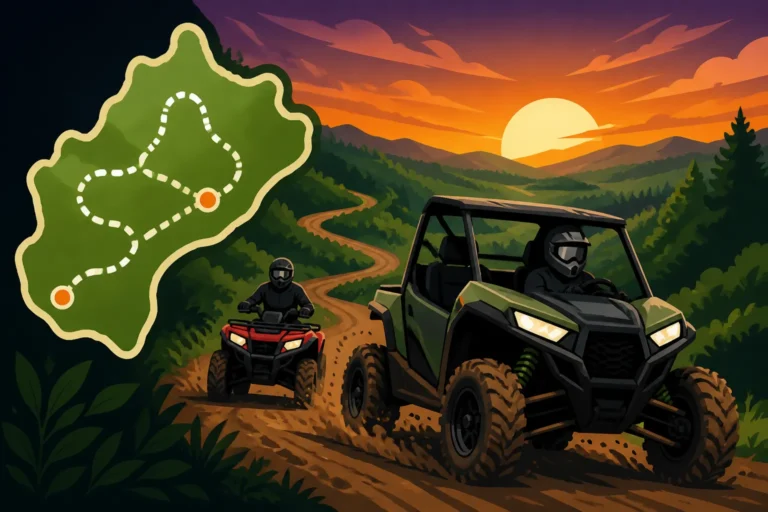
If you use a navigation app such as onX Offroad, treat it as a planning aid, not proof that a road is open or appropriate for riding. Review the route in advance, save the information you may need where your phone has no signal, and confirm access with the land manager. A map can help you avoid getting turned around in a holler, but it cannot replace current signs or local instructions.
Make yourself visible without creating confusion
Wear high-visibility clothing and protective gear
A rider can be difficult to see in a wooded hollow, particularly when wearing dark riding gear beneath a helmet. Choose bright, visible outer layers when conditions and park rules allow, and consider blaze orange during hunting season. A bright vest or jacket can help hunters distinguish a person from the background, but it does not make every situation safe by itself.
Visibility also depends on the terrain. A rider on a ridge may stand out against the sky, while someone stopped beneath trees can blend into the shadows. Wear visible clothing even when you expect to stay on a well-used trail, and make sure passengers do the same. For a season-focused discussion, see Blaze Orange on a Kentucky November Ride.
Keep required riding protection in place as well. A high-visibility layer should not interfere with a properly fitted helmet, eye protection, or other protective equipment. Avoid loose items that could snag on branches or machinery. If you ride in a group, agree on a simple plan before setting out: stay together, stop in a safe place if separated, and don’t leave a rider behind to search unfamiliar terrain alone.
Use lights and ride in a predictable way
Use your machine’s lights when riding, including during daylight if they help others notice you sooner. Check that they work before the trip, and keep lenses reasonably clear of mud. A headlight can help an oncoming hunter spot a machine through trees, while a UTV’s larger profile may still be partly hidden by brush or a bend.
Ride at a speed that gives you room to react to people, wildlife, fallen limbs, or stopped machines. Slow down before blind corners and narrow sections rather than waiting until you see someone. Avoid sudden swerves, aggressive acceleration, or unnecessary engine noise near people on foot. A predictable rider is easier to understand and safer to pass.
A navigation app can help you stay oriented when several roads look alike, but don’t try to read a phone while moving. Stop somewhere safe before checking the route. If using onX Offroad, prepare your map before heading into a cell dead zone and use it to stay on the route you have already confirmed is open. For additional route-preparation ideas, see Kentucky Trail Maps Worth Carrying.
| Situation | Safer choice | Avoid |
|---|---|---|
| Approaching a blind bend | Slow down, stay to your side, and be ready to stop | Cutting the corner or accelerating through it |
| Seeing a person on foot | Stop at a safe distance and make your presence known calmly | Revving, crowding, or passing close |
| Meeting another machine on a narrow bench | Use a wider pullout if available and agree who will move | Reversing toward an edge without checking |
| Losing the route | Stop in a safe spot and consult your prepared map | Continuing onto an unverified road |
| Finding a gate or closure notice | Turn around and follow the posted direction | Going around a barrier or assuming it is temporary |
Share trails and roads with care
Give hunters and other trail users room
When you see a hunter, slow down well before reaching them and leave enough distance to stop comfortably. If the trail is narrow, wait for a safe place to pass rather than squeezing by. A calm greeting can clear up confusion, but avoid startling someone who is focused on the woods. Give them time to notice you before moving closer.
If a hunter is near the trail or appears to be using the same access road, don’t assume they can hear your machine clearly. Trees, terrain, and wind can muffle engine noise. Stop where you are visible and out of the way, then communicate in a straightforward way. If the person asks you to wait while they move equipment or cross, be patient.
The same courtesy applies to hikers, other riders, landowners, and workers. Keep to marked routes, leave gates as you found them, and don’t ride around a person to continue on an uncertain track. On narrow mountain routes, a small delay is far better than a close pass or a conflict. See Kentucky Trail Etiquette on Narrow Benches for more on handling tight trail encounters.
Respect boundaries and avoid disturbing the area
Stay on designated routes, even when an old road or game trail looks inviting. A track visible on the ground does not necessarily mean motorized use is allowed. Riding off-route can disturb wildlife, damage the surface, cross onto private property, or put you near someone who is hunting away from the main trail.
Respect posted boundaries and landowner instructions. If you are uncertain whether a route crosses private land, stop and confirm access rather than relying on another rider’s assumption. Written permission may be important when riding private property; review Kentucky Rules for Riding Private Land before planning a ride there.
Keep noise and speed under control around cabins, camps, homes, and staging areas. Don’t leave litter, approach hunting setups, or handle equipment that belongs to someone else. If a route is visibly crowded with hunters or other users, consider turning back or choosing another permitted trail. The goal is not just to avoid an accident; it is to leave the area usable and welcoming for everyone.
If something feels unsafe
Stop, communicate, and reassess
If you encounter an unexpected closure, a tense interaction, or a situation where you cannot pass safely, stop in a place that does not block the route. Keep your group together and avoid making sudden movements. Speak calmly, listen to the other person, and give them room. If the situation remains uncomfortable, turn around when it is safe and contact the land manager or park operator.
If you become separated from your group, don’t ride farther into unfamiliar terrain in an attempt to find them. Stop somewhere safe, use your prearranged meeting plan, and check your map. Before the trip, tell someone at home where you plan to ride and when you expect to return. In remote areas, cell service may be unreliable, so don’t make a phone call your only safety plan.
If anyone is injured or there is an immediate threat, contact emergency services when possible and provide the clearest location information you can. A saved map, trail name, nearby landmark, gate, or staging area may help responders locate you. Use onX Offroad or another mapping tool to help identify your position if available, but follow emergency instructions and don’t put yourself or others at additional risk to retrieve a machine.
Build a simple pre-ride routine
A few minutes of preparation can prevent a stressful ride. Before leaving, check the route’s access status, weather, and any hunting-season notices. Make sure each rider knows the route, the group’s stopping plan, and what to do if someone gets separated. Confirm that machines have working lights and that riders have suitable visibility and protective gear.
On the trail, stay alert for people, signs, gates, and changes in the route. Slow down near blind corners, yield when there is no safe passing space, and stop to check your map rather than navigating while moving. If conditions change or the area feels too crowded, turning around is a sensible decision—not a failed ride.
For more season-specific planning, see Kentucky Riding in Hunting Season. A considerate ride helps keep shared mountain routes safer for hunters, riders, and everyone else who depends on them.
Disclaimer
This article is for general informational purposes only and does not constitute professional advice. Laws, prices and regulations vary by location and change over time. Consult a qualified professional for guidance on your specific situation.