Parking a Trailer at a Kentucky Trailhead
A trailer that fits in the driveway can feel impossibly large once you reach a busy Kentucky trailhead. Tight turns, soft shoulders, limited space, and unclear overnight rules can turn the start of a ride into a stressful parking problem. This guide explains how to plan your approach, choose a suitable place to stage, and avoid blocking other riders or access roads.
Plan Your Trailhead Parking Before You Leave
The most useful parking decision often happens before you load the ATV or UTV. A trailhead may have room for a tow vehicle but not enough space for a long truck-and-trailer combination to turn around, unload, and park without interfering with other visitors. Treat parking as part of your ride plan, not a detail to figure out after you arrive.
Check the specific riding area and its rules
Kentucky riding areas are not interchangeable. A parking setup that works at one park may be unsuitable at another, and trailhead access, parking arrangements, and overnight policies can vary by location and season. Before leaving, check the riding area’s official information and look for current instructions about where trailers may be left, whether overnight parking is allowed, and whether separate camping rules apply.
This matters at places such as Black Mountain Off-Road Adventure Area near Harlan, Leatherwood Off-Road Park, Turkey Bay OHV Area in Land Between the Lakes, Rush Off-Road, and the Redbird Crest Trail system. Each has its own access points and visitor arrangements. Don’t assume that the nearest flat-looking area is a designated place to park a trailer. A gravel turnout, shoulder, or wide spot beside a trail can still be needed for traffic, emergency access, or park operations.
If you’re comparing places to ride, Kentucky ATV Trail Mileage by Park can help you think about the scale of a destination, while Kentucky Trail Conditions Before You Ride is a useful reminder to check more than the weather. A route may be open while a particular access point or parking area is busy, muddy, or otherwise unsuitable for your setup.
When an official page doesn’t answer your parking question, contact the park or land manager directly. Ask a practical, specific question: “Can a truck towing a 20-foot trailer turn around and park at this entrance?” is more useful than simply asking whether parking is available. If you plan to arrive late or leave a trailer overnight, ask about those details explicitly.
Map the approach, not just the riding route
A trail map can help you find the general area, but it may not show whether the final approach is comfortable for a long trailer. Look at the route from the highway to the entrance, including narrow roads, sharp bends, steep grades, and places where you could safely pull over if traffic builds up. In eastern Kentucky, a route through a narrow holler or along a winding mountain road can feel very different when towing than it does in a passenger car.
Use onX Offroad or another mapping tool to review the area and save useful information before you lose cell service. A map can help you orient yourself and distinguish the road you intend to follow from nearby routes, but it is not permission to drive onto private, closed, or restricted land. Confirm access with the riding area and follow posted signs when you arrive.
For a useful backup plan, identify a safe place to stop before the last few miles. If the entrance is crowded or the turn looks too tight, you don’t want to be deciding whether to reverse a trailer on a steep, narrow road. Knowing where you can pause without blocking traffic gives you time to call the park, check directions, or wait for a safer opportunity.
Match Your Parking Plan to Your Tow Setup
A pickup towing a small utility trailer and a long truck towing a wide enclosed trailer have different needs. The main question isn’t simply whether a vehicle can reach a trailhead. It’s whether the full combination can enter, turn, unload, and park without putting people or equipment in the way.
Think through turning, unloading, and parking
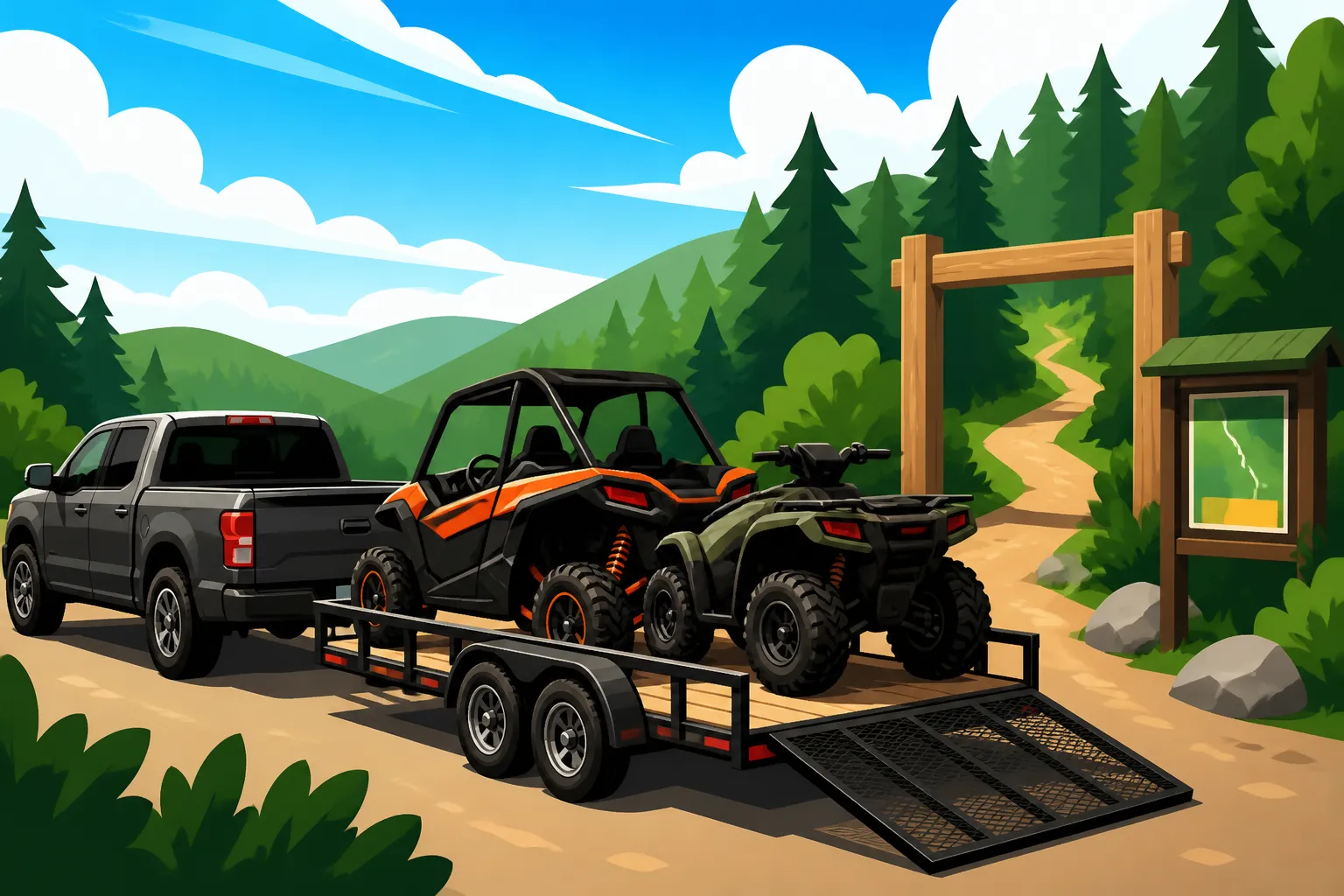
Before your trip, consider the entire sequence. Can you pull in without swinging the trailer into oncoming traffic? Is there room to unload the machine while keeping the truck and trailer out of the way? Once unloaded, can you park without blocking an entrance, another trailer, a gate, a road, or an emergency access route?
If the answers are uncertain, avoid planning to unload in the first open-looking space you see. A trailer may be able to fit on a shoulder but still leave too little room for another vehicle to pass. On a busy day, riders may be loading, unloading, walking between vehicles, and moving machines at the same time. Leaving a clear path is safer than trying to squeeze into a space that technically accommodates your tires.
| Your setup or situation | What to check before arriving | A safer approach |
|---|---|---|
| Short open trailer | Turning room and space to unload | Confirm the trailer can fit fully within the designated parking area |
| Long enclosed trailer | Entrance width, turning clearance, and exit route | Ask the park about your full vehicle-and-trailer length |
| Crowded weekend arrival | Whether parking fills early and where overflow is directed | Arrive with a backup plan and follow staff instructions |
| Overnight parking | Whether the specific location allows it | Get permission rather than relying on what other visitors appear to do |
| Wet or soft ground | Surface firmness and drainage | Avoid shoulders or grass that could rut or trap a vehicle |
| Unfamiliar access road | Sharp turns, grades, and places to pull over | Review the approach and avoid entering if you cannot safely turn around |
The table is a planning aid, not a substitute for site-specific instructions. A space that looks wide enough in a photo may be too tight for your trailer once other vehicles are parked there. If you need to know whether a particular setup will fit, give the park your truck-and-trailer dimensions and ask where it should go.
Bring the right supplies for unloading
A little preparation can keep the unload from becoming a scramble. Pack wheel chocks, tie-downs, gloves, and any ramps or loading equipment you use. Keep the items you need first—such as keys, riding gear, and a phone—in a place you can reach without unloading half the truck. If the ground is uneven, take time to position the trailer safely before anyone starts moving a machine.
Choose a spot where the machine can come off the trailer without crossing a vehicle lane or walking path. Ask passengers to stay clear while the ATV or UTV is being unloaded, and don’t let children wander behind a reversing trailer. If you’re traveling with a group, decide who will guide the driver and where everyone else should wait. A simple plan helps prevent the familiar trailhead tangle of people, ramps, straps, and vehicles all moving at once.
If you ride at places with changing trail access or multiple entrances, save your intended access point in advance. onX Offroad may help you orient yourself during trip planning, especially when you’re comparing nearby roads and routes. Still, confirm that the route is open to your vehicle and trailer, and rely on posted directions and staff for on-site instructions.
Park Considerately at Busy Kentucky Trailheads
At a popular riding area, you’re sharing limited space with other visitors and park staff. Careful parking helps everyone unload more safely, keeps roads open, and reduces the chance that someone has to maneuver around your trailer while trying to enter or leave.
Keep roads, gates, and access routes clear
Never treat a gate, narrow road, or entrance as temporary parking—even if you’re only stopping to unload for a few minutes. Emergency vehicles, maintenance equipment, and other visitors may need to pass. A parked trailer can create a hazard when it blocks sight lines or forces traffic onto a soft shoulder.
Follow signs and any directions from staff. Don’t move cones, barriers, or other markers to make room for your rig. If designated spaces are full, ask where overflow parking is permitted rather than creating your own space on grass, a road edge, or an access lane. A ground surface that looks firm can become soft after rain or repeated traffic, and a trailer can leave deep ruts or become difficult to move.
Give other vehicles enough room to open doors, unload machines, and turn around. If you’re positioned close to another trailer, take a moment to check whether the other driver can leave without asking you to move. This courtesy can make a bigger difference than squeezing in one extra vehicle.
Decide carefully about overnight parking
Parking during the ride and leaving a trailer overnight are different questions. A location that permits daytime parking may not allow overnight storage, and permission to park a vehicle does not automatically mean you can camp beside it. Check the rules for the exact parking area and the dates of your visit.
If you are staying near Black Mountain, Leatherwood, Turkey Bay, or another riding destination, look into the area’s designated camping or lodging options rather than assuming the trailhead is a suitable overnight spot. Ask whether your truck and trailer can remain there while you ride, whether there are separate arrangements for camping, and whether you need to use a particular lot. Keep valuable gear secured and avoid leaving loose equipment visible in the truck bed or trailer.
A map app such as onX Offroad can help you keep track of your planned access point, but it won’t tell you whether leaving a trailer overnight is permitted. For that, use the riding area’s rules or get direct confirmation. If you can’t confirm permission, plan to park at an approved campground or other authorized location.
For visitors headed to Black Mountain, Parking a Trailer at a Kentucky Trailhead is only one part of preparing for the day. Review Starting From the Evarts or Putney Trailhead if you’re planning around that riding area, and check Kentucky Trail Closures to Check before you tow. Conditions and access can change, so the safest plan is the one that leaves room to adapt.
Use a Practical Arrival and Departure Routine
A calm arrival is easier when everyone knows what to do. Trailhead parking can feel hectic when several groups arrive together, but a few simple steps help you avoid rushed reversing, blocked lanes, and misplaced gear.
Follow a step-by-step arrival plan
- Confirm the access point before the drive. Check the riding area’s directions, opening information, parking instructions, and any posted notices. Save the details offline in case cell service is weak.
- Approach slowly and watch for signs. Look for entrance restrictions, parking directions, staff, and traffic already using the area. Don’t assume a route suitable for a car is suitable for a long trailer.
- Pause before entering if the space is unclear. Stop only where it is safe and legal to do so. If you cannot see enough room to turn or park, contact the park or follow its directions rather than improvising.
- Park fully within the designated area. Keep the entrance, road, gate, and access lanes open. Use a spot that leaves enough space for nearby visitors to maneuver.
- Secure the towing vehicle and trailer. Set the parking brake, use chocks when appropriate, and check the trailer before unloading. Keep passengers clear of the vehicle’s path.
- Unload deliberately. Use a guide when backing or positioning the trailer, and keep the machine’s route away from pedestrian traffic.
- Check your parking spot before riding away. Secure loose equipment, take valuables with you when practical, and make sure the vehicle and trailer are not blocking anyone.
If the parking area is crowded, avoid the temptation to unload in a travel lane while waiting for a space. That can create a bottleneck for everyone behind you. Wait in a permitted location or follow staff direction to an approved overflow area.
Make departure as orderly as arrival
Before loading, check that you have the space and time to do it safely. Riders may return at once near closing time, and a busy lot can make it harder to line up a trailer or back into a space. If your group finishes at different times, agree on a meeting point that does not block traffic.
Walk around the trailer before pulling out. Check tie-downs, ramps, lights, and anything that may have shifted during the ride. Look for people, machines, and vehicles that may be moving behind or beside you. If you need to reverse, use a spotter who can stay visible to the driver and stand clear of the trailer’s path.
Leave the parking area as you found it. Take trash and loose gear with you, avoid driving onto soft shoulders to get around a queue, and report a damaged sign, blocked access route, or unsafe parking situation to the appropriate staff. A considerate exit helps the next group start its ride without dealing with someone else’s mess.
For broader trip planning, Kentucky Trail Maps Worth Carrying can help you think about navigation beyond the parking lot, while Calling a Kentucky Park Before You Load is a sensible step when your trailer dimensions, arrival time, or overnight plans are unusual. A quick confirmation before you leave home is far easier than discovering a problem after you’ve hauled your machine across the state.
Disclaimer
This article is for general informational purposes only and does not constitute professional advice. Laws, prices and regulations vary by location and change over time. Consult a qualified professional for guidance on your specific situation.