Riding a Ridge Road in Rain
Rain can turn a Kentucky ridge road from firm gravel into slick clay, loose rock, and ruts that are hard to read from the seat. This guide explains how to decide whether to ride, prepare your ATV or UTV, handle changing traction, and get home safely—while keeping wet-weather riding separate from the rules for using public roads.
Decide Whether the Ridge Road Is Safe to Ride
Check the route, not just the forecast
A forecast that says “showers” does not tell you what a particular ridge road will be like. Rain can move across the mountains unevenly, and a route may be dry at the trailhead but slick on a shaded climb or exposed ridge. In eastern Kentucky, steep slopes and narrow hollers can also funnel runoff onto the road, carrying gravel, branches, and mud into places that looked clear earlier.
Before unloading, check trail notices and contact the land manager or park when conditions are uncertain. A closed gate or posted restriction is the answer, even if the road looks rideable. Rain can make the surface unsafe and increase erosion, especially where tires churn soft soil or water is already cutting channels. Use [Kentucky Trail Conditions Before You Ride] and [Kentucky Trail Closures to Check] as planning reminders, and confirm the rules for the specific property you intend to ride.
Consider what the route will be like on the way back, too. A short climb that feels manageable on firm ground can become difficult when you return over a wet descent. If rain is expected to intensify, or if the road has already started shedding mud and gravel, shortening the ride is often the wiser choice. There is no shame in turning around before a manageable outing becomes a recovery problem.
Recognize conditions that call for a turnaround
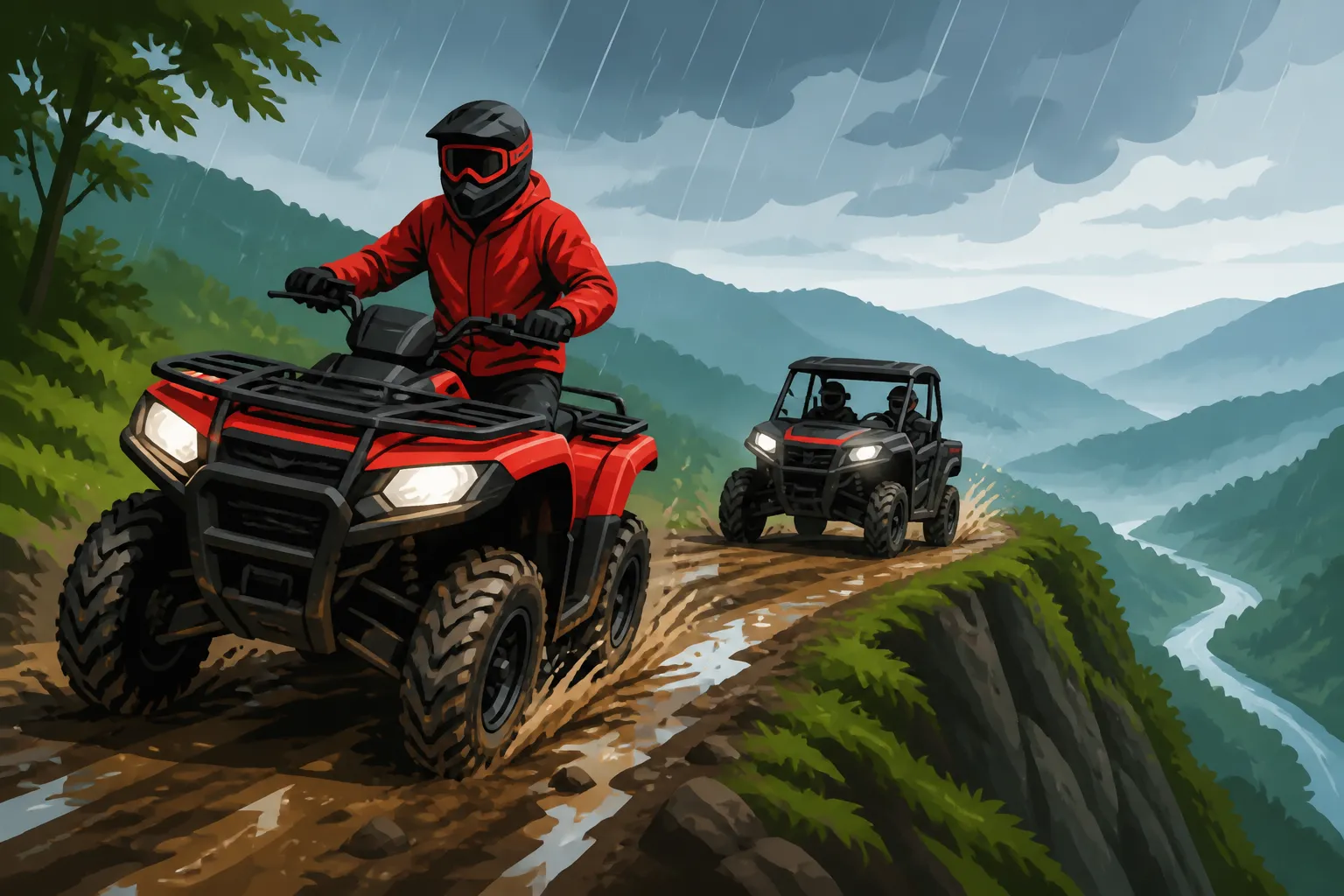
A ridge road is a poor place to test your limits in a storm. Turn around or postpone the ride if you see water flowing across the track, fresh washouts, deepening ruts, exposed roots, or loose rock sliding under the tires. A narrow road with a steep drop, a soft outer edge, or limited room to pass deserves extra caution even when the rain seems light.
Lightning, high winds, fog, and rapidly rising water are reasons to stop riding and seek a safer location. Trees and branches can come down in gusts, while thick fog can hide a sharp bend or another vehicle until the last moment. If you cannot see enough of the road to stop within the visible distance, continuing is not a reasonable gamble.
Use a simple decision check before each section:
- Can the machine climb and descend without spinning or sliding?
- Is there enough room to turn around safely if conditions worsen?
- Can every rider see the route and communicate with the group?
- Is the road open and are you authorized to ride there?
- Would you still choose this route if you had to travel it again in heavier rain?
If any answer is no, choose a safer route or call the ride. For a broader view of how wet ground changes a trip, read [Kentucky Riding After Heavy Rain].
Confirm that the road is actually open to riding
“Ridge road” describes a kind of route, not permission to ride it. Some roads are on private land, some are maintained for work traffic, and others may be public roads where ATV and UTV use is restricted. Do not assume a road is legal to ride because it is unpaved, remote, or marked by tire tracks.
Check the landowner’s permission and the property’s posted rules. If the route connects to a county road or crosses a highway, make sure you understand what is allowed before you set out. Kentucky road rules can be different from trail-park rules, and a trail permit does not automatically grant access to a public road. Start with [Kentucky Rules for Riding Private Land], [Kentucky Rules for Riding a County Road], and [Why Kentucky Roads Are Closed by Default]. For a wider overview of public-road restrictions, see [Are ATVs Street Legal in Kentucky?].
Prepare Your ATV or UTV for Wet Conditions
Inspect the machine before the tires hit the road
A pre-ride check matters more in rain because mud can conceal problems and wet surfaces demand predictable braking and steering. Check tire condition and pressure against the manufacturer’s guidance, inspect the brakes, and look for loose steering or suspension components. Make sure the lights work if visibility may deteriorate, even if your plan is to finish well before dark.
Check that the air intake, electrical connections, and any exposed cargo are ready for the conditions. Follow the owner’s manual for water crossings and avoid water deep enough to reach components that should stay dry. A puddle can hide a rut, a rock, or a sudden drop-off, so never treat standing water as a harmless shortcut.
For a UTV, also check the seat belts, doors or nets, and roof or windshield attachments. A windshield can help keep rain and trail spray out of the cab, but it may also collect mud or fog and reduce visibility. If you are considering accessories from a company such as SuperATV, confirm that a windshield or wiper setup fits your exact machine and does not interfere with the manufacturer’s safety equipment. An accessory cannot make a closed road legal or turn poor conditions into safe ones.
Choose tires and gear for the surface you expect
There is no single tire setup that is best for every Kentucky ridge road. Firm gravel, slick clay, wet rock, and leaf-covered ground each behave differently. Before a trip, consider the route’s surface and the machine’s tires, but do not assume aggressive tread will prevent a slide on a steep, wet descent. Traction depends on speed, slope, tire condition, machine weight, and how smoothly the rider applies power and brakes.
Wear a properly fitted helmet and clothing that protects against rain, cold, and flying debris. Wet gloves can lose grip, while soaked layers can make a rider cold and slow to react. Bring dry layers in a waterproof bag, along with eye protection that gives a clear view through rain and spray. UTV occupants should use the vehicle’s restraints as intended; riders should not stand or lean outside the protective structure to get a better view.
A SuperATV windshield may be useful for reducing direct rain and debris in some UTV setups, but visibility needs attention throughout the ride. If it fogs or becomes coated in mud, stop in a safe place to clear it rather than driving by guesswork. Keep a microfiber cloth or other suitable cleaning supplies protected from moisture, and check the manufacturer’s care guidance for the particular windshield material.
Pack for delays, not only for the planned ride
Wet-weather rides can take longer than expected. A group may need to stop to clean a windshield, inspect a tire, wait for a storm to pass, or reroute around a washed-out section. Carry drinking water, food, a first-aid kit, a charged phone, and a way to communicate when cell service is unreliable. Tell someone where you plan to ride and when you expect to return.
A compact recovery kit may include a winch or suitable recovery equipment, gloves, a basic tool kit, and supplies for common minor problems. Use recovery equipment only when you understand the method and have a secure anchor point. Never stand in the path of a loaded winch line, and do not attach a strap to a tree without appropriate protection.
| Wet-weather condition | Main concern | Safer response |
|---|---|---|
| Slick clay on a climb | Tires spin and the machine slides sideways | Use smooth, steady control; turn around if the surface will not hold |
| Loose gravel on a descent | Braking can push gravel and reduce control | Reduce speed before the slope and avoid abrupt inputs |
| Water covering the road | Hidden ruts, rocks, or washouts | Do not enter if you cannot judge depth and the surface underneath |
| Fog on an exposed ridge | Reduced sight distance and delayed reactions | Stop in a safe place or leave the route |
| Mud on a UTV windshield | Obstructed visibility | Pull over safely and clean it before continuing |
| Thunder or strong wind | Lightning, falling branches, and poor visibility | End the ride and move to a safer location |
Ride With Control on Mud, Gravel, and Steep Grades
Use smooth inputs and leave room to react
Wet traction is easier to lose than it is to regain. Accelerate gently, steer without sudden movements, and avoid grabbing the brakes when a tire begins to slide. Look farther ahead than you would on a wide, dry road so you can spot a change in surface before reaching it. On a narrow ridge, that extra time can make the difference between slowing down in a safe place and having to react at the edge.
Keep a generous gap between machines. The rider in front can throw mud, and the machine behind needs room to stop if the lead rider slows or encounters a hazard. In a group, agree on a pace that the least experienced rider can manage. Use clear hand signals or radios if available, and stop in a pullout or another safe location rather than bunching up around a blind bend.
If the tires begin to spin, avoid repeatedly applying more throttle. That can dig deeper ruts and make the machine harder to control. Ease off, reassess the line, and back out only if you can do so safely. If you cannot find a stable route, turn around or use appropriate recovery equipment instead of forcing the machine forward.
Treat downhill sections as a separate challenge
A descent can be more difficult than the climb that came before it. Mud and loose stones can move under the tires, and water may run down the same channel you need to use for braking. Approach downhill sections slowly, before the slope begins. Use the braking method recommended in your owner’s manual, and avoid sudden braking or sharp steering while the machine is already sliding.
Choose a line with a stable surface and enough space to correct your path. Avoid riding close to a soft outer edge, especially where rain has undercut the road or pushed gravel downhill. Do not follow deep ruts blindly; they can channel water and pull the tires in a direction you did not intend. If you cannot identify a controlled route down, do not commit just because you reached the top.
When riding with others, give each machine space to descend separately. A stopped vehicle on a steep grade can leave the next rider with too little room to maneuver. Keep the group together through communication, not by crowding each other.
Watch for other road users and work traffic
A ridge road may be used by landowners, maintenance crews, utility workers, forestry vehicles, or mining traffic. Rain can make it harder for everyone to stop, and a large truck may need most of the available road. Slow down near blind corners, listen for engines, and pull into a suitable wide area when passing is necessary. Do not stop on a narrow section where another vehicle cannot get around you.
Be especially cautious on work roads in coal country. A road that appears quiet may still serve active operations, and mud can make heavy vehicles harder to see or hear in time. Follow posted directions and never ride around a barricade or into an area marked closed. [Meeting a Coal Truck on a Narrow Road] offers a useful reminder that these routes may be shared with much larger vehicles.
If a route reaches a public road, do not assume you can continue along it just because you have reached the pavement. Public-road access is governed by separate rules from riding on a private trail or within a park. Review [Kentucky Rules for Crossing a Highway] before planning a route that involves a crossing, and check the requirements that apply to the particular road and machine.
Finish Safely and Learn From the Conditions
Make the return trip part of the plan
Before heading back, pause in a safe place and reassess the weather and surface. A brief shower can become a steady downpour, and traffic can leave fresh ruts or churn a previously firm section. If the route has deteriorated, do not feel obligated to retrace the whole plan at the same speed. Use an authorized alternative if one exists, or turn back while you still have control over the decision.
Keep track of the group, especially after a stop or change of route. Count machines and riders, make sure everyone is warm enough, and check that nobody is trying to continue with a mechanical problem. If a rider is cold, shaken, or struggling to see, a shorter route is the safer route.
Plan to be off the ridge before visibility becomes poor. Rain, fog, and fading light can combine quickly in wooded or mountainous terrain. Avoid relying on a phone map alone if service is unreliable; carry a route map or know the major turns and landmarks before leaving the trailhead.
Clean and inspect the machine afterward
Mud left on a machine can hide damage. After the ride, rinse off mud and debris without directing high-pressure water into bearings, electrical connections, or other sensitive areas. Check the tires for cuts or embedded objects, inspect the brakes and steering, and look for loose fasteners or damaged bodywork. Follow the owner’s manual for cleaning and maintenance.
For a UTV with a windshield, clean it using products and cloths approved for its material. Abrasive dirt can scratch the surface if wiped away dry. If a wiper or accessory was used, inspect it and its mounting points before the next trip. SuperATV products, like any accessory, should be maintained according to the instructions for that specific item rather than treated as maintenance-free.
Write down anything that surprised you: where water crossed the road, which climb became slick, where visibility dropped, and whether the route was busier than expected. That information can help you choose a better route next time. Share it with your riding group without encouraging anyone to ignore closures or landowner restrictions.
Let the conditions set the limit
A successful rainy-day ride is not measured by how far you pushed into bad weather. It is measured by whether everyone returned without injury, the machine stayed under control, and the group respected the road and the land. Kentucky ridge roads can be beautiful in a light rain, but the same weather can change the surface and visibility in a matter of minutes.
When in doubt, wait, shorten the route, or choose a different day. That may feel disappointing after loading the trailer and making the drive, but it is better than getting stuck on a narrow slope or damaging a trail that needs time to recover. The best preparation is knowing that turning around is always an acceptable plan.
Disclaimer
This article is for general informational purposes only and does not constitute professional advice. Laws, prices and regulations vary by location and change over time. Consult a qualified professional for guidance on your specific situation.