Kentucky Helmet Law for ATV Riders
It's no secret that hitting the trails in Kentucky on your ATV or UTV is an exhilarating experience, but before you rev that engine, there's a crucial piece of gear you need to think about: your helmet. The rules around helmet use in Kentucky can sometimes feel like a tangled mess of "when, where, and for whom," leaving many riders scratching their heads and wondering if they're playing by the book. This guide aims to unravel that confusion, giving you a clear, empathetic look at Kentucky's ATV helmet laws so you can ride safely and legally, without the constant worry of an unexpected citation.
Understanding Kentucky's Baseline Helmet Law for ATV Riders
When you think about ATV riding, safety should always be at the forefront, and that's exactly why Kentucky has specific laws regarding helmets. The state isn't trying to dampen your fun; they're genuinely trying to protect riders. The primary confusion often arises because the law isn't a blanket "everyone, everywhere, all the time" rule, but rather has specific triggers based on age and location.
The Age Mandate: Riders Under Sixteen
Let's start with the clearest rule: if you're under the age of sixteen and riding an ATV in Kentucky, your helmet needs to be on, period. This isn't just a suggestion; it's a legal requirement. Parents and guardians often carry the responsibility here, as they're the ones ensuring their younger riders comply. Imagine a crisp autumn morning, you're getting ready for a ride at a local trail park, and your excited 12-year-old is bouncing off the walls. Before they even think about starting their machine, that helmet needs to be securely fastened. For more details on what's expected of younger riders, you might find [Kentucky Helmet Rules for Riders Under 16] particularly helpful.
This rule is rooted in protecting our most vulnerable riders. Kids, naturally, might not always make the safest choices, and their developing bodies are more susceptible to serious injury in an accident. The manufacturer's age label on an ATV often plays a role here, influencing the state's approach to youth ridership. Even if your child is an experienced rider, the law doesn't make exceptions for skill level when it comes to age. It’s a bright-line rule designed to provide a layer of protection that could literally be life-saving.
Where the Law Applies: Public Land and Property
Now, here's where it can get a little nuanced. Kentucky's helmet law for ATV riders primarily applies when you're operating an ATV on public property. What exactly constitutes "public property"? This can include state-managed trail systems like Black Mountain Off-Road Adventure Area, county roads where ATVs are permitted under specific conditions, or even public easements. If you're riding along a [Kentucky Rules for Riding a County Road], even if it's just for a short stretch, and you're under 16, that helmet absolutely needs to be on.
The intent behind this is to ensure safety in environments where the state has a vested interest in public welfare. When you're on public land, you're sharing space, and the state sets the safety standards. Think of it this way: if you're on a trail at Rush Off-Road, which is technically accessible to the public, the state's rules, including the helmet mandate for minors, are in full effect. It’s about creating a baseline of safety for everyone enjoying these shared resources, and it's a concept that often surprises riders who are used to more lax rules in other settings.
What About Passengers?
It's not just the operator who needs to think about helmet safety; passengers are also covered by Kentucky's age-based helmet law. If you have a passenger who is under 16 years old, they too are required to wear a helmet when riding on public property. This is a critical point that sometimes gets overlooked, especially when families are out enjoying a ride together. Imagine you're on a side-by-side with your younger cousin riding shotgun on a permitted public trail. Just like the operator, that young passenger needs to have a helmet securely in place.
The reasoning here is identical to that for the operator: to protect minors from head injuries in the event of an accident. ATVs and UTVs, while incredibly fun, can be unpredictable, especially on rough terrain. A sudden jolt or an unexpected obstacle could send an unhelmeted passenger flying, with potentially devastating consequences. For more details on protecting your younger companions, consider reading [Kentucky Rules for a Passenger Under 16]. It’s a simple but vital step to ensure everyone returns home safely after a day of adventure.
Key Exemptions to Kentucky's ATV Helmet Rules
While the general rule for riders under 16 on public property is pretty clear, Kentucky law does acknowledge specific situations where the helmet requirement might be waived. These aren't loopholes for recreational riding; rather, they're carefully carved-out exemptions for practical, often work-related, scenarios. Understanding these distinctions is crucial to avoid any misunderstandings with local authorities.
The Farm, Mining, and Logging Work Exception
Kentucky understands that ATVs and UTVs are often invaluable tools for work, especially in rural, agricultural, or industrial settings. That's why there are specific exemptions for individuals operating these machines while performing duties related to farming, mining, or logging. If you're using your ATV to haul feed across your property, inspect fences, or transport tools on a mine site, the helmet requirement for minors might not apply in that specific context. For instance, a 15-year-old helping their parent on the family farm might ride without a helmet while performing farm duties. You can learn more about this exception specifically for agriculture in [Kentucky Helmet Exemption for Farm Work].
These exemptions aren't a free pass for joyriding on a farm or mine property. They're tied directly to the activity being performed. The intent is to facilitate necessary work without undue burden, recognizing that in certain work environments, a helmet might actually hinder visibility or communication, though safety should still be paramount. However, if that same 15-year-old finishes their chores and decides to take a spin purely for recreation on a public road or trail, the age-based helmet rule kicks right back in. The context of your ride is everything in these scenarios, and it's always wise to err on the side of caution.
- Mining and Logging Specifics: Similarly, if you're engaged in mining or logging operations, there are exemptions. A younger worker, supervised and on a private mine haul road, might not be required to wear a helmet under the letter of the law. This is often due to specific industry safety regulations that might take precedence or address different types of hazards. However, it’s imperative to confirm these details with your employer or the specific site safety officer, as interpretations can vary. For those working in mining, [Kentucky Helmet Exemption for Mining] provides further context, and for logging, [Kentucky Helmet Exemption for Logging] will be useful. The key takeaway is that these are work-related exemptions, not recreational ones.
Brief Road Crossings: A Limited Window
Another common point of confusion revolves around using ATVs or UTVs to briefly cross public roads. Kentucky law does allow for short, direct crossings of two-lane public roads, often at a 90-degree angle, to get from one private property to another, or to access an adjacent trail. In these very specific, limited circumstances, the helmet requirement for minors might not apply during the crossing itself, provided no other laws are being violated. This is not an invitation to ride down the road for miles.
Think about a situation where your private property is bisected by a county road, and you need to move your ATV from one field to another. You can make a direct, quick crossing. However, this exemption is incredibly narrow. It doesn't mean you can ride along the shoulder, cruise to the general store, or travel more than the bare minimum distance required. If you're considering a slightly longer journey, like [Crossing a 55 mph Road Without a Helmet], you need to be very aware of the strict limits. Any deviation from the "brief, direct crossing" rule, and you're back under the full scope of the public property laws, including helmet requirements for those under 16.
Riding on Private Property
This is perhaps the biggest "gray area" for many riders. When you're riding solely on private property that you own, lease, or have explicit permission to use, Kentucky's state helmet laws generally do not apply to any age group. This means that if you're on your own land, or a friend's land with their blessing, the decision to wear a helmet is largely a personal one, regardless of age. Many riders find this freedom appealing, and it's where many families teach younger riders the ropes without the immediate legal pressure of public land rules. If you're riding on private ground, this might be of interest: [Kentucky Rules for Riding Private Land].
However, "not legally required" does not mean "not recommended." From a safety perspective, riding on private land is no less dangerous than riding on public trails. Accidents can happen anywhere, and a head injury is just as severe no matter where it occurs. Many experienced riders, and even parents supervising young riders, choose to wear helmets on private property simply because it's the smartest safety choice. It's also worth noting that if you're riding on private property that is then accessed via public roads or trails, those public segments still fall under state law. It's a balance of personal freedom and common-sense safety.
Choosing the Right Helmet and Other Safety Gear in Kentucky
Okay, so we've established when a helmet is required, especially for our younger riders. But what kind of helmet are we talking about? It's not just about slapping on any old piece of headgear. To be truly effective and meet any regulatory expectations, your helmet needs to hit certain benchmarks for safety. Plus, let's be real, a helmet is just one piece of the safety puzzle.
Meeting Safety Standards: DOT Approval and Beyond
When it comes to helmets, the gold standard for safety in the US is the Department of Transportation (DOT) certification. A DOT-approved helmet means it has met minimum performance standards designed to protect your head in a crash. You'll typically find a DOT sticker on the back of the helmet. While Kentucky law itself may not explicitly state "DOT approved" for ATV helmets in all contexts, it's generally understood that any protective headgear should meet recognized safety standards. Riding with a novelty helmet that offers no real protection is a dangerous game, and it certainly won't satisfy any legal requirements if they were to apply.
Beyond DOT, you might also see Snell or ECE certifications. These often indicate even more rigorous testing and higher safety performance. Many serious ATV enthusiasts, or those riding high-performance machines, opt for helmets with these additional certifications for an extra layer of peace of mind. Investing in a good helmet from a reputable brand that specializes in off-road gear is truly investing in your safety. Companies like SuperATV offer a wide range of helmets and protective gear designed specifically for the demands of off-road riding.
The Importance of a Proper Fit
A helmet, no matter how highly rated, is useless if it doesn't fit correctly. This is one of the most overlooked aspects of helmet safety. A helmet that's too loose can shift during a crash, exposing your head to impact. One that's too tight can be uncomfortable and distracting. When you try on a helmet, it should feel snug all the way around your head, without painful pressure points. It shouldn't move side-to-side or front-to-back when you shake your head, and the chin strap should be adjusted so it's tight enough that you can't pull the helmet off by rolling it forward.
It's particularly important for growing children. What fit last season might not fit this season. Always check the fit before every riding season, especially for young riders whose bodies are constantly changing. A properly fitted helmet can significantly reduce the risk of head injury, turning a potentially severe incident into a minor one, or even preventing injury altogether. Don't just grab the cheapest helmet; make sure it's the right helmet for the rider, both in terms of size and safety standards.
Beyond the Helmet: Eye Protection and Protective Clothing
While this guide focuses on helmets, it's crucial to remember that a helmet is just one piece of a comprehensive safety ensemble. Eye protection, typically in the form of goggles or a face shield, is absolutely essential. Kicking up dust, mud, or debris from the trail can instantly blind a rider, leading to a loss of control and an accident. Imagine hitting a dusty patch at speed; without goggles, you're flying blind.
Beyond that, think about long sleeves, long pants, gloves, and sturdy over-the-ankle boots. This protective clothing acts as a shield against scrapes, cuts, bruises, and even burns from hot engine parts. Even a minor tumble can result in nasty road rash if you're riding in shorts and a t-shirt. While Kentucky doesn't mandate these additional items for general ATV use, they are strongly, strongly recommended by every safety organization out there. Protecting your body as a whole ensures a safer and more enjoyable riding experience, letting you focus on the trail ahead rather than worrying about potential injuries.
The Real-World Impact of Non-Compliance
Ignoring Kentucky's helmet laws, especially for younger riders, isn't just a minor oversight. It carries genuine, tangible consequences that can affect your wallet, your insurance, and most importantly, your physical well-being. It's about more than just getting caught; it's about understanding the ripple effect of making unsafe choices.
Financial Penalties and Citations
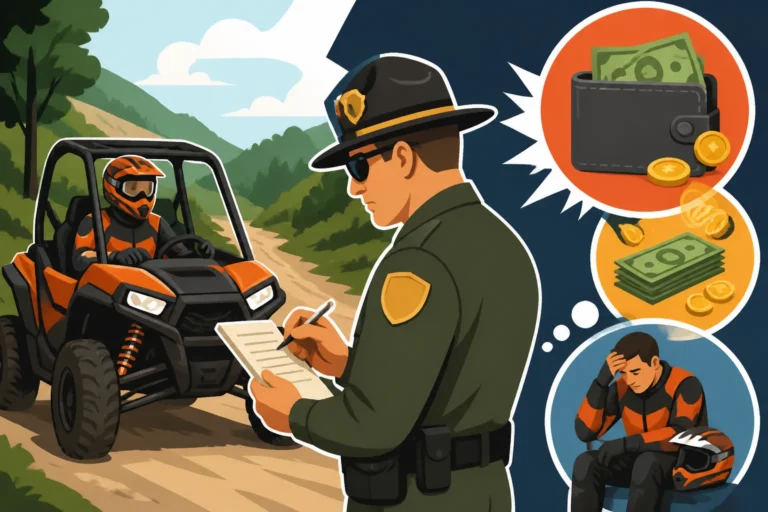
If a law enforcement officer observes a violation of the helmet law, particularly concerning an underage rider on public property, you could face a citation. These aren't just polite warnings; they come with fines. While specific amounts can vary, it's never a trivial sum, and it can quickly put a damper on your trail riding budget. Imagine you're enjoying a ride in Harlan County, and you're pulled over because your 14-year-old isn't wearing a helmet. A conversation with a deputy could easily turn into a financial penalty. If you want an idea of the costs, [What a Harlan County Road Ticket Costs a Rider] might give you some insight into potential financial setbacks.
Beyond the initial fine, repeated offenses could lead to more severe penalties. It's not just about the monetary hit, either. A citation can also create a record, and while it might not be a traffic ticket in the traditional sense, it signifies a disregard for safety regulations. These fines are designed to act as a deterrent, encouraging riders and parents to prioritize safety and compliance. It's always cheaper and safer to just wear the helmet.
Safety Risks and Accident Scenarios
This is perhaps the most critical consequence of not wearing a helmet: the increased risk of severe injury or even fatality in an accident. Helmets are specifically designed to absorb impact and protect your brain, which is incredibly vulnerable. Even a low-speed tip-over on an uneven trail can result in a devastating head injury if you're not wearing proper protection. Picture a scenario where you hit an unexpected rut, and your machine lurches violently. Without a helmet, your head could strike the ground, a rock, or even part of the ATV itself, with catastrophic results.
The statistics on ATV-related head injuries are sobering. Helmets significantly reduce the risk of traumatic brain injury (TBI) and death. When you choose not to wear one, you're playing a dangerous game of chance with your health and future. It's not just about protecting yourself; if you're a parent, it's about protecting your child from preventable harm. No amount of fun on the trail is worth the potential cost of a life-altering head injury. SuperATV, among other reputable retailers, strongly advocates for helmet use because they understand the inherent risks of off-road riding.
Insurance and Liability Considerations
While [Kentucky ATV Insurance Requirement] for general ATV use on private land is often not mandated, riding an ATV on public roads or trails where the law requires a helmet without one can have serious implications for insurance and liability. If you're involved in an accident and weren't wearing a helmet when legally required, your insurance coverage could be affected. Insurers might argue that you contributed to your injuries by not following the law, potentially reducing or denying your claim for medical expenses or property damage.
Beyond your own injuries, there's the question of liability if others are involved. If you, or a minor under your supervision, cause an accident while non-compliant with helmet laws, you could face increased legal exposure. A lawsuit stemming from an accident could be significantly more complicated and costly if a helmet violation is a factor. Always consult your insurance provider for specifics, but generally, adhering to safety laws is a good way to ensure your coverage remains valid and your liability is minimized. It's one more reason why following the rules, even the ones that seem inconvenient, ultimately benefits everyone involved.
Disclaimer
This article is for general informational purposes only and does not constitute professional advice. Laws, prices and regulations vary by location and change over time. Consult a qualified professional for guidance on your specific situation.