One Headlight and Two Taillights in Kentucky
Oh, the age-old question that plagues so many of us who own ATVs and UTVs in Kentucky: "Can I just ride my machine down the road to get to the trails?" It's a perfectly natural thought when your favorite riding spot is just a mile or two down a county road. But the reality in Kentucky is often a frustrating maze of specific rules, and getting your machine truly "street legal" isn't as simple as slapping on a license plate. This guide is here to untangle the confusion, especially around the crucial topic of lighting and other necessary equipment, so you can understand what it really takes to legally operate your off-road vehicle on Kentucky's paved roads.
The Dream vs. Reality: Why Road Riding is Tricky in Kentucky
For many, the appeal of an ATV or UTV is its off-road prowess – climbing hills, slinging mud, and exploring trails. But what about those times you need to get from your house to the trailhead, or even just cross a highway to reach a buddy's farm? The dream is to seamlessly transition from dirt to pavement, but Kentucky law often throws up roadblocks (pun intended!). It's not about prohibiting fun, but about ensuring safety for everyone sharing the road. This is where the core conflict lies for many riders.
The Default Rule: Roads are Generally Closed
Let's be blunt: in Kentucky, the default rule is that ATVs and UTVs are not permitted on public roads. This isn't just a suggestion; it's the law. Many riders, especially those new to the state or to owning these machines, find this incredibly restrictive. You see other vehicles on the road, and it feels natural to want to join them, but an ATV is fundamentally different in the eyes of the law. They lack many of the safety features of standard automobiles and are designed for different terrain. Trying to operate your machine on a public road without meeting specific criteria can quickly lead to citations and fines, turning a fun outing into a costly headache. [Kentucky Fines for Illegal ATV Road Use] are not to be taken lightly.
Limited Exceptions: Crossings and Farm Use
Now, before you lose all hope, there are indeed some very narrow exceptions to the "no roads" rule. These exceptions are crucial to understand, as they allow for some limited movement, but they are not a blanket permission to ride freely on public highways. For instance, Kentucky law allows for brief, direct crossings of two-lane highways at a 90-degree angle, primarily to get from one section of private property or trail to another. This is often limited to [0.2 Mile and Not a Yard More]. It's a quick dash across, not a cruise down the shoulder.
Another significant exception is for agricultural purposes. Farmers often rely on ATVs and UTVs as essential tools for daily tasks, from checking fences to hauling feed. The law recognizes this, allowing these machines to be operated on public roads for bona fide farm use, often with no mileage cap. [Why a Farm Run Has No Mileage Ceiling] is a huge benefit for rural landowners, but it's important to remember this isn't for recreational rides; it's strictly for farm business. These exceptions highlight that while the state acknowledges the utility of these machines, it still prioritizes road safety by keeping recreational use off most public thoroughfares.
Kentucky's Path to Limited Street Legality: The Special Purpose Vehicle (SPV) Law
For those who want more than just a quick crossing or farm use, Kentucky did create a pathway, albeit a somewhat complex one, for certain off-road machines to gain limited street-legal status. This is where the concept of a "Special Purpose Vehicle" (SPV) comes into play. It's an attempt to bridge the gap between dedicated off-road machines and traditional road-going vehicles, but it comes with a stringent set of requirements and limitations that many riders might not initially be aware of.
What Qualifies as a Special Purpose Vehicle?
Not every ATV or UTV can become an SPV. The law defines an SPV as a vehicle that is not an ATV, but is "designed for recreational use or for off-road use and is not an automobile, golf cart, motorcycle, low-speed vehicle, or truck." This primarily encompasses side-by-sides and certain larger UTVs. The key is that the vehicle must also meet specific safety and equipment standards, which we'll dive into shortly. It's not enough to simply call your UTV an SPV; it has to be legally recognized as one after passing a detailed inspection. This is the big hurdle for many riders, as their stock machines often lack several critical components required for SPV designation.
Where SPVs Can and Cannot Be Ridden
Even if your machine is designated an SPV, it doesn't mean you can cruise down I-64 or any state highway. The SPV law has very specific limitations on where these vehicles can be operated. Generally, SPVs are allowed on county and city streets where the posted speed limit is 45 mph or less. However, there's a huge caveat: individual cities and counties must opt in to allow SPVs on their roads. This means that an SPV legal in one county might be illegal the moment you cross into the next one if that county hasn't passed the necessary ordinance. [Kentucky Cities That Allow UTVs on Streets] are still relatively few, and it requires careful research to know where you can and cannot ride. You also cannot exceed a 20-mile radius from your point of origin unless you're on a designated state highway that has opted into SPV use, which is rare. This geographic restriction, coupled with the speed limit and opt-in requirements, means that SPV status provides very localized road access, not widespread freedom.
Essential Lighting Requirements for Kentucky Road Use
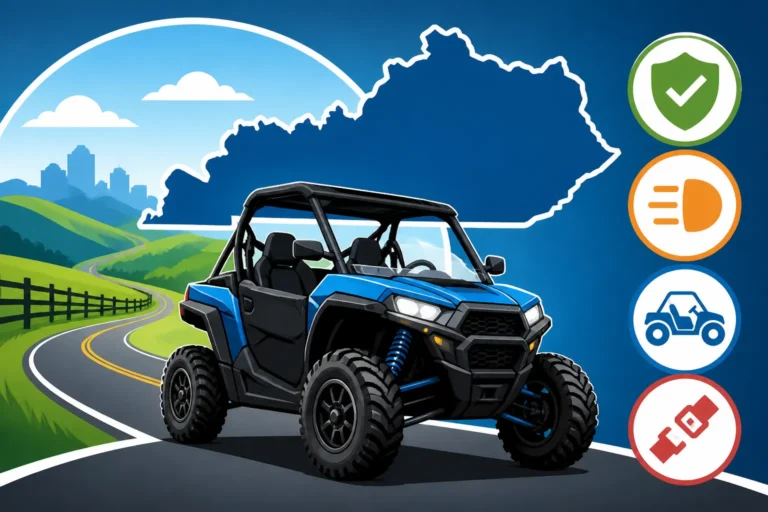
This is where the rubber meets the road, so to speak, for getting your machine legally on pavement. The title "One Headlight and Two Taillights in Kentucky" directly addresses a core part of the SPV equipment list. Without these, and other related lighting, your machine simply won't pass inspection, and you definitely shouldn't be on any public road. These requirements are in place for clear reasons: visibility for yourself and other drivers, and the ability to signal your intentions safely.
Headlights: Illuminating the Path Forward
When it comes to SPVs, your machine must have at least one headlamp, and if it has more than one, they must be mounted and wired to work in unison. Crucially, this headlamp must be capable of illuminating persons and vehicles at least 200 feet ahead. For many stock ATVs and UTVs, the factory headlights are perfectly adequate for trail riding but might not meet the brightness or beam pattern requirements for road use, especially if you plan to operate at night (though SPVs are generally restricted to [Daylight Only Under the Statute], emergency exceptions aside). You might find yourself needing to upgrade to brighter bulbs or even entirely new headlight assemblies. Aftermarket options, like those from companies such as SuperATV, often provide kits designed specifically to meet or exceed these requirements, making it easier to ensure your machine is road-ready in terms of forward illumination. Proper aiming of your headlight is also critical to avoid blinding oncoming traffic.
Taillights and Brake Lights: Visibility from Behind
Just as important as seeing where you're going is being seen by those behind you. Kentucky law for SPVs mandates two functioning taillights. These taillights must be illuminated whenever your headlamp is on, and they need to be visible from a distance of 500 feet to the rear. Additionally, you must have brake lights that activate when the brake pedal or lever is applied, clearly signaling when you're slowing down or stopping. These are vital safety features that are standard on cars but might be an addition for some off-road machines. If your UTV only came with one taillight from the factory, you'll need to install a second one. Again, many aftermarket kits are available to help riders add or upgrade these components to meet the two-taillight requirement, ensuring you're not a hazard from the rear.
Turn Signals and Reflectors: Communicating Your Intent
Beyond simply seeing and being seen, you need to be able to communicate your intentions to other drivers. This is where turn signals come in. An SPV must be equipped with working turn signals on both the front and rear of the vehicle. These signals allow you to clearly indicate when you plan to turn left or right, preventing confusion and potential accidents. For many off-road machines, turn signals are not standard equipment, so this will almost certainly be an aftermarket addition. Companies like SuperATV offer comprehensive turn signal kits that integrate seamlessly into most UTVs, providing a professional and legal solution. In addition to active lighting, adequate reflectors are also typically required on the sides and rear of the vehicle to enhance passive visibility, especially in low light conditions or if electrical systems fail. These small, often overlooked details are critical for full compliance.
Beyond Lighting: Other Critical SPV Equipment
While proper lighting is a major component, making your machine an SPV involves much more than just headlights and taillights. Kentucky's SPV law is quite comprehensive, ensuring that these vehicles have a basic level of safety features comparable to other road-going vehicles. Overlooking any of these additional requirements will result in a failed inspection and an inability to get your SPV registered. It’s a holistic approach to safety, considering everything from driver control to passenger protection.
Mirrors, Horns, and Seatbelts
Just like any car, an SPV needs to give the operator a clear view of what's happening around them. This means you must have at least one rearview mirror, and often dual mirrors, providing visibility to the rear. [Turn Signals and Dual Mirrors on a Kentucky SPV] are often required for a full setup. A working horn is also mandatory, allowing you to signal warnings to other drivers or pedestrians. This isn't just a friendly "toot-toot"; it needs to be loud enough to be heard in traffic. And for the safety of occupants, all seating positions must be equipped with seatbelts. While most modern UTVs come with factory seatbelts, they must be in good working order and properly mounted. These seemingly minor additions are fundamental to safe road operation and are rigorously checked during the inspection process.
Tires, Brakes, and Fenders
The tires on your machine are another critical component. They must be in good condition, free of major damage, and have adequate tread depth. The law often specifies a minimum tread depth, typically [Two Thirty-Seconds of Tread in Kentucky], to ensure proper grip on paved surfaces, especially in wet conditions. Off-road tires are generally acceptable as long as they meet the tread depth requirement and are not excessively aggressive for pavement, which could cause handling issues. Your braking system must also be fully functional and capable of safely stopping the vehicle. This includes both your foot and hand brakes (if applicable), and they must operate independently. Finally, fenders or mudguards are usually required to prevent dirt, water, and debris from being thrown up by the tires, which can obscure visibility for other drivers and create hazards. Many aftermarket fender flares, often found through brands like SuperATV, can help ensure compliance if your stock fenders are too minimal.
The Inspection and Registration Process for an SPV
So, you've put in the work, installed all the necessary lights, mirrors, and other equipment. Now what? Getting your machine officially recognized as an SPV in Kentucky involves a specific inspection and registration process. This isn't just a formality; it's the state's way of verifying that your vehicle truly meets all the safety standards before it's allowed on public roads. Skipping steps here will only lead to frustration and delay.
Passing the State Inspection
Once your machine is outfitted, it must undergo a state inspection performed by a certified inspector, usually at your local county clerk's office or a designated facility. This inspection is thorough and verifies every single piece of required equipment, from the single headlight and two taillights to the horn, mirrors, seatbelts, tires, and fenders. The inspector will check that everything is correctly installed, fully functional, and meets the legal specifications. This is [The $25 Kentucky Inspection] that every prospective SPV owner faces. If your machine fails any part of the inspection, you'll be given a chance to make the necessary corrections and have it re-inspected. It's a good idea to double-check every item on the SPV equipment list yourself before you even bring it in to avoid multiple trips. Ensure all lights are working, signals blink correctly, the horn honks loudly, and mirrors provide a clear view.
Annual Registration and Fees
After successfully passing the inspection, you can then proceed with registering your SPV at your county clerk's office. This involves submitting the inspection form, proof of ownership (like a title or MCO), and paying the required fees. [The $10 Kentucky SPV Registration] is typically an annual fee. At this point, you'll also need to provide proof of insurance. Kentucky mandates that SPVs operating on public roads carry liability insurance comparable to what's required for motorcycles, which is more robust than what might be needed for off-road-only use. Once everything is processed, you'll receive your SPV registration and a special license plate that designates your machine as a street-legal Special Purpose Vehicle. Remember, this registration must be renewed annually to maintain your street-legal status. It's also important to keep your registration and proof of insurance with you whenever you operate the SPV on public roads, as law enforcement can and will check for proper documentation.
Disclaimer
This article is for general informational purposes only and does not constitute professional advice. Laws, prices and regulations vary by location and change over time. Consult a qualified professional for guidance on your specific situation.