Crossing a Two-Lane at Ninety Degrees in Kentucky
It's incredibly frustrating when you're out enjoying the Kentucky trails, perhaps moving between different sections of an off-road park, or just trying to get from your hunting camp to a back forty, and a paved road stands in your way. You know you can't just cruise down the highway, but sometimes a short stretch of pavement, especially a two-lane road, seems unavoidable. This guide is here to untangle the specific rules around legally crossing a two-lane public road in Kentucky with your ATV or UTV, so you can navigate those tricky situations without a citation or, worse, an accident.
Understanding Kentucky's Default Road Rules for ATVs and UTVs
Before we dive into the specifics of crossing a two-lane road, it’s absolutely essential to grasp the fundamental principle guiding ATV and UTV use on public roads in Kentucky. Many riders assume that if a road is rarely used or looks unmaintained, it's fair game. Unfortunately, that's rarely the case. The law is quite clear, and understanding this baseline is your first step to staying legal and safe.
Why Kentucky Roads Are Closed by Default
In Kentucky, the default stance on public roads is that they are generally off-limits to ATVs and UTVs. Unlike states where certain county roads might be open unless explicitly closed, Kentucky takes the opposite approach. If a road isn't specifically designated for ATV or UTV use, or if your machine doesn't meet very specific "street legal" criteria, it's considered illegal to operate it there. This can be a bitter pill to swallow, especially when you’re looking at a short hop down a quiet road that connects two fantastic trail systems or leads directly to your favorite fishing spot. It feels like common sense should prevail, but the law operates on a different set of principles, primarily focused on public safety and vehicle classifications. You can learn more about this in [Why Kentucky Roads Are Closed by Default].
Think about it from a lawmaker's perspective: ATVs and UTVs are designed for off-road terrain. They handle differently than cars or trucks, often lack the full suite of safety equipment required for on-road vehicles, and their speed and stability characteristics are optimized for dirt, mud, and rocks, not asphalt. This inherent difference is why Kentucky, like many states, places strict limits on their road use. This isn't meant to punish riders but to ensure everyone's safety, both on and off the machine.
The Importance of Knowing State Statutes
It’s easy to listen to anecdotal advice from fellow riders or assume that what applies in a neighboring county applies everywhere. However, Kentucky's laws regarding ATV and UTV use on public roads are state statutes, and they are applied uniformly across the Commonwealth unless a very specific local ordinance provides an exception (which is rare for general ATV road use, more common for Street Legal Vehicles, or SPVs, which we'll touch on later). Relying on hearsay can land you in serious trouble, from significant fines to having your machine impounded.
Knowing the exact language of the law empowers you. It allows you to confidently decline when a less informed friend suggests a shortcut down a restricted road, and it gives you the peace of mind that you're operating within legal boundaries. Many times, the specific wording defines not just if you can use a road, but how – and that "how" is critical, especially when it comes to crossing a two-lane highway. Ignorance of the law is never an excuse, and a deputy out in the holler isn't going to care that your buddy said it was okay.
Differentiating ATVs from Other Vehicles Legally
One of the biggest areas of confusion revolves around what Kentucky actually defines as an ATV or a UTV, and how that impacts road use. The state has a fairly narrow definition for an ATV, generally referring to a motorized vehicle designed for off-highway use, having four low-pressure tires, a seat designed to be straddled by the operator, and handlebars for steering. UTVs, or side-by-sides, often fall under the broader umbrella of "off-road vehicles" but can sometimes be registered as "Special Purpose Vehicles" (SPVs) if they meet a long list of equipment requirements.
The critical distinction is that a standard, factory-built ATV or UTV, even one equipped with some aftermarket accessories from a company like SuperATV, is not automatically considered street-legal in the same way a car or motorcycle is. Unless it's been converted and inspected as an SPV, it's an off-road machine first and foremost. This classification is the lynchpin for understanding why the rules for crossing a road are so specific and limited, rather than allowing general travel. It’s not about how capable your machine is, but how it's legally classified for road use.
The Limited Access: Kentucky's 0.2 Mile Rule
So, if roads are generally off-limits, what about those essential crossings? Kentucky law does provide a very specific, limited allowance for ATVs and UTVs to briefly use public roads. This isn't a loophole for joyriding; it's a carefully defined exception designed for practical necessity. Understanding this rule is paramount for anyone who rides in Kentucky.
The Two-Tenths of a Mile Limit Explained
The cornerstone of limited road use for ATVs and UTVs in Kentucky is the "two-tenths of a mile" rule. This statute explicitly permits the operation of an ATV or UTV on a public road or highway for a distance not exceeding two-tenths (0.2) of a mile. This isn't a suggestion; it's a hard limit. Exceeding this distance, even by a few yards, puts you in violation of the law. You can dive deeper into this specific rule in [Kentucky's 0.2-Mile Crossing Rule].
Why such a precise, short distance? It's all about minimizing risk. The law acknowledges that riders might need to cross a road to access private property, connect segments of a trail system, or reach an adjacent field. However, it also recognizes the inherent dangers of these machines on pavement. Two-tenths of a mile is seen as a practical minimum to facilitate these necessary movements while preventing prolonged exposure to traffic and road hazards. It's a pragmatic compromise, but one that demands strict adherence from riders. Imagine needing to go just a bit further, perhaps to the next driveway. That extra distance, while seemingly minor, could be the difference between a legal maneuver and a costly ticket.
Permitted Reasons for the 0.2-Mile Crossing
While the distance is fixed, the law also specifies the reasons for which this 0.2-mile rule can be invoked. You can't just cross a road for any reason that suits you. The primary permitted reasons often revolve around agricultural, utility, or property access needs. For instance, if you need to move your UTV from one field to another across a two-lane county road, or if a utility worker needs to access equipment on the opposite side, the 0.2-mile rule provides the narrow allowance.
This means you can’t use the 0.2-mile allowance to simply drive to a store down the street, or to link up with friends at a different trailhead that requires a longer pavement run. The intent of the law is not to provide general road access, but to facilitate specific, short, and necessary crossings. Always ask yourself if your reason for being on the pavement fits within these strict guidelines. If you're using a quality off-road tire from SuperATV, it's certainly not designed for extended pavement use, reinforcing the intent of these short crossings.
Crossing a Two-Lane at Ninety Degrees: The Specific Method
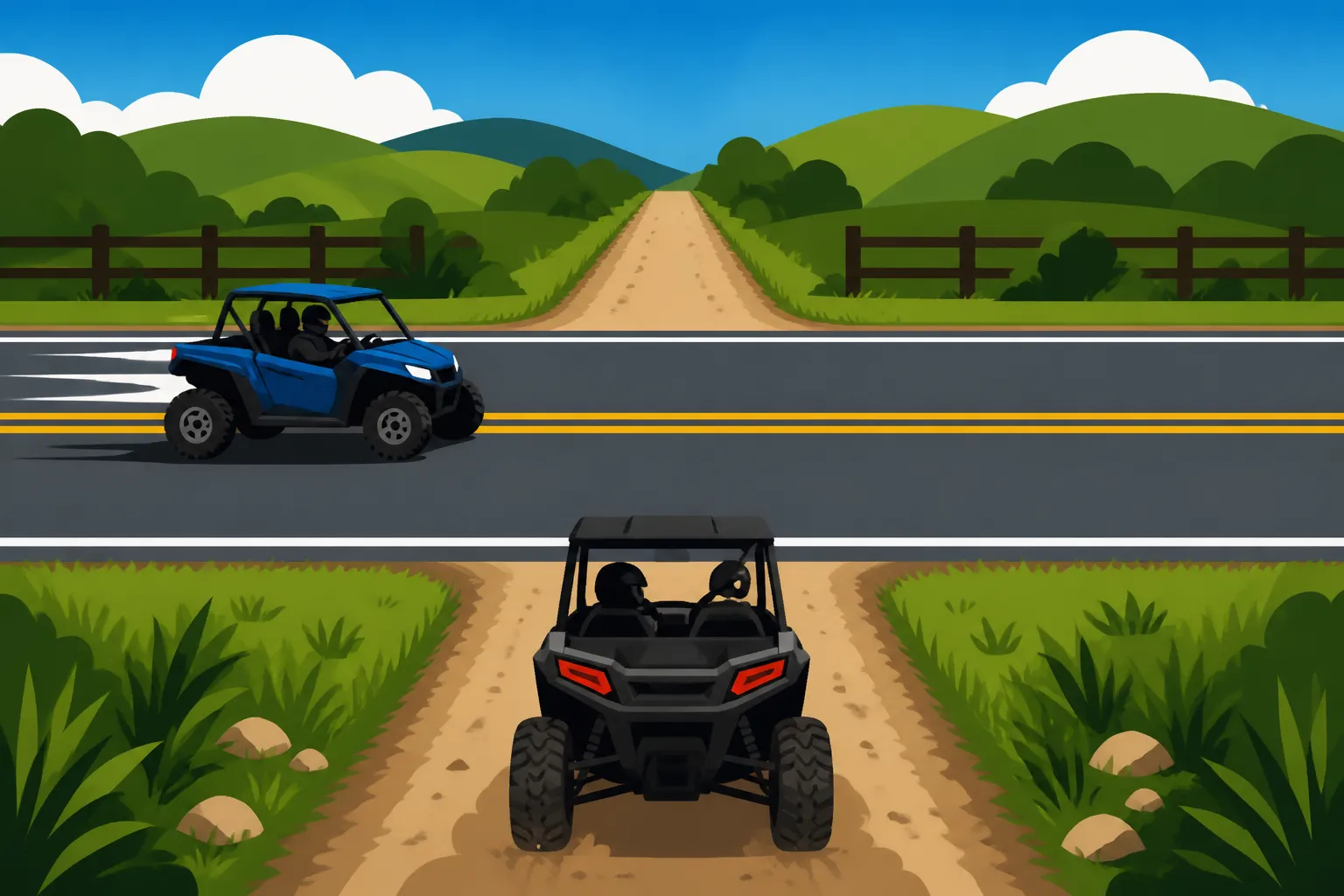
Now we get to the heart of the matter: how you actually perform the crossing. The Kentucky statute is incredibly specific here, stating that any crossing of a public road or highway must be made at an angle of approximately ninety degrees to the roadway. This means you must cross as directly as possible, minimizing your time on the paved surface and making your intentions clear to any approaching traffic.
This "ninety degrees" rule isn't arbitrary. It's a critical safety measure. When you cross perpendicularly, you're exposing the side of your machine to oncoming traffic for the shortest possible duration. It also makes your movement predictable. If you were to angle down the road even slightly, you'd be traveling in the flow of traffic, increasing your exposure time and creating confusion for other drivers. Imagine a driver seeing an ATV moving with traffic instead of simply across it – that uncertainty is exactly what the ninety-degree rule aims to prevent. It's about being seen, being predictable, and getting off the pavement as quickly and safely as possible. You can refer to [Crossing a Two-Lane at Ninety Degrees in Kentucky] for further details on this.
Nuances of the Ninety-Degree Crossing
Understanding the letter of the law is one thing; safely and practically executing a ninety-degree crossing on a two-lane road in the real world is another. This isn't just about avoiding a ticket; it's about avoiding serious injury or worse. Every crossing should be approached with extreme caution and a clear plan.
Practical Application of the Ninety-Degree Rule
When you're faced with a two-lane road that needs crossing, the ninety-degree rule means you should approach the road, stop, look for traffic in both directions, and then proceed straight across to the other side. You are not meant to ride on the road to find a better crossing point a hundred feet down; you cross from where you are. This might mean pulling off a dirt track or trail, stopping, and then going directly across to the opposite side where another track or private property awaits.
This requires excellent situational awareness. You'll need to judge traffic speed and distance carefully. On a busy road, this might mean waiting for a significant gap in both directions. Never assume drivers see you or understand your intentions. Your machine, especially if it’s an ATV, can be difficult for motorists to spot, and its lower speed means you’ll be on the pavement for a longer period than a car. Always be prepared to yield to all traffic, even if you feel you have the right of way in a particular moment. The goal is to minimize your exposure and make the crossing as swift and uneventful as possible.
Safety Considerations for Road Crossings
Safety must be your absolute top priority when crossing any public road. Here's a table summarizing key safety considerations:
| Safety Consideration | Description | Why It Matters |
|---|---|---|
| Visibility | Wear bright clothing, especially blaze orange or neon colors. Ensure your machine's lights (headlights, taillights) are on. | ATVs and UTVs are small and low to the ground. Making yourself as visible as possible drastically reduces the risk of being overlooked by drivers. |
| Situational Awareness | Scan for traffic far down the road in both directions. Be aware of blind spots, crests of hills, and curves that limit visibility. | What you don't see can hurt you. A quick glance isn't enough; you need a thorough assessment of the road and its surroundings before entering. |
| Machine Readiness | Ensure your brakes are in perfect working order. Check tire pressure, especially if you've been riding aggressively off-road. | A mechanical failure during a crossing could be catastrophic. Your machine needs to respond predictably and reliably. |
| Passenger Safety | Ensure any passengers are properly seated and understand the crossing procedure. Children should be extra secure. | The sudden acceleration and braking inherent in a quick crossing can unbalance passengers, especially if they are not expecting it. |
| Group Riding | Cross one at a time. The lead rider should signal "all clear" before the next rider proceeds. Avoid crossing in a staggered formation. | A group crossing can be chaotic and unpredictable to drivers. Individual crossings are safer and more manageable. |
| Road Surface | Be aware that pavement offers less grip than dirt or gravel. Sudden braking or steering can be more dangerous. | The transition from off-road to pavement changes your machine's handling characteristics. Adjust your speed and control accordingly. |
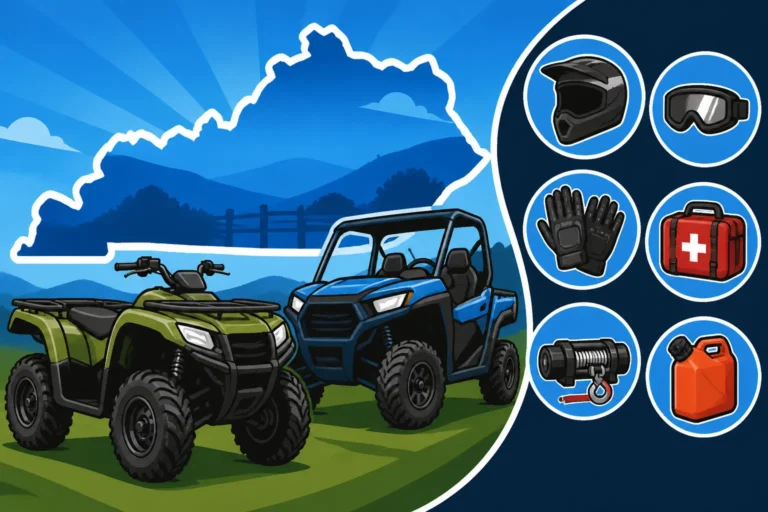
Remember, safety gear is crucial, even for short crossings. Always wear a helmet. [Kentucky Helmet Law for ATV Riders] details these requirements, which apply even more so when interacting with public roads.
Equipment Considerations for Visibility
While standard ATVs and UTVs aren't required to have all the bells and whistles of street-legal vehicles, enhancing your visibility for any road use, including crossings, is just plain smart. Think about it: a small machine covered in mud against a dark background is incredibly hard to spot.
Consider adding aftermarket lighting. Even if your stock headlights and taillights are functional, additional LED lights can make a huge difference, especially if you find yourself needing to cross near dawn or dusk. You can find robust lighting options from companies like SuperATV that are designed for off-road durability but also provide excellent visibility for quick road stints. Bright flags, even on short poles, can also help. Anything that increases your profile and makes you more noticeable to drivers is an investment in your safety. For those considering more extensive road use, looking into the requirements for [One Headlight and Two Taillights in Kentucky] for SPVs can give you an idea of the types of lighting considered essential for visibility on public roads.
Exemptions and Special Circumstances
While the 0.2-mile, ninety-degree crossing rule is the general standard for most ATV and UTV riders, Kentucky law does carve out specific exemptions for certain situations and also offers an alternative path for more extensive road use through the Special Purpose Vehicle (SPV) designation. These are important distinctions that can often confuse riders.
The Kentucky Farm Exception With No Mileage Cap
One of the most significant exemptions in Kentucky law is for bona fide agricultural purposes. If you are operating an ATV or UTV for farming purposes, you are generally allowed to use public roads without the 0.2-mile restriction. This means a farmer can drive their UTV down a county road for several miles to move between fields, check fences, or haul feed, as long as the use is directly related to the farming operation. This is a common-sense allowance that recognizes the utility of these machines in rural settings. You can find more information about this in [Why Kentucky's Farm Exception Has No Limit].
However, "farming purposes" is not a blanket term. It needs to be genuinely tied to agricultural production. Hauling your fishing gear to a pond on your property or taking a scenic drive with your family is not considered a farming purpose, even if you own a farm. Law enforcement generally understands the difference between a working farm vehicle and a recreational ride. This exemption is a lifesaver for many rural Kentuckians, but it comes with the responsibility of genuine agricultural use.
Utility, Mining, and Construction Exemptions
Similar to the farm exception, Kentucky law also provides exemptions for ATVs and UTVs used by utility companies, in mining operations, and for construction or maintenance purposes. These machines are often essential tools for these industries, allowing workers to navigate difficult terrain, inspect power lines, or move equipment on large sites. When performing these official duties, operators can often use public roads in ways that recreational riders cannot.
For example, a utility crew might use a side-by-side to access a remote transformer that requires a mile-long drive down a county road. Similarly, in Kentucky's coal country, ATVs and UTVs are integral to many mining and logging operations, and the law provides allowances for their use on and across public ways when directly engaged in these activities. Again, these are not recreational allowances. They are strictly for official, work-related functions, and abusing these exemptions could lead to citations.
The Evolution of Special Purpose Vehicle SPV Laws
For those who desire more extensive road use than the 0.2-mile crossing or specific exemptions allow, Kentucky has introduced laws for "Special Purpose Vehicles" (SPVs). An SPV is essentially an ATV or UTV that has been modified to meet specific safety and equipment standards, inspected by the Kentucky State Police, and then registered with the county clerk. If a machine qualifies as an SPV, it can operate on certain public roads and highways within specific parameters.
This involves significant modifications, such as adding turn signals, dual mirrors, a horn, a lit speedometer, specific tire tread depths, and often a windshield and seat belts (if not already present). The machine must then pass a safety inspection. This path allows for more freedom on public roads, but it comes with a much higher bar for equipment and ongoing costs like [Kentucky SPV Registration Cost] and mandatory motorcycle-level insurance. It's a significant commitment, but for some riders who frequently need to connect trails or access towns, it's a valuable option that SuperATV and similar companies provide many of the necessary parts for, such as their mirrors or signal kits. For more on general road use for SPVs, you can read [Kentucky Rules for ATVs on Public Roads].
The Consequences of Non-Compliance
Operating an ATV or UTV on Kentucky's public roads outside of the very narrow legal allowances carries significant risks and penalties. It’s not just about getting a slap on the wrist; the consequences can be costly, inconvenient, and in some cases, truly life-altering. Understanding these potential repercussions should reinforce the importance of adhering to the rules.
Kentucky Fines for Illegal ATV Road Use
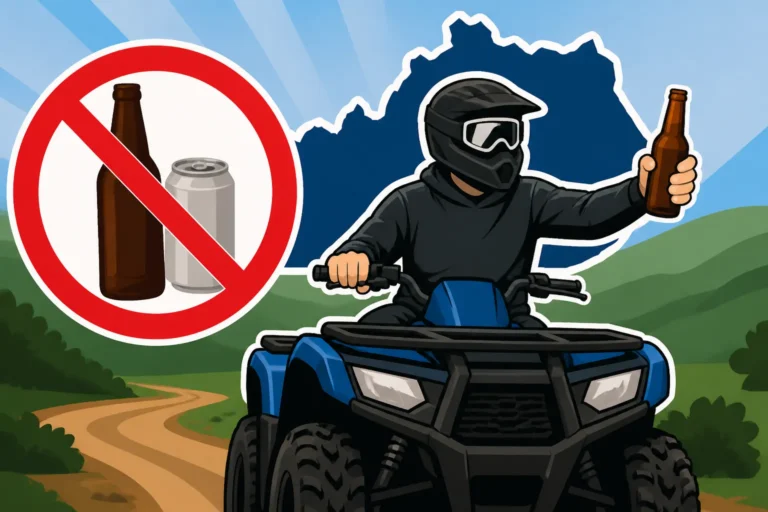
The most immediate consequence of violating Kentucky's ATV road use laws is a citation and a fine. These aren't minor parking tickets. The fines can be substantial, often in the hundreds of dollars, and can quickly add up if you're cited multiple times. Furthermore, the cost isn't just the fine itself; you'll likely incur court costs and potentially legal fees if you choose to fight the ticket. These costs can quickly overshadow the convenience you might have gained by illegally riding on the pavement. Find out more about the financial penalties in [Kentucky Fines for Illegal ATV Road Use].
Beyond the monetary penalties, a conviction for illegal road use can stay on your record. While it might not impact your standard driver's license points in the same way a speeding ticket in your car would, it's still a legal infraction. Future encounters with law enforcement, especially if you're a repeat offender, could lead to more severe penalties, including impoundment of your machine. Imagine getting pulled over near a popular trail system after a great day of riding, only to have your prized UTV, perhaps even one decked out with custom parts from SuperATV, towed away on the spot. That's a day-ruiner, for sure.
Insurance Implications and Personal Liability
This is arguably the most critical and often overlooked consequence. Your standard off-road ATV or UTV insurance policy is typically designed to cover incidents that occur during off-road use, or sometimes on private property. It is highly unlikely to cover an accident that happens while you are illegally operating your machine on a public road. If you're involved in a collision with a car or another vehicle while riding illegally on pavement, you could face devastating personal liability.
Consider this scenario: you decide to "just quickly" cross a two-lane road outside the ninety-degree rule, or exceed the 0.2-mile limit, and an oncoming car doesn't see you. A collision occurs. If you are found to be operating your ATV or UTV illegally on the road, your insurance company will almost certainly deny coverage for any damages to the other vehicle or injuries to its occupants. You would then be personally responsible for potentially tens of thousands, or even hundreds of thousands, of dollars in medical bills, vehicle repairs, and lost wages. This kind of financial ruin can haunt you for the rest of your life. It's simply not worth the risk for a shortcut or a quick pavement run.
Protecting Your Riding Privileges
Consistent disregard for ATV and UTV laws can also impact your ability to enjoy the sport in the long run. While Kentucky doesn't have a statewide registration system for ATVs (other than titling for machines purchased after July 2010), and thus no "points" system for ATV infractions in the same way it does for car licenses, repeated violations could still lead to problems. For example, if you're caught frequently riding illegally, authorities might eventually impound your machine, requiring you to pay significant fees to get it back, if you can get it back at all.
Furthermore, some off-road parks or organized trail systems might have rules or agreements with local law enforcement that could impact your access if you're known for breaking the law on nearby public roads. Protecting your riding privileges isn't just about avoiding a ticket; it's about maintaining a good standing within the riding community and with local authorities, ensuring that these machines remain a welcome part of Kentucky's recreational landscape. Always make sure to adhere to all rules, whether it's for titling your machine or using it on public roads.
Disclaimer
This article is for general informational purposes only and does not constitute professional advice. Laws, prices and regulations vary by location and change over time. Consult a qualified professional for guidance on your specific situation.