Riding Off a Marked Kentucky Trail
Riding off a marked Kentucky trail can seem harmless when a shortcut looks clear or a route appears to continue beyond its sign. But an unmarked path may cross private land, a closed area, or fragile ground. The safest approach is to treat trail markings and closures as boundaries, then check with the land manager before taking any route that is not clearly open.
What riding off a marked trail means in Kentucky
“Off-trail” can describe several different situations: leaving a designated route to make a shortcut, following an unmarked track, entering a closed section, or riding across open ground beside a trail. Those situations may look alike from the seat of a machine, but the rules can differ depending on who manages the land and what access has been granted.
A trail map is not blanket permission to ride anywhere within the area it shows. It may display approved routes, staging areas, and boundaries while leaving out private parcels, restricted work areas, or temporary closures. Likewise, seeing tire tracks does not establish that a route is legal. Someone else’s tracks could be old, unauthorized, or left before a closure.
Kentucky riding areas may involve private property, leased coal land, public land, or a managed off-road park. Each can have its own route system and restrictions. A park permit generally covers the riding allowed under that park’s rules; it does not automatically authorize travel beyond the park’s designated routes. For broader context on how different systems work, see Kentucky Trail Permits Explained and Why Kentucky Has No Statewide Trail Sticker.
| Situation | Why it matters | Safer response |
|---|---|---|
| A marked trail appears to continue past a confusing junction | The route may turn, end, or connect to a restricted area | Stop and check the map or ask park staff |
| A clear track leaves the designated route | Tire tracks do not prove permission | Stay on the marked route |
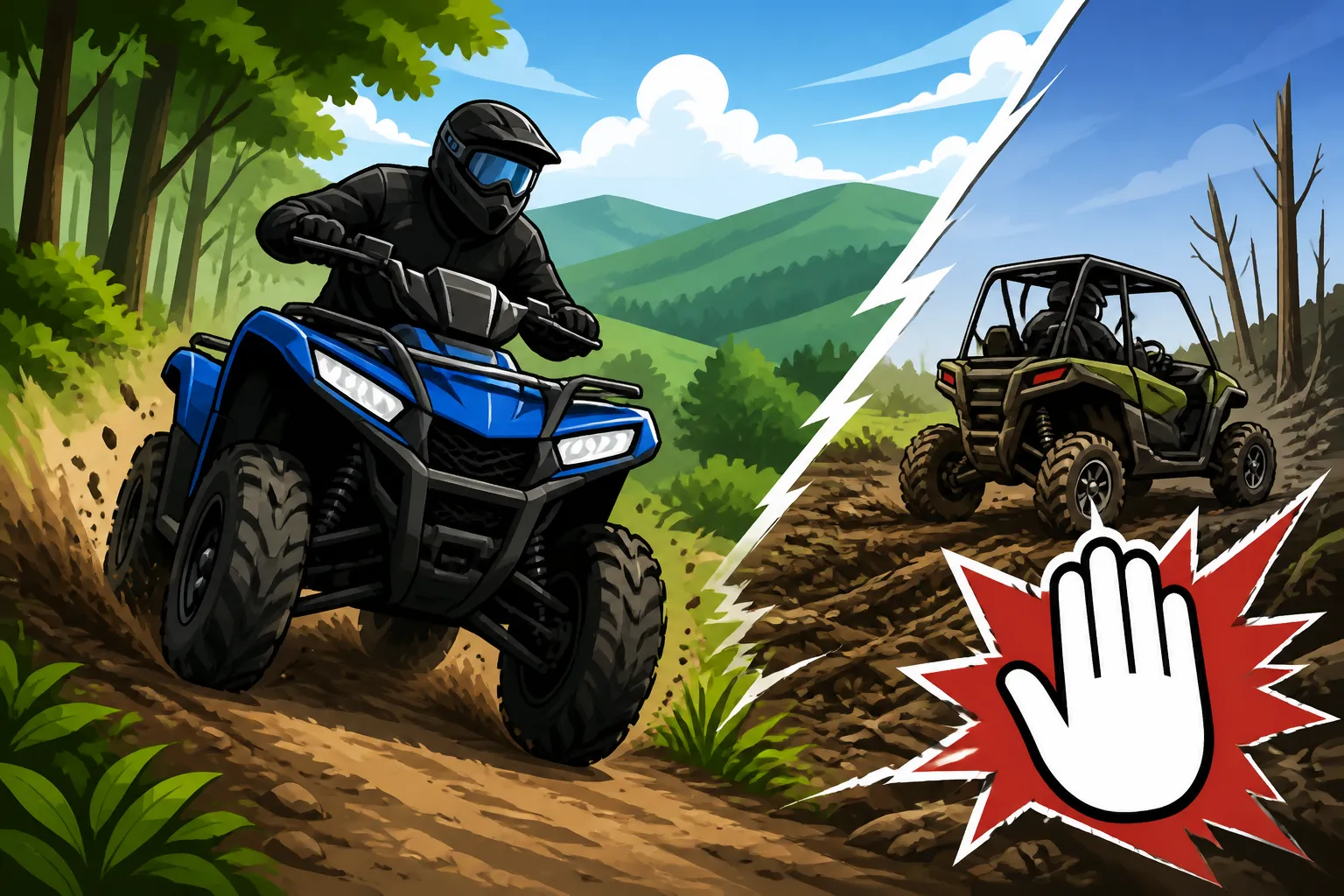
| A sign or gate indicates a closure | The closure may protect riders, workers, or the land | Turn around; do not go around the barrier |
| A route crosses private or leased property | Access may be limited to specific trails or conditions | Confirm permission and boundaries with the land manager |
| A trail is washed out or blocked | A detour could lead into unsafe or unauthorized terrain | Return to the last clear junction and report the problem |
The practical rule is simple: if you cannot confirm that a route is open to your machine, do not assume it is. A trail can be physically passable but still off-limits.
Why markers and closures matter
Trail markers are more than navigation aids. They help keep riders away from hazards, protect the land, and prevent conflicts with people using the same property for other purposes. A route that appears to be an easy detour could lead into a steep drop, unstable ground, a creek crossing, an active work area, or a boundary where riding is not allowed.
Closures can be temporary or permanent. Heavy rain may make a trail unsafe or particularly vulnerable to damage. A route could also be closed for maintenance, land-management work, or another activity. Conditions change, so a trail map saved before a trip may not reflect a current closure. Before loading up, check the park’s latest notices and contact the operator if an important junction or detour is unclear. Kentucky Trail Closures to Check offers more on what to verify before heading out.
Going around a closed gate or sign is not a harmless way to keep a ride moving. The closure applies to the route or area, not just the obstacle blocking it. Riding around a barrier may put you into the very area that managers are trying to keep clear. It can also make emergency response more difficult if rescuers have to determine which route you took.
Stay alert to other people and vehicles, too. A trail system may share access with workers, hikers, hunters, or other riders. An unofficial route can bring you onto a road or property where those users do not expect an ATV or UTV. Narrow trails and benches leave little room to pass, so using the established route helps make travel more predictable. See Kentucky Trail Etiquette on Narrow Benches for practical guidance on sharing tight routes.
Land impacts are another reason to stay on the trail. A new track can widen an existing route, cut across vegetation, or channel water downhill. Repeated travel over wet ground can turn a small disturbance into a muddy rut or an eroded track. Riders following the first set of fresh tracks may enlarge it further. Choosing the marked route helps avoid creating damage that could lead to more closures.
A permit does not settle these questions by itself. It may be required to ride in a particular area, but it does not necessarily grant permission to leave designated routes, cross into another property, or ignore a closure. Check the specific park or land manager’s rules rather than relying on a permit from another location.
How to handle an unclear route or an accidental turn
A confusing junction is a reason to pause, not guess. Stop somewhere safe and out of the way of other riders. Check the official map, posted signs, and any current closure notices. If the route still is not clear, go back to the last junction you recognize. Do not follow a faint track simply because it seems to point toward your destination.
Use this process when a marked route becomes uncertain:
- Stop before entering the questionable section. Keep the machine clear of the main riding line where possible.
- Check your map against visible signs, junction markers, and known landmarks.
- Look for a posted closure, boundary sign, gate, or route designation. Do not treat the absence of a sign as proof that riding is allowed.
- If you cannot establish that the route is open, turn back to the last known marked trail.
- Ask park staff or the land manager for direction if the map and signs conflict or a marker is missing.
- Report a missing sign, blocked route, or confusing junction when you can do so safely.
If you realize you have left the marked trail, do not continue exploring to find a more convenient way back. Stop and retrace your route to the last known legal trail, if it is safe to do so. Avoid widening the track or attempting a risky maneuver on steep, unstable, or wet terrain. If you cannot return safely, contact the appropriate park staff or emergency help rather than pushing farther into unknown ground.
Do not move a sign, open a gate, or ride around a barrier to make a route easier to follow. A marker may be placed to guide riders away from a hazard or restricted area. If it looks damaged or out of place, treat the route as uncertain and ask the operator.
For trips on public or leased land, find out who manages the specific riding area before departure. The rules for a designated trail system are not necessarily the same as the rules for surrounding property. Kentucky Rules for Riding a National Forest and Kentucky Rules for Riding a Leased Coal Property cover two settings where route boundaries and land-management rules are important. On private ground, get permission from the person who controls access and ask which routes are open; see Kentucky Rules for Riding Private Property.
What can happen if you leave the route
The consequences depend on where you are, who controls the land, and what you do. A park operator may direct a rider back to the approved route or take action under its rules. On other land, riding beyond permitted boundaries may be treated as unauthorized access or trespass. A route may also be closed because of a hazard, so entering it can expose you and other riders to risks that are not obvious from the trail entrance.
There can be practical consequences even when no citation is issued. An off-route detour can damage the machine, lead to a difficult recovery, or put the rider in a place where there is no safe turnaround. In areas with limited cell service, that can turn a navigation mistake into a longer problem. It can also affect other riders: damaged ground and repeated boundary violations may contribute to restrictions or closures for everyone.
The safest plan is to build a little flexibility into the ride. Carry a current map, keep the park or land manager’s contact details available, and identify a turnaround point before taking a route that is new to you. Avoid planning a ride that depends on an unmarked connection. If a trail is closed or uncertain, choose a confirmed open route instead.
If you are stopped by park staff or another authorized person, stay calm, follow directions, and explain where you entered the route. Do not argue that other riders have used it or that no sign was visible. If you believe the closure or boundary was unclear, document the location and raise the question through the proper channel after returning to a safe place. Rules and enforcement vary by site, so consult Kentucky Rules for Riding Off the Trail for related information and confirm current requirements with the land manager.
A marked route is the clearest indication that travel is expected there, but markers can be missing, confusing, or temporarily changed. When that happens, stop and verify rather than treating uncertainty as permission. Staying on confirmed trails protects your ride, the land, and access for other riders.
Disclaimer
This article is for general informational purposes only and does not constitute professional advice. Laws, prices and regulations vary by location and change over time. Consult a qualified professional for guidance on your specific situation.