Teaching a Child on Family Ground
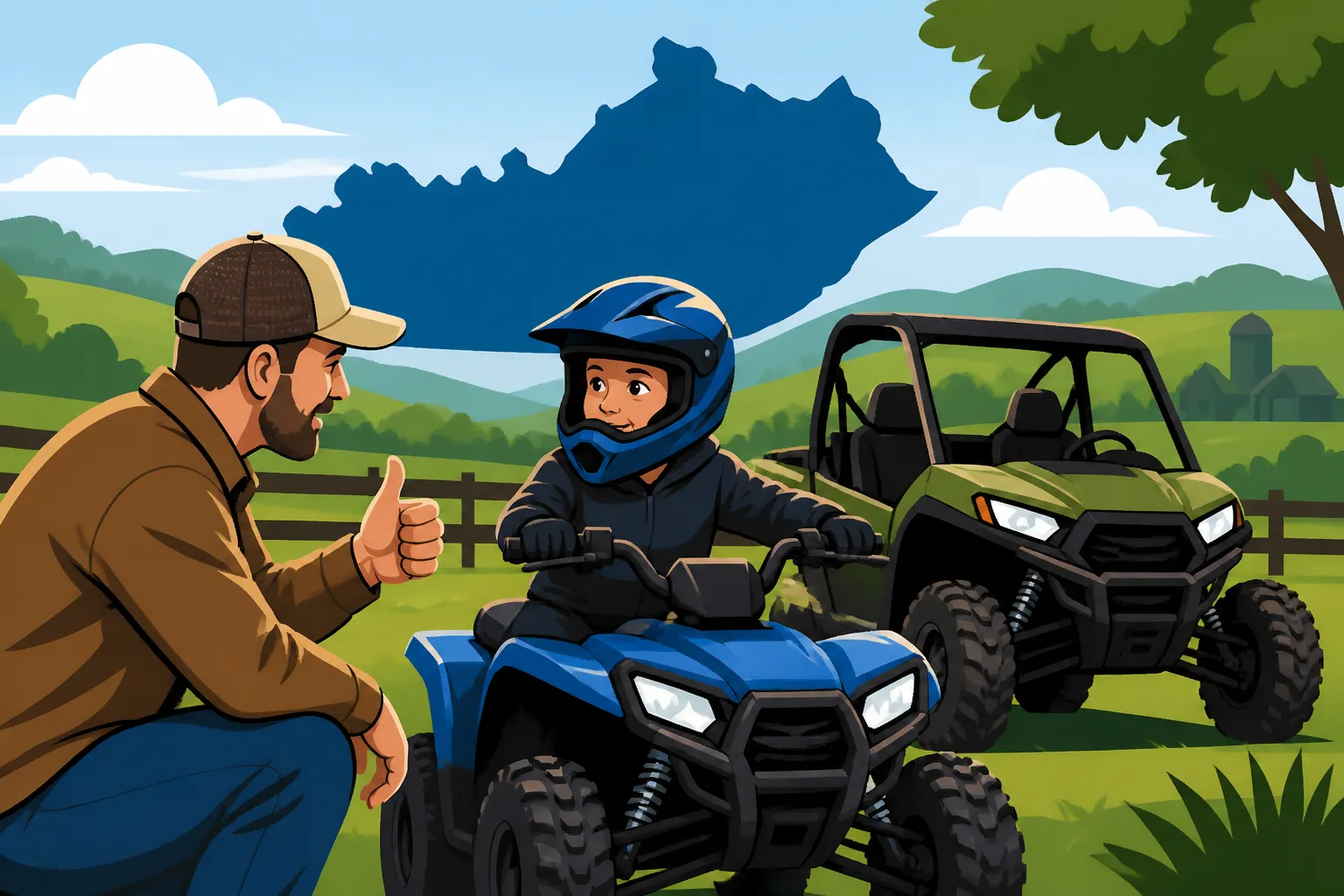
Teaching a child to ride on family ground can feel safer than heading straight to a trail, but private property does not remove every rule or risk. Kentucky parents need to account for the child’s age, the machine’s warning label, supervision and protective gear. A simple practice plan can help a young rider build skills without turning the yard into a hazard.
Start with the age, label and supervision rules
Before choosing a practice spot, check whether the child may legally operate the machine. In Kentucky, children under the age of six are prohibited from operating an ATV, according to the Legislative Research Commission. The same agency says a parent or guardian may not knowingly allow a child under six to operate one.
For a child who is old enough to ride, check the manufacturer’s age-restriction warning label on the ATV. Under Kentucky law, parents or guardians may not allow a minor under sixteen to operate an ATV in violation of that warning, according to the Legislative Research Commission. The label is specific to the machine; a child being allowed to ride a different ATV does not automatically mean this one is appropriate. For help understanding the label, see The Manufacturer’s Age Label as Kentucky’s Age Rule and Reading a Manufacturer’s Age Label.
Kentucky also requires direct parental supervision for anyone under sixteen operating an ATV. The Legislative Research Commission says that supervision rule applies on private land as well as public land. It is not enough to assume that a child can manage alone because the riding area is familiar. Stay close enough to keep the rider in view and respond promptly if the machine moves off course or the child becomes distressed. For a fuller explanation of the rule, see Kentucky Parental Supervision Rules Explained.
Approved protective headgear is required for anyone under sixteen operating an ATV, and it must be worn whenever the vehicle is in motion, according to the Legislative Research Commission. That requirement applies on private ground, too. A helmet is a legal minimum, not a guarantee against injury, so use other suitable protective clothing and footwear as well.
| What to check | What Kentucky’s rules say | Practical step |
|---|---|---|
| Minimum age | Children under six may not operate an ATV, according to the Legislative Research Commission. | Do not put a child under six on the machine, even for a short demonstration. |
| Manufacturer’s label | Parents or guardians may not allow a minor under sixteen to ride contrary to the age warning, according to the Legislative Research Commission. | Read the label on the specific machine before practice. |
| Supervision | Riders under sixteen must have direct parental supervision on private and public land, according to the Legislative Research Commission. | Keep the child under active observation and stay close enough to intervene. |
| Headgear | Riders under sixteen must wear approved protective headgear whenever the ATV is moving, according to the Legislative Research Commission. | Check fit and condition before every practice session. |
| Passengers | The Kentucky Department of Fish and Wildlife Resources says single-rider ATVs are for one person, consistent with manufacturer recommendations. | Do not carry a child as a passenger on a single-rider ATV. |
A young rider should not be carried on a single-rider ATV. The Kentucky Department of Fish and Wildlife Resources says operators must follow manufacturer recommendations that restrict these machines to one person. If a child is not ready to operate an appropriate machine, do not treat a passenger ride as a substitute lesson. Review Kentucky Rules for a Passenger on an ATV before deciding who can ride on a particular vehicle.
These requirements are a starting point, not a complete safety plan. A child who technically meets the minimum conditions may still be too small, hesitant or inexperienced for a particular machine. If the child cannot comfortably reach and operate the controls, keep a stable position, and follow instructions, postpone the ride and reassess the setup.
Prepare the ground and the machine before practice
Family property can still contain hidden hazards: holes, loose debris, steep edges, wire, animals, vehicles, water, trees and other people. Walk the intended practice area before starting the engine. Choose a clear, level space with room to stop and turn, and keep other people and pets out of it. Do not assume that a familiar field is safe just because the child has played there.
Start with a small, controlled area rather than a long route across the property. Remove obstacles where practical and identify a clear boundary the child must not cross. Avoid slopes, ditches and surfaces that can change quickly. Wet grass, loose gravel and mud can reduce traction; a child still learning the controls may not be ready to respond when the tires slide or the machine turns unexpectedly.
Check the ATV before each session. Confirm that the controls work, the tires look sound, and there are no obvious leaks or loose parts. Make sure the child understands how to stop the machine and can reach the controls while seated in a stable position. Consult the owner’s manual for the machine’s operating instructions and limits; do not rely on an informal guess about what a particular model can handle.
Protective equipment should fit the child and stay secured during the ride. Choose an approved helmet that sits correctly and does not shift around, along with clothing that covers exposed skin and sturdy footwear. Gloves and eye protection can make handling and visibility more comfortable. If you shop locally or use Amazon to source gear, check the product details and fit carefully rather than choosing by appearance alone.
Private-property practice is different from riding at a public trail system. For example, the Legislative Research Commission says an off-highway vehicle must be equipped with a spark arrestor when used on specific public off-highway vehicle trail systems. That public-trail rule is not a reason to assume the same equipment rule applies to every patch of family ground; check the requirements for the place where you plan to ride. Kentucky Rules for Riding Private Property can help with the broader land-use questions.
Also separate the machine’s title from permission to practice. Kentucky requires an ATV bought on or after July 1, 2010, to be titled, and the title application must be submitted within fifteen days of purchase, according to the Kentucky Transportation Cabinet. The Cabinet says off-road ATVs are titled rather than registered and do not have an annual registration fee, though obtaining an initial title requires a one-time application fee. Those ownership rules do not replace the need to follow age, supervision and safety requirements. For background, see Why Kentucky Does Not Register ATVs and Kentucky ATV Title Deadline.
Teach one skill at a time
A child learns more from a calm, repeatable session than from being sent out to ride freely. Before the engine starts, explain the controls, the practice boundary and the signal to stop. Use simple instructions and ask the child to repeat them back. If the child is nervous or distracted, stop and try another time rather than adding pressure.
A sensible sequence moves from understanding the machine to low-speed control:
- Get familiar with the controls. With the ATV stopped, show the child where the throttle, brakes and shutoff control are, using the owner’s manual as the reference. Have the child identify how to stop before attempting to move.
- Practice starting and stopping. Begin at a walking pace in a clear area. Ask the child to move a short distance and stop at a visible point. Repeat only while the child remains calm and responsive.
- Build basic steering control. Once starting and stopping are consistent, introduce broad turns at low speed. Leave plenty of space and avoid asking for sharp turns or quick corrections.
- Practice looking and listening. Teach the child to look in the direction of travel, listen for instructions and stop when asked. Do not shout complex directions while the machine is moving.
- End before fatigue sets in. A child who is tired, cold, overheated or frustrated is more likely to make poor decisions. Finish the session while the child can still focus.
Keep the engine off during explanations whenever possible. A child may miss instructions over engine noise, and a running machine can move unexpectedly if a control is touched. Start each practice period with a short reminder of the boundaries and stopping signal.
Do not let a child ride beyond your ability to supervise. Direct supervision is a legal requirement for riders under sixteen, according to the Legislative Research Commission; staying close, avoiding distractions and keeping the child in view are practical ways to take that responsibility seriously. Put away a phone and do not supervise from inside the house or from another part of the property.
Progress should depend on demonstrated control, not on how long the child has been riding. If the child cannot stop reliably, turns too sharply, ignores directions or looks uncomfortable, pause the lesson. Returning to an earlier skill is not a setback; it is a way to keep practice within the child’s ability.
Kentucky’s ATV safety program is referenced through state resources compiled by the U.S. Consumer Product Safety Commission. Parents can consult those resources when looking for additional safety information. A safety course or resource can supplement hands-on supervision, but it does not override the age label or the rules that apply to a young rider. See Kentucky ATV Safety Course Requirements for related information.
Know when family-ground practice stops being enough
A practice session on private land does not authorize a child to ride on roads or in a public trail area. Public riding can involve other operators, changing terrain, posted rules and equipment requirements that do not apply in the same way to a contained practice space. Before taking a child off family ground, check the specific riding area’s access rules, permit requirements, and rules for young riders.
Kentucky requires an off-highway vehicle recreation pass sticker or rider wristband on specific public lands such as the Daniel Boone National Forest, according to the USDA Forest Service. An ATV’s Kentucky title is not a substitute for that location-specific pass. See Kentucky Rules for Riding a National Forest and Kentucky Trail Permits Explained before planning a public-land ride.
Do not let a practice ride drift onto a public road. Kentucky permits an ATV to cross a two-lane public highway only under specified conditions: the operator must cross as close to a right angle as practical and safe, must not travel on the highway for more than two-tenths of a mile, must have a valid operator’s license, must obey applicable traffic rules, and must use illuminated headlights and taillights during daylight hours, according to the Legislative Research Commission. Those conditions are not a general permission for a child to ride along a road. Check Kentucky Rules for Crossing a Highway before considering any crossing.
The age and supervision rules remain important even when the machine changes. For public-property operation, the Legislative Research Commission says operators aged sixteen or older generally must wear approved protective headgear, subject to exceptions for specified activities such as farming, mining or logging. For riders under sixteen, the requirement to wear approved headgear whenever the ATV is moving applies on private as well as public land. More detail is available in Kentucky Helmet Law for ATV Riders.
If the child will eventually ride a UTV, do not assume that ATV practice transfers automatically. A UTV has different controls, handling and seating, so the child needs instruction specific to that vehicle. For street-legal operation on Kentucky public roadways, multi-passenger UTVs classified as special purpose vehicles must have a roll bar or roll cage and a seatbelt assembly for each designated seating position; they must also have a windshield unless the operator wears eye protection, according to the Legislative Research Commission. These are roadway equipment requirements, not a reason to take a young rider onto the road.
The safest family-ground lesson is deliberately uneventful: an age-appropriate machine, a clear practice area, the required helmet, an attentive adult and a child who can stop when asked. Keep the session within those limits, and treat hesitation, fatigue or missed instructions as a reason to pause rather than push on.
Sources
- Legislative Research Commission — Kentucky Revised Statutes § 189.281 (checked November 2, 2026)
- Legislative Research Commission — 189.515 Restrictions on operation of all-terrain vehicles. (checked November 2, 2026)
- Kentucky Transportation Cabinet — Vehicle Titling – Drive KY (checked November 2, 2026)
Disclaimer
This article is for general informational purposes only and does not constitute professional advice. Laws, prices and regulations vary by location and change over time. Consult a qualified professional for guidance on your specific situation.