Kentucky Helmet Rules at a Trail Park
A helmet rule at a Kentucky trail park can depend on more than the kind of machine you ride. The key question is whether the riding area counts as public property, because Kentucky’s headgear rule applies there, while a park may also set its own conditions. Here’s how to check what applies before you unload, and how to avoid confusing helmet rules with permits or other equipment requirements.
When Kentucky’s helmet rule applies
According to the Legislative Research Commission, people aged 16 or older operating an ATV on public property in Kentucky are generally required to wear approved protective headgear. The rule has exceptions for people engaged in specific activities, including farming, mining, or logging. Those work-related exceptions do not automatically apply to a recreational ride at a trail park.
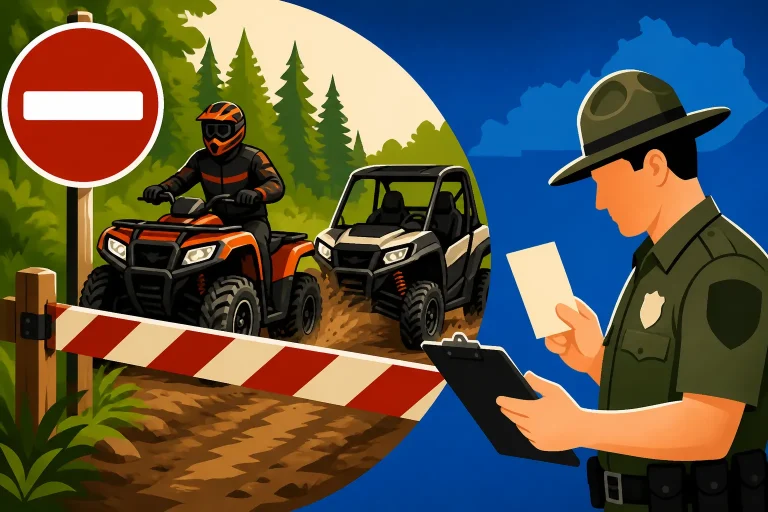
The important detail is public property. A trail park’s name, trail system, or location does not by itself establish whether the helmet rule applies. Check who manages the riding area and what its access rules say. A public off-highway vehicle trail system and a privately operated park may have different rules, and the operator may set helmet conditions that apply even when a state-law requirement is not clear from the property’s status.
| Riding situation | What to check |
|---|---|
| ATV on public property | According to the Legislative Research Commission, operators aged 16 or older generally must wear approved protective headgear, subject to specified work-related exceptions. |
| Recreational ride at a park | Confirm whether the riding area is public property and check the park’s own rider requirements. |
| Work activity such as farming, mining, or logging | According to the Legislative Research Commission, these activities are among the exceptions to the general public-property headgear rule. |
| Riding in a national forest recreation area | Check the forest’s current requirements as well as applicable state rules. The USDA Forest Service requires an official off-highway vehicle recreation pass sticker or rider wristband to be displayed or worn for operation on specific public lands such as the Daniel Boone National Forest. |
This is why a simple answer such as “helmets are always required at every Kentucky park” or “a helmet is optional at a private park” can be misleading. The state rule described by the Legislative Research Commission turns on public-property operation. A park can also have its own entry or safety requirements, so riders should confirm both rather than relying on the type of land alone.
If a park’s website or staff do not clearly explain the rule, ask directly whether the trails are public property and whether the park requires a helmet for every rider. If the park has different conditions for ATVs, UTVs, passengers, or rented machines, ask about the machine and rider you actually plan to bring. For more on the state rule, see Kentucky Helmet Law for ATV Riders.
A trail pass is a separate issue. A helmet does not replace a required pass, and having a pass does not answer whether a helmet is required. Kentucky requires off-road ATVs to be titled rather than generally registered, while particular public riding areas can have their own pass requirements. For example, the USDA Forest Service requires an official off-highway vehicle recreation pass sticker or rider wristband on specified public lands such as the Daniel Boone National Forest. Check the riding area’s rules before traveling; Kentucky Trail Permits Explained covers how site-specific permits differ from a statewide requirement.
What counts as approved headgear and how to prepare
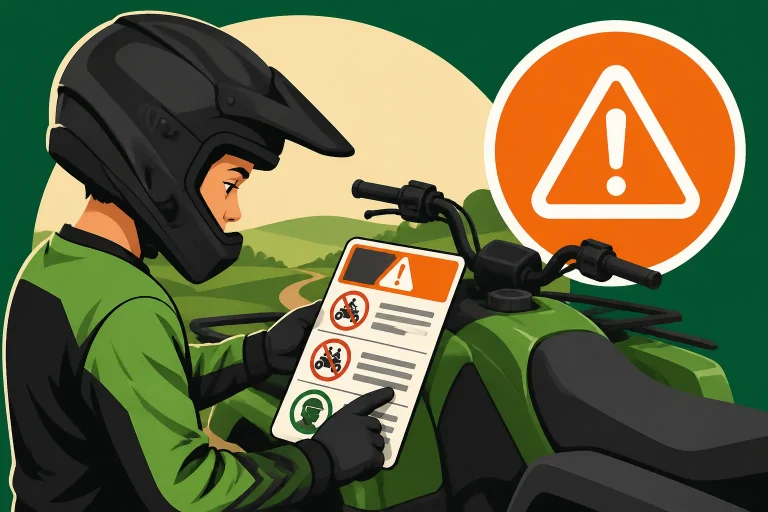
The Legislative Research Commission’s rule refers to approved protective headgear. That wording matters: wearing a cap, bicycle helmet, or other item that is not approved for ATV use should not be assumed to satisfy the requirement. If the law applies to your ride, choose protective headgear intended for the activity and check the helmet’s manufacturer information for its approval and use instructions.
Fit matters as well. A helmet that shifts, sits poorly, or cannot be fastened as designed may offer less protection and may not meet a park’s requirements. Before leaving, check the condition of the shell and fastening system, make sure the helmet fits the intended rider, and follow the manufacturer’s directions. If you are buying one online, including through Amazon, review the product details and manufacturer information rather than relying on a listing title or a photograph.
A helmet is only one part of a safe ride. A trail park may have separate requirements for eye protection, passengers, lighting, or the machine itself. Do not assume that equipment rules for a UTV are identical to the rules for an ATV, or that a machine approved for private land is automatically suitable for every public trail system.
For public off-highway vehicle trail systems, the Legislative Research Commission says an off-highway vehicle must be equipped with a spark arrestor. That requirement is separate from headgear: wearing a helmet does not make a machine compliant if it lacks required equipment. Check the machine before the trip, especially if it has been modified or has not recently been used on a public trail system.
Passenger rules also deserve attention. The Kentucky Department of Fish and Wildlife Resources says passengers are not allowed on single-rider ATVs because operators must follow manufacturer recommendations that restrict those machines to one person. A passenger’s helmet does not make an ATV designed for a single rider suitable for carrying someone else. For passenger-specific information, see Kentucky Helmet Law for Passengers and confirm the machine’s own seating and use instructions.
If someone in your group is under 16, check the rules that apply to that rider separately instead of assuming the general headgear rule for operators aged 16 or older answers every question. According to the Legislative Research Commission, children under six are prohibited from operating an ATV, and a parent or guardian may not allow a minor under 16 to operate an ATV in violation of the manufacturer’s age-restriction warning label. Those age and operation rules are distinct from a park’s helmet policy. See Kentucky Rules for Riders Under 16 before planning a ride with a young operator.
A practical check before riding
A quick check with the park can prevent a wasted trip and make it easier to prepare the right gear. Start with the property and park rules, then check the rider, machine, and permit requirements. If the rules are not clear online, contact the park before loading the ATV or UTV.
- Confirm where the trails are. Ask whether the riding area is public property, private property, or a public land system managed by an agency. This helps identify whether Kentucky’s general public-property headgear rule applies, but it does not replace checking park conditions.
- Ask what headgear the park accepts. Use the park’s exact description of approved protective headgear, and confirm whether its rule covers operators, passengers, or both. If the park has a written policy, keep it available when organizing a group ride.
- Check each rider’s situation. Do not assume the same rule answers questions about minors, passengers, or work-related exceptions. The Legislative Research Commission’s public-property rule and age-related requirements address different issues.
- Inspect the machine. Confirm that it is appropriate for the trail system and equipped as required. The Legislative Research Commission requires a spark arrestor on an off-highway vehicle used on a public off-highway vehicle trail system.
- Confirm pass and access requirements. A state title is not the same as a recreation pass. For specified public lands, the USDA Forest Service requires an official off-highway vehicle recreation pass sticker or rider wristband. See Kentucky Rules for Riding a National Forest if that is where you plan to ride.
- Check current operating conditions. Trail access and local park rules can change. Review the park’s notices before departure, especially if weather or maintenance may affect access; Kentucky Trail Conditions Before You Ride offers more on checking before you haul.
If you are renting, ask the rental provider what gear is supplied, what riders must bring, and whether the rental arrangement includes any required park pass. Do not assume that a helmet is included or that a rental machine automatically meets every rule for the trail you choose. The park’s requirements and the rental company’s conditions may be separate. For a broader checklist, see Kentucky Rules for Riding a Rented Machine.
The same careful approach helps with UTVs. A UTV’s roof, doors, roll cage, or seat belts do not by themselves settle whether a helmet is required at a particular trail park. Check the park’s rule for the vehicle and its occupants, and follow the applicable safety instructions for the machine. If a UTV is being operated on a public roadway rather than on trails, different equipment and operating rules may apply; do not treat a trail-park answer as road-use permission.
Keep the helmet question separate from road rules
A trail park’s helmet policy is not permission to ride on a public road. Kentucky has distinct rules for ATVs and UTVs on public roadways, and a machine’s title or trail pass does not make it street legal. If your route involves a road, check the specific road-use conditions before riding there.
For example, the Legislative Research Commission says ATVs may cross a two-lane public highway only under stated conditions, including crossing as close to a right angle as practical and safe and not traveling on the highway for more than two-tenths of a mile. The operator must also meet the other stated conditions, including having a valid operator’s license, using illuminated headlights and taillights, following applicable traffic regulations, and crossing during daylight hours. These are crossing rules, not general permission to ride along a highway.
Similarly, public-road requirements for a UTV or other special purpose vehicle differ from its trail setup. The Legislative Research Commission requires headlights and taillights on UTVs and similar off-highway vehicles when operated on public roadways or highways. Street-legal operation can also involve other equipment conditions, so ask about the exact route and vehicle rather than relying on a helmet or park pass as proof that road travel is allowed.
The practical takeaway is straightforward: first establish whether the park’s trails are public property, then follow the park’s own headgear policy and any additional requirements for your machine and riders. If the public-property rule applies, the Legislative Research Commission generally requires approved protective headgear for ATV operators aged 16 or older, except for specified activities such as farming, mining, or logging. When in doubt, ask the park before the trip and carry the protective gear its rules call for.
Disclaimer
This article is for general informational purposes only and does not constitute professional advice. Laws, prices and regulations vary by location and change over time. Consult a qualified professional for guidance on your specific situation.