When a Daniel Boone Day Pass Is Enough
A Daniel Boone day pass can be the right fit for a short ride, but it is easy to confuse a forest pass with a statewide permit or a vehicle title. The key is to match the pass to the riding day and location, then check what paperwork and equipment your machine needs separately.
What the Daniel Boone day pass covers
The Daniel Boone National Forest uses an off-highway vehicle recreation pass system for eligible riding. According to the USDA Forest Service, a day pass is valid for one day and costs $15, as of November 2026. The pass must be displayed as an official sticker or worn as a rider wristband, as applicable.
That makes a day pass a practical choice when your plans involve a single riding day in an area where the Forest Service requires the pass. It does not make the machine legal everywhere in Kentucky, and it does not replace rules for a different forest, park, trail system, or private property. Land managers set their own access and permit requirements, so confirm that the place you intend to ride accepts the Daniel Boone pass.
| Your plan | Is a Daniel Boone day pass likely to fit? | What to confirm |
|---|---|---|
| Riding in a Daniel Boone National Forest area where an OHV pass is required for one day | Yes, if the pass and riding area match your plan | Where and how the pass must be displayed, and which routes are open |
| Riding on more than one day | Not by itself for the additional day | Whether another pass type is available and what it covers |
| Visiting a different forest, private park, or another managed trail system | Do not assume so | The other land manager’s permit and access rules |
| Riding only on private land | The forest pass may not be the relevant permission | The landowner’s permission and any applicable site rules |
| Hauling the ATV to the forest but not riding | The pass may not answer every access or parking question | Current Forest Service requirements for your destination |
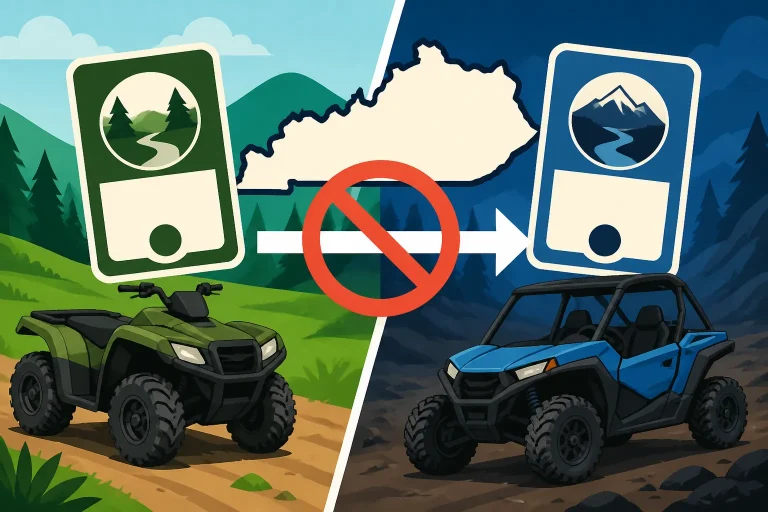
The pass is about access to the applicable riding area for its stated period. It is not a general Kentucky trail sticker. Kentucky has no single state-issued off-road permit that automatically grants access to every riding area, so a pass for one place should not be treated as a substitute for a different place’s requirements. For the wider distinction between local permits, see Why Kentucky Has No Statewide Trail Sticker and Why One Park’s Permit Does Not Travel.
Before leaving home, check the Forest Service’s current instructions for where to obtain the pass and how it must be displayed. If you need practical details about obtaining and using it, see Buying and Using the Daniel Boone Forest OHV Pass and Where Kentucky Forest Passes Are Sold. The cost and rules can change, so confirm current information with the Forest Service rather than relying on an old trip note or a third-party listing.
When a day pass is enough, and when it is not
The clearest case for a day pass is a single-day outing where you already know your riding area is covered by the Daniel Boone National Forest pass system. You do not need to pay for access to additional days you do not plan to ride, and you avoid assuming that one area’s permit carries over to another.
A day pass may be a poor fit when your schedule is likely to stretch beyond the day, or when the trip includes more than one riding property. A multi-day trip does not become a single-day visit just because you buy one pass. Ask the Forest Service what pass options are available for your exact itinerary, and ask each separate park or land manager about its own permit. Do not assume that a pass type exists, that it costs a particular amount, or that it can be shared across different systems unless the responsible agency confirms it.
It also helps to separate the riding area from the route you take to reach it. A pass does not turn a public road into an ATV trail or authorize riding on a closed route. Before your trip, confirm the intended route is open to your machine and that any access or pass requirement applies to that particular location. The broader planning basics are covered in Kentucky Rules for Riding a National Forest and Kentucky Trail Closures to Check First.
A simple way to decide is to ask:
- Are you riding in an area managed under the Daniel Boone National Forest OHV pass system?
- Does that area require the pass for your planned activity?
- Will you ride only during the day covered by the pass?
- Does your trip include another park, private property, or trail system with separate rules?
- Do you know whether to display a sticker or wear a wristband?
If the answer to the first three questions is yes, and you have checked the last two, a day pass may be all the access pass you need for that part of the trip. If your route crosses onto another property or extends beyond the pass period, check the additional requirements before you load the machine.
An online store or a recreation forum can help with gear and planning, but it is not the authority on pass coverage. A pass holder bought through Amazon might help protect a paper document, but it cannot replace an official Forest Service sticker or wristband. Follow the Forest Service’s directions for the required form of display.
A forest pass is not a title or a road permit
A common source of confusion is treating three separate things as if they were interchangeable: permission to ride in a particular area, the vehicle’s title, and authorization to use public roads. The Daniel Boone pass addresses the first issue only. It does not establish ownership, satisfy Kentucky title requirements, or make an off-highway vehicle street-legal.
According to the Kentucky Transportation Cabinet, ATVs used strictly for off-road purposes must be titled rather than registered, and off-road use does not require an annual state registration fee. The Cabinet also says an initial title application requires a one-time application fee. Check with the Cabinet or the county clerk for current title costs and paperwork; a forest pass does not replace that process. For details, see Do You Need a Title for an ATV in Kentucky? and Kentucky ATV Title Paperwork.
The purchase date can matter. According to the Kentucky Transportation Cabinet, ATVs purchased on or after July 1, 2010, must be titled, and the title application must be submitted within 15 days of purchase. The Cabinet also says an ATV operated on public roadways must be registered. Those requirements remain separate from the Forest Service pass, even if the machine is used mostly on trails. For a step-by-step overview, see Titling an ATV in Kentucky.
Public-road use has additional limits and equipment rules. According to the Legislative Research Commission, an ATV may cross a two-lane public highway only under specified conditions, including crossing as close to a right angle as is practical and safe, not traveling along the highway for more than two-tenths of a mile, and crossing during daylight. The same source says the operator must have a valid operator’s license, obey applicable traffic rules, and use illuminated headlights and taillights. These are road-use rules, not conditions satisfied by buying a forest pass.
A UTV or side-by-side may be subject to different road requirements than an ATV. For example, the Legislative Research Commission says multi-passenger UTVs treated as special purpose vehicles need a roll bar or roll cage and a seatbelt assembly for each designated seating position for street-legal operation; a windshield is required unless the operator wears eye protection. Do not assume that a pass for an off-road area changes the machine’s classification or equipment obligations. See Kentucky Rules for ATVs on Public Roads and Titling a Side-by-Side in Kentucky for related distinctions.
The practical takeaway is straightforward: buy or obtain the pass for the riding area, handle Kentucky title paperwork separately, and do not treat either of those steps as permission to ride on a public road.
A pre-ride check that prevents avoidable problems
A little preparation makes it easier to use the day pass correctly and avoid finding out at the trailhead that the pass, machine, or route does not fit the plan.
- Confirm the riding area. Identify the specific Forest Service area or route you intend to use. Check whether the day pass applies there and whether the route is open to your vehicle.
- Confirm how the pass must be shown. The USDA Forest Service identifies an official pass sticker or rider wristband for OHV recreation on applicable public lands. Follow the current instructions rather than substituting a receipt or an aftermarket holder.
- Check the trip length. A day pass is valid for one day according to the USDA Forest Service. If you intend to ride on another day, contact the Forest Service about the appropriate option instead of assuming that the original pass remains valid.
- Check other land managers. If your itinerary includes a separate park or private property, ask that manager about access permission and permits. Do not assume the Daniel Boone pass is accepted there.
- Keep vehicle documents separate from the pass. The pass is for riding-area access; Kentucky title requirements concern the machine. If you recently bought an ATV, confirm title paperwork and deadlines with the Kentucky Transportation Cabinet or the relevant county clerk.
- Review equipment and rider rules. Pass purchase does not certify the ATV or rider as compliant. Check applicable rules for helmets, age restrictions, spark arrestors, passengers, and any road crossing you might need. According to the Legislative Research Commission, off-highway vehicles using public OHV trail systems must have a spark arrestor. According to the Kentucky Department of Fish and Wildlife Resources, single-rider ATVs are not for passengers; follow the manufacturer’s recommendations.
- Recheck close to departure. A saved screenshot or a past visit can be useful for planning, but it may not reflect a current closure or changed pass instruction. Use the responsible agency’s current information before loading up.
If you are riding on public property, remember that the pass is only one part of the safety picture. According to the Legislative Research Commission, people aged 16 or older operating an ATV on public property generally must wear approved protective headgear, subject to exceptions for specified activities such as farming, mining, or logging. Other rider restrictions may apply, especially for young operators. Checking the rules before the trip is better than assuming that a paid pass settles every question.
A day pass is enough when it matches the specific Daniel Boone riding area and the day you plan to ride. For anything beyond that—another day, another property, a title question, or public-road use—check the separate rule with the agency or land manager responsible.
Sources
- Kentucky Transportation Cabinet — Vehicle Titling – Drive KY (checked November 2, 2026)
- USDA Forest Service — Daniel Boone National Forest | White Sulphur OHV Trail (checked November 2, 2026)
Disclaimer
This article is for general informational purposes only and does not constitute professional advice. Laws, prices and regulations vary by location and change over time. Consult a qualified professional for guidance on your specific situation.