Kentucky’s Narrow ATV Definition
If you're an ATV enthusiast in Kentucky, you've probably encountered the frustrating reality that not every off-road machine is considered an "ATV" in the eyes of state law. This narrow definition can throw a wrench into everything from titling your beloved rig to knowing where you can legally ride, leaving many owners scratching their heads and worrying about compliance. This guide aims to clear up the confusion, diving deep into Kentucky's specific ATV definition and explaining exactly what it means for you and your machine.
The Legal Landscape of ATVs in Kentucky
Kentucky's approach to ATVs is, shall we say, particular. Unlike some other states that might lump a broader range of off-road vehicles under a general "ATV" or "OHV" umbrella, Kentucky's statute draws very specific lines. These lines aren't just bureaucratic red tape; they profoundly impact how you can own, title, and even operate your machine within the Commonwealth. Understanding this specific legal framework is the first step toward avoiding headaches down the line.
More Than Just Semantics
It's easy to dismiss legal definitions as mere technicalities, but in Kentucky, the precise wording of what constitutes an ATV has real-world consequences for owners. For example, if your machine doesn't fit the state's narrow definition, you might find yourself unable to get a traditional ATV title, leading to challenges when you try to sell it or prove ownership. Imagine buying what you thought was a typical ATV, only to discover later that your local county clerk considers it something else entirely. This isn't a hypothetical scenario; it's a common point of confusion for many Kentuckians. The distinction also plays a huge role in how law enforcement views your machine, especially if you're ever stopped for a violation or involved in an incident.
The implications don't stop there. Trail systems and riding parks, both public and private, often base their access rules on these definitions. A machine that looks and feels like an ATV might be barred from certain trails if it technically falls outside the state's legal classification. This can be incredibly frustrating if you've invested heavily in a machine, only to find its use restricted by a definition you didn't fully understand. It's why delving into the specifics now can save you a lot of grief and money in the long run.
Historical Context of Kentucky's Definition
Kentucky's journey to its current ATV definition is rooted in legislative efforts to regulate these vehicles, particularly concerning ownership and road safety. For many years, off-road vehicles operated in a kind of legal gray area, leading to difficulties in tracking ownership, managing sales, and enforcing safety regulations. The legislative landscape began to shift more definitively around 2010. Before that time, many ATVs weren't formally titled in Kentucky, which created significant challenges for buyers and sellers trying to prove legal ownership.
The critical turning point came with legislation effective July 1, 2010. This is a date etched into the minds of many Kentucky ATV owners because it mandated titling for all newly purchased ATVs. This wasn't just a simple update; it introduced a formal legal definition of an ATV into the state statutes, thereby clarifying what machines qualified for a title and which did not. So, while machines bought before July 2010 might have a different titling history (or lack thereof), anything purchased after that date has been subject to this more stringent definition. Understanding [Why Kentucky Titles Machines Bought After July 2010] and also [Machines Bought Before July 2010 in Kentucky] helps shed light on how we arrived at the current, very specific parameters.
Breaking Down the Official Definition
Kentucky Revised Statutes (KRS) Chapter 189, specifically KRS 189.010(26), provides the definitive legal definition of an "all-terrain vehicle." It's a precise description that leaves little room for ambiguity, but its exact wording can be a mouthful to parse. Let's break down the key components that define an ATV in Kentucky, separating it from the myriad of other off-road machines out there.
The "Four Low-Pressure Tires" Clause
One of the most foundational elements of Kentucky's ATV definition is the requirement for "four low-pressure tires." This might seem obvious to many ATV enthusiasts, as most traditional quads fit this description. However, it's a crucial distinction that immediately separates ATVs from motorcycles, dirt bikes (which have two tires), and even some specialized off-road vehicles that might use high-pressure tires or have a different wheel configuration.
The "low-pressure" aspect is also significant. These are tires designed to operate at pressures typically lower than those found in passenger vehicle tires, which helps them conform to terrain and provide traction off-road. This characteristic is intrinsic to the ATV's design purpose – to traverse varied, often soft or uneven, landscapes. Without those four specific low-pressure tires, your machine, no matter how much it resembles an ATV, simply doesn't meet this primary definitional hurdle in Kentucky. This clause alone rules out a surprising number of machines that someone might think is an ATV.
The "Straddle Seat" Requirement
Another non-negotiable component of Kentucky's ATV definition is the "straddle seat." This particular phrase refers to a saddle-type seat designed for the operator to sit astride, much like on a motorcycle or a horse. This is a critical design feature that directly influences how the vehicle is operated and handled, differentiating it from vehicles where the operator sits in the vehicle, often side-by-side with a passenger, like a car or truck.
The straddle seat is what gives a traditional ATV its unique riding experience, allowing the rider to shift their weight and body position to maneuver the machine over challenging terrain. It requires a specific riding posture and active engagement from the operator. This single point of definition is a major reason why many popular side-by-side vehicles, despite being off-road machines, are explicitly not considered ATVs under Kentucky law. If your machine has bucket seats or a bench seat where you sit in it, rather than on it, then it doesn't have a straddle seat, and therefore, it's not a Kentucky-defined ATV.
Handlebars, Not a Steering Wheel
Complementing the straddle seat, the Kentucky definition specifies that an ATV must be "controlled by handlebars." This element works in tandem with the straddle seat to paint a clear picture of the ATV's design and operation. Handlebars are a hallmark of two-wheeled vehicles like motorcycles and bicycles, and their presence on a four-wheeled off-road machine is a key identifier for an ATV. They provide direct, tactile control over the front wheels, requiring the rider to steer using their upper body and arms in a way that is distinctly different from a steering wheel.
This criterion further solidifies the distinction between ATVs and other vehicles like side-by-sides, which universally feature a steering wheel, similar to a car. The type of control mechanism—handlebars versus a steering wheel—is not just an aesthetic choice; it fundamentally alters the driving dynamics and the skills required to operate the machine safely and effectively. Therefore, if your off-road machine has a steering wheel, it falls outside Kentucky's narrow legal definition of an ATV, no matter how many tires it has or how capable it is off-road.
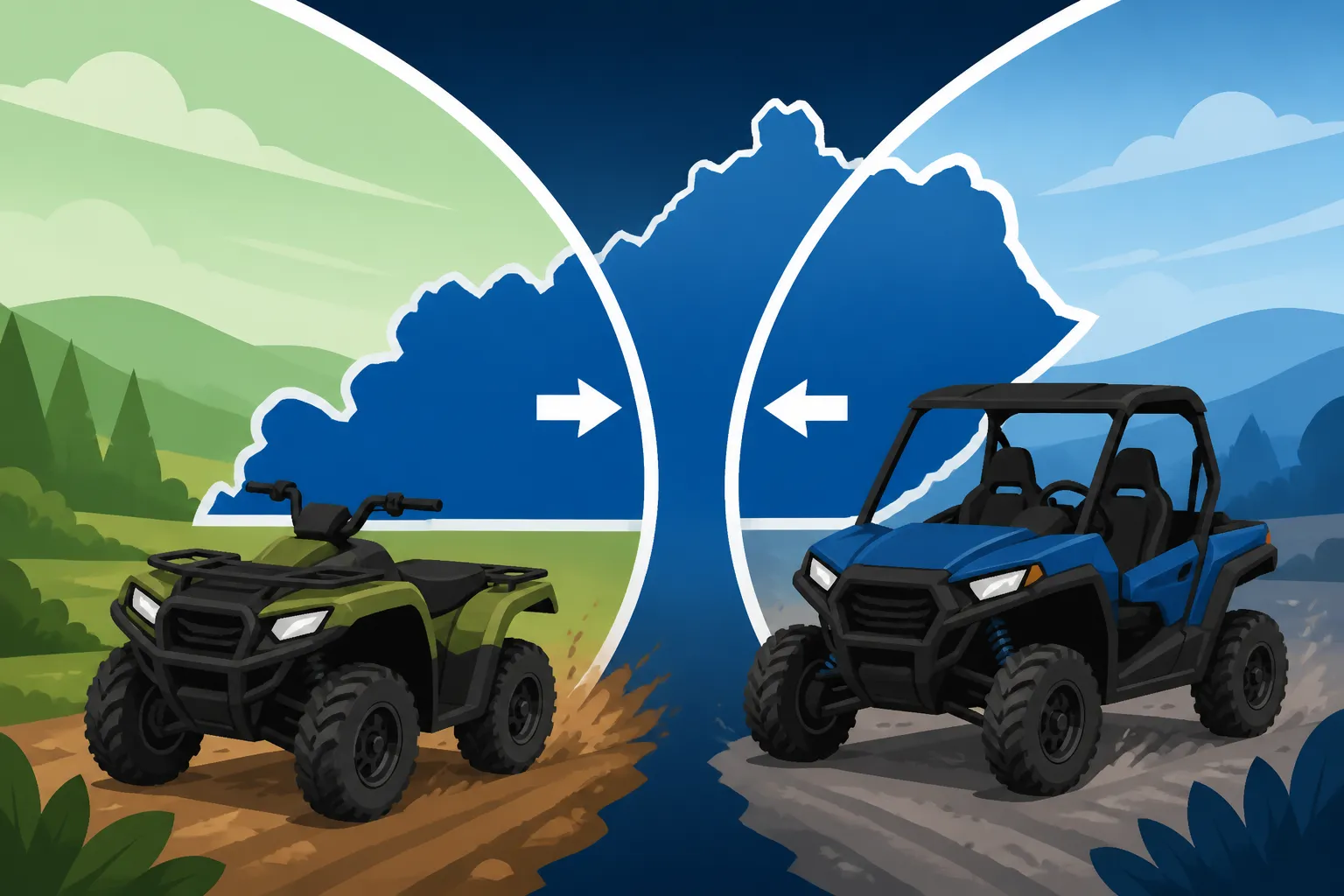
Here's a quick comparison of key features that Kentucky uses to distinguish an ATV from other common off-road vehicles like UTVs:
| Feature | Kentucky ATV Definition | Typical UTV/Side-by-Side |
|---|---|---|
| Number of Wheels | Four | Four (sometimes six) |
| Tire Type | Low-pressure tires | Low-pressure tires |
| Seating Position | Operator sits astride (straddle) | Operator sits in (bucket/bench) |
| Steering Mechanism | Handlebars | Steering Wheel |
| Designed For | Single operator (some two-up models exist) | One or more passengers side-by-side |
What Falls Outside the ATV Box
Given Kentucky's precise definition, it's inevitable that many popular off-road machines, while fantastic for trail riding or farm work, simply don't make the cut as an "ATV." This is where a lot of confusion, and sometimes frustration, arises for owners. It’s not that these machines are illegal or undesirable; it’s just that they are classified differently, which brings with it a different set of rules for titling, registration, and operation.
The UTV Conundrum
Perhaps the most common victim of Kentucky's narrow ATV definition is the Utility Terrain Vehicle, or UTV – often referred to as a side-by-side. These machines have exploded in popularity, offering incredible versatility for recreation, hunting, and utility work. They typically feature a roll cage, seat belts, a steering wheel, and seating for two or more passengers side-by-side. These very characteristics, which make them so appealing, are precisely what prevents them from being classified as an "ATV" in Kentucky. Because they lack a straddle seat and are controlled by a steering wheel, they simply don't fit the state's legal criteria for an ATV.
So, if a UTV isn't an ATV, what is it? Kentucky has a separate classification for "Special Purpose Vehicles" (SPVs) that often includes UTVs. This distinction is vital because the rules governing SPVs, particularly regarding titling and road use, are entirely different from those for ATVs. Many owners find themselves navigating a different legal path, perhaps needing to apply for an SPV registration if they intend to use their machine on public roads where allowed. Understanding [Why a Side-by-Side Sits Awkwardly in Kentucky Law] is key, as is knowing how to approach [Titling a Side-by-Side in Kentucky] if you own one. It's a common point of confusion, and it’s important to clarify early on.
Golf Carts, Dirt Bikes, and Other Off-Roaders
Beyond UTVs, Kentucky's definition of an ATV also excludes a variety of other common off-road and utility vehicles. Dirt bikes, for instance, are clearly not ATVs because they only have two wheels. They fall under the motorcycle classification for titling and registration purposes, with their own set of rules and regulations. Golf carts, while often used off pavement or within planned communities, also don't fit the ATV definition due to their seating arrangement, steering wheel, and often, higher pressure tires. They typically have their own specific, albeit limited, provisions for operation on certain public roads in designated areas.
Even some specialized multi-wheel vehicles or high-performance off-road buggies that don't fit the "four low-pressure tires, straddle seat, handlebars" criteria would not be legally considered ATVs. This strict interpretation means that if you own something unconventional, you'll need to carefully examine its specific features against the Kentucky statute to understand its legal classification. Essentially, if it deviates from the "classic" quad described by the law, it's likely something else entirely. Ultimately, [What Kentucky Counts as an ATV] is a very specific mold.
The Practical Impact of a Narrow Definition
The legal distinctions aren't just for bureaucrats; they have very real, practical implications for every ATV and UTV owner in Kentucky. From the paperwork you need to sign at the county clerk's office to where you can legally put your tires, the state's narrow ATV definition shapes your entire off-road experience. Ignoring these distinctions can lead to unexpected fines, titling difficulties, or even being turned away from your favorite riding area.
Titling Implications
This is where the rubber meets the road, quite literally. If your machine fits Kentucky's narrow ATV definition, you'll follow the standard titling process for an ATV. This generally involves presenting a manufacturer's certificate of origin (MCO) for a new machine or a properly signed-over title for a used one, along with other required paperwork, to your local county clerk's office. The process is relatively straightforward for a true ATV, as covered in detail in guides like [Titling an ATV in Kentucky] and [Do You Need a Title for an ATV in Kentucky?].
However, if your machine doesn't fit the ATV definition – like a UTV, for example – you won't be able to get an ATV title. Instead, you might pursue a "Special Purpose Vehicle" (SPV) registration, which is a different classification entirely. The SPV path is specifically designed for vehicles that don't fit standard categories but may need to operate on certain public roads. This means different forms, different fees, and a different set of rules. The challenges can range from proving ownership for a machine that was never formally titled to ensuring you have all the correct documentation. It's a common source of frustration for owners who assumed all off-road vehicles followed the same titling procedures.
Trail Access and Park Rules
The narrow definition also significantly impacts where you can ride. Many public and private trail systems in Kentucky, while generally welcoming to off-roaders, often have specific rules that differentiate between ATVs and UTVs (or other non-ATV machines). For example, some trails might be open exclusively to ATVs due to their design, width restrictions, or environmental considerations. You might arrive at a park, excited for a ride, only to find that your side-by-side is considered too wide or simply not an "ATV" per their internal regulations, which often mirror state law.
Even when UTVs are allowed, there might be specific areas designated for them, or different permit requirements. [Where to Ride an ATV in Kentucky] provides an overview of various parks, but it's crucial to check each park's specific rules, especially if you own a machine that might fall outside the traditional ATV definition. Parks like Black Mountain Off-Road Adventure Area in Kentucky or Rush Off-Road in Eastern Kentucky are generally accommodating to a range of off-road vehicles, but understanding their specific categories and any restrictions based on the type of machine you have is always recommended before you haul your rig.
Road Use and "Street Legal" Status
The most significant practical impact of Kentucky's narrow ATV definition often comes down to road use. Generally, ATVs, as defined by Kentucky law, are not street legal on public roads by default. There are extremely limited exceptions for crossing certain roads at a 90-degree angle for short distances or specific uses for farm work, but broad street legality is not part of the ATV classification.
For machines that don't fit the ATV definition, particularly UTVs, there's the possibility of registering them as Special Purpose Vehicles (SPVs). This is a distinct process with its own set of requirements, including specific equipment mandates like turn signals, rearview mirrors, an illuminated speedometer, and even specific insurance. If you're wondering [Are ATVs Street Legal in Kentucky?] or what the [Kentucky Street Legal UTV Requirements] are, the answer hinges entirely on whether your machine is a legal ATV or if it qualifies as an SPV. Trying to operate a non-SPV UTV or a traditional ATV on public roads without meeting the strict exceptions can lead to significant fines and legal trouble. The definition, therefore, is paramount in determining your machine's eligibility for any form of public road use.
Navigating Ownership with Ambiguous Machines
When your off-road machine doesn't neatly fit into Kentucky's precise ATV definition, or if you're dealing with an older machine with murky ownership history, the path to clear, legal ownership can feel like riding a rocky trail without a map. But don't despair! There are definite steps you can take to protect yourself and ensure you have the proper documentation, even for machines that sit in a legal gray area.
The Importance of a Clear Bill of Sale
Regardless of whether your machine is a pure ATV or something else, a clear, comprehensive bill of sale is your absolute best friend. This document is your primary proof of purchase and can be invaluable, especially for machines that might have titling complexities or if you're buying from a state that doesn't issue titles for ATVs. For instance, if you're buying a side-by-side that doesn't qualify for an ATV title, or an older machine that predates Kentucky's titling laws, a detailed bill of sale provides a paper trail for ownership.
A good bill of sale should include:
- The full names and addresses of both the buyer and the seller.
- A detailed description of the machine, including make, model, year, and crucially, the full Vehicle Identification Number (VIN).
- The purchase price and date of sale.
- Statements attesting that the seller is the legal owner and that the machine is free of liens (if applicable).
- Signatures of both parties.
Using a reputable template can ensure you don't miss any critical information. Services like LawDepot offer customizable bill of sale templates that can be tailored to specific situations, giving you peace of mind that all necessary legal details are covered. Having this document, even if a title isn't issued, can be instrumental in proving your ownership, especially if you ever need to retrieve the machine after it's been stolen or if there's a dispute over its rightful owner. A solid bill of sale from a resource like LawDepot can prevent many headaches down the line, whether you're buying or selling.
When in Doubt, Consult the Clerk
The various county clerks' offices across Kentucky are your direct interface with the state's titling and registration processes. While laws are state-wide, the practical application and specific forms can sometimes feel different depending on your local office. If you have any doubts about your machine's classification, whether it needs a title, or what documentation you'll need, your very first stop should be your local county clerk's office. They are the experts on [Titling at a Kentucky County Clerk] and can provide the most accurate, up-to-date information for your specific situation.
Don't rely solely on word-of-mouth or online forums for complex titling questions, especially concerning unique machines or those with incomplete paperwork. Prepare by gathering any existing documentation you have – an old bill of sale, a previous owner's registration, or even just the VIN – and present it to the clerk. They can often tell you definitively what category your machine falls under and what steps you need to take. It's much better to clarify upfront than to show up with the wrong paperwork, only to be turned away.
Understanding Manufacturer Labels
An often-overlooked but crucial piece of information is the manufacturer's label or sticker on your machine. These labels typically provide important details about the vehicle, including its type (ATV, UTV, etc.), engine size, and recommended age for operators. Kentucky law, particularly concerning youth riders, often refers directly to the manufacturer's age recommendations. So, while the state has its own definition of an ATV, the manufacturer's original classification can provide valuable context and sometimes even legal weight.
For example, a machine explicitly labeled by the manufacturer as a "side-by-side" or "utility vehicle" reinforces the fact that it's not intended to be classified as an ATV under Kentucky's straddle-seat and handlebar definition. This can be helpful documentation if you're trying to explain why your UTV doesn't have an ATV title or why it's being registered as an SPV. Always pay attention to these labels, and if possible, ensure they are intact on your machine. For any important transactions, whether it's buying or selling, using a clear document like a LawDepot bill of sale, which accurately reflects the machine's manufacturer details, can provide an extra layer of protection.
Disclaimer
This article is for general informational purposes only and does not constitute professional advice. Laws, prices and regulations vary by location and change over time. Consult a qualified professional for guidance on your specific situation.