Kentucky ATV Title for a Machine Bought in Tennessee
Buying an ATV from a private seller in another state, especially one like Tennessee, can feel like you're stepping into a legal labyrinth. You've found the perfect machine across the state line, shaken hands, and now you're wondering how on earth to get it legally recognized in your home state of Kentucky. This guide will walk you through the specific steps and paperwork needed to title an ATV in Kentucky that you've purchased in Tennessee, helping you navigate the sometimes-tricky waters of out-of-state acquisitions.
The Unique Challenge of Tennessee ATV Purchases
Let's face it, buying an ATV in Tennessee and bringing it back to Kentucky can throw a wrench in what usually seems like a straightforward process. The biggest hurdle often comes down to how Tennessee handles ATV ownership documentation. While Kentucky has a pretty clear titling process for ATVs bought after July 2010, many other states, Tennessee included, have historically approached it quite differently. This means you might get vastly different paperwork from a Tennessee seller than you'd expect from a Kentucky one.
Understanding Tennessee's Approach to ATV Documentation
Tennessee's laws regarding ATV titles have been less stringent than Kentucky's, especially for older machines. Historically, many ATVs sold in Tennessee, particularly by private parties, might not have a formal certificate of title in the way Kentucky understands it. This isn't necessarily a red flag from the seller's side; it's just how things have been done there. They often rely on a bill of sale or an old registration document as proof of ownership. This can be confusing and frankly, a bit unsettling when you know Kentucky is going to ask for a title.
Imagine you're buying a machine from a private owner in a small Tennessee town. They might hand you a handwritten bill of sale and tell you that's all they ever had. In their mind, it's perfectly legitimate. But when you get back to Kentucky, your county clerk's office might raise an eyebrow. This difference in documentation standards is why you need to be extra prepared when buying across the border. Always remember that what's acceptable in Tennessee for proving ownership might not meet Kentucky's requirements for [Proving Kentucky ATV Ownership] or for initiating a new title.
Common Documents You Might Receive from a Tennessee Seller
When you're dealing with a Tennessee seller, you might encounter a few different types of documents. The most common will likely be a bill of sale. This is crucial, but its quality can vary wildly. Some sellers might have a professionally printed form, while others might just scribble something on a piece of notebook paper. What matters is the information contained within it: buyer and seller names and addresses, machine make, model, year, and crucially, the full seventeen-character Vehicle Identification Number (VIN) for [Kentucky's Seventeen-Character VIN Rule].
In some cases, especially for newer machines or those that were financed, a Tennessee seller might actually possess a physical title certificate. If so, fantastic! This makes your life significantly easier. You'll want to ensure it's properly signed over to you. However, don't be surprised if no title is present, particularly for machines manufactured before 2008, as Tennessee's titling requirements changed around that time. You might also encounter an old registration document, which, while not a title, can sometimes serve as additional proof of prior ownership history. Just be aware that an out-of-state registration alone, or a bill of sale from a non-titling state, will need to be carefully presented to your Kentucky County Clerk for acceptance.
Essential Kentucky Requirements for Out-of-State ATVs
Once you've got your ATV home from Tennessee, the real work of titling it in Kentucky begins. Kentucky's laws are clear: ATVs and UTVs purchased after July 15, 2010, must be titled. This applies regardless of where you bought the machine. The good news is that while the initial documentation from Tennessee might be a bit murky, Kentucky's process is designed to bring these machines into compliance, provided you have enough verifiable information.
What Kentucky Expects in Terms of Ownership Proof
Kentucky takes ownership proof very seriously. When you visit your local county clerk's office, they'll want to see a clear chain of custody for your ATV. If the Tennessee seller provided a properly signed-over title certificate, that's your golden ticket. It's the cleanest way to prove ownership. Make sure the seller completed all the necessary sections, including their signature, the date of sale, and the selling price. An incomplete or improperly signed title can cause significant delays.
If there's no title from Tennessee, you'll primarily rely on a robust bill of sale. This document is your primary evidence. It needs to be detailed, ideally notarized, and include all identifying information about the ATV and both parties involved in the sale. Think of it as telling the machine's story. If you can also provide an old Tennessee registration document that matches the seller's name, it can strengthen your case. The clerk needs to be satisfied that the person who sold you the ATV truly owned it and had the right to transfer it. [A Kentucky Bill of Sale for an ATV] is an excellent starting point for understanding what details Kentucky expects. Websites like LawDepot offer templates for comprehensive bills of sale that can help ensure you capture all the necessary information, even if the seller doesn't have a formal one.
The Critical Role of Kentucky Form TC 96-182
Kentucky Form TC 96-182, officially known as the "Affidavit of Kentucky Ownership," is absolutely vital when you're titling an ATV that doesn't have a traditional manufacturer's certificate of origin (MCO) or a clear title from a non-titling state. This form is where you, as the buyer, attest to your ownership under oath. It's your formal declaration to the state that you legitimately acquired the ATV.
You'll fill out this form at the county clerk's office, and it will require specific details about your ATV, including the VIN, make, model, and year. You'll also need to explain how you acquired the machine and swear that you are the rightful owner. Because this form is an affidavit, it requires notarization, which can usually be done right there at the clerk's office. This form essentially bridges the gap when the usual paper trail is incomplete, making it indispensable for many out-of-state purchases, especially from places like Tennessee where titles aren't always issued. For a deeper dive, check out [Kentucky Form TC 96-182 Explained].
The Kentucky Titling Process Step-by-Step
Now that you understand the documentation challenges and Kentucky's expectations, let's walk through the actual process of getting your Tennessee-bought ATV titled in Kentucky. This isn't as daunting as it might seem, but it does require attention to detail and a willingness to gather the right papers.
Gathering Your Documents and Heading to the County Clerk
Your journey begins by assembling every single piece of documentation you have related to your ATV purchase from Tennessee. This includes:
- The Bill of Sale: As detailed and comprehensive as possible. If the seller didn't have one, or it was handwritten, consider creating a more formal one with them using a template from a service like LawDepot, ensuring it's signed by both parties.
- Tennessee Title (if applicable): If the seller had one, make sure it's properly assigned to you.
- Tennessee Registration (if applicable): Any old registration cards can help establish a paper trail.
- Your Photo ID: You'll need this for identification at the clerk's office. [A Kentucky Photo ID at the Clerk's Counter] is a must.
- Proof of Kentucky Residency: Like a utility bill or Kentucky driver's license.
- Funds for Fees and Sales Tax: Be prepared for [What a Kentucky ATV Title Costs] and the sales tax, which is typically due at the time of titling.
Once you have everything, head to your local County Clerk's office. This is the only place you can title your ATV in Kentucky. They are the official agents for the Kentucky Transportation Cabinet in this regard. You can't just mail things in; you need to present your documents in person. The clerk will review your paperwork and guide you through the next steps, including filling out Form TC 96-182 if a title isn't available.
Navigating VIN Verification and Sales Tax
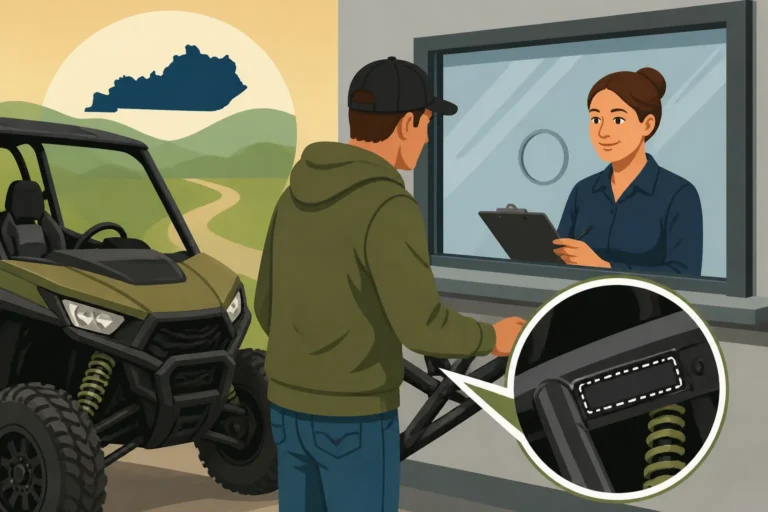
A crucial step in titling any ATV in Kentucky, especially one from out of state, is VIN verification. The county clerk's office needs to ensure that the VIN on your documentation matches the physical VIN on the machine. In some cases, they might ask you to bring the ATV to the office for a physical inspection, or they might accept a pencil tracing or a photograph of the VIN. Always make sure the full seventeen-character VIN is clearly visible and matches all your paperwork. Without a valid VIN, you won't be able to title the machine. [Kentucky ATV VIN Requirements] are strict for good reason.
You'll also be responsible for paying Kentucky sales tax on the purchase price of the ATV. This is generally calculated at the state's sales tax rate on the declared purchase price. Be honest about the price; if the clerk suspects undervaluation, they might refer to valuation guides, which could lead to a higher tax burden than you anticipated. There's also the title fee itself. It's important to complete this process within Kentucky's [Kentucky's Fifteen-Day Titling Deadline] from the date of purchase to avoid potential penalties. Once all the paperwork is complete, fees are paid, and the VIN is verified, the clerk's office will process your application. Your new Kentucky title will then typically be mailed to you within a few weeks.
| Document Type | From Tennessee Seller (Possible) | Required for Kentucky Titling (No Tennessee Title) | Required for Kentucky Titling (With Tennessee Title) |
|---|---|---|---|
| Bill of Sale | Yes (often handwritten) | Yes (detailed, notarized recommended) | Yes (still good for purchase price proof) |
| Tennessee Title | Sometimes | No (replaced by Bill of Sale + TC 96-182) | Yes (properly assigned) |
| Tennessee Reg. | Sometimes | Helpful as supplementary proof | Not strictly required, but good to have |
| Kentucky Form TC 96-182 | No | Yes (filled out at Clerk, notarized) | No |
| Photo ID | No | Yes (yours) | Yes (yours) |
| VIN Verification | No | Yes (by Clerk or designated agent) | Yes (by Clerk or designated agent) |
| Proof of Residency | No | Yes (yours) | Yes (yours) |
Common Pitfalls and How to Avoid Them
Even with all your ducks in a row, buying an out-of-state ATV can sometimes present unexpected challenges. Being aware of these potential issues beforehand can save you a lot of headache and frustration at the county clerk's window. It's about being proactive and ensuring you have as much verifiable information as possible.
Missing or Incomplete Documentation
The most common pitfall when buying an ATV from Tennessee is insufficient or incomplete documentation. A handwritten bill of sale with minimal information, a VIN that doesn't quite match, or a lack of clarity on the seller's part can all lead to problems. Always aim for the most thorough documentation possible. If the seller only offers a basic bill of sale, politely ask if they'd be willing to use a more comprehensive form. As mentioned earlier, sites like LawDepot can provide excellent, legally sound templates for a bill of sale that you can both fill out and sign. This extra step upfront can prevent significant delays and multiple trips to the county clerk.
Also, be wary of sellers who claim "no papers" whatsoever. While older machines bought before Kentucky's titling law came into effect might genuinely lack titles in Kentucky, the county clerk will still need some proof of ownership for a Tennessee machine. If a seller has absolutely nothing, or seems evasive, it might be a sign to walk away, as proving legitimate ownership in Kentucky without any prior documentation can be extremely difficult, bordering on impossible. [Should You Buy a Quad Advertised With No Title?] explores this risky scenario in more detail.
Dealing with Discrepancies and Potential Liens
It's crucial to cross-reference all information provided by the seller before you finalize the purchase. Does the VIN on the bill of sale match the VIN on the machine? Does the seller's name match any previous registration documents? Any discrepancies can trigger red flags at the clerk's office and lead to further investigation, potentially delaying your title. [Checking a VIN Before a Kentucky Purchase] is a critical step.
Another less common but serious issue is an undisclosed lien on the ATV. If the previous owner in Tennessee still owes money on the machine, that lien could potentially follow the ATV, complicating your ability to obtain a clean title in Kentucky. While Kentucky’s titling system can sometimes flag these, it’s best practice to ask the seller directly if there are any outstanding loans or liens on the ATV. If a title is provided, check for any lienholder information printed on it. If there's any doubt, and especially if the seller can't provide a clear title, proceed with extreme caution. Getting a proper lien release can be a complicated process if you buy a machine with an outstanding debt.
Disclaimer
This article is for general informational purposes only and does not constitute professional advice. Laws, prices and regulations vary by location and change over time. Consult a qualified professional for guidance on your specific situation.