Kentucky Spark Arrester Rules
A spark arrestor can look like a minor exhaust part, but it matters when you ride a Kentucky public off-highway vehicle trail system. Kentucky law requires an off-highway vehicle on those systems to have one. The practical questions are whether your machine has the right equipment, whether it is in usable condition, and what other trail access rules you need to check.
What Kentucky’s spark arrester rule requires
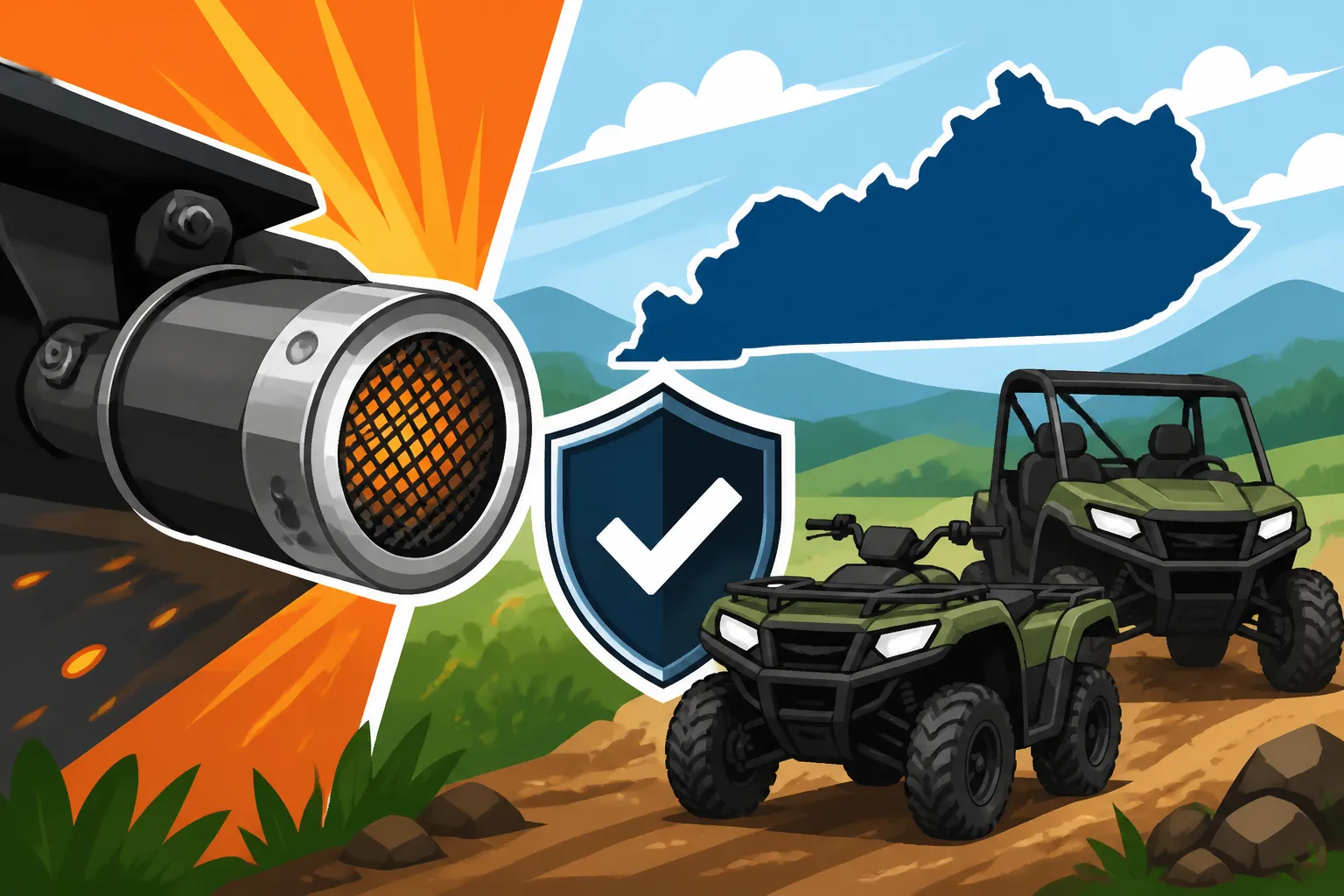
According to the Legislative Research Commission, an off-highway vehicle must be equipped with a spark arrestor when operated on a public off-highway vehicle trail system in Kentucky. That is the central rule: if you plan to ride one of these systems, make sure the vehicle has the required equipment before you arrive.
A spark arrestor is an exhaust-system component designed to reduce the escape of sparks or hot particles. It is not the same thing as a trail permit, vehicle title, or registration. Having one does not by itself authorize access to a trail, and a permit does not replace required equipment.
The wording matters. The stated rule applies to public off-highway vehicle trail systems. It should not be stretched into a claim that every ride on every kind of land has identical requirements. A private property owner, public land manager, or individual riding area may have additional rules, and the requirements for public-road operation are a separate issue. Before a trip, check the rules for the specific trail system rather than assuming that a machine legal in one setting is automatically ready for another.
| Question | Practical answer |
|---|---|
| Is a spark arrestor required on a Kentucky public OHV trail system? | Yes. The Legislative Research Commission says an OHV operated on these systems must be equipped with one. |
| Does a spark arrestor replace a trail permit? | No. Equipment and access permission are separate requirements. |
| Does a trail permit replace a spark arrestor? | No. Riders still need the required vehicle equipment. |
| Does the rule establish the same requirement for every private riding area? | The stated rule concerns public OHV trail systems. Confirm requirements for the land where you plan to ride. |
| Is an ATV title the same as trail access permission? | No. Kentucky’s title rules and a riding area’s access rules serve different purposes. |
A common source of confusion is the difference between state paperwork and trail-specific access. According to the USDA Forest Service, ATVs in Kentucky must be titled but are not subject to general state-issued vehicle registration plates for off-road use. For certain public lands, including Daniel Boone National Forest, the Forest Service says an official OHV recreation pass sticker or rider wristband must be displayed or worn. That access requirement is separate from the spark arrestor rule.
For help sorting out land access from equipment requirements, see Kentucky Trail Permits Explained and Do You Need a Permit for Kentucky Trails?. If your destination is a national forest, review Kentucky Rules for Riding a National Forest as well.
How to check your ATV or UTV before riding
The first step is to identify what is actually installed on the machine. Do not rely only on a previous owner’s assurance, a general description in a sale listing, or the fact that the vehicle has an exhaust system. Check the owner’s manual and the information for the specific exhaust component. If you are unsure whether the equipment qualifies, ask the vehicle or part manufacturer, a qualified repair shop, or the trail system’s manager before riding.
A careful pre-ride check can prevent a frustrating problem at the trailhead:
- Confirm the exhaust setup. Look for documentation or markings that identify the spark-arresting component. If parts have been changed, do not assume the original equipment is still present.
- Check for damage or tampering. A component that is missing, visibly damaged, or altered may not perform as intended. Have questionable parts inspected before using the machine on a public OHV trail system.
- Keep relevant information available. The owner’s manual, product documentation, or a record of a repair can help answer questions about what is fitted to the vehicle.
- Ask about the exact trail system. If the trail manager provides equipment rules, follow those rules and clarify anything you cannot verify from the vehicle documentation.
- Check again after exhaust work. A replacement or modified exhaust can change the setup. Confirm that the required spark-arresting equipment remains installed after repairs or upgrades.
If a part needs replacement, use the machine’s exact make, model, and exhaust configuration to confirm fit. A broad search can turn up parts that look similar but are not intended for your vehicle. A dealer or repair shop may be able to confirm compatibility; Amazon can also be a place to search for a model-specific part, but verify the listing and manufacturer information before ordering. Do not treat a product title or customer review as proof that a component satisfies the rule for your intended trail.
The rule is about the vehicle being equipped with a spark arrestor, not merely carrying a loose part in a storage box. If the component is absent or its condition is uncertain, resolve that before the ride. A trailhead is a poor place to discover that the exhaust has been changed or that a part does not fit.
It also helps to inspect the machine after a demanding ride, especially if the exhaust has taken an impact or the vehicle has had recent service. A quick visual check cannot certify that a component meets every applicable requirement, but it can reveal obvious problems that deserve attention. When in doubt, get qualified help instead of relying on a guess.
Spark arrestors, permits, and other rules are separate checks
A compliant machine is only one part of planning a legal ride. Access rules depend on where you are going, and the same paperwork does not necessarily work across different riding areas. A pass for one land manager or park should not be assumed to cover another. Read the current instructions for the destination and confirm whether the pass must be displayed on the vehicle or carried by the rider.
This is particularly important for riders who cross between privately operated parks and public land. A park may have its own access process, while a public land area may require a separate pass. Start with the destination’s official information, then check Why Kentucky Has No Statewide Trail Sticker and Where to Buy a Daniel Boone OHV Pass if those topics apply to your plans.
Do not confuse off-road paperwork with permission to ride on a roadway. Kentucky has separate rules for public-road operation, and some roadway equipment requirements do not replace trail-system requirements. According to the Legislative Research Commission, ATVs may cross a two-lane public highway only under specified conditions, including crossing as close to a right angle as is practical and safe, not traveling on the highway for more than two-tenths of a mile, and making the crossing during daylight hours. The same source says the operator must have a valid operator’s license, obey applicable traffic rules, and use illuminated headlights and taillights. Those crossing rules do not create general permission to ride along a highway.
Before loading the machine, use a short checklist:
- Confirm that the destination is open and that you are allowed to ride there.
- Check the trail system’s current access and permit instructions.
- Verify that the vehicle has the required spark arrestor and that its exhaust setup has not been changed unexpectedly.
- Review any additional equipment requirements that apply to the destination or the type of vehicle.
- Make sure you have the required title or other paperwork and any land-specific pass.
- Check trail conditions and closures before setting out.
For current conditions and closures, Kentucky Trail Conditions Before You Ride is a useful next step. It is also sensible to contact the trail operator when the posted information does not answer a specific question about equipment. Give them the vehicle type and describe the exhaust component rather than asking only whether “an ATV” is allowed; a clear description makes it easier to resolve uncertainty.
The main takeaway is straightforward: for a public off-highway vehicle trail system in Kentucky, do not ride without a spark arrestor. Confirm the component on your own machine, check the destination’s access rules separately, and ask the trail manager or manufacturer when the equipment is unclear. That small amount of preparation can keep an avoidable equipment issue from disrupting the trip.
Disclaimer
This article is for general informational purposes only and does not constitute professional advice. Laws, prices and regulations vary by location and change over time. Consult a qualified professional for guidance on your specific situation.