Kentucky ATV Title for a Trailered Machine
It's a common scenario for many ATV and UTV enthusiasts in Kentucky: you buy a machine, maybe from a friend down the road or a dealer a few counties over, and your plan is strictly to trailer it from your home straight to the trails—Black Mountain, Leatherwood, Turkey Bay, you name it. You might think, "If it's never hitting a public road from my driveway, why bother with a title?" This guide will clear up that misconception, explaining why every ATV or UTV operating in Kentucky needs a title, regardless of whether it lives permanently on a trailer or not, and walk you through the process to ensure you're covered.
Understanding Kentucky's ATV Titling Law for All Machines
When Kentucky established its ATV titling law, it wasn't about whether your machine would ever see asphalt from your personal property. The intent behind the law was much broader: to establish clear ownership for all off-road vehicles. This means that if you own an ATV or UTV in Kentucky, the same titling rules generally apply to you, whether your machine is trailered exclusively to private land, a public trail system, or even if it sits parked in your garage most of the time. The act of trailering doesn't create an exemption; it simply dictates how your machine gets to its destination.
Why Every Machine Needs a Title (Post-2010)
The key date to remember in Kentucky is July 15, 2010. If your ATV or UTV was purchased new or brought into Kentucky after this date, the law requires it to be titled. This isn't just a bureaucratic hurdle; it's a fundamental aspect of establishing clear legal ownership. Imagine you're at a popular trailhead, unloading your prized machine from its trailer, and a state park ranger or local sheriff's deputy approaches with a question about your ownership. Having a valid Kentucky title in your name is the definitive answer, leaving no room for doubt. It's your undisputed proof that the machine belongs to you, plain and simple.
This titling mandate provides a crucial layer of protection for you as the owner. Should your machine ever be stolen—perhaps right off your trailer in a parking lot or even from your secured property—that title is the document law enforcement will use to verify your claim and help recover your property. Without it, proving ownership can become a tangled, frustrating mess, delaying recovery and adding unnecessary stress to an already awful situation. The title establishes a clear chain of custody, linking you directly to the vehicle. For a deeper dive into this specific requirement, you might find [Why Kentucky Titles Machines Bought After July 2010] helpful.
The Purpose of a Title: Ownership, Not Registration
It’s crucial to understand that a Kentucky ATV title is solely for proving ownership. It is not a registration, and it doesn't give you permission to ride on public roads. Kentucky, unlike some other states, does not register ATVs for general off-road use, nor does it issue registration decals. Your title serves the same basic purpose as the title for your car or truck: it identifies you as the legal owner.
This distinction is especially important for trailered machines. Even if your ATV is only ever ridden at a dedicated off-road park or on private land with permission, the title is still your primary proof of legal possession. It separates your lawfully acquired machine from those that might be stolen or of questionable origin. This legal clarity is what makes buying, selling, or even inheriting an ATV a smooth process in Kentucky. It truly underpins the entire ownership system for these types of vehicles. To learn more about the underlying principles, check out [Kentucky's ATV Title Rule Explained].
The Trailered Machine and Proof of Ownership
For a machine that spends its life on a trailer, moving from one off-road adventure to the next, solid proof of ownership is not just a good idea—it's essential. The fact that it's trailered doesn't make it invisible to the law or immune to disputes over who truly owns it. Whether you're pulling it down I-75 to a trail system or just across town to a buddy's property, that legal backing from a title safeguards your investment.
Securing Your Investment, On and Off the Trailer
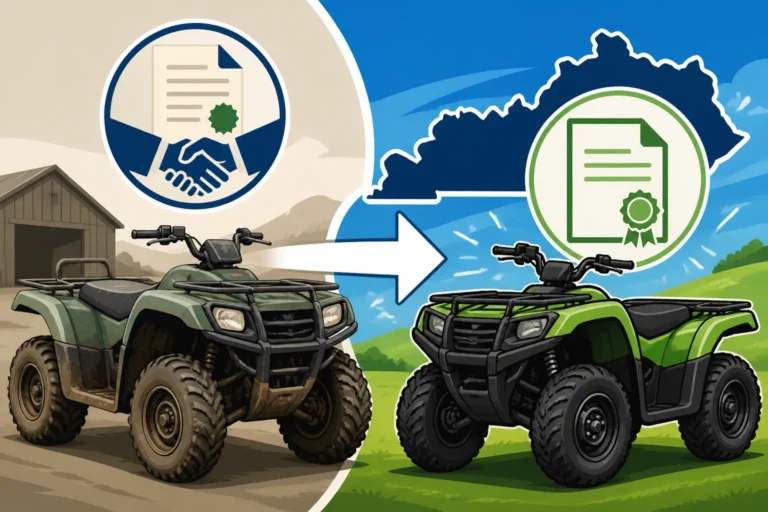
Imagine you've just bought a used side-by-side, perfect for hauling gear on those long weekends at Leatherwood Off-Road Park. You paid cash, shook hands, and loaded it onto your trailer, ready for adventure. Without a proper title transfer, however, you might technically be in possession of the machine, but you lack the definitive legal proof of ownership that Kentucky requires. This can become a huge problem if, for instance, the previous owner still has a lien on the machine that you weren't aware of, or if they decide to later claim it was stolen. The title is your shield against such headaches.
This protection extends beyond just preventing disputes. If you're pulled over while trailering your machine, and for some reason, the officer questions its ownership, a title in your name is the fastest way to clear things up. Furthermore, if you plan to sell the machine down the line, a clean Kentucky title is what any serious buyer will demand. It simplifies the transaction and gives confidence to the next owner, ensuring a smooth transfer. Without it, you might find your machine significantly devalued or difficult to sell, as potential buyers will rightly be wary of legal complications. For more on what constitutes valid ownership, refer to [Proving Kentucky ATV Ownership].
The Importance of a Bill of Sale
While a signed-over title is the gold standard for proving ownership, there are situations, especially when buying used or from out-of-state, where a comprehensive bill of sale becomes critical. This is particularly true if you’re purchasing an ATV from a state that doesn’t issue titles for off-road vehicles. In such cases, the bill of sale will be your primary document at the County Clerk's office to establish the chain of ownership and apply for a Kentucky title.
A good bill of sale should include specific details: the buyer's and seller's full names and addresses, the date of sale, the purchase price, and most importantly, a detailed description of the ATV, including its make, model, year, and its complete seventeen-character Vehicle Identification Number (VIN). Services like LawDepot offer customizable bill of sale templates that can help you draft a clear and legally sound document, ensuring all necessary information is present. This can be an invaluable resource, providing peace of mind and streamlining the titling process when you head to the clerk. Having a robust bill of sale means you're not just relying on a handshake; you have a written record of the transaction. You can learn more about this in [Using a Bill of Sale From a Non-Titling State].
The Process for Titling a Trailered ATV in Kentucky
Titling your trailered ATV or UTV in Kentucky might seem like a daunting task, but it's a straightforward process once you know the steps. The good news is that the procedure is essentially the same for all ATVs, regardless of whether they're trailered or ridden directly from your property. The key is gathering the correct paperwork and knowing where to go.
Where to Go and What to Bring
To title your ATV, you'll need to visit your local Kentucky County Clerk's office. This is the official agency responsible for processing vehicle titles and ensuring that all state requirements are met. You can't just send in your paperwork; you'll need to appear in person to present your documents and pay the necessary fees. The staff there are generally helpful and can guide you through any specific nuances for your situation. It’s always a good idea to call ahead or check their website for their hours and any specific COVID-related requirements or recommendations they might have. For more details on this, see [Titling at a Kentucky County Clerk].
When you go, be prepared with a few essential items. First, you'll need a valid Kentucky photo ID, such as a driver's license. This is crucial for verifying your identity. Second, you'll need the proper paperwork for your specific situation. This usually means a properly signed-over title from the previous owner if you bought a used machine that already had a Kentucky title. If you bought it new, you'll have a Manufacturer's Statement of Origin (MSO). If you bought it from out of state or in a situation where a title wasn't issued by the previous state, you'll need a comprehensive bill of sale, which, as mentioned, can be expertly drafted using resources like LawDepot.
Understanding Form TC 96-182 and the 15-Day Deadline
One of the most important forms you'll encounter is Kentucky Form TC 96-182, which is the application for a Kentucky Certificate of Title. You'll need to fill this out accurately and completely. The clerk's office will often have copies available, or you might be able to download it from the Kentucky Transportation Cabinet website in advance. This form captures all the essential information about you and your machine, ensuring a smooth transfer of ownership. Pay close attention to details like the VIN, your address, and any lienholder information if you financed the purchase. Errors on this form can delay your titling process significantly. We have a dedicated article for this form, [Kentucky Form TC 96-182 Explained].
Kentucky law imposes a fairly strict deadline for titling your newly acquired ATV: you have 15 days from the date of purchase to complete the titling process at your County Clerk's office. This isn't just a suggestion; it's a legal requirement designed to ensure prompt and accurate ownership transfers. Missing this deadline can result in penalties or additional fees, so it's best to prioritize your visit to the clerk's office as soon as possible after acquiring your machine. Even if you're excited to hit the trails, make that pit stop at the clerk first. Details on this deadline can be found in [Kentucky's Fifteen-Day Titling Deadline].
Special Considerations for Out-of-State Purchases
Buying an ATV out-of-state, even if you plan to trailer it immediately to a Kentucky trail, adds a few extra steps to the titling process. If the machine comes from a state that issues titles for ATVs, you'll need that original, signed-over title from the seller. This is a critical piece of paperwork. However, if you purchase an ATV from a state that does not title off-road vehicles, your comprehensive bill of sale becomes paramount. In these cases, the clerk will use the bill of sale, along with proof of your identity and residency, to initiate the Kentucky title application. It's always a good idea to confirm with your Kentucky County Clerk beforehand what specific documents they require for an out-of-state purchase from a non-titling state. You can get more information on this specific scenario by reading [Buying an Out-of-State Machine for Kentucky].
Common Scenarios and Titling Nuances for Trailered ATVs
Even with a clear understanding of the basic titling process, real-world situations can introduce a few wrinkles. Owning a trailered ATV means you might encounter various scenarios, from buying used machines with unclear histories to owning different types of off-road vehicles. Knowing how to navigate these situations ensures your titling process remains smooth.
Buying a Used Machine with No Title
This is a scenario that often causes concern: you find a great deal on a used ATV advertised with "no title." While it might seem tempting, especially if the price is right, proceeding without a title carries significant risks in Kentucky. In most cases, a seller claiming "no title" might indicate the machine was purchased before the July 2010 rule and simply never titled, or it could suggest a more problematic history, such as a stolen machine or one with an undisclosed lien.
Before even considering such a purchase, you should be extremely cautious. A title is your best defense against inadvertently buying a stolen vehicle or inheriting someone else's legal problems. It's often advisable to walk away from a deal where the seller cannot provide a clean, properly signed-over title. If you absolutely insist on pursuing it, you'll need to work closely with your County Clerk to determine if a title can even be issued. This might involve extensive research into the machine's history and potentially a bond. For more advice on this risky situation, see [Should You Buy a Quad Advertised With No Title?].
Older Machines and Their Titling Status
Kentucky's July 2010 rule is quite specific, but it doesn't mean older machines are entirely exempt from titling. If an ATV was purchased new or brought into Kentucky before that July 2010 date, it was not legally required to be titled at that time. However, there are exceptions. If an older machine had a lien placed on it—for example, if it was financed through a bank—then it would have been titled, as a title is necessary to record a lien.
So, if you're buying an older, trailered ATV that the seller claims has no title, it's possible they are correct if it was a cash purchase prior to July 2010. Even in these cases, having a robust bill of sale is crucial for your own records and to prove ownership should any questions arise. However, if the machine was ever titled, you should insist on receiving that title. Don't assume an older machine automatically means "no title." For more on why some older machines might lack a title, check out [Why an Older Machine May Have No Title].
Titling Imported Machines and Side-by-Sides
Imported ATVs and UTVs present their own set of challenges, primarily centered around the Vehicle Identification Number (VIN). Kentucky law, like federal standards, typically expects a seventeen-character VIN. Many imported machines, especially older ones or those not originally intended for the North American market, might have shorter or non-standard VINs. If you're importing a machine, even if it's strictly for trailering, you'll need to go through a process that might involve a VIN inspection or verification to ensure it meets Kentucky's requirements before a title can be issued. This can add delays and require extra documentation. You might find relevant information in [Imported Machines and the Kentucky VIN Rule].
Side-by-sides (UTVs) are another category that sometimes creates confusion. While they are distinct from traditional ATVs in their design and some legal applications (like potential for "Special Purpose Vehicle" designation for limited road use), for titling purposes, Kentucky generally treats them under the same ATV titling framework. So, if you're trailering a side-by-side to your favorite hunting camp or off-road park, it still needs to be titled just like an ATV purchased after July 2010. The titling process for a side-by-side will mirror that of an ATV at the County Clerk's office. For a closer look at this, consult [Titling a Side-by-Side in Kentucky].
Here's a quick reference table for documents commonly needed when titling an ATV or UTV in Kentucky:
| Document Type | Scenario 1: New ATV from a KY Dealer | Scenario 2: Used ATV with existing KY Title | Scenario 3: Used ATV from Non-Titling State | Scenario 4: Older ATV (Pre-July 2010, No Title) |
|---|---|---|---|---|
| Kentucky Photo ID | Required | Required | Required | Required |
| Manufacturer's Statement of Origin (MSO) | Required | Not Applicable | Not Applicable | Not Applicable |
| Signed-Over KY Title | Not Applicable | Required | Not Applicable | Only if one was issued |
| Comprehensive Bill of Sale | Dealer-provided sales contract | Recommended (for your records) | Crucial (for ownership proof) | Crucial (for ownership proof) |
| Kentucky Form TC 96-182 | Required | Required | Required | Required (if a title can be issued) |
| Proof of Sales Tax Payment | Required (usually collected by dealer) | Required (collected at clerk's office) | Required (collected at clerk's office) | Required (if a title can be issued) |
| Lien Release (if applicable) | Not Applicable | Required (if a lien was on old title) | Not Applicable | Required (if a lien was ever recorded) |
| VIN Verification | Usually not required | Usually not required | May be required | May be required (if no existing title record) |
Disclaimer
This article is for general informational purposes only and does not constitute professional advice. Laws, prices and regulations vary by location and change over time. Consult a qualified professional for guidance on your specific situation.