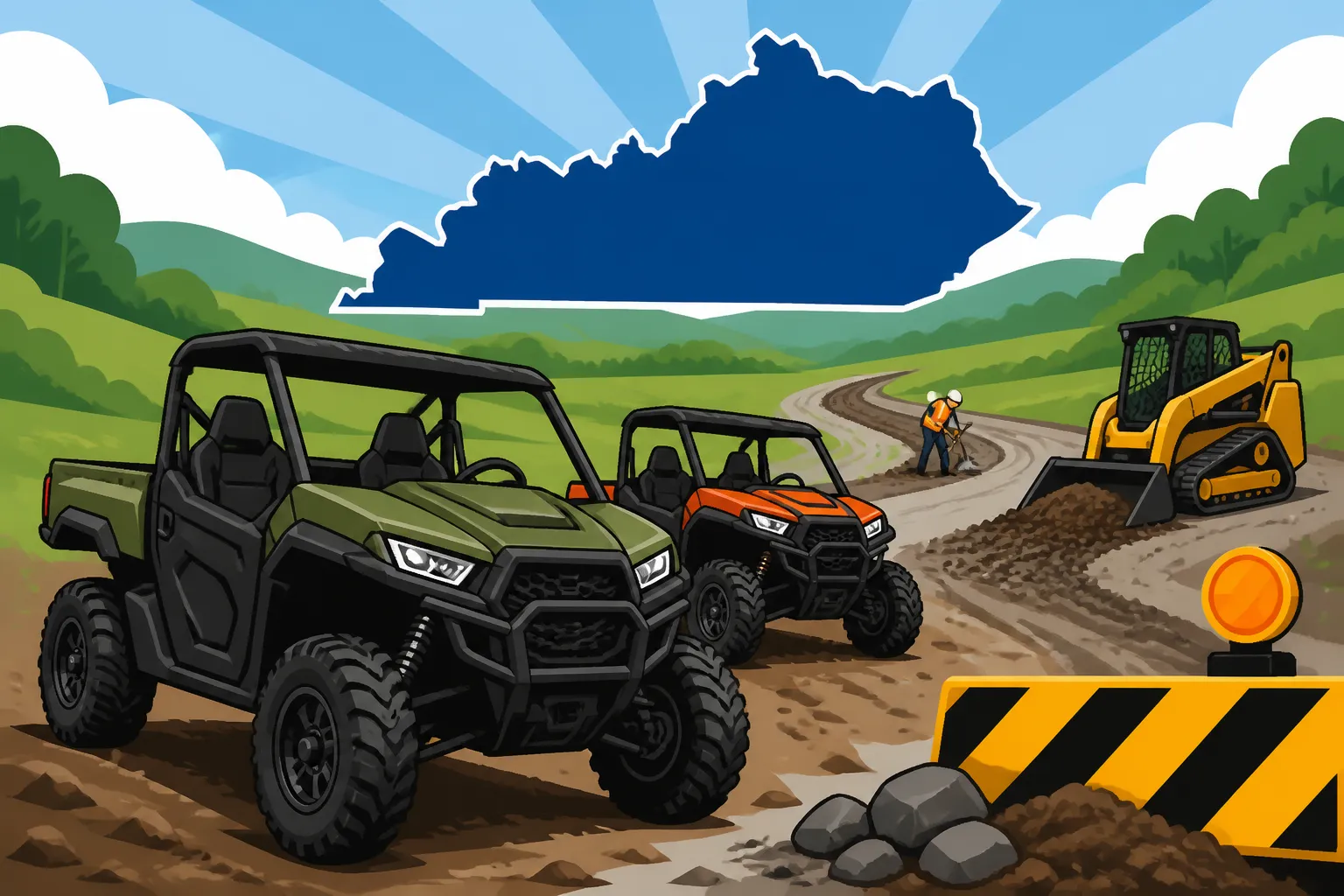
Construction and Road Maintenance in Kentucky
Navigating Kentucky's roads with an ATV or UTV can feel like walking a tightrope, especially when your work involves construction or road maintenance. Many contractors, utility workers, and even local government crews find themselves in a bind, needing the agility and go-anywhere capability of these machines but unsure if they're actually allowed on public asphalt. This guide aims to clear up the confusion surrounding Kentucky's specific, yet often overlooked, legal exemptions that permit ATVs and UTVs to be used legitimately for official construction and road maintenance activities, helping you avoid fines and keep your operations running smoothly.
Understanding Kentucky's Default Road Rules for ATVs/UTVs
Before we dive into the specifics of construction and road maintenance, it's crucial to grasp why ATVs and UTVs are generally kept off Kentucky's public roads in the first place. The default stance of the law is quite restrictive, a point that often frustrates riders and workers alike who see the utility of these machines.
Why Roads Are Generally Off-Limits
For most casual riders, taking an ATV or UTV onto a public road in Kentucky is a no-go. The state's statutes classify these machines primarily as off-highway vehicles, designed for trails, private property, and agricultural use, not for mingling with cars and trucks on paved surfaces. This default prohibition stems from concerns over safety, vehicle design, and the inherent differences between an ATV or UTV and a street-legal vehicle. They lack many of the safety features required for road use, such as proper lighting, turn signals, and mirrors, and their handling characteristics are simply not suited for highway speeds and traffic. You'll often hear discussions about [Kentucky Rules for ATVs on Public Roads] and why [Why Kentucky Roads Are Closed by Default], which underscores this fundamental principle. Ignoring these rules can lead to citations, fines, and even vehicle impoundment, creating a real headache for anyone caught unaware.
Brief Look at Standard Exemptions: Crossing and Farm Use
While the general rule is "no public roads," Kentucky law does provide a few very narrow exceptions. For instance, riders are typically permitted to cross a two-lane road or highway, provided they do so at a ninety-degree angle and get off the pavement as quickly and safely as possible. This is often referred to as [Crossing a Two-Lane at Ninety Degrees in Kentucky] and comes with strict limitations, often cited as a maximum of [0.2 Mile and Not a Yard More]. This isn't permission to ride down the road, but merely to traverse it to access another trail or piece of private property.
Another significant exemption exists for agricultural purposes. Farmers can use their ATVs and UTVs on public roads for farm-related tasks, such as hauling feed, checking fences, or moving equipment between fields. This "farm exception" is quite broad and has [Why Kentucky's Farm Exception Has No Limit], allowing for necessary agricultural operations without a strict mileage cap, unlike the crossing rule. However, even these exemptions come with their own set of considerations, such as the requirement for [Daylight Only Under the Statute] in many cases, highlighting that even when allowed, it's not a free-for-all. These exceptions, while helpful for specific scenarios, don't fully cover the diverse needs of construction and road maintenance crews.
The Specific Exemption: Official Construction and Road Maintenance
This is where the rubber meets the road, quite literally, for those working on Kentucky's infrastructure. Kentucky law carves out a specific, vital exemption for ATVs and UTVs when they are actively engaged in construction or maintenance activities on public roads or rights-of-way. This isn't a loophole; it's a deliberate acknowledgment of the practical needs of these industries.
What the Statute Actually Says
The relevant Kentucky statute (KRS 189.515(8)(c)) provides that the prohibition against operating ATVs and UTVs on public roads "shall not apply to persons operating all-terrain vehicles or utility terrain vehicles when engaged in utility, construction, or maintenance work." This is a crucial distinction. It means that if you are genuinely performing work related to utility services, construction projects, or road maintenance, your ATV or UTV is exempt from the general ban on public roads. The law recognizes that these machines offer unique advantages for accessing difficult terrains, transporting tools over short distances, and maneuvering in tight work zones that larger trucks or traditional equipment might struggle with. This exemption allows for efficiency and safety in environments where traditional vehicles are simply not practical.
Who Qualifies Under This Exemption
The "persons operating" clause is important. It typically applies to employees of government agencies (like county road departments or state highway crews), utility companies (electric, gas, water, telecommunications), and private contractors hired by these entities to perform specified work. For example, a county road crew clearing storm debris from a remote county road, a utility worker inspecting power lines along a right-of-way, or a private contractor preparing a site for new guardrail installation would generally fall under this exemption. It's not for a private citizen doing a DIY project on their property, nor is it for someone commuting to a construction site in their personal UTV. The key is that the operation must be directly related to official utility, construction, or maintenance work on or along a public road or its right-of-way. This ensures the exemption is used for its intended purpose: facilitating essential public services and infrastructure projects.
Defining "Construction" and "Maintenance" in Practice
Understanding what truly constitutes "construction" and "maintenance" is key to lawfully using your ATV or UTV. "Construction" generally refers to the building of new infrastructure or significant upgrades to existing ones. This could include tasks like surveying for a new road extension, transporting materials to a bridge repair site, or assisting with the installation of new culverts. For example, a UTV equipped with a small trailer could ferry tools and materials to a crew working on a new section of road in a remote area, saving time and effort compared to driving a full-size pickup.
"Maintenance" covers activities aimed at preserving or restoring the condition of existing roads and utilities. Think about tasks such as repairing potholes, clearing brush from road shoulders, inspecting drainage ditches, or servicing utility boxes along the right-of-way. Imagine a crew member using an ATV to quickly inspect a long stretch of [Kentucky Rules for Riding a County Road] after a severe storm, identifying downed trees or washouts more efficiently than walking or driving a larger vehicle. The versatility of these machines allows crews to respond rapidly and effectively to various demands that arise in keeping Kentucky's infrastructure functional and safe.
Equipping Your Machine for Road Work Duty
While the law grants an exemption for construction and maintenance, it doesn't mean you can just throw any ATV or UTV onto the road and call it good. There's a practical and, in some cases, a legal expectation that these machines will be suitably equipped for the job, especially when operating on public rights-of-way.
Choosing the Right ATV or UTV
The type of work dictates the ideal machine. For lighter tasks like inspections, boundary marking, or quick transport of small tools, a standard ATV might suffice due to its nimbleness. However, for more intensive work, a UTV (or side-by-side) often proves more practical. UTVs offer greater cargo capacity, the ability to carry multiple crew members, and often more robust frames for mounting attachments. Consider models known for their durability and versatility. For instance, a UTV with a dump bed can be invaluable for hauling gravel, tools, or debris. If the job involves uneven terrain or crossing soft ground adjacent to the road, look for machines with higher ground clearance and capable four-wheel-drive systems. Brands like SuperATV offer a wide range of accessories that can enhance the utility of your chosen machine, from lift kits for better clearance to heavy-duty bumpers for protection in demanding environments.
Essential Attachments and Modifications
To truly be effective in construction and road maintenance, an ATV or UTV often needs more than its factory configuration. Attachments can transform these vehicles into powerful workhorses. For road maintenance, consider utility trailers for hauling, small plows for snow or debris removal (especially on side roads or access paths), or spreaders for salt or gravel. For construction, winches are almost indispensable for pulling, lifting, or self-recovery, and storage solutions like cargo boxes or racks are vital for organizing tools and supplies.
When looking for such enhancements, it's worth exploring aftermarket options. Companies like SuperATV specialize in rugged, purpose-built accessories, from heavy-duty axles and suspension components that can handle the extra weight and stress of work, to full cab enclosures for operator comfort in adverse weather. Equipping your machine with robust tires suitable for mixed terrain – meaning they can handle both pavement briefly and rough off-road conditions – is also critical. These modifications not only improve efficiency but also contribute to the safety and longevity of the vehicle in demanding work settings.
Meeting Basic Safety and Visibility Standards
Even though they're exempt from full street-legal requirements, ATVs and UTVs used for construction and maintenance on public ways still need to meet common-sense safety and visibility standards. After all, you're sharing space, even if temporarily, with other vehicles. This typically means ensuring the machine has at least [One Headlight and Two Taillights in Kentucky] that are fully operational. Given the nature of road work, adding extra amber or flashing lights, like those often used on commercial vehicles, is highly recommended to maximize visibility, particularly in low-light conditions or busy work zones.
Reflective tape on the vehicle and high-visibility apparel for the operators are also crucial. Remember, the goal is to make your presence undeniable to oncoming traffic and other workers. While a specific [Kentucky Inspection] isn't mandated for this exemption, common sense dictates that your brakes, steering, and tires should be in excellent working order. This isn't just about compliance; it's about protecting yourself and others on the job site.
Operational Guidelines and Legal Responsibilities
Operating an ATV or UTV for construction and road maintenance comes with significant responsibilities. While the law grants permission, it also implicitly demands a high degree of professionalism and adherence to safety protocols. This isn't recreational riding; it's work that impacts public safety.
Licensing, Age, and Training Considerations
Kentucky law generally doesn't require a special driver's license specifically for operating an ATV or UTV off-road. However, when operating these machines on public roads, even under an exemption, the situation can become a bit nuanced. For employees of government entities or contractors, it's widely accepted that the operator should possess a valid driver's license if the vehicle is being operated on a public highway. While the statute creating the exemption doesn't explicitly state it, it's a practical and professional standard for anyone using a vehicle on a public road, regardless of its classification. For a deeper dive, consider [A License for Kentucky Highway Operation].
Age requirements are also paramount. While Kentucky has specific rules for [Kentucky Rules for a Rider Under 16] on ATVs in general, when it comes to work on public roads, the operator should be of legal driving age and meet any internal company or agency policies regarding vehicle operation. Furthermore, comprehensive training on the safe operation of ATVs and UTVs, especially when equipped with attachments or operating in hazardous construction zones, is not just advisable but often mandatory for employers. Knowing the machine's capabilities and limitations is crucial.
Insurance and Liability Protections
This is a critical area that cannot be overlooked. While the state does not typically mandate [Kentucky ATV Insurance Requirement] for off-road use on private land, operating these machines on public rights-of-way, even for work, brings significant liability exposure. Any government agency or private contractor utilizing ATVs or UTVs for construction and maintenance should ensure they have robust liability insurance coverage that specifically addresses the operation of these vehicles on public property. This coverage protects against potential damages, injuries, or legal claims that could arise from an incident involving the ATV or UTV during work operations.
Companies should also have clear policies regarding incident reporting and review. A detailed understanding of what an [Kentucky ATV Insurance Requirement] entails for commercial operations is essential. This protects not only the organization but also the individual operators, ensuring that if an unfortunate event occurs, there is a clear plan for managing the aftermath and mitigating financial risks.
Navigating the Work Zone Safely
Operating an ATV or UTV within an active construction or maintenance zone on a public road demands extreme caution and adherence to all work zone safety protocols. This includes wearing appropriate personal protective equipment (PPE), such as high-visibility vests and helmets (even if not explicitly required by statute for the ATV itself, it's a best practice in a work zone, and [Kentucky Helmet Law for ATV Riders] should always be considered).
Drivers must be acutely aware of their surroundings, including other vehicles, heavy equipment, pedestrians, and fellow workers. Following established traffic control plans, including cones, barrels, and flaggers, is non-negotiable. The agility of ATVs and UTVs can be a double-edged sword; while they can move quickly, they can also be less visible than larger vehicles. Operators should maintain appropriate speeds, use turn signals (if equipped, and if not, hand signals should be clearly utilized), and always assume other road users may not see them. Effective communication within the work crew is paramount to ensure everyone is aware of the ATV/UTV's movements.
The Practical Advantages and Limitations
ATVs and UTVs aren't a silver bullet for all construction and road maintenance tasks, but they certainly carve out a valuable niche. Understanding their strengths and weaknesses helps decision-makers deploy them most effectively.
When ATVs and UTVs Outperform Traditional Equipment
The primary advantage of ATVs and UTVs in road work is their unmatched versatility and ability to access challenging areas. Traditional pickup trucks or larger construction vehicles often struggle with soft shoulders, steep embankments, narrow paths, or extremely rough terrain adjacent to the road. ATVs and UTVs, with their compact size, four-wheel drive, and often lower ground pressure, can navigate these conditions with ease. Imagine a crew needing to inspect a culvert tucked away down a muddy, overgrown path that a full-size truck couldn't dream of reaching. An ATV or UTV can get there quickly, allowing for efficient assessment and minimal disruption.
They also excel at tasks requiring frequent stops and starts, or when only small amounts of material or equipment need to be transported. For instance, a UTV can quickly deliver a handful of tools, a few bags of concrete mix, or even a small generator to a specific point along a long stretch of road where a crew is working. This saves time and fuel compared to repositioning a larger, heavier vehicle. For certain maintenance tasks like clearing debris from ditches or inspecting guardrails along long stretches, their speed and maneuverability can significantly boost efficiency.
Situations Where Larger Equipment Remains Essential
Despite their advantages, ATVs and UTVs have clear limitations. For heavy lifting, major excavation, significant hauling of materials (like large quantities of gravel, asphalt, or large pieces of equipment), or projects requiring high horsepower and torque, traditional construction equipment remains indispensable. You wouldn't use a UTV to grade a new roadbed, move a fallen tree across a highway, or pour a concrete bridge deck. These tasks demand the specialized power and capacity of excavators, loaders, dump trucks, and cranes.
Furthermore, while ATVs and UTVs can be made more visible, they can never truly match the commanding presence of a large truck or a dedicated road maintenance vehicle, especially in high-speed traffic environments. For tasks that require extensive presence on high-volume roads, the safety benefits of larger, more conspicuous vehicles often outweigh the maneuverability of an ATV or UTV. The key is to integrate ATVs and UTVs as complementary tools, filling specific operational gaps rather than attempting to replace an entire fleet of heavy machinery.
Cost-Effectiveness and Efficiency Gains
When deployed appropriately, ATVs and UTVs can offer significant cost savings and efficiency gains. Their initial purchase price is generally much lower than that of a dedicated work truck or larger piece of equipment. They also typically have lower operating costs, consuming less fuel and requiring less expensive maintenance. For jobs that traditionally might have involved one crew member walking a long stretch or taking a large truck for a small task, an ATV or UTV can dramatically reduce time and labor.
Consider the scenario of inspecting power lines or pipeline routes through rough terrain along a highway's right-of-way. Using a UTV to conduct these inspections instead of sending a two-person crew on foot or attempting to navigate a heavy truck through dense brush can save countless man-hours and fuel. The time saved translates directly into increased productivity and reduced project timelines. Furthermore, the specialized attachments available, some from companies like SuperATV, can transform a single platform into a multi-tasking asset, further enhancing its value.
Here's a quick comparison of when ATVs/UTVs shine versus when traditional equipment is best:
| Task / Scenario | Best Suited for ATV/UTV | Best Suited for Traditional Heavy Equipment |
|---|---|---|
| Material Transport | Small tools, safety cones, minor debris, single equipment | Large quantities of gravel, asphalt, large culverts |
| Site Access | Muddy trails, steep embankments, narrow rights-of-way | Paved roads, established construction access routes |
| Inspection/Surveying | Remote areas, long linear paths, post-storm damage checks | Large-scale mapping, precise structural assessments |
| Ground Disturbance | Light digging, post-hole drilling (with attachments) | Trenching, major excavation, road grading |
| Snow/Debris Removal | Light snow, clearing brush from shoulders, small fallen limbs | Heavy snow removal, large tree clearing, major flood debris |
| Worker Transport | Small crew (2-4 people) to specific work points | Full crews, heavy equipment operators |
Staying Compliant and Looking to the Future
The world of regulations and equipment is always evolving. For those using ATVs and UTVs in official capacities, staying informed is not just good practice, it's essential for continued compliance and operational success.
Keeping Up with Kentucky Regulations
Kentucky's laws regarding ATVs and UTVs can change, and interpretations may be refined over time. What holds true today might have a slight modification next year. It's crucial for agencies, utility companies, and contractors to stay abreast of any amendments to KRS 189.515 or other related statutes that could impact the use of off-highway vehicles in road work. Regularly checking the Kentucky Transportation Cabinet's (KYTC) official publications or consulting with legal counsel familiar with state vehicle laws is advisable. Pay attention to any proposed bills in the state legislature that might affect [Kentucky Street Legal UTV Requirements] or other aspects of ATV/UTV operation. Being proactive in monitoring these changes can prevent future compliance issues and ensure your operations remain fully legal.
Best Practices for Agencies and Contractors
Beyond mere compliance, implementing best practices can further enhance safety and efficiency when using ATVs and UTVs for construction and maintenance. This includes developing clear internal policies and standard operating procedures (SOPs) for their use, specifying approved tasks, routes, and safety gear. Regular maintenance schedules for all machines are paramount to ensure reliability and prevent breakdowns on the job.
Furthermore, continuous training for operators, focusing not only on machine operation but also on work zone safety and hazard identification, should be a cornerstone of any program. Documenting machine usage, maintenance, and training records can be invaluable for internal reviews, insurance purposes, and demonstrating due diligence. Considering the availability of SuperATV aftermarket accessories, investing in quality modifications that enhance safety (like better lighting or warning flags) and utility (like specialized tool racks or plow systems) can lead to a safer, more productive workforce.
The Evolving Role of Off-Road Vehicles in Infrastructure
The trend toward greater integration of ATVs and UTVs into professional work fleets is likely to continue. As technology advances, these machines are becoming more powerful, more specialized, and increasingly capable. Electric UTVs, for example, offer quieter operation and reduced emissions, which can be beneficial in certain environments or for evening work. The development of more sophisticated attachments and purpose-built models will further expand their utility in areas like remote monitoring, surveying, and light infrastructure repair.
As Kentucky's infrastructure ages and demand for efficient maintenance grows, the agile and cost-effective nature of ATVs and UTVs will make them increasingly attractive tools for counties, cities, and private companies alike. Their ability to reach inaccessible areas, transport small crews and equipment quickly, and operate with lower overhead costs positions them as key players in keeping the Bluegrass State's roads and utilities in top condition for years to come.
Disclaimer
This article is for general informational purposes only and does not constitute professional advice. Laws, prices and regulations vary by location and change over time. Consult a qualified professional for guidance on your specific situation.