Carrying Four Permits for Four Parks
A Kentucky ride that includes several parks can involve several separate permit systems, even when the same machine and riders make the whole trip. The practical challenge is knowing which permit belongs to which property, who must hold it, and what proof to carry. Treat each destination as its own check-in rather than assuming one pass covers the route.
Why One Permit Does Not Cover Four Parks
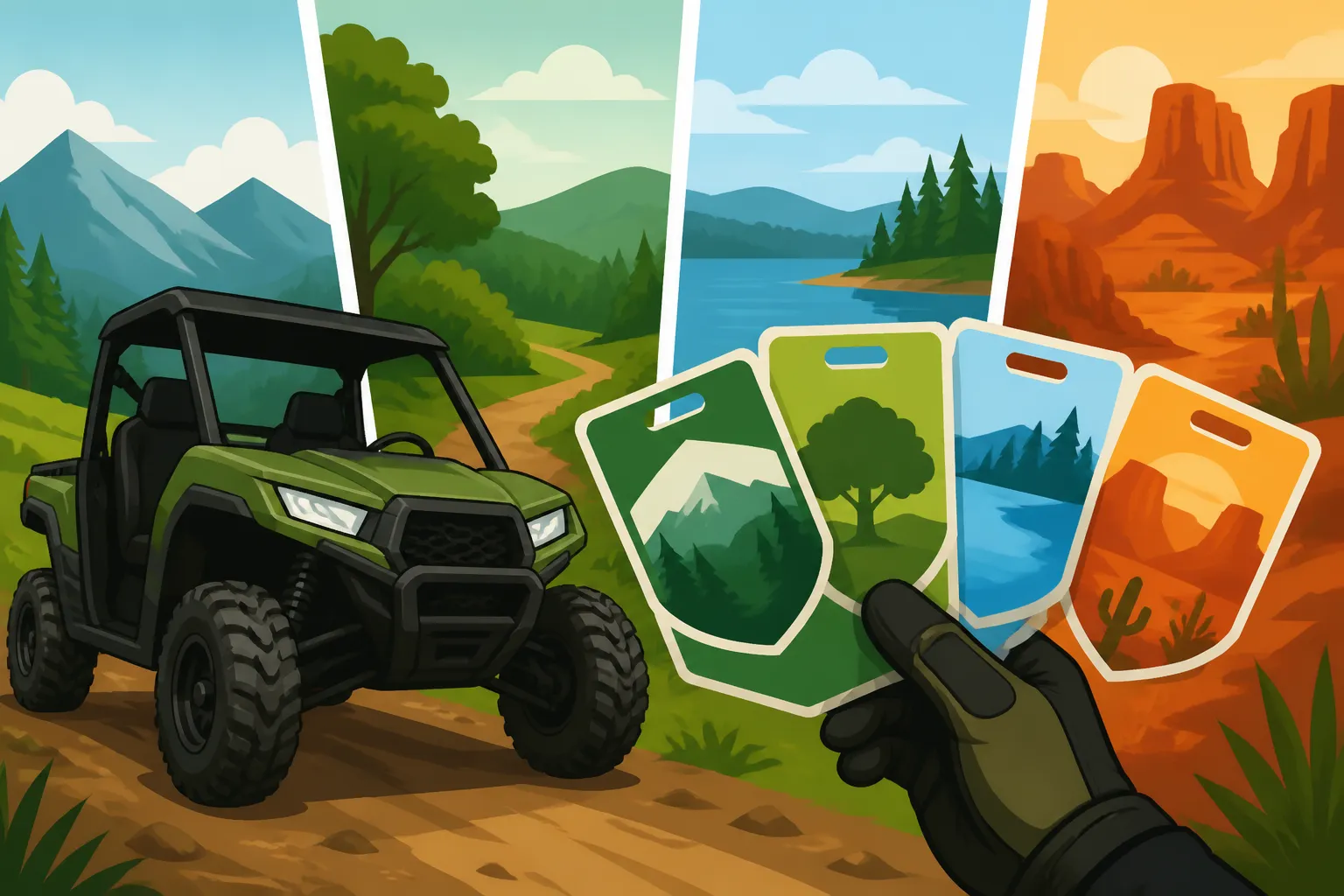
Kentucky does not have one statewide off-road permit that automatically works at every trail system. A permit is generally tied to the land manager or riding area that issues it, and its conditions apply there. A pass for Black Mountain does not become a pass for Leatherwood, Turkey Bay, or the Daniel Boone National Forest simply because all four are in Kentucky.
The areas operate under different systems. Black Mountain and Leatherwood are distinct riding destinations with their own access rules. Turkey Bay is an OHV area within Land Between the Lakes, while the Daniel Boone National Forest has its own OHV pass requirements for designated riding opportunities. A permit from one does not replace the rules set by another.
That matters most on a multi-stop trip. A rider might buy a park permit for the first destination, then discover at the next gate that the permit is not recognized there. The problem is not necessarily that the first pass was invalid; it may be valid only for the property, dates, people, or machines specified by its issuer.
| Destination | What to verify before leaving | Why a different permit may be needed |
|---|---|---|
| Black Mountain Off-Road Adventure Area | Permit coverage, machine details, and how proof must be carried or displayed | It is a separate riding area with its own permit system |
| Leatherwood Off-Road Park | Whether each rider or passenger needs a permit, and what the permit covers | Its access requirements may be organized differently from a machine-based pass |
| Turkey Bay OHV Area | Current permit rules, eligible riding area, and where to obtain or show proof | Turkey Bay has a separate system within Land Between the Lakes |
| Daniel Boone National Forest | Which routes or areas require an OHV pass and how the pass applies to the machine | Forest access is governed by its own rules, not a private park permit |
This is why the phrase “I already have a Kentucky trail permit” can be misleading. There may be no single permit to describe that way. It is more accurate to name the destination and identify the pass or authorization required there. For the broader distinction between park access and statewide requirements, see Why a Kentucky Park Permit Is Not a State Permit and Why Kentucky Has No Statewide Trail Sticker.
A permit also is not the same thing as a title, registration, or proof of ownership. Those documents deal with different issues. A title may establish ownership, while a trail permit grants access under the issuer’s rules. Kentucky’s title and registration rules are separate from individual trail-system requirements; Does Kentucky Register ATVs? explains the state-level distinction.
What to Check for Each Riding Area
Before buying or packing permits, confirm the requirements for every place on the itinerary. The word “permit” can describe different arrangements: one pass may be associated with a machine, another may require a separate permit for each rider, and another may apply only to specified routes or dates. Do not infer coverage from the permit’s name alone.
Black Mountain
For Black Mountain, check what the permit covers, whether the permit is linked to a particular machine, and whether riders must carry or display proof in a specific way. If several machines are traveling together, confirm that each is covered rather than assuming a single purchase applies to the whole group. Also check current purchase arrangements and operating notices before hauling.
The permit is only one part of the visit. Trail access, closures, and park instructions can affect where you may ride after entering. The details in Black Mountain Permits Must Be Bought in Person and Why Black Mountain Permits Cannot Be Bought Online may help explain the park’s permit process, but check the park directly for current instructions before relying on older information.
Leatherwood
Leatherwood’s requirements may be organized around people rather than only around machines. Confirm whether every rider or passenger needs an individual permit, and whether a machine’s operator can purchase or carry permits for others. A group should not assume that one permit covers everyone in a side-by-side or riding party.
This distinction can cause confusion when a group visits multiple areas in one trip. A machine-based permit at one destination does not establish that each person has satisfied Leatherwood’s requirements. Check the current rules for the full group, including passengers, before arriving. For more on the person-based question, see Why Leatherwood Charges Every Person and Does a Passenger Need Their Own Leatherwood Permit?.
Turkey Bay
Turkey Bay has a separate OHV permit system within Land Between the Lakes. Check the current rules for the riding area, the permit period, and how the permit must be obtained or shown. Make sure the permit is appropriate for your machine and the intended visit; do not assume that a pass purchased for another Kentucky park is accepted there.
Turkey Bay’s access conditions can also change with operating hours, seasonal schedules, or ground conditions. A permit does not guarantee that the area is open on the day you arrive. Before loading up, check the current notice and gate information. How the Turkey Bay OHV Permit Works and Call Before You Haul to Turkey Bay are useful starting points.
Daniel Boone National Forest
The Daniel Boone National Forest has a different management system from private off-road parks. Confirm which routes are open to OHV use, whether a pass is required for your planned route, and how that pass applies to your machine. Having a permit from Black Mountain, Leatherwood, or Turkey Bay does not automatically authorize riding on forest routes.
Do not treat a forest pass as permission to ride anywhere on national forest land. Access is limited to routes and areas where OHV use is allowed, and current closures or route rules still apply. Check the official forest information before your ride. Buying and Using the Daniel Boone Forest OHV Pass and Kentucky Rules for Riding a National Forest cover related questions.
How to Carry Proof Without Mixing It Up
Carrying several permits is manageable if each one is clearly connected to its destination. The goal is not to collect paperwork for its own sake; it is to be able to show the right proof at the right place and avoid relying on a receipt or permit that belongs to a different system.
- Make a stop-by-stop list. Write down each riding area, the date of the visit, and what the park or land manager says must be purchased, carried, or displayed. Include the person or machine covered by each permit.
- Keep confirmation details with the permit. Save receipts, order confirmations, or other proof of purchase if the issuer provides them. Note any instructions about display, expiration, transfer, or check-in.
- Separate permits by destination. Use labeled envelopes or separate sections of a document holder. Label digital files with the park name and visit date so you do not have to search through a camera roll at a gate.
- Carry proof in the required format. If an issuer requires an original, physical permit, a screenshot may not be an acceptable substitute. If the permit must be displayed on a machine, a receipt in a phone app may not meet that requirement.
- Check before each departure. Recheck closures, hours, and permit instructions shortly before leaving. An old confirmation does not tell you whether a trail is open today.
- Keep a backup where practical. Save digital confirmation offline if cell service may be unreliable, and keep paper documents dry and readable. A small waterproof document sleeve, including one available through Amazon, can help protect paper proof; it does not replace any required decal or official permit.
If you are traveling with a group, assign one person to maintain the permit list and make sure each rider knows what they are responsible for carrying. That helps avoid the assumption that the driver’s paperwork covers passengers or other machines. Where a permit is tied to a specific person or vehicle, keep the associated details together.
A photo can be useful as a backup record, but do not assume it is valid for entry. Some systems may require a physical pass or visible display, and a photo of one permit cannot establish coverage at another destination. Review Does a Photo of Your Title Count as Proof? for a related example of why a photograph and an accepted original document are not always interchangeable.
A Simple Plan for a Four-Park Trip
Build the permit plan around the itinerary, not around the idea that one purchase should cover the whole trip. Start by confirming which areas you will actually ride. Then check the issuing authority’s current requirements for each stop, including whether the permit is per machine, per rider, or subject to a different limit.
A practical checklist looks like this:
- Name the destination precisely. “Kentucky trails” is not specific enough. Record Black Mountain, Leatherwood, Turkey Bay, or the Daniel Boone National Forest as applicable.
- Identify who and what the permit covers. List the driver, passengers, machine, or machines if the rules require those details.
- Confirm the permitted area. A pass may be limited to a particular park, trail system, or designated route.
- Check when it is valid. Match the permit period to the trip and verify any schedule or closure notice.
- Find out how proof is handled. Confirm whether you need to carry a receipt, display a pass, check in at an office, or follow another instruction.
- Keep each permit separate. Store it with the correct destination’s notes, not in a mixed stack where it could be mistaken for another pass.
- Recheck directly with the issuer. Permit terms, purchase methods, hours, and trail access can change. Use the current information from the park or land manager, especially before a long tow.
If the trip includes only one or two destinations, do not buy permits for the other areas simply because they are part of a general four-park comparison. Conversely, if you expect to add a stop during the trip, verify that destination’s rules before turning onto its trails. A permit for a nearby riding area is not a substitute.
The core planning rule is straightforward: treat each permit as local to the system that issued it unless that issuer clearly says otherwise. Keeping four separate sets of requirements may feel less convenient than one statewide pass, but it prevents a common mistake—arriving prepared for the wrong park. For a broader explanation of how separate systems work, see Why Kentucky Cannot Reciprocate Anything.
Disclaimer
This article is for general informational purposes only and does not constitute professional advice. Laws, prices and regulations vary by location and change over time. Consult a qualified professional for guidance on your specific situation.