Meeting a Coal Truck on a Park Road
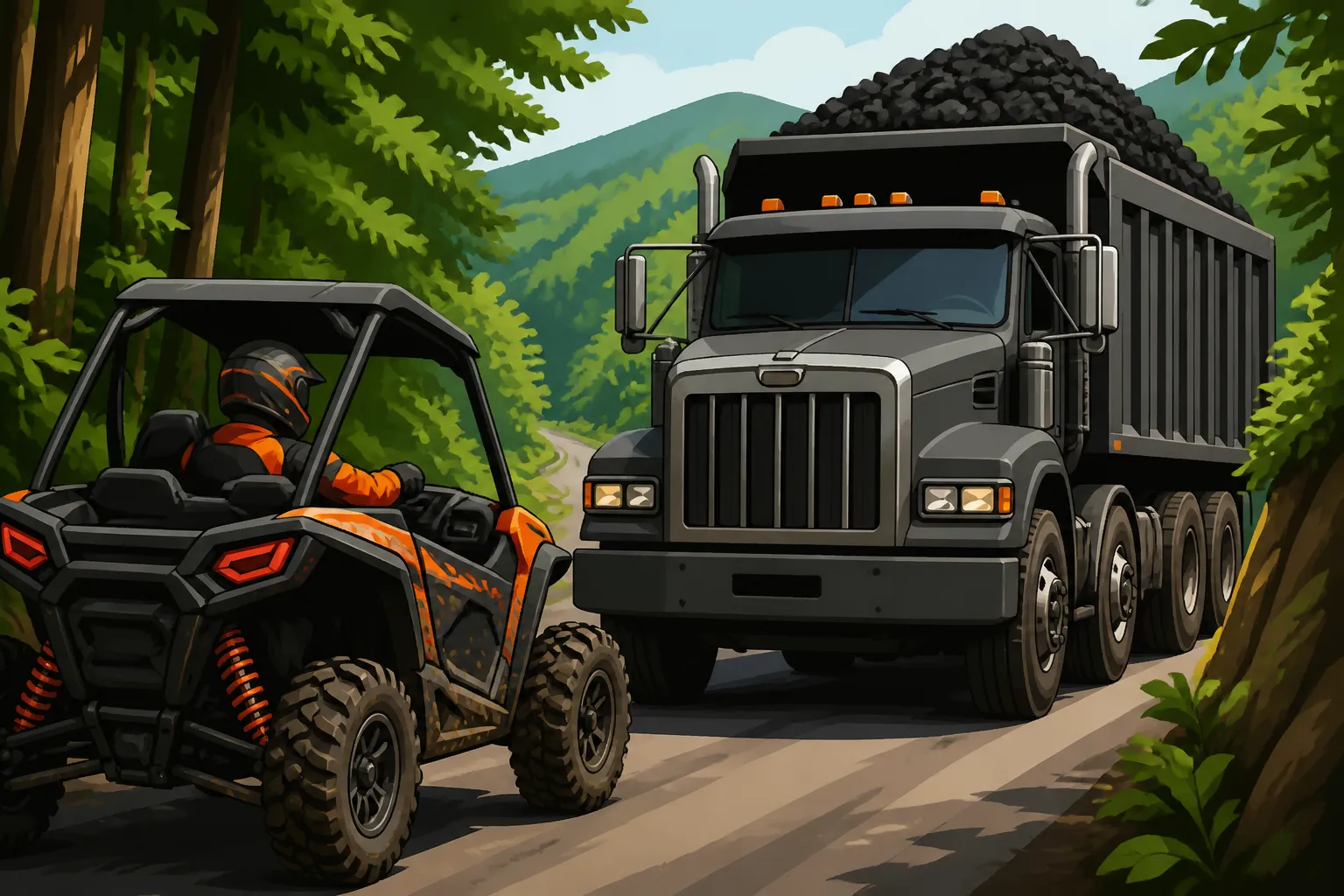
A coal truck appearing around a bend on a narrow Kentucky park road can leave an ATV or UTV rider with very little room to react. The safest response is to slow early, get out of the truck’s path when you can do so safely, and follow posted directions or staff instructions. This guide explains how to prepare, yield, and handle the encounter without making a risky move.
Why coal trucks and off-road riders may share a road
Park roads are not always trail-only roads
In Kentucky’s coal country, an off-road route may pass near working land, mine access roads, service roads, or other routes used by large vehicles. A road that feels like part of a recreation area may still have permitted commercial traffic. Conditions and access arrangements differ by location, so don’t assume that every road inside or near a riding area is closed to trucks.
A route may also change character as it climbs or crosses a ridge. A wide gravel section can narrow into a bench road with a steep slope on one side, a rock face on the other, or limited visibility around a bend. A truck may need much of that space to travel safely, especially if the road is uneven or the vehicle is carrying a load.
Before riding, review the park’s rules and route information, and obey signs at entrances and along the way. A map can help you understand the route, but it cannot tell you that a road is clear at this moment or authorize you to enter land where riding is restricted. For broader context, see Kentucky Rules for Riding a Leased Coal Property and Riding an Old Haul Road.
A loaded truck needs room and time
A coal truck is much larger and heavier than an ATV or UTV. Its driver may need a longer distance to slow down, may not be able to stop on a steep or loose surface, and may have limited visibility close to the vehicle. Dust, engine noise, and the shape of a bend can also make it harder for either driver or rider to spot the other early.
That mismatch is why trying to “squeeze by” is a poor plan. Even if there appears to be enough space, the road edge may be soft, rutted, or unstable. A UTV can be especially vulnerable if its tires are close to a drop-off or its side-by-side width leaves little room to maneuver. The practical goal is not to win an argument about who belongs on the road; it is to create space and avoid surprising the truck driver.
Treat the route as shared until signs say otherwise
At a park or trail system, follow its current access rules rather than relying on assumptions based on a previous visit. If a sign indicates that a road is closed, restricted, or used by industrial traffic, take that instruction seriously. If the status is unclear, ask park staff before setting out. Kentucky Trail Closures to Check is useful background for making a pre-ride check part of your routine.
Some riders use onX Offroad or another mapping tool to plan a route and keep track of their location. That can be helpful when roads and trails branch, but a mapped line is not a substitute for posted restrictions, permission, or current directions from the park. Save or review route details before entering areas where cell service may be unreliable, and don’t stop in the road to study a screen.
What to do when you see a coal truck
Slow down before the road becomes a squeeze
When you spot a truck, reduce speed promptly and smoothly. Avoid a sudden turn or hard stop that could make your machine slide, particularly on gravel, mud, or a steep grade. If you are riding with others, alert the group and leave enough space for the machines ahead to react. Don’t crowd the rider in front of you; a short line of ATVs needs room to stop without stacking up.
If you can safely pull into a broad, stable turnout, move fully out of the truck’s travel path and stop. Choose ground that is firm and level where possible. Don’t put your tires on a soft shoulder, hang over a slope, or block a gate, intersection, or place where the truck may need to turn. If there is no safe turnout, stop where you have the best available visibility and follow posted instructions or the truck driver’s direction.
Make your position easy to understand
Once stopped, give the truck room and avoid sudden movements. Keep riders together and out of the vehicle’s path. If the truck is approaching, don’t wave it forward and then change position, and don’t assume the driver can see you just because you can see the cab. Dust, mirrors, blind spots, and road geometry can all affect visibility.
If the truck is already stopped, wait for a clear signal or instruction before passing. Do not pass beneath a raised bed, squeeze between the truck and a bank, or move behind it where the driver may not see you. If the driver gestures for you to wait, wait. If you cannot tell what the gesture means, remain in a safe position rather than guessing.
Use this decision guide
| What you encounter | Safer response | Avoid |
|---|---|---|
| Truck approaching on a wide section | Slow early and pull fully into a safe turnout if available | Stopping in the center of the road |
| Truck approaching on a narrow bench | Stop where you can be seen and wait for the driver’s direction | Trying to squeeze past or riding onto an unstable edge |
| Truck stopped at a bend or junction | Keep clear of its turning and stopping space; wait for a signal | Passing close to the cab, wheels, or rear |
| Dust or a blind curve blocks your view | Stop before entering the obscured section and let visibility improve | Following another machine into the dust cloud |
| Posted sign or staff instruction restricts access | Follow the instruction and use an authorized route | Treating a map line or prior visit as permission |
The exact safe position depends on the road. A wide turnout may be appropriate in one place; on a narrow bench, moving farther could put you closer to a drop-off. Prioritize stable ground, visibility, and keeping clear of the truck’s path rather than following a single maneuver in every situation. The narrow-road guidance in Kentucky Trail Etiquette on Narrow Benches and Meeting a Coal Truck on a Narrow Road is particularly relevant.
Preparing before you ride
Check access, closures, and route conditions
Before unloading, ask whether your intended route is open to recreational riders and whether any sections are used by work vehicles. Check park notices and follow instructions from the operator. If you are uncertain whether a road is part of an authorized riding route, don’t use it until you have clarified access.
Carry a route map or have a reliable offline map available, but treat it as a navigation aid rather than a live safety report. onX Offroad can help with route planning and location awareness when you have prepared the map in advance. It cannot confirm that a work road is clear or that a closure has been lifted. Park information and signs take priority. See Kentucky Trail Maps Worth Carrying for more on preparing your route, and Kentucky Trail Conditions Before You Ride for the value of checking conditions before you haul.
Plan for poor visibility and weak cell service
In a holler, a rider may lose cell coverage while still being far from the staging area. Don’t count on calling someone to settle a road-access question or guide you around a closure. Let someone know your general riding plan, carry the essentials you need for the outing, and agree on a regrouping point if your group gets separated.
An offline map in onX Offroad may help you orient yourself when service drops, but download or prepare what you need before you lose coverage. Keep the device secured and use it only when stopped somewhere safe. A map check in the middle of a narrow road can turn a manageable pause into a hazard for you and anyone approaching from either direction. Cell Dead Zones in a Holler offers related planning context.
Brief the whole group before entering narrow roads
A quick conversation at the trailhead can prevent confusion later. Agree on who will signal the group to slow down, how riders will stop in a line, and where everyone should wait if a truck appears. Make sure newer riders understand that they should not follow another machine blindly around a bend or into dust.
If the group includes several machines, keep enough space between them to stop without blocking the road. Avoid bunching up at a blind corner, and don’t let the last rider assume the group is clear just because the riders ahead have moved. A simple rule—stop, stay visible, and wait for clear direction—works better than several people trying different maneuvers at once.
Common mistakes to avoid
Don’t assume the truck will yield
An ATV may be more maneuverable, but that does not make it safer to dart into a narrow gap. The truck driver may not see a rider near the front wheel or along the side of the vehicle. On a hill, the truck may also need to keep moving to manage the grade. Stop early, make your machine visible, and give the driver time and space to respond.
Likewise, don’t use a horn, hand wave, or verbal exchange as a substitute for a safe position. A signal can be misunderstood, especially through engine noise or dust. If there is uncertainty, staying put in a safe place is usually less risky than improvising a pass.
Don’t ride around a closure or onto mine property
A blocked route is not an invitation to find a way around the barrier. The alternate track may be an active work route, private property, or an unstable area that is not intended for recreational vehicles. A GPS or app showing a line there does not establish that riders are permitted to use it. Turn around only where it is safe, and ask staff for an authorized alternative.
This matters even when a route looks familiar. Work access can change, and a road that was quiet during one visit may be in use later. For a location-specific riding example, Riding a Strip Mine Bench in Harlan County helps explain why terrain and land use deserve attention beyond the trail map.
Don’t let dust push you into a blind pass
A truck can leave a dense cloud that hides the road, other machines, loose gravel, and sharp turns. Resist the urge to follow closely so you can keep up. Slow down, increase your distance, and wait until you can see the route clearly. If the truck stops, don’t pass until you know why it stopped and have room to do so safely.
Once the encounter is over, continue at a pace that allows you to stop within the distance you can see. On a winding road, the next truck, service vehicle, or group of riders may be just beyond the next bend. A careful ride is not merely slower; it gives everyone more time to recognize a problem and make a controlled choice.
Disclaimer
This article is for general informational purposes only and does not constitute professional advice. Laws, prices and regulations vary by location and change over time. Consult a qualified professional for guidance on your specific situation.