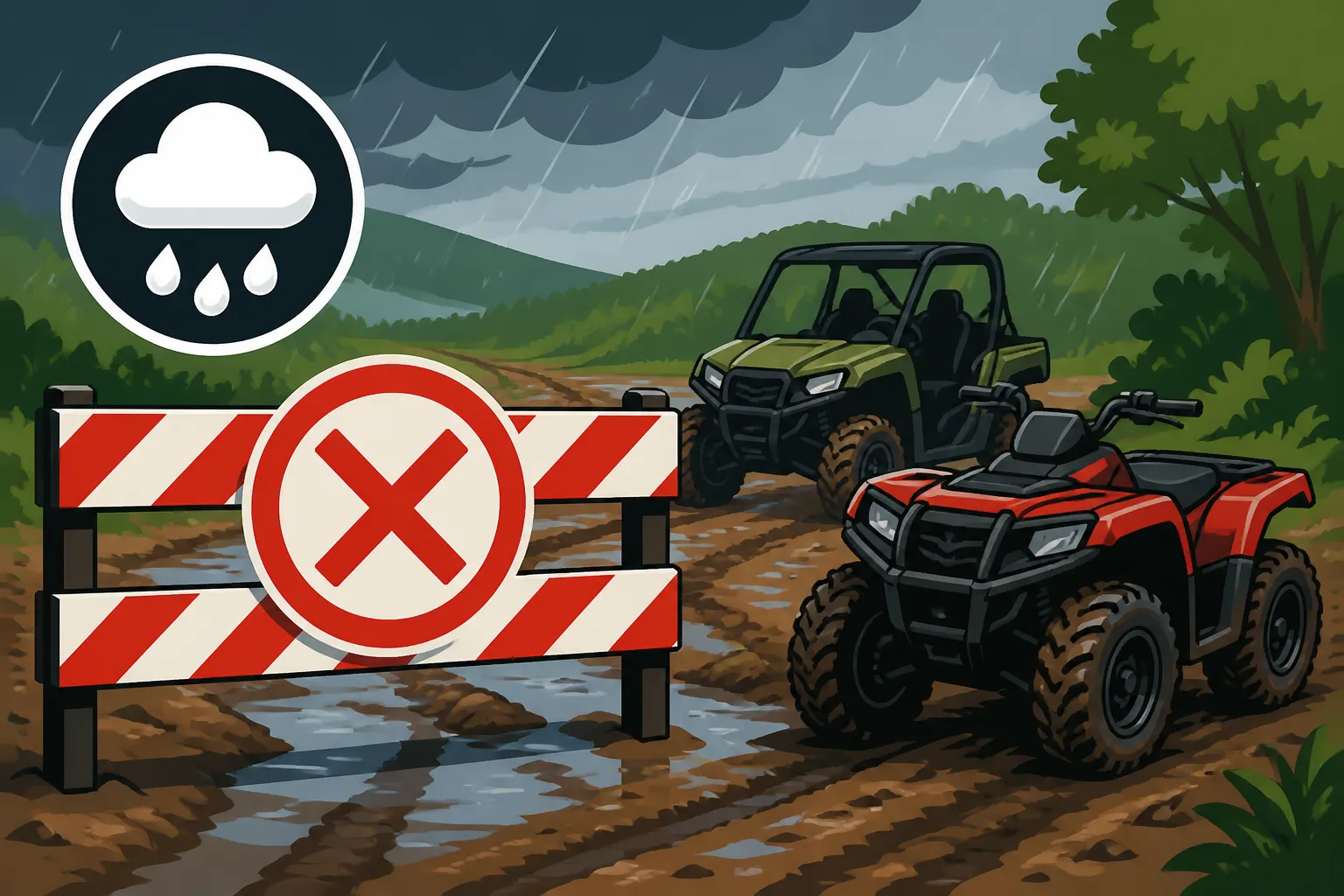
Kentucky Trails Closed After Rain
Rain can turn a Kentucky trail from firm and predictable to slick, rutted, and unsafe in a surprisingly short time. It can also prompt a park or land manager to close routes to protect the ground. This guide explains how to check a closure, decide whether conditions are rideable, and adjust your plans without turning a wet weekend into a costly or frustrating trip.
Why Kentucky trails close after rain
Wet ground can take lasting damage
A trail may look passable while still being too soft to support repeated ATV or UTV traffic. Tires press into saturated soil, and each pass can deepen ruts, loosen the surface, or push mud and sediment downhill. On a steep section, that damage can spread quickly as water follows the tracks instead of draining naturally.
This is one reason trail managers may close routes even when there is no standing water at the entrance. A hard-packed staging area does not tell you what a shaded ridge, creek crossing, or narrow bench trail looks like farther in. Kentucky’s mountain terrain can also make conditions vary over short distances: a sunny gravel road may be firm while a nearby hollow remains wet and soft.
Closures are not just about preserving a pleasant ride. Deep ruts can become hazards for riders, pedestrians, maintenance crews, and other trail users. They can also channel runoff toward streams and low areas. Giving a trail time to drain and recover can prevent damage that would take far longer to repair than the rain lasted.
A closed trail is different from a trail that merely feels difficult
Mud, puddles, and slick rocks do not automatically mean a trail is legally closed. The decision belongs to the operator or land manager, and rules can differ between public riding areas, private parks, leased land, and forest routes. A park may close its entire riding area, restrict only certain trails, or keep operating while asking riders to avoid particularly vulnerable sections.
Do not assume that a route is open just because the gate is unlocked, another vehicle is entering, or an old map shows it as available. A closure notice may be posted online, at the entrance, or at a junction. If the notice is unclear, ask the office or gate staff before unloading. For Turkey Bay, for example, wet-ground closures are a condition riders should check directly rather than guess about from rainfall totals alone. See [Why Turkey Bay Closes on Saturated Ground](Why Turkey Bay Closes on Saturated Ground).
It helps to distinguish three situations:
| Situation | What it means | Sensible response |
|---|---|---|
| Official closure | The operator or land manager has closed an area or route | Do not enter; ask when or how reopening updates are shared |
| Open with wet conditions | Riding is permitted, but surfaces may be slick or soft | Choose suitable routes, reduce impact, and turn back if conditions worsen |
| Unclear status | You cannot confirm whether a route is open | Contact the operator or land manager before riding |
A closure can change after conditions improve, but a sunny afternoon does not necessarily mean the trail has drained. Check the official notice again before you travel, especially if you are hauling from another part of Kentucky or crossing state lines for a ride.
How to check trail conditions before you haul
Start with the operator or land manager
Check the place responsible for the riding area first. A park’s own website, social media page, phone line, or gate office may carry notices that third-party trail listings do not. Look for the date of the update, the specific area affected, and any instructions about reopening. A post saying “trails closed” may apply to the whole property, while another notice may name only a loop or trail system.
For public land, check the agency responsible for that land and confirm which routes are designated for motorized use. Do not treat a map app’s line as permission to ride. A route can appear on a map even when it is not open to ATVs, has a seasonal restriction, or is temporarily closed. The same caution applies to roads crossing private or leased property: a track that looks continuous on a screen does not establish access rights.
When you call, ask practical questions rather than only “Are you open?” For example: Is the whole area open? Are any routes closed? Are side-by-sides subject to the same restrictions? Is the closure likely to be reassessed before the weekend? Is there a place to check for updates on the morning of your trip? These answers help you decide whether to travel, switch destinations, or postpone.
Use maps as a planning aid, not a closure notice
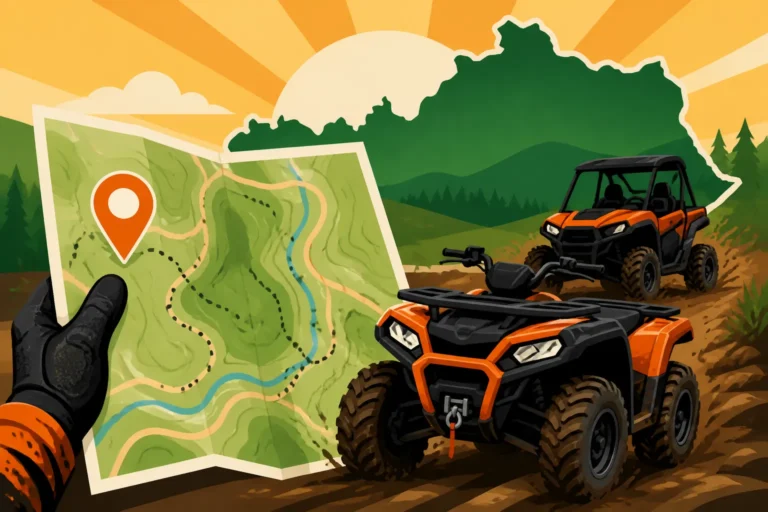
A mapping app can help you understand the shape of a ride, identify junctions, and prepare for areas where cell service may be weak. Some riders use onX Offroad to review routes and save map information for trips where signal may be unreliable. That can be useful for navigation, but a saved map does not confirm that a trail is open today. Check the park or land manager’s latest information separately.
Before leaving home, compare the route you intend to ride with the area’s current access information. If a closure affects a connector, the rest of your planned loop may no longer be reachable. Mark a shorter option and a clear turnaround point. For a trip in eastern Kentucky, where a route may wind through hollows and over ridges, a backup plan can be more useful than trying to improvise at a muddy junction.
If you use onX Offroad or another map while riding, download or save what you need before losing service, and keep the official closure information accessible in another way. A screenshot of a notice or a written phone number can help if you need to confirm details at the staging area. The map supports navigation; the operator’s current instructions determine access.
Check again on the day of the ride
Conditions can shift overnight. A forecast may call for clearing skies, but a storm that passed through a narrow valley can leave a creek crossing high or a shaded slope saturated. Conversely, a closure notice may be updated after an area drains. Recheck before loading the machines and, if possible, once more before entering the trail system.
Use the same habit when plans include more than one destination. A closure at one park does not mean every riding area in Kentucky is closed, but it also does not mean a nearby area is automatically open. Each site has its own operator, land conditions, and access rules. A quick call can save a long drive with a trailer, fuel, food, and a group waiting to ride.
For a broader planning checklist, [Kentucky Trail Conditions Before You Ride](Kentucky Trail Conditions Before You Ride) and [Kentucky Trail Closures to Check First](Kentucky Trail Closures to Check First) are useful companion topics. Keep in mind that an old trip report, photo, or map review may describe conditions from a different storm or season.
What to do when trails are wet but open
Match your route to the ground
If the area is officially open, choose your route conservatively. Favor well-drained, established trails over soft shoulders, steep slopes, or low spots that hold water. Avoid trying to climb a muddy grade simply because another rider left tracks there. Those tracks may be deep, unstable, or part of a route that should be avoided.
A UTV can feel planted because of its size and weight, but that weight can also press into soft ground and widen a rut. An ATV may be easier to turn around in a tight space, yet a sudden throttle burst can spin tires and dig into the trail. In either vehicle, use smooth control and keep a pace that allows you to stop before a hazard. If the tires begin sinking or the surface is breaking apart, continuing forward often makes the damage and recovery problem worse.
Be particularly cautious around creek crossings, drainage dips, and narrow mountain benches. Rain can change water depth, weaken the edge of a crossing, or wash loose gravel onto a hard surface. Do not enter moving water if you cannot judge the depth and bottom, and do not ride around a marked closure by creating a new track through brush. That shortcut can damage the land and may put you on property or a route where you do not have permission.
Turn around before the trail becomes a recovery job
A muddy section can look manageable from the driver’s seat and become difficult once the machine is halfway through it. Before committing, consider whether you have enough room to turn around, whether the ground is firm enough to support the vehicle, and whether another rider can safely assist. If you are traveling with a group, discuss a turnaround rule before the first muddy obstacle rather than negotiating it after someone is stuck.
Do not let sunk costs make the decision for you. You may have driven several hours, paid for a stay, or waited for a weekend with friends, but that does not make a deteriorating trail safer. A cautious retreat can protect your machine, the trail, and the rest of the group. A winch is recovery equipment, not a reason to enter every soft or steep section.
Keep the group together when conditions are poor. Leave space between machines so the rider ahead has room to stop, and avoid bunching up on a narrow slope or near a crossing. If a route is becoming badly rutted, return the way you came if that is safe and permitted. Tell the operator about an unexpected hazard or a trail that appears to have deteriorated; managers may not know about a problem until someone reports it.
Avoid making the trail worse
Ride only on designated routes and avoid widening the trail to bypass puddles or mud. Going around a wet patch may seem gentler, but repeated detours can flatten vegetation, expose soil, and create parallel tracks that channel more water. If the official guidance says to stay on marked trails, do exactly that—even when the marked line is messy.
After the ride, clean your machine where allowed and check for damage before heading home. Mud packed around brakes, suspension, or cooling components can cause problems later. Do not wash a machine into a stream or drainage channel. Follow the park’s instructions for wash stations and waste disposal.
For more context on wet-ground preparation and closures, see [Kentucky Riding After Heavy Rain](Kentucky Riding After Heavy Rain) and [Where to Ride When a Kentucky Park Closes Wet](Where to Ride When a Kentucky Park Closes Wet). A closed park is a reason to change the plan, not to search for an unmarked shortcut or ride somewhere without permission.
How to plan a backup ride
Choose alternatives by confirming access first
If your first choice is closed, look for another managed riding area and verify its status directly. Do not assume that a nearby destination has the same weather, ground conditions, or opening decision. One area may have better drainage, while another may have received heavier rain or have more vulnerable trails.
A useful backup is one you have checked before the day of travel. Keep a short list of destinations within reasonable driving distance, along with their contact details and access requirements. If your group is traveling from Lexington, Louisville, or farther away, compare the added drive with the possibility of postponing. Sometimes the least frustrating choice is to reschedule rather than spend the day chasing uncertain conditions.
If you are considering a forest route, verify that motorized riding is allowed on that specific route and that no temporary restrictions apply. If you are considering a private park, check whether it is open, what routes are available, and whether any conditions or equipment rules have changed. [Kentucky Trail Closures to Check](Kentucky Trail Closures to Check) and [Kentucky Riding Areas Near a Town](Kentucky Riding Areas Near a Town) can help you think through alternatives, but confirm details with the site before setting out.
Make a simple rain-day decision plan
Before booking a trip, agree on what the group will do if rain arrives. Decide whether you will ride only if the official status is open, whether you are willing to switch locations, and how much extra driving is acceptable. This avoids the familiar parking-lot debate where half the group wants to push ahead and the other half is worried about the ground.
A practical plan can be as simple as:
- Check the operator’s current notice the evening before travel.
- Call or recheck the notice before loading on the morning of the ride.
- Confirm the planned route is both open and suitable for your machine.
- Identify one verified alternative or agree to postpone.
- Reassess at the gate if conditions differ from what you expected.
For navigation, onX Offroad can help you prepare a route and keep relevant map details available when cell reception is limited. Still, treat the map as a planning tool and use direct updates from the land manager for closures. Keeping those roles separate makes it easier to avoid relying on a route line that may not reflect today’s access.
A wet-weather cancellation can feel like wasted time, especially when the trip has been planned for weeks. But taking a few minutes to verify conditions can prevent a long haul to a closed gate, a damaged trail, or a recovery situation that turns a ride into a much bigger problem. The best call is the one that respects the closure, the land, and the people riding with you.
Disclaimer
This article is for general informational purposes only and does not constitute professional advice. Laws, prices and regulations vary by location and change over time. Consult a qualified professional for guidance on your specific situation.