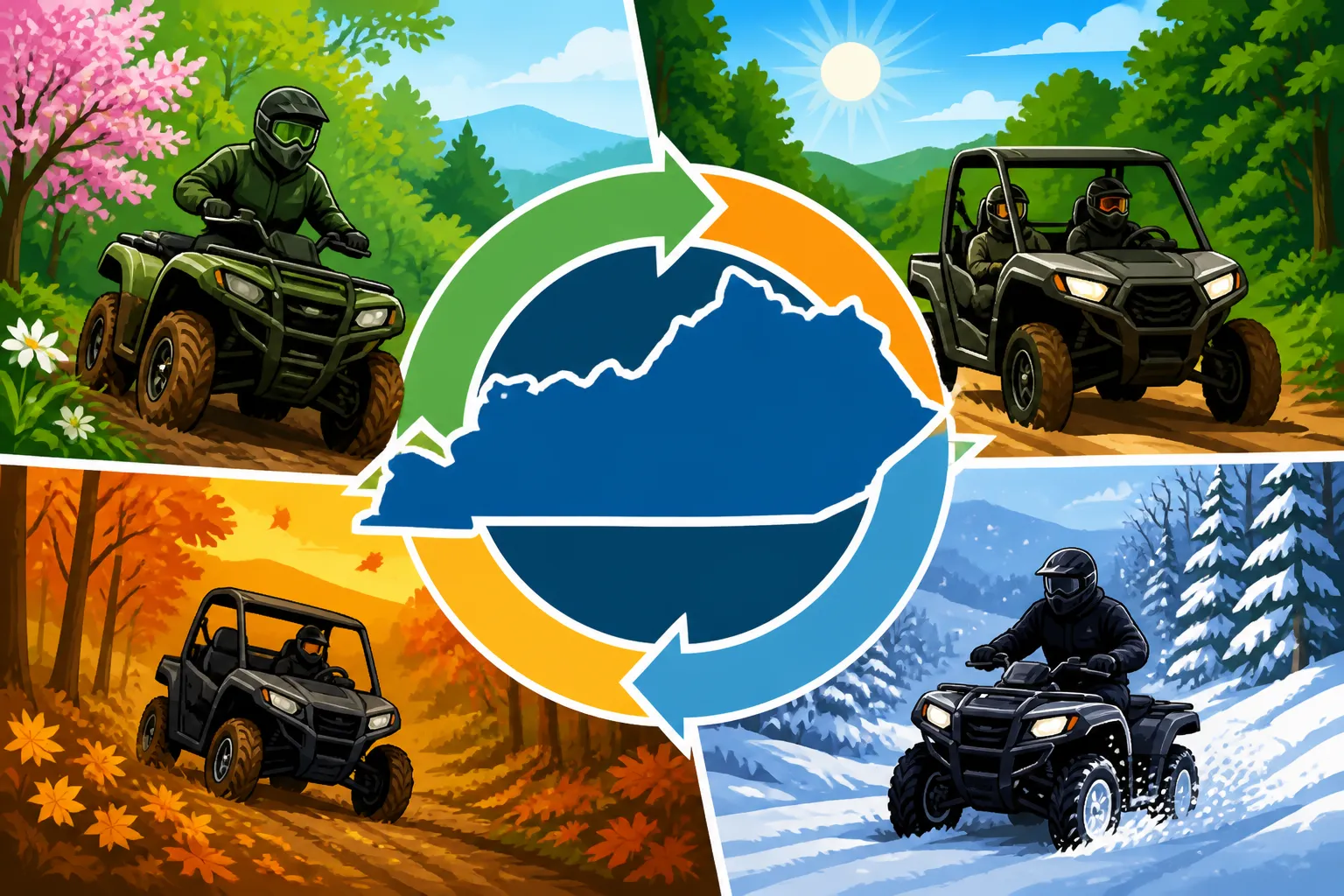
Kentucky Trails Open Year Round
A “year-round” trail listing can be misleading when rain, ice, maintenance, or a park’s own schedule closes the gate. Kentucky riders planning a winter weekend or an off-season trip need to know which areas may offer riding beyond the warmer months—and what to confirm before towing a machine across the state. This guide explains how to plan around seasonal access and changing trail conditions.
What year-round riding means in Kentucky
Open all year does not mean open every day
Kentucky does not have one statewide calendar that guarantees every off-road trail is open throughout the year. Access depends on the landowner or park operator, the type of trail system, weather, maintenance, and any seasonal restrictions. A place described as open year-round may still close a particular trail, limit hours, or shut its gates temporarily.
That difference matters most when you have already loaded the ATV or UTV, booked a cabin, and driven several hours. A park can be open in winter in general while a storm or thaw makes some routes unsafe or unusable on your chosen day. Treat “year-round” as a sign that riding may be available outside the main season—not as a promise that every route will be open whenever you arrive.
Before leaving, check the specific riding area’s current notices and contact its operator if the information is unclear. The overview in [Kentucky Trail Seasons and Closures] is a useful starting point, but the park’s own gate notice or staff is the better source for a same-day decision.
Weather can close a trail even when the park is open
Winter conditions in Kentucky vary by region and elevation. A clear, mild day near western Kentucky’s Land Between the Lakes can feel very different from a cold, wet day on a shaded bench road in Harlan County. Mud, ice, fallen branches, poor visibility, and saturated ground can all affect whether a trail is rideable.
Rain deserves particular attention. A route that seems manageable from the parking area may become slick, rutted, or difficult to climb after sustained precipitation. Operators may close trails to prevent damage or reduce safety risks, even if the forecast looks better by the time you arrive. Check [Kentucky Riding After Heavy Rain] and [Kentucky Trail Conditions Before You Ride] when planning around recent storms.
Kentucky riding areas to check for off-season access
Black Mountain near Harlan
Black Mountain Off-Road Adventure Area is a well-known option to investigate for riding beyond the warm-weather season. Its extensive trail network in Harlan County gives riders a reason to plan a weekend around the area, but the size of the system does not mean every route is suitable in every condition. Elevation, exposure, mud, and winter weather can make the experience change quickly from one trail to another.
Before heading toward Harlan or the Evarts and Putney trailheads, check park notices and ask what is open for your machine and skill level. Be especially cautious after rain or when temperatures have been dropping overnight. A trail that is merely wet in the afternoon can have icy patches in shaded sections early in the day. For an overview of the area, see [Black Mountain Off-Road Adventure Area in Kentucky].
Rush Off-Road and Leatherwood
Rush Off-Road in eastern Kentucky and Leatherwood Off-Road Park are other places riders may want to check when looking for an off-season trip. Their location, terrain, and operating arrangements differ, so don’t assume that a schedule or condition report for one applies to the other. Confirm access directly with each operator before you make a long drive.
Ask specific questions rather than only asking whether the park is open. For example: Are the trails open to ATVs as well as UTVs? Are any routes closed because of weather or maintenance? Is there a machine-width restriction on the trails available today? What time does the gate or office operate? The park profiles for [Rush Off-Road in Eastern Kentucky] and [Leatherwood Off-Road Park in Kentucky] can help you compare the areas before you call.
Turkey Bay and other seasonal systems
Turkey Bay OHV Area, within Land Between the Lakes in western Kentucky, is a popular destination, but riders should pay close attention to its seasonal operating details. Gate hours, access periods, and closures can differ from what you might expect at a privately operated park. Don’t assume that a trail system is open in winter just because the surrounding recreation area remains accessible.
Use the latest information from the managing agency or gatehouse when planning a Turkey Bay visit, particularly near seasonal transitions or after wet weather. The same approach applies to public-land routes elsewhere: trail access can depend on specific rules, permits, and closures, not just whether the land itself is open. Start with [Turkey Bay OHV Area in Western Kentucky] and [Kentucky Trail Closures to Check First].
| Riding area | What to verify before traveling | Why a same-day check matters |
|---|---|---|
| Black Mountain near Harlan | Open routes, weather closures, machine suitability, and access details | Mountain conditions can vary across the trail system |
| Rush Off-Road | Operating schedule, available trails, and current conditions | Park access and trail access may not be identical |
| Leatherwood | Gate or office arrangements, trail status, and machine restrictions | Conditions and access details may change by route |
| Turkey Bay at Land Between the Lakes | Seasonal access, gate hours, and current closure notices | Public-area access does not automatically mean OHV trails are open |
This table is a planning aid, not a live status report. Confirm details with the operator or managing agency before you set out.
How to plan a year-round ATV or UTV trip
Check access, machine fit, and rules before loading
Start by identifying the exact trail system and the organization responsible for it. Then check whether it permits your type of machine. A wide side-by-side may not fit routes intended for narrower ATVs, and a park’s general welcome to off-road vehicles does not necessarily mean every trail is suitable for every vehicle.
Next, review the rules for permits, helmets, passengers, and designated routes. Rules can differ between private parks, public recreation areas, and national forest land. Don’t treat a trail permit as permission to ride anywhere nearby, and don’t assume that a public road leading to a trailhead is open to off-road vehicles. [Kentucky Trail Permits Explained] provides helpful context for understanding why access requirements can vary.
If you use onX Offroad to plan a route, treat it as a navigation and preparation tool—not as confirmation that a trail is open or that you have permission to ride there. Check the map against the operator’s current information, and make sure you understand which roads and tracks are authorized for your machine.
Build a weather check into the plan
Look beyond the forecast for your arrival time. Consider recent rainfall, overnight temperatures, wind, and conditions at higher elevations. A sunny afternoon can follow a night when shaded trails remain icy, while a dry morning can turn muddy after rain moves through. If the park posts a closure notice, follow it rather than trying to find an unofficial way around a blocked section.
Have a backup plan before you leave home. If your first choice closes, another area may be too far away, may have different access requirements, or may also be affected by the weather. Calling ahead can save you from discovering those complications in the parking lot. For route planning, [Kentucky Trail Maps Worth Carrying] is useful alongside a current operator update.
onX Offroad can also help you keep a route plan organized, but don’t rely on an app’s mapped line alone to determine whether a road is private, closed, or authorized for riding. Use the official trail map or posted directions where available, and carry a backup navigation option if you’ll be riding in an area with weak cell coverage.
Pack for shorter daylight and changing conditions
Off-season riding often means colder starts, damp gear, and less daylight than a midsummer outing. Dress in layers, bring dry gloves, and protect any phone or navigation device from water and cold. For a UTV ride, make sure passengers have suitable clothing too; a cab can reduce wind exposure without keeping everyone warm or dry.
Tell someone where you plan to ride and when you expect to return. Carry basic recovery and repair supplies suited to your machine and route, and avoid planning a long loop that leaves no margin for a slow section, a navigation mistake, or a weather change. If temperatures are near freezing, allow extra time for shaded trail surfaces and creek crossings to become hazardous.
An app such as onX Offroad may help you keep track of your planned route, but download or prepare the information you need before entering an area where cell service may be unreliable. Confirm your route against the park’s permitted trails, and follow posted signs even if a digital map appears to show a continuation.
A practical pre-trip checklist
The day before you go
Use this quick sequence to reduce the chance of arriving at a closed gate or finding that your planned route is unsuitable:
- Confirm the park or trail system is open on your intended date.
- Check for weather-related, maintenance, or seasonal closures.
- Verify that your ATV or UTV is allowed on the trails you plan to use.
- Review permits, entry procedures, hours, and any passenger requirements.
- Ask about trail conditions after recent rain, snow, or freezing temperatures.
- Save the operator’s directions and contact details before you lose cell service.
- Tell someone your route and expected return time.
If you are deciding between areas, compare more than distance. A closer trailhead may not be the better choice if it has limited off-season access, unsuitable routes for your machine, or conditions that don’t match your experience. It is worth a phone call to avoid a wasted trip.
What to ask when calling
A vague question such as “Are you open?” may not get you the details you need. Try asking whether the specific trails you hope to ride are open, whether recent weather has affected access, and whether the area has restrictions for your vehicle’s width or type. Ask whether you need to buy or obtain a permit in advance, and whether the posted schedule applies to the gate, office, or trail access itself.
If the answer is uncertain, ask when the park expects to confirm conditions or whether there is an official notice board or phone line to check again before departure. Keep in mind that conditions can change between a morning call and your arrival, especially after heavy rain or a sudden temperature drop.
A year-round riding plan works best when you treat flexibility as part of the trip. Pick a primary destination, identify a realistic backup, and be willing to change plans when the operator reports unsafe conditions. That approach is less frustrating than towing a machine to a closed or unsuitable trail—and safer than trying to ride around a closure.
Disclaimer
This article is for general informational purposes only and does not constitute professional advice. Laws, prices and regulations vary by location and change over time. Consult a qualified professional for guidance on your specific situation.