Kentucky ATV Title for a Machine Bought in Ohio
Buying an ATV or UTV can be an exciting prospect, especially when you find the perfect machine across state lines. However, bringing that shiny new-to-you quad home to Kentucky from a state like Ohio can quickly turn that excitement into a headache when you realize the titling rules are vastly different. Many folks get frustrated trying to navigate the Kentucky County Clerk's requirements when the machine they just bought doesn't come with the kind of paperwork Kentucky expects. This guide is here to walk you through exactly what you need to do to get a Kentucky ATV title for a machine you purchased in Ohio, helping you avoid common pitfalls and get out on the trails faster.
Understanding the Ohio-Kentucky Titling Divide
It’s easy to assume that vehicle titling works the same everywhere, but when you step across state lines, you quickly learn that isn't the case. Ohio and Kentucky have distinct approaches to ATV ownership, and understanding these differences is the first crucial step in successfully titling your new machine.
Why Ohio's Rules Impact Your Kentucky Title
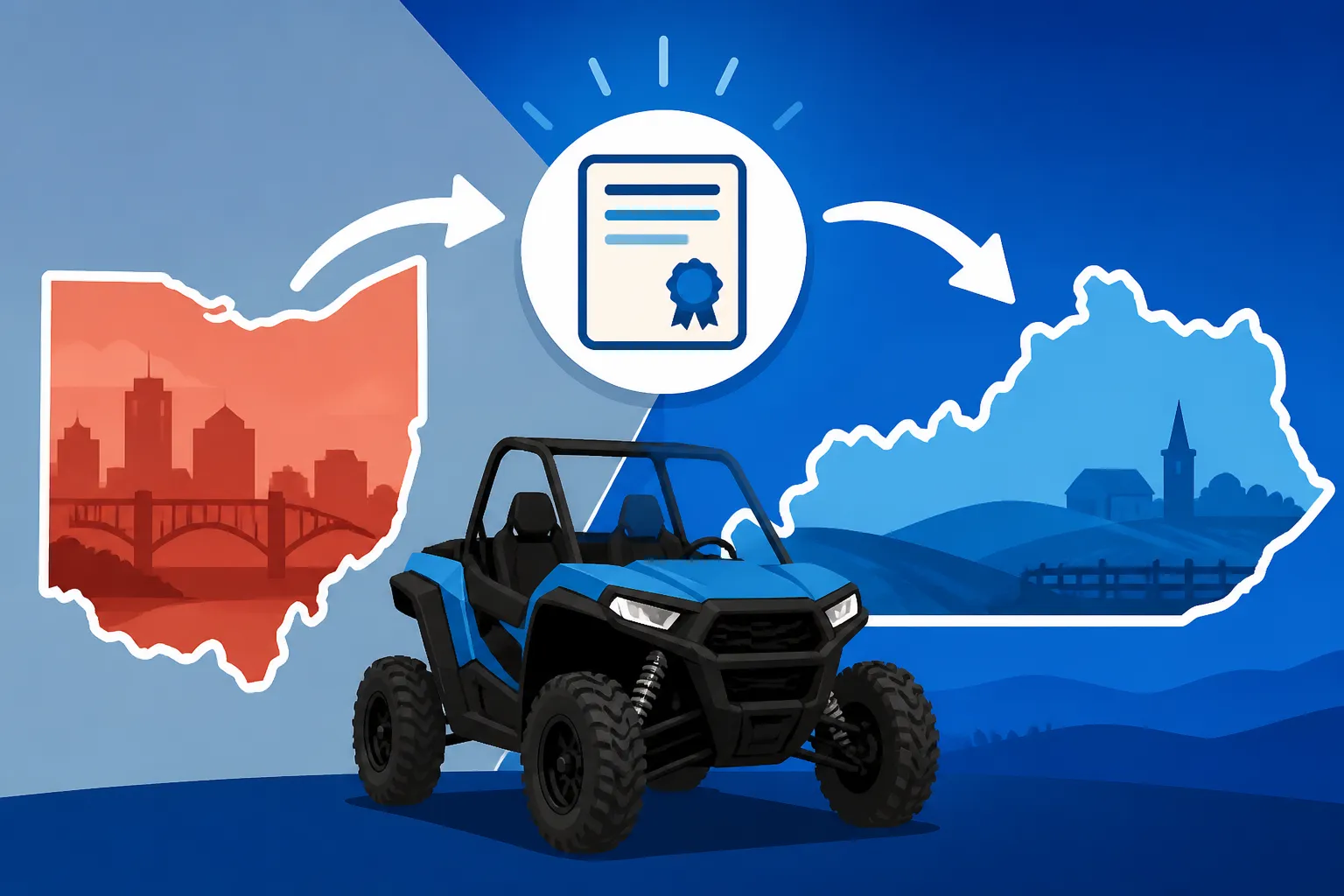
The biggest hurdle for many Kentucky residents buying an ATV in Ohio is that Ohio doesn't require titles for ATVs or UTVs. That's right—while Kentucky firmly believes in a title for most ATVs bought after July 2010, Ohio often considers them similar to other recreational equipment, typically exchanging them with just a bill of sale. This creates a disconnect, as Kentucky will absolutely expect proof of ownership that can stand up to its own titling standards.
Imagine you've just driven your new-to-you machine from a seller in Columbus, thrilled with the deal you got. You have a signed bill of sale, maybe even a registration slip, but no actual "title." You head to your local County Clerk in Kentucky, ready to get your machine legal, only to be met with a blank stare or a polite but firm rejection because you don't have the primary document Kentucky usually requires. This scenario is incredibly common and can be a real punch to the gut. Kentucky wants to see a clear chain of ownership, and a simple bill of sale from a state that doesn't title ATVs can sometimes feel insufficient in their eyes. For more on Kentucky's specific requirements, you might want to read [Why Kentucky Titles Machines Bought After July 2010].
The Core Challenge: Proving Ownership to Kentucky
Given Ohio's lack of ATV titles, your primary mission becomes proving to the Kentucky County Clerk that you are indeed the rightful owner of the machine. Kentucky needs a solid paper trail, something tangible that confirms the sale and identifies the ATV. Without an official Ohio title to sign over, you're going to rely heavily on other documents to make your case.
This isn't just about having a piece of paper; it's about having the right kind of paper, with the right information. The clerk needs to confirm the machine's identity (via its Vehicle Identification Number or VIN) and that the person who sold it to you had the legal right to do so. This is where a detailed and properly executed bill of sale becomes absolutely paramount. Anything less, and you might find yourself in a bureaucratic limbo, unable to complete the titling process. Understanding what counts as legitimate proof of ownership in Kentucky is key to a smooth transaction. For more details on this, check out our guide on [Proving Kentucky ATV Ownership].
Gathering Your Documents for the Kentucky County Clerk
When you're trying to title an out-of-state ATV that didn't come with a traditional title, the key is preparation. You need to assemble a robust packet of documents to present to your Kentucky County Clerk. Think of it as building your case for ownership.
The Ohio Bill of Sale: Your Most Important Document
If your ATV purchase in Ohio didn't involve a transfer of title (which it likely didn't), then the bill of sale isn't just a formality—it's your legal bedrock. This document must be incredibly thorough and clearly lay out all the essential details of the transaction. A flimsy, handwritten note on a napkin simply won't cut it with the Kentucky County Clerk.
Your bill of sale needs to include the full legal names and addresses of both the seller and the buyer. It must specify the date of the sale and the exact purchase price. Most critically, it needs to accurately list the ATV's Vehicle Identification Number (VIN), make, model, and year. Both the seller and the buyer absolutely must sign the document. If you're feeling unsure about how to draft a comprehensive bill of sale, or if you want to ensure it covers all the legal bases, resources like LawDepot offer templates for various legal documents, including bills of sale, that you can customize to fit your specific needs. Having a professionally structured document, even if filled out by hand, gives it more weight. Remember, this isn't just a receipt; it's the legal record of ownership transfer in the absence of a title. We've got a detailed breakdown on what makes a good bill of sale in Kentucky here: [A Kentucky Bill of Sale for an ATV].
Other Ohio-Specific Documentation
While the bill of sale is critical, other documents from Ohio can strengthen your claim of ownership, especially if the machine is newer or has some history you can trace.
If the ATV was relatively new when purchased in Ohio, the seller might have provided you with a Manufacturer's Certificate of Origin (MCO) or Manufacturer's Statement of Origin (MSO). This document is essentially the "birth certificate" of the ATV, issued by the manufacturer when the machine was new. If you have this, it's gold! It proves the machine's initial origin and provides the VIN directly from the factory. If the Ohio seller never titled the machine, but was the original owner, the MCO/MSO, properly signed over, can often serve as excellent proof for Kentucky.
For older machines, you might not have an MCO/MSO. In these cases, any previous registration documents from Ohio, even if they're not a full "title," can be helpful. While Kentucky doesn't register ATVs, seeing an out-of-state registration in the seller's name can help establish their prior ownership. This isn't a direct replacement for a title, but it adds to the overall picture of legitimate transfer. Always bring anything that substantiates the seller's right to sell the machine and your right to now own it. For situations where a bill of sale from a non-titling state is your main document, check out [Using a Bill of Sale From a Non-Titling State]. If you only have an out-of-state registration, then [An Out-of-State Registration as Kentucky Proof] provides more insights.
The Kentucky Titling Process for an Ohio Machine
Once you have all your ducks in a row with the documentation from Ohio, it's time to tackle the Kentucky side of things. The process isn't overly complicated, but it does require attention to detail and understanding where to go and what to expect.
Visiting Your Local Kentucky County Clerk
Unlike some states where you might go to a state-level Department of Motor Vehicles, in Kentucky, all ATV titling happens at your local County Clerk's office. This is where you'll bring all your carefully gathered documents. It's crucial that you visit the County Clerk in the county where you, the buyer, legally reside. Don't go to the seller's county in Ohio or even a different county in Kentucky just because it's closer; it needs to be your county of residence.
When you go, make sure you have your current Kentucky photo identification, such as your driver's license or state-issued ID card. This is essential for the clerk to verify your identity. They'll need to confirm that you are who you say you are before they process any ownership transfer. It's always a good idea to call your specific County Clerk's office ahead of time to confirm their hours, any specific requirements they might have, and if they recommend making an appointment. This can save you a wasted trip. Learn more about the specific steps at [Titling at a Kentucky County Clerk] and what ID you'll need at [A Kentucky Photo ID at the Clerk's Counter].
Completing Kentucky Form TC 96-182
In Kentucky, the primary application form for titling any vehicle, including an ATV, is Form TC 96-182, which is titled "Application for Kentucky Certificate of Title/Registration." Even though ATVs don't get a registration, you still use this form for the title. You can usually pick up a blank copy at the County Clerk's office, or sometimes download it from the Kentucky Transportation Cabinet's website to fill out beforehand.
This form requires you to provide details about yourself as the applicant, information about the ATV (including the all-important VIN, make, model, and year), and details about the seller. You'll need to indicate that you purchased the machine out of state and that it's an ATV. Be meticulous in filling out every section accurately. Any missing information or discrepancies can lead to delays or rejection. While LawDepot doesn't specifically provide Kentucky state forms, their broader legal document resources can help you organize the information you need for transactions, which can make completing forms like TC 96-182 smoother, as you'll have all your details clearly laid out. A comprehensive guide to filling out this form is available in [Kentucky Form TC 96-182 Explained].
Understanding Fees and Taxes
Titling your ATV in Kentucky isn't a free process. There are several fees and taxes you'll need to pay at the County Clerk's office when you submit your application.
First, there's the actual titling fee. This is a standard charge for processing and issuing your new Kentucky ATV title. If there's a lien on the machine (for example, if you financed it), there will also be a separate lien filing fee. Beyond these administrative fees, Kentucky requires you to pay sales tax on the purchase price of the ATV. This sales tax is calculated based on the purchase price you declared on your bill of sale. If the clerk believes the declared price is significantly undervalued, they may refer to an appraisal guide to determine a fair market value for tax purposes, so always be honest about the sale price. It's always a good idea to call your County Clerk's office or check their website for the most current fee schedule, as these figures can change. For a general overview of the costs involved, refer to [What a Kentucky ATV Title Costs] and for sales tax specifics, see [Kentucky ATV Sales Tax at Titling].
The VIN Inspection and Other Specifics
When you bring an out-of-state machine to Kentucky for titling, especially one from a non-titling state like Ohio, a VIN inspection is often a crucial step. The County Clerk, or sometimes a deputy or police officer if required by your specific county's procedure, will physically inspect the ATV's Vehicle Identification Number. They do this to ensure that the VIN on the machine matches the VIN on your bill of sale and application form, and to confirm that the ATV is legitimate and not stolen.
Kentucky generally requires a 17-character VIN for modern vehicles. While most ATVs manufactured in recent decades will have this, it's something the clerk will be looking for. It's important to know that Kentucky will only accept the VIN found stamped directly on the ATV's frame—they will not accept an engine number or any number found only on a sticker. Make sure the VIN on your machine is clean, legible, and easily accessible for the clerk to verify. If your machine's VIN doesn't conform to the 17-character standard, or if it's damaged, it can complicate the titling process significantly. For more on this, check out [Kentucky's Seventeen-Character VIN Rule] and [Why a Kentucky Clerk Rejects an Engine Number].
Potential Hurdles and How to Overcome Them
Even with the best preparation, titling an out-of-state ATV can sometimes present unexpected challenges. Being aware of these common hurdles and having a plan to address them can save you a lot of stress and time.
Missing or Incomplete Documentation from Ohio
One of the most common frustrations when buying an ATV from a state like Ohio is dealing with sellers who don't understand Kentucky's stringent documentation requirements. They might give you a minimal bill of sale or simply won't have an MCO for an older machine. If your initial documentation from Ohio is missing critical details or is just plain incomplete, you have a few options, though some are more challenging than others.
First and foremost, try to contact the original seller. Politely explain Kentucky's requirements and see if they can provide a more detailed bill of sale or any other supporting documents they might have, such as old registration cards or a copy of the MCO. If the seller is unresponsive or untraceable, you're in a trickier spot. This is where the quality of your existing bill of sale really shines. If you used a service like LawDepot to generate a comprehensive bill of sale initially, it's far more likely to pass muster.
If you genuinely have very little documentation and can't get more, you might have to explore options like a bonded title. This is a complex process that involves obtaining a surety bond, often for 1.5 times the value of the ATV, which protects the state and any potential previous owners if it turns out the machine was stolen or improperly sold. It's a last resort because it adds significant cost and time, but it can be a pathway to ownership when all other options are exhausted. Remember, the County Clerk's office is your primary point of contact for these matters; they are the experts on what documentation is acceptable for your specific situation. This is also why you're dealing with a County Clerk and not a state office—they handle the local specifics. You can find more about this in [Why a County Clerk and Not a State Office].
Addressing the 15-Day Titling Deadline
Kentucky law is quite clear about the timeline for titling a newly acquired vehicle: you have fifteen days from the date of purchase to apply for your new title. This deadline applies whether you bought the ATV from a dealer down the road or from a private seller in Ohio. Missing this deadline isn't just a minor inconvenience; it can result in penalties.
If you fail to title your ATV within the specified 15-day grace period, the County Clerk's office can charge you a late penalty fee. This fee is in addition to all the regular titling fees and sales tax. While it might not seem like much, it's an unnecessary expense that's easily avoidable with proper planning. This is why it's so important to have all your Ohio documentation in order before you even walk into the clerk's office. Don't wait until day 14 to start gathering papers! Have your bill of sale, MCO (if applicable), photo ID, and completed Form TC 96-182 ready to go as soon as possible after your purchase. Knowing this deadline can help you prioritize your tasks and ensure a smoother, penalty-free titling experience. For a more in-depth look at this deadline, read [Kentucky's Fifteen-Day Titling Deadline] and [Fifteen Days From the Day You Buy].
Here’s a summary of the typical documents you'll need:
| Document Type | Purpose | From Ohio (Seller) | For Kentucky Clerk (Buyer) | Notes |
|---|---|---|---|---|
| Bill of Sale | Primary proof of purchase & ownership transfer | Essential (signed by seller) | Buyer copy, often with seller | Must be detailed, include VIN, price, date, signatures. Using a template from a service like LawDepot is recommended for clarity. |
| Manufacturer's Certificate of Origin (MCO/MSO) | First ownership record from manufacturer | If machine was new or never titled | Original document | Only for machines never titled before; strengthens your case. |
| Previous Registration (Ohio) | Secondary proof of seller's prior ownership | If Ohio registered ATVs | Copy, if available | Not a title, but can support ownership chain for older machines. |
| Kentucky Photo ID | Identity verification for buyer | N/A | Required | Kentucky driver's license or state ID. |
| Kentucky Form TC 96-182 | Application for Kentucky title | N/A | Complete and sign | Available at clerk's office or online; fill out meticulously. |
Disclaimer
This article is for general informational purposes only and does not constitute professional advice. Laws, prices and regulations vary by location and change over time. Consult a qualified professional for guidance on your specific situation.