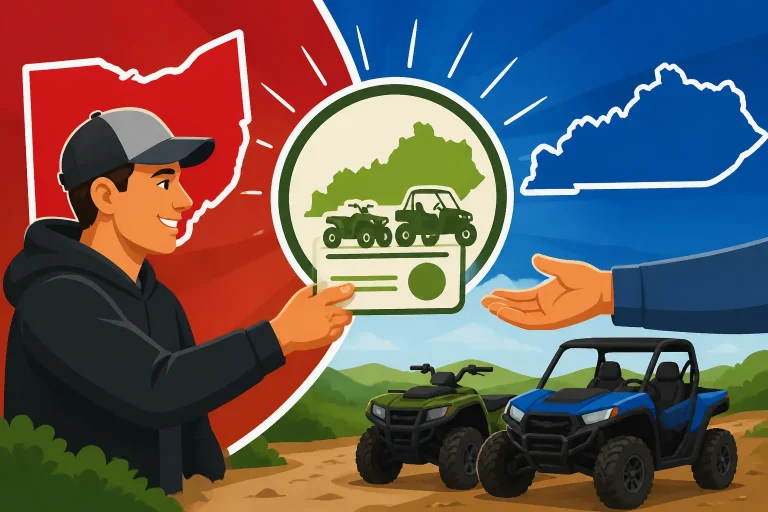
One Daniel Boone Pass, Two Trail Systems
A single Daniel Boone National Forest OHV recreation pass covers both the Redbird Crest OHV Trail System and the White Sulphur OHV Trail System. The practical question is what that shared coverage means at the trailhead—and what it does not replace. Here’s how to think about the pass, Kentucky title rules, and the details to confirm before you ride.
What one Daniel Boone pass covers
The USDA Forest Service says a single Daniel Boone National Forest OHV recreation pass covers both the Redbird Crest OHV Trail System and the White Sulphur OHV Trail System. If you’re planning rides at both systems, that shared coverage means you don’t need to treat them as unrelated pass areas when checking whether your Daniel Boone pass applies.
The coverage is specific to those two named systems. It should not be read as a pass for every off-road riding area in Kentucky, nor as permission to ride on any road or trail you encounter. A recreation pass addresses access under the rules for the relevant public land; it does not override closures, trail restrictions, or other operating requirements. For a broader look at riding in the national forest, see Kentucky’s National Forest Riding.
The USDA Forest Service says an official OHV recreation pass sticker must be displayed or a rider wristband worn on specific public lands such as the Daniel Boone National Forest. Treat that as a separate requirement from having the pass itself: make sure you understand how the pass is issued and how it must be shown or worn before leaving for the trail.
| Question | Practical answer |
|---|---|
| Does one Daniel Boone pass cover both systems? | Yes. The USDA Forest Service says a single pass covers Redbird Crest and White Sulphur. |
| Does that mean every Kentucky trail is included? | No. The stated coverage applies to these two Daniel Boone National Forest trail systems. |
| What must be displayed or worn on relevant public lands? | The USDA Forest Service says an official pass sticker must be displayed or a rider wristband worn. |
| Does a pass replace the ATV title? | No. Kentucky title requirements and public-land recreation-pass requirements are separate. |
| Can you assume the pass applies to another park? | No. Check that area’s own current rules before riding there. |
The pass also does not settle every practical question about how coverage is assigned. The supplied Forest Service information confirms that the same pass covers both named systems, but it does not specify every detail about who must carry it, how it is tied to a machine, or how a group should handle multiple riders. Before setting out, confirm those details with the Forest Service’s current information for the Daniel Boone National Forest. For a closer look at the pass itself, see Buying and Using the Daniel Boone Forest OHV Pass, Daniel Boone Forest OHV Pass Cost, and Where Kentucky Forest Passes Are Sold.
That verification matters even if you already have a pass in hand. A pass that applies to Redbird Crest and White Sulphur does not necessarily travel to a different park or public land. Separate recreation areas can set separate permit and access rules, so don’t treat a Daniel Boone pass as a statewide credential. The distinction is explained further in Why One Park’s Permit Does Not Travel and Kentucky Trail Permits Explained.
Keep the recreation pass separate from Kentucky title rules
Kentucky’s vehicle paperwork is a different layer from the Forest Service pass. According to the USDA Forest Service, ATVs used on specific public lands such as the Daniel Boone National Forest need the official OHV recreation pass displayed as a sticker or worn as a rider wristband. Separately, according to the Kentucky Transportation Cabinet, ATVs purchased on or after July 1, 2010, must be titled, and the title application must be submitted within 15 days of purchase.
According to the Kentucky Transportation Cabinet, ATVs used strictly for off-road purposes are titled rather than registered, so they are not subject to an annual state registration fee. The initial title application does have a one-time fee; check with the Transportation Cabinet for the current amount. That title is proof of ownership under Kentucky’s rules, not a substitute for the recreation pass required on specific public lands.
This difference can be easy to miss because both requirements involve paperwork or proof connected to the same machine. A title relates to ownership and Kentucky’s vehicle-title system. A recreation pass relates to riding access on the relevant public land. Having one does not establish that you have the other.
If you bought your machine recently, handle the title process on its own timetable rather than waiting until a ride is approaching. The Kentucky Transportation Cabinet’s 15-day deadline applies to the title application for an ATV purchased on or after July 1, 2010. The Forest Service pass requirement, meanwhile, concerns use on the specified public lands. See Titling an ATV in Kentucky and Does Kentucky Register ATVs? for the state paperwork distinction.
The same separation applies to public-road use. According to the Kentucky Transportation Cabinet, an ATV that will be operated on public roadways must also be registered. Roadway rules are not the same as off-road trail-access rules, and a Daniel Boone Forest pass does not make an ATV street legal. Before using a public road, check the specific requirements for that kind of operation; Kentucky Rules for ATVs on Public Roads and Are ATVs Street Legal in Kentucky? cover that separate question.
A useful pre-trip paperwork check is therefore simple:
- Confirm that the ATV’s title paperwork is in order under Kentucky rules.
- Confirm that the Daniel Boone pass covers the trail system you intend to ride.
- Confirm how the official sticker or wristband must be displayed or worn.
- Check the specific trail system’s current access information for closures and operating requirements.
- Keep road-use questions separate from trail-access questions.
This approach avoids a common mix-up: a state title does not grant access to a Forest Service trail, and a Forest Service pass does not satisfy Kentucky’s title requirements. They are separate obligations with separate purposes.
What the pass does not tell you about riding
A pass is not a blanket waiver from safety rules or trail restrictions. It identifies recreation access under the relevant public-land program, but riders still need to operate legally and safely. Kentucky’s requirements can apply whether the ride is at Redbird Crest, White Sulphur, or another location; the pass does not cancel them.
For example, according to the Legislative Research Commission, individuals aged 16 or older operating an ATV on public property are generally required to wear approved protective headgear, with exceptions for certain activities such as farming, mining, or logging. The Commission also says children under the age of six are prohibited from operating an ATV, and parents or guardians may not allow minors under 16 to operate one contrary to the manufacturer’s age-restriction warning labels. A rider should not assume a pass changes these rules.
Equipment matters as well. According to the Legislative Research Commission, an OHV operating on public off-highway vehicle trail systems must have a spark arrestor. The Forest Service pass is not a substitute for that equipment. Before the ride, check the machine itself and the applicable trail information rather than relying on the pass as evidence that the vehicle is ready for every trail.
Passenger arrangements need the same attention. The Kentucky Department of Fish and Wildlife Resources says single-rider ATVs are for one person, consistent with manufacturer recommendations. A pass does not make an otherwise unsuitable ATV safe or appropriate for an extra passenger. If more than one person will ride, verify that the machine is designed for the intended number of occupants and follow the manufacturer’s instructions.
For public roadway operation, Kentucky has separate equipment and conduct requirements. The Legislative Research Commission says headlights and taillights are required on UTVs and similar off-highway vehicles when operated on public roadways or highways. It also says a multi-passenger UTV classified as a special purpose vehicle must have a roll bar or roll cage and a seatbelt assembly for each designated seating position; it must have a windshield unless the operator wears eye protection. Those roadway requirements do not expand the scope of a Daniel Boone Forest pass.
There are also limits on roadway crossings. According to the Legislative Research Commission, ATVs may cross a two-lane public highway at as close to a 90-degree angle as practical and safe, and may not travel on the highway for more than two-tenths of a mile. The Commission also specifies daylight crossing, illuminated headlights and taillights, a valid operator’s license, and compliance with applicable traffic regulations. These are road-crossing rules, not privileges granted by the recreation pass.
The same is true for impaired operation. According to the Legislative Research Commission, a blood alcohol concentration of 0.08 or more creates a presumption that an ATV operator is under the influence, while operators under 21 are subject to a 0.02 zero-tolerance limit. A pass does not change those limits or make impaired riding acceptable.
A practical check before riding Redbird Crest or White Sulphur
Before loading the machine, confirm the pass coverage and the day’s access information together. The USDA Forest Service confirms that one Daniel Boone National Forest OHV recreation pass covers Redbird Crest and White Sulphur, but that general coverage does not tell you whether a particular route is open or whether temporary conditions affect access. Check the current Forest Service information for the system you plan to visit.
Then confirm how you need to carry or display the pass. The USDA Forest Service identifies a pass sticker displayed on the vehicle or a rider wristband worn on specific public lands. If you are unsure which form applies to your pass or riding group, resolve that before arriving rather than assuming that a receipt or proof of purchase will be accepted in place of the official item.
Make sure your machine and paperwork are ready as separate checks. Kentucky’s title rules apply to ownership documentation, while the Forest Service pass applies to access on the named public-land systems. Also check the spark-arrestor requirement for public OHV trail systems and any other machine or rider conditions relevant to your trip.
If your plans include more than the two covered systems, verify each additional destination independently. A Daniel Boone Forest pass should not be assumed to cover a privately operated park, another forest, or a different trail network. The safest planning habit is to identify the land manager for each riding area and follow that area’s current instructions. The pass’s shared coverage is useful, but it is not universal reciprocity.
For a straightforward trip plan, keep these questions together:
- Is the destination Redbird Crest, White Sulphur, or another riding area?
- Does the Daniel Boone pass cover the destination?
- Is the official sticker displayed or the wristband worn as required?
- Is the trail system open, and are there any current restrictions?
- Is the ATV titled as Kentucky requires?
- Does the machine meet applicable safety and equipment rules?
- Are road crossings or public-road travel part of the plan, requiring separate checks?
When the trip is limited to Redbird Crest and White Sulphur, the central answer is clear: according to the USDA Forest Service, one Daniel Boone National Forest OHV recreation pass covers both trail systems. The important qualification is that this shared pass coverage applies to those systems; it does not replace Kentucky title requirements, broader riding rules, or the separate access rules of other areas.
Sources
- Legislative Research Commission — Kentucky Revised Statutes § 189.281 (checked November 2, 2026)
- Legislative Research Commission — 189.515 Restrictions on operation of all-terrain vehicles. (checked November 2, 2026)
- Legislative Research Commission — KRS 189.520 (checked November 2, 2026)
- Kentucky Transportation Cabinet — Vehicle Titling – Drive KY (checked November 2, 2026)
Disclaimer
This article is for general informational purposes only and does not constitute professional advice. Laws, prices and regulations vary by location and change over time. Consult a qualified professional for guidance on your specific situation.