Kentucky Rules for a Machine Over the Width Limit
A wide side-by-side can be legal to own and still be barred from a particular Kentucky trail. The hard part is that “the width limit” may refer to a specific park, forest route, gate, or bridge—not one rule for every place you might ride. Here’s how to check the limit, measure your machine, and avoid hauling to a trail it cannot use.
Kentucky does not have one width limit for every riding area
A width restriction usually comes from the agency or operator managing the land, or from the design of a particular route. A trail system may set a maximum vehicle width, limit access to certain routes, or use gates and barriers that physically exclude wider machines. A different park may allow them.
That means a machine being called an ATV, UTV, or side-by-side does not answer whether it can use a specific trail. Nor does having a valid permit. The permit covers the access it is issued for; it does not cancel a width restriction or guarantee access to every route in the area. See Kentucky Trail Permits Explained and Why One Park’s Permit Does Not Travel for more on the difference between permits and riding access.
Width can matter even when a route is technically open. A narrow trail may include trees close to the edges, tight turns, drainage structures, or a barrier that a wider vehicle cannot pass safely. Some trail networks also have a mix of route types, so a wide machine might be accepted in one area but not on every trail.
Before planning around a limit, identify the exact place you want to ride and the exact route, if possible. “The park allows UTVs” is not as useful as confirmation that your machine’s measured width is permitted on the route you intend to use.
| What you need to check | Why it matters |
|---|---|
| The managing agency or park operator | Different properties can set different access rules |
| The specific trail or route | Access may vary within one riding area |
| How the width limit is measured | The official method may not match a brochure’s vehicle specification |
| Your machine’s actual width | Tires and accessories can make it wider than the published factory figure |
| Current closures and restrictions | Access can change because of maintenance, conditions, or temporary rules |
Do not assume that a width limit you saw for a national forest applies to a privately operated park, or that a park’s rule applies to a forest trail. For federal land, begin with the forest’s official riding information and route designations. Kentucky Rules for Riding a National Forest and Buying and Using the Daniel Boone Forest OHV Pass can help you understand why checking the land manager’s requirements matters.
Measure the machine as it will be ridden
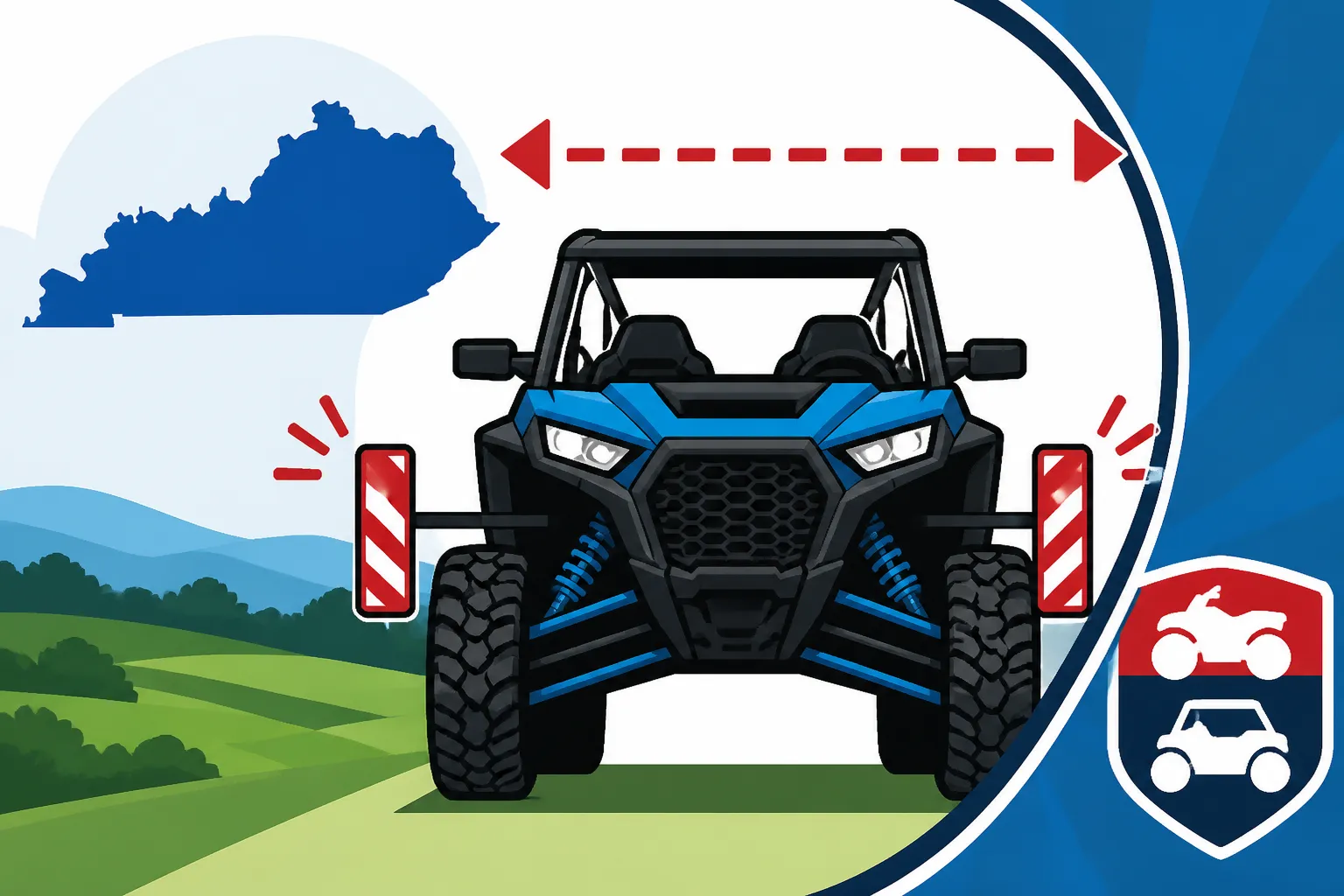
A manufacturer’s specification is a helpful starting point, but it may not tell you whether your particular machine meets a trail’s limit. Different tires, wheel offsets, fender additions, nerf bars, bumpers, mirrors, or other modifications can affect the overall width. Tire bulge can also make the widest point extend beyond the wheels’ nominal measurement.
Measure the actual machine, then ask the trail operator whether that matches its definition of vehicle width. The operator may specify whether to measure at the tires, bodywork, or another point. Do not guess if you are close to the stated limit.
A practical measurement process is:
- Park the machine on level ground with the wheels pointed straight ahead.
- Check the operator’s instructions for what counts as width before measuring.
- Measure across the machine’s widest relevant points, including any permanent or installed equipment the operator says to include.
- Account for tire sidewall bulge and aftermarket parts that extend outward.
- Write down the measurement and keep a photo of the measuring tape in place, if useful.
- Contact the trail operator with the measurement and your make, model, and configuration if the fit is uncertain.
A tape measure or suitable measuring tool is enough for a basic check; you do not need specialized equipment. If shopping for one, Amazon is one possible source, but the important part is measuring carefully and following the trail operator’s method.
If a machine is close to the limit, get a clear answer before traveling. A brochure may state a nominal width, while the trail operator may assess the machine as equipped. Ask whether accessories count, whether the limit applies to the whole vehicle or a particular part, and whether the rule is enforced at entry or on individual routes. Keep the response available when you arrive, but remember that posted rules and staff instructions at the property control access.
Confirm route access before loading the trailer
A quick call or message to the land manager can prevent a frustrating trip. Give them the machine’s measured width rather than only its model name. If the machine has changed tires or has aftermarket parts, mention those details. Ask directly whether it can use the intended trail, not simply whether the property permits UTVs.
Use current official maps and notices as part of that check. A general map may show a trail network without making every width restriction obvious. Look for route-specific designations, gate information, notices about closed sections, and instructions for different vehicle classes. Kentucky Trail Maps Worth Carrying and Kentucky Trail Closures to Check are useful starting points for planning, but confirm details with the operator when the width question is not clear.
Use a checklist before you leave:
- Confirm the property is open to the type of machine you have.
- Check the width limit and how the operator measures it.
- Ask whether the limit applies throughout the property or only to certain routes.
- Verify whether your chosen route has a separate restriction or barrier.
- Confirm the permit or access requirement for that property.
- Check for current closures, temporary detours, and weather-related restrictions.
- Save the operator’s contact information and any relevant access notice.
This is particularly important when a trip involves more than one riding area. A machine that fits one system may be too wide for another, and a permit from one place does not provide access elsewhere. For a broader comparison of how riding areas differ, see Kentucky Pay-to-Ride Parks Compared. If you are selecting a destination for a wider machine, Kentucky Trails for a Wide Machine may help you narrow the search, but still verify the current rules directly.
What to do if your machine exceeds the limit
If the operator confirms that your machine is too wide for a route or property, do not try to squeeze through a gate or ride around a barrier. A barrier may mark a real safety or land-access restriction, and bypassing it can create damage, trespass, or other problems. A machine that barely clears a narrow point may also leave little room to steer around obstacles or pass other riders safely.
The practical options are to choose a location that accepts the machine, use a route specifically approved for its width, or bring a narrower vehicle. Do not assume that removing an accessory will make the machine eligible; ask whether the measurement can be reassessed in that configuration and whether the operator accepts that method.
If a limit is expressed in the property’s rules but your machine’s measurement is close, request clarification before you pay for access or make travel plans. Ask whether staff can confirm the measurement at the gate, and whether the measurement must include tires, mirrors, bumpers, or other equipment. If the answer is uncertain, treat access as unconfirmed rather than relying on an informal assumption.
Also keep width separate from road-use rules. A machine being narrow enough for a trail does not automatically make it legal to operate on a public road, and a road-use classification does not give it permission to use a trail. Kentucky’s public-road requirements and land-based riding rules address different questions. Check the requirements for the place where you plan to operate, and do not use a trail permit as proof of road access.
The safest plan is simple: measure the machine as equipped, identify the trail system and route, and confirm the limit with the organization that manages it. That extra check matters most for wide side-by-sides, modified machines, and routes with gates or narrow trail features. When the rule is unclear, get confirmation before the trip rather than discovering the restriction at the entrance.
Disclaimer
This article is for general informational purposes only and does not constitute professional advice. Laws, prices and regulations vary by location and change over time. Consult a qualified professional for guidance on your specific situation.