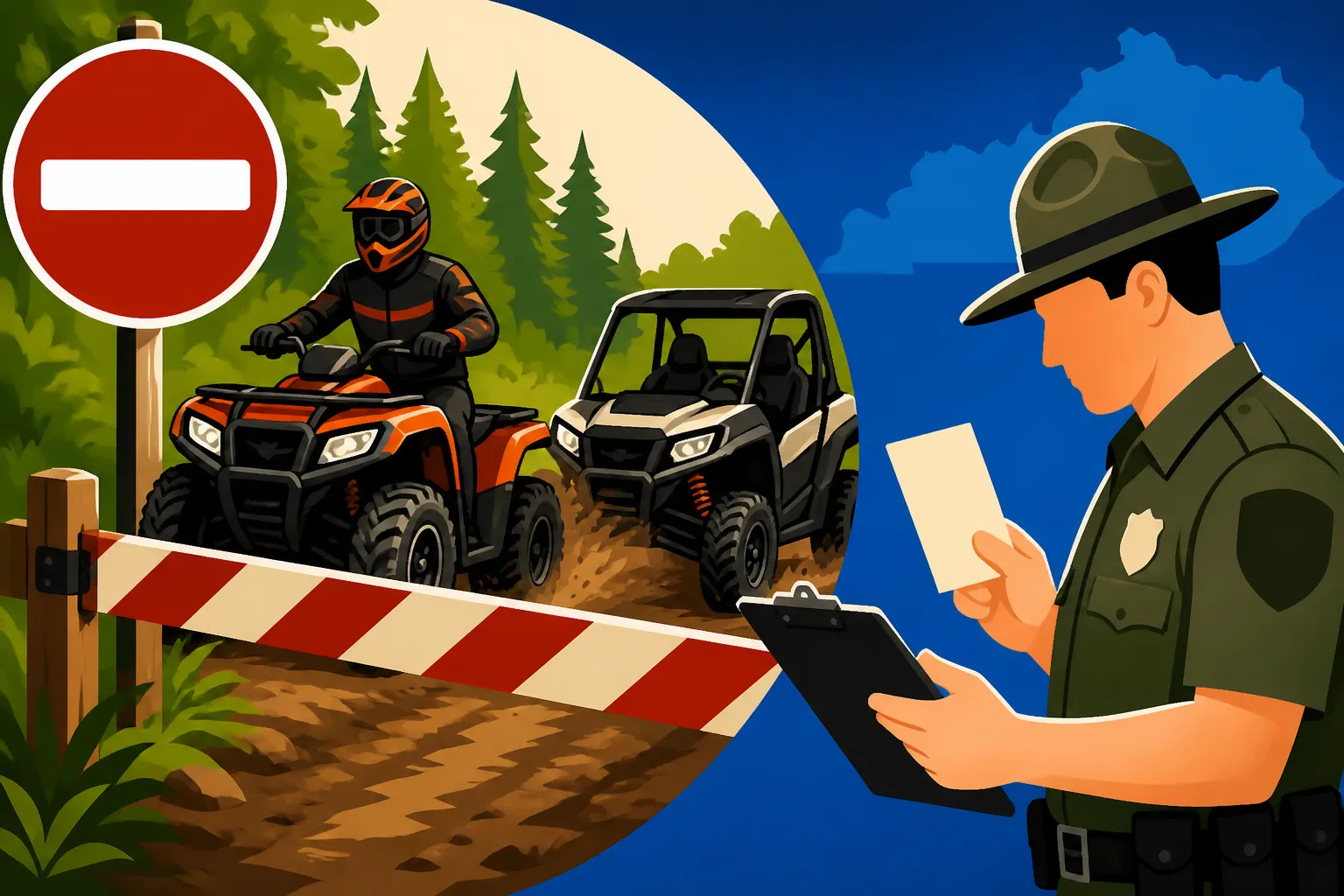
Kentucky Fines for Riding a Closed Trail
A closed-trail sign can look like a minor obstacle when the rest of a riding area is open, but crossing it can create more than a park-rule problem. In Kentucky, the consequences depend on who manages the land, why the route is closed, and what rules apply there. Here’s what riders should understand before taking an ATV or UTV past a closure.
What can happen if you ride a closed trail
There is no single fine that applies to every closed-trail violation across Kentucky. A trail may be managed by a private park, a public land agency, a local authority, or a landowner. Each can have different rules and enforcement procedures. The consequences may also depend on whether the closure is temporary, whether the rider had clear notice, and whether the machine caused damage or entered land without permission.
Possible outcomes include:
- A warning or direction to leave the closed area.
- A park or land-manager citation, if that operator has an enforcement process.
- Loss or suspension of riding privileges, such as having a permit or park access revoked.
- A trespassing complaint or other legal action, depending on the land, posted notice, and circumstances.
- Separate consequences if the rider damages property, ignores an official direction, or violates another rule at the same time.
These are possibilities, not a guaranteed penalty ladder. A land manager may use one response or several, and a closed-trail incident is not automatically treated the same way at every Kentucky riding area. Ask the operator or relevant authority what its current rules say rather than relying on a rider’s account of what happened somewhere else.
| Situation | Why it matters | What to check |
|---|---|---|
| A trail is closed for maintenance or weather | Riding it may damage the surface or put riders and workers at risk | The closure notice and the manager’s enforcement policy |
| A gate or sign marks a boundary | Passing it may mean entering an area where riding is not authorized | Who controls the land and whether access is allowed |
| A route is open, but your permit does not cover it | A permit may be limited to a particular park, area, or trail system | The permit terms and trail map |
| You accidentally enter a closed route | Promptly leaving and explaining the situation may help clarify what happened, but does not guarantee no consequence | The manager’s directions and any written notice |
A trail permit is not permission to use every route. Permits are generally tied to a particular property or riding system, and the rules for one location do not automatically apply at another. For background, see Kentucky Trail Permits Explained and Why a Kentucky Park Permit Is Not a State Permit.
A closure can also be separate from a permit violation. Riding without a required permit on an open trail is one issue; entering a route that is specifically closed can be another. If both happen, the operator or an enforcement authority may address both. The possible consequences for lacking a permit are covered separately in Kentucky Fines for No Trail Permit.
Why a trail may be closed and who sets the rules
The reason for a closure matters because it can affect both the risk of riding there and how the incident is handled. Some closures are short-term and easy to miss if a rider has not checked current notices. Others mark areas where access is not authorized.
Common reasons include:
- Wet or saturated ground. A machine can deepen ruts, loosen soil, or make a trail unsafe. Areas may close when conditions are poor and reopen when the ground can support traffic.
- Maintenance or repair. Crews may be working on the trail, a bridge, a gate, or another part of the property. A rider who goes around a barrier can enter the work area.
- Hazards or emergencies. A washout, fallen tree, unstable slope, fire, or other hazard may make the route unsafe.
- Seasonal or wildlife restrictions. A manager may limit access at certain times or in particular areas.
- Property boundaries or changes in access. A route shown on an old map may cross land where riding is no longer permitted.
- Event or operating rules. A trail or section may be closed during an event or while the property is being managed for another use.
The rules come from the authority or owner responsible for that particular land. A public riding area may have agency rules, while a privately operated park may set conditions for entry and use. A leased property can involve additional access limits, so a trail that appears to connect to an open route is not necessarily open to riders.
That is why a closure notice should be treated as a real boundary, not a suggestion. A sign, gate, posted message, or direction from staff can communicate that access is prohibited even if the reason is not obvious from the trail. If a route looks passable but is marked closed, do not assume the sign is outdated. Check with the manager before proceeding.
Trail status and riding permissions are also different questions. A trail may be open but require a particular permit; a permit may be valid while a specific trail is closed. The permit does not override the closure. Kentucky Trail Closures to Check First and Kentucky Trail Conditions Before You Ride explain what to verify before loading up.
What to do if you receive a citation or are told to leave
Stay calm, stop where directed, and follow lawful instructions from an authorized official or land manager. Arguing at the scene or continuing farther into the closed area can make a manageable misunderstanding more serious. If you believe you reached the closure by mistake, explain that clearly and factually without inventing an excuse.
Ask what rule or notice is involved and who issued it. If you receive a written citation or notice, read it carefully. Note the stated deadline, any hearing or appeal instructions, the alleged conduct, and the contact information provided. A park notice and a citation issued under a law are not necessarily the same thing, so identify what document you have before deciding how to respond.
Keep relevant records while details are fresh:
- Photograph the citation, closure sign, gate, and nearby trail markers if it is safe and permitted to do so.
- Write down the date, approximate time, route you took, and what you saw before reaching the closed section.
- Save your permit, receipt, map, booking confirmation, and any closure information you checked before the ride.
- Record the name or role of the person you spoke with, and keep notes of what was said.
- Follow the response instructions on the document. If it involves a formal legal citation or possible trespassing allegation, consider asking a qualified Kentucky attorney for advice.
Do not remove a sign, move a barrier, or post identifying details about other riders online. Those actions do not help resolve the incident and may create separate problems. If you think the closure was not adequately marked, document what you observed and raise that point through the process listed by the operator or issuing authority.
A mistake does not automatically erase a violation, and a rider’s belief that a trail was open may not settle the issue. At the same time, the specific facts matter. The location, visibility of the notice, land ownership, and the authority issuing the citation can all affect what options are available. Avoid assuming that an informal warning from one park establishes the rule or outcome at another.
If the issue is a road rather than a trail, a different set of restrictions may apply. Closed-trail rules should not be confused with road-use rules or permission to cross pavement. See [Kentucky Rules for Riding Off the Trail] and Kentucky Fines for Illegal ATV Road Use for related issues.
How to avoid a closed-trail violation
The most dependable approach is to check the status of the specific riding area shortly before you leave, then follow signs and directions once you arrive. Old maps, social media posts, and a route saved on a phone can be useful for planning, but they may not show a temporary closure.
Before riding:
- Check the current map and closure notices from the land manager, not only a third-party trail app.
- Confirm that your permit covers the property and the kind of riding you plan to do.
- Look for conditions that can change access, including heavy rain, maintenance, fire, or an event.
- Ask at the gate or office if a sign, map, or trail junction is unclear.
- Save the manager’s contact details so you can ask about a closure without guessing.
- Make a backup plan for an alternate open route or a different riding area.
At the trailhead, read the posted rules before unloading. Pay attention to temporary signs and barriers along the route as well as notices at the entrance. If a trail is marked closed, turn around and use a route the manager confirms is open. Do not go around a gate or barrier because the route appears dry, quiet, or passable.
If you find a closure that is not clear on the map, stop before entering the area and contact staff. If there is no signal, the conservative choice is to turn back rather than test whether the closure is enforced. Checking a Kentucky Trail Notice First, A Gate Board With Today’s Rules in Kentucky, and Calling a Kentucky Park Before You Load offer more detail on checking current information.
The practical rule is simple: a permit allows access only under the conditions set for that property, and a closed trail is outside those conditions unless the manager says otherwise. Confirming the route before you ride is easier than trying to sort out a citation or access dispute afterward.
Disclaimer
This article is for general informational purposes only and does not constitute professional advice. Laws, prices and regulations vary by location and change over time. Consult a qualified professional for guidance on your specific situation.