Kentucky Supervision Rules for Young Riders
A young rider may be ready to steer an ATV or UTV before they are ready to judge speed, terrain, or other trail users. In Kentucky, supervision is a legal and practical part of riding with children, not a substitute for choosing a suitable machine. Here’s how to think about adult oversight, age labels, helmets, and trail-park rules before you head out.
What supervision means for a young Kentucky rider
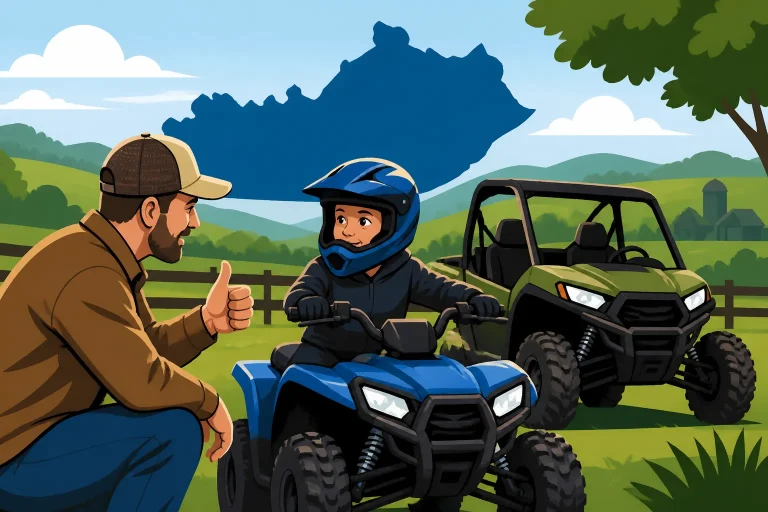
Kentucky’s rules require direct parental supervision for ATV riders under 16. That makes an adult’s role more active than simply being somewhere on the same property or available by phone. A young rider needs an adult who can keep track of the ride and respond if something changes.
The phrase “direct parental supervision” is important. Do not assume that a child is covered because an adult is riding in another group, waiting back at camp, or watching only occasionally. The safest approach is to have a parent, guardian, or adult specifically authorized by the parent stay close enough to observe the rider and intervene promptly. If you are unsure whether a particular arrangement meets the legal definition, check current Kentucky requirements before riding.
For practical purposes, supervision should mean more than following a child’s dust cloud. The adult should know the route, the child’s ability, and the machine’s limits; maintain reliable visual or otherwise effective oversight; and be ready to stop the ride. What counts as legally sufficient supervision can depend on the applicable rule and setting, so don’t treat a general safety practice as a definitive legal test.
A parent who is responsible for more than one young rider should plan how to supervise the group before leaving the staging area. A large group spread across a trail makes it harder to notice when a child falls behind, takes a wrong turn, or gets into difficulty. Keep the group small enough that the supervising adult can maintain attention and communicate clearly.
For a closer explanation of the legal requirement, see Kentucky Parental Supervision Rules Explained and What Direct Parental Supervision Actually Means on a Trail. The key practical point is straightforward: supervision should be active, close, and suited to the rider and terrain.
Supervision does not make every ride appropriate
An adult’s presence does not turn an unsuitable machine or trail into a safe one. Before riding, consider whether the child can comfortably reach and operate the controls, follow instructions, stop when asked, and respond to a sudden change in terrain. A child who can start a machine is not necessarily ready to ride independently on a busy or technical trail.
The supervising adult also needs enough control over the situation to set limits. If the child is going too fast, losing focus, or ignoring instructions, the adult should be able to end the ride rather than hope the problem resolves itself. For a young or inexperienced rider, that may mean riding only on a quiet, controlled area rather than a shared trail.
Check the rider’s age, the machine, and its label
Age is only one part of the decision. The machine’s size and design matter, and so does the manufacturer’s age recommendation. Kentucky’s rules make the manufacturer’s age label important, so do not treat adult supervision as permission to ignore it. Review the machine’s label and applicable requirements before putting a child on it. The Manufacturer’s Label as Kentucky’s Age Rule explains why that label matters.
A child who is physically small may struggle with a machine that is too heavy or powerful, even if they can reach some of the controls. A larger machine can also be harder to stop or recover from on a slope. Consider whether the rider can operate the throttle and brakes smoothly, turn without losing control, and keep a stable position on the seat or footrests. If any answer is no, choose a smaller, more appropriate machine or wait.
A UTV is not automatically a safer choice for every young rider. Its seating arrangement and protective structure differ from an ATV, but speed, terrain, passengers, and the driver’s experience still matter. A child riding as a passenger needs to be able to sit securely, use the restraint system correctly, and follow instructions. A child driving needs to meet applicable rules and be capable of controlling that specific machine. For model-specific age guidance, check the manufacturer’s label and manual.
| Before the ride | What to check | Why it matters |
|---|---|---|
| Rider’s age | Whether the rider may operate that kind of machine under current Kentucky rules | Supervision does not erase age-related restrictions |
| Machine label | Manufacturer’s recommended age and any operating guidance | A machine can be too large or powerful for a particular child |
| Controls | Whether the rider can reach and use them reliably | Poor control increases the chance of losing control or failing to stop |
| Protective gear | A properly fitted helmet and other suitable gear | A helmet that shifts or does not fit correctly may not protect as intended |
| Route | Trail difficulty, traffic, weather, and visibility | A manageable machine can still be unsafe on an unsuitable route |
| Adult oversight | Who is supervising and how the group will stay together | A plan prevents supervision from becoming distant or inconsistent |
If you are deciding whether a child is old enough to ride at all, review Kentucky Minimum Age to Ride an ATV and Kentucky Rules for Riders Under 16. These topics are related, but they are not interchangeable: a rider’s age, the machine’s age label, and the supervision arrangement all need to be considered.
Do not use supervision to bypass the age label
A common mistake is to assume that an adult can simply ride alongside a child on a machine labeled for older riders. That is not a sound way to interpret the rules. Read the manufacturer’s age label and manual, then confirm how Kentucky law applies. If the machine is not appropriate for the child, choose another machine rather than trying to solve the mismatch by following closely.
Also consider the child’s experience honestly. A child who has ridden on flat, private ground may not be prepared for a narrow trail, loose rock, mud, steep grades, or a crowded riding area. Start with a setting that allows the rider to practice basic control without pressure from other machines.
Plan the route and set clear boundaries
Supervision works best when the adult and child agree on the plan before the engine starts. Set simple rules the rider can remember: stay with the group, keep a safe following distance, stop when the adult signals, and do not leave the marked route. Explain what to do if the rider loses sight of the adult or the group. A child should know to stop in a safe place rather than keep riding in an attempt to catch up.
Choose a route that matches the least experienced rider, not the most confident adult. Trail conditions can change, and a route that seems easy at the start may include ruts, loose surfaces, steep sections, water, or other riders. Check current park notices and closures before loading. A permit or entry pass is not permission to use every trail, and it does not replace supervision or safety rules.
Build in frequent pauses. Children can tire, lose concentration, or become uncomfortable without saying so right away. A break is a good time to check that the helmet remains secure, the rider is warm or hydrated as appropriate, and the group is still following the planned route. If the child is tired or upset, end the ride rather than pushing on to finish a loop.
For the adult, “stay close” should be a real plan rather than a vague intention. Agree on who rides ahead and who stays with the child; avoid placing a young rider at the back of a group where no one can see them easily. If the adult must split attention between several riders, reduce the group size or ride a simpler route.
Consider these questions before setting out:
- Can the supervising adult see or reliably monitor the young rider throughout the route?
- Is there a clear way to stop, regroup, and communicate?
- Is the route suitable for the least experienced rider in the group?
- Does the child know what to do if separated?
- Is there a plan to turn around if conditions or the rider’s confidence change?
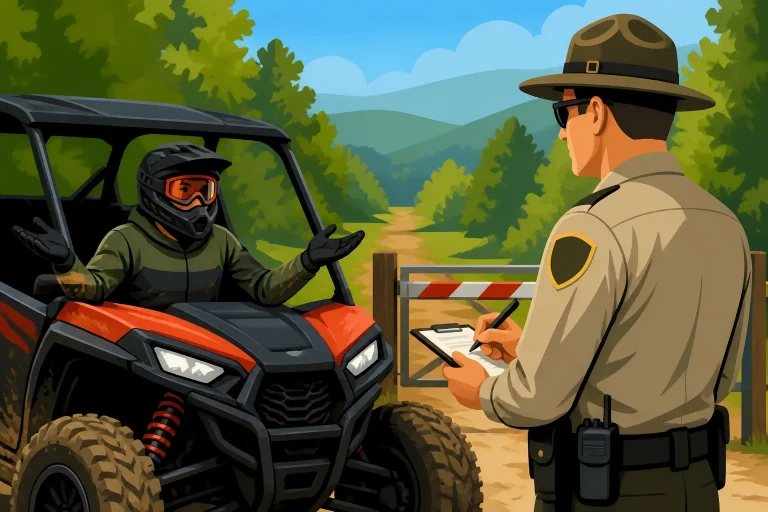
Trail operators may have rules beyond statewide requirements. Check the specific park’s current rider requirements, age guidance, permit conditions, and equipment rules before you travel. A rule that applies at one location may not apply at another. Kentucky Trail Rules for Riders Under 16 is useful background, but confirm details directly with the riding area you plan to visit.
Make protective gear and adult decisions part of the plan
Kentucky has helmet requirements for young riders, and a helmet should be treated as essential even when you are unsure which specific rule applies to a particular ride. Choose a helmet designed for the type of riding, follow the manufacturer’s fit instructions, and make sure it stays in place when the rider moves their head. A helmet that is too loose, too large, or worn incorrectly is not a good fit.
Other gear can help with comfort and reduce exposure to common riding hazards. Eye protection keeps dust and debris out of the eyes; gloves can improve grip and protect hands; sturdy footwear helps protect feet and ankles. Gear should fit the child, not merely be borrowed from an adult. If you shop online, including through Amazon, check the product’s intended use, safety information, size guidance, and return terms. A low price or appealing design is not a substitute for fit.
Protective equipment is only one layer of safety. It cannot compensate for an unsuitable machine, poor judgment, an inattentive supervisor, or a trail that exceeds the rider’s ability. The adult should be willing to cancel or shorten the ride if the weather, trail conditions, or child’s behavior make the plan unsafe.
It also helps to discuss supervision without making it sound like a punishment. Explain that the adult is there to help the ride stay safe, not to race or criticize. Give the child a clear signal to stop, and practice using it somewhere controlled before entering a busy area. Praise steady control and good decisions rather than speed or distance.
If a child repeatedly ignores instructions, cannot maintain a safe pace, or becomes overwhelmed, pause the ride. Move to a safer area if possible, talk through what happened, and decide whether to continue. If the child cannot follow the group’s basic rules, ending the ride is the responsible choice.
For an overview of the age-related rules that apply to younger riders, see Kentucky Rules for Riders Under 16. If the question is specifically whether a child can operate a particular machine, the manufacturer’s label and current Kentucky requirements should both be checked before riding. The safest decision is the one that accounts for all three: the child’s ability, the machine’s design, and the route.
Disclaimer
This article is for general informational purposes only and does not constitute professional advice. Laws, prices and regulations vary by location and change over time. Consult a qualified professional for guidance on your specific situation.