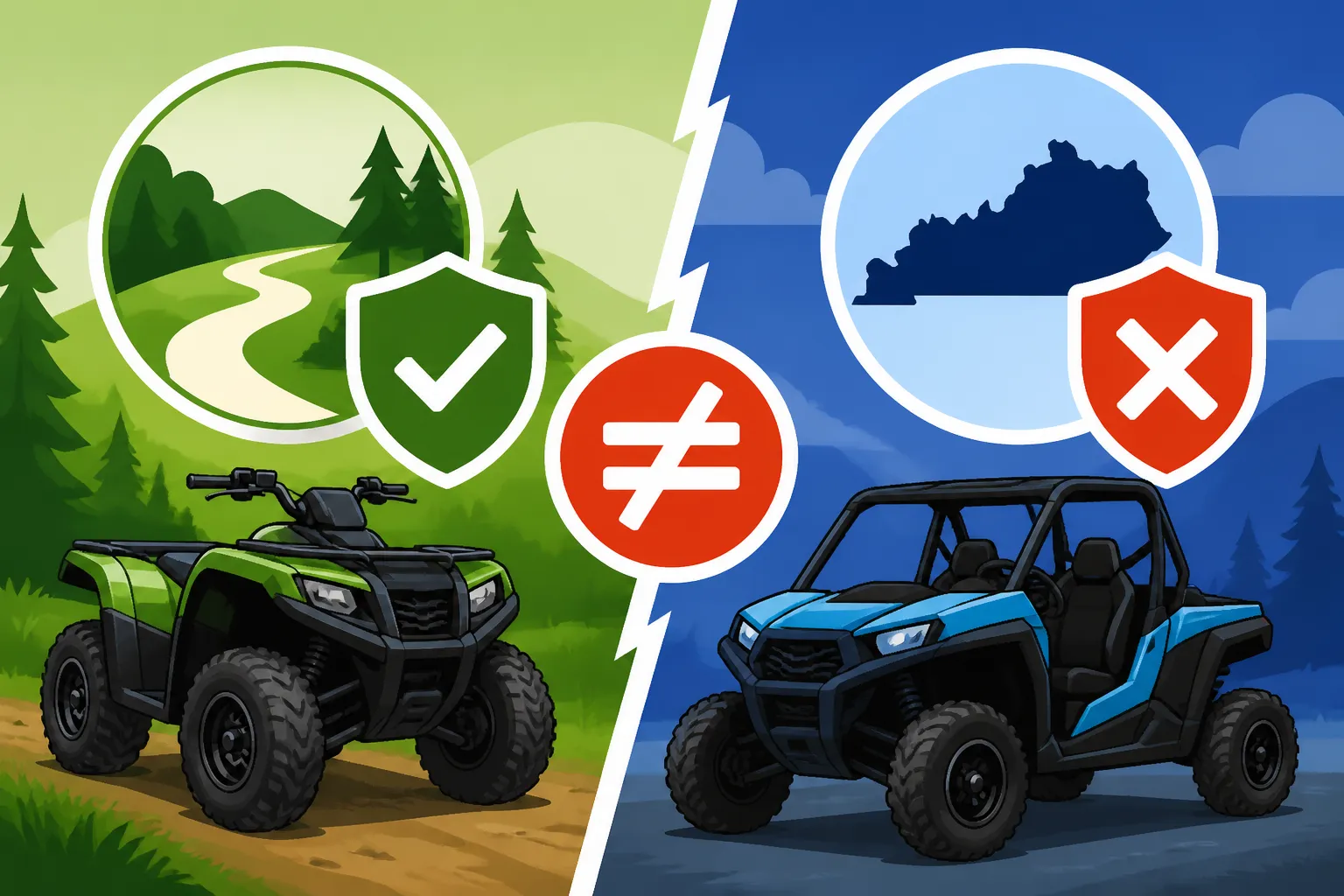
Why a Kentucky Park Permit Is Not a State Permit
A permit bought at one Kentucky riding area can feel like a general ATV pass, especially when the same machine and rider are involved. It usually is not. The permit comes from a particular park or land manager and covers only the access that issuer defines. Knowing that boundary helps you avoid arriving with the wrong pass—or assuming a park permit replaces title, registration, or road-use requirements.
What a Kentucky park permit actually authorizes
A trail permit is permission to use a particular riding area under that area’s conditions. It is not a general Kentucky credential for every ATV or UTV trail. The organization issuing the permit sets its coverage, such as where it is valid, who must hold one, which machines it covers, and when it may be used.
That distinction matters because “permit” can mean different things in different places. One riding area may issue a pass for a rider, while another may require a permit tied to a machine, a visit, or a particular type of access. Some permit systems may have separate rules for passengers, children, groups, or camping. There is no reason to assume that one area’s format applies somewhere else.
A permit might authorize you to:
- Enter a named off-highway vehicle area.
- Ride on designated trails within that area.
- Use access for a stated period or under specified conditions.
- Meet that site’s requirements for a rider, passenger, or vehicle.
It does not automatically give you permission to ride on a neighboring property, a public road, a different park, or every trail in the same region. It also does not decide whether your machine is titled or whether a particular road is open to it. Those are separate questions governed by other rules and authorities.
For example, a permit for Black Mountain Off-Road Adventure Area is not, by default, a permit for Leatherwood Off-Road Park or Turkey Bay OHV Area. A rider going between areas should check each operator’s requirements rather than treating the first permit as a statewide pass. The same principle applies to a permit for a designated trail system on public land: its terms belong to that site, not every public riding area.
If you are trying to work out whether your trip requires a pass at all, start with Do You Need a Permit for Kentucky Trails?. The answer depends on where you plan to ride and who manages that land. A private park, a public-land recreation area, and a trail on another managed property can have different entry rules.
Why one permit does not cover the whole state
Kentucky does not issue one universal trail sticker that grants access to all ATV and UTV riding areas. Trail access is managed by the individual parks and land authorities, which set their own permit requirements. As a result, a permit from one issuer does not automatically transfer to another.
This is different from a statewide registration or licensing system. Kentucky’s lack of a general ATV registration decal does not mean that riding areas must admit machines without a local permit. It means that state registration and site access are separate matters. For the distinction between those concepts, see Why Kentucky Does Not Register ATVs and Why Kentucky Has No Statewide Trail Sticker.
A park permit is more like permission to enter a defined venue than a document that travels with you everywhere. You can compare it to a ticket for one attraction: having it may get you through that attraction’s gate, but it does not grant entry to another operator’s property. The analogy has limits because parks may use different pass systems, but the important point is the boundary set by the issuer.
Different owners mean different rules
Kentucky riding areas are not all run by one office. Some are privately operated, some are managed through local or regional organizations, and some are part of larger public recreation areas. Their permit processes and riding conditions may differ because each operator is responsible for its own land and access system.
That can affect details such as:
- Whether a permit is required before riding.
- Whether the permit is issued to a person, a vehicle, or a visit.
- Whether passengers need separate authorization.
- Which trails or facilities are included.
- Whether the permit is valid for a particular date or period.
- Whether you must display or carry proof of the permit.
- What happens if weather, maintenance, or a closure changes access.
Do not treat a familiar name or nearby location as evidence that permits are shared. Two trail systems may be close together and still have different land managers, gate procedures, and pass requirements. Even where a common operator administers more than one area, check the permit terms rather than assuming coverage.
No state permit means no automatic reciprocity
“Reciprocity” usually means one authority accepts a permit issued by another. For that to happen, the authorities need an arrangement or a rule that recognizes each other’s credentials. Kentucky does not provide a single statewide ATV trail permit that makes every park’s pass interchangeable.
That is why a permit purchased at one Kentucky park should be treated as valid only for the area described by its issuer. The lack of a statewide permit also means an out-of-state credential is not automatically a substitute for a Kentucky site permit. A park may have a specific policy for visiting riders, but that policy has to come from the park or land manager.
The practical version is simple: if you are riding on more than one managed property, plan to verify each property separately. A pass may be useful at one site and irrelevant at the next. For the broader reason that park passes do not operate as a shared state system, see Why There Is Nothing Statewide to Reciprocate.
How permits differ across Kentucky riding areas
The easiest way to understand the system is to look at the issuer and the place where you plan to ride. These examples are not a promise that each area’s current requirements will stay the same; check the operator’s current information before loading your machine.
| Riding area or pass | Who sets the access terms | What to verify |
|---|---|---|
| Black Mountain Off-Road Adventure Area | The organization operating the area | Where the permit is valid, who it covers, how to obtain it, and any current access conditions |
| Leatherwood Off-Road Park | The park operator | Whether permits are required for each rider or passenger, and which access is included |
| Turkey Bay OHV Area | The authority responsible for the recreation area | Permit type, validity, gate procedures, and any closures or seasonal conditions |
| Daniel Boone National Forest OHV trails | The relevant public-land manager | Which trails require a pass, where it applies, and the rules for carrying or displaying it |
The table is a planning aid, not a substitute for checking the individual issuer. A permit name can sound broad while still applying only to a specific place or kind of use. Likewise, a particular pass may cover more than one designated trail within its own system without becoming valid at an unrelated park.
Black Mountain and Leatherwood
Black Mountain and Leatherwood are separate riding areas. A permit for one should not be assumed to cover the other, even if both are part of the same trip. Check each area’s access information for the purchase process, the people or machines the permit covers, and the rules for the riding dates you have in mind. Information about one park’s pass procedure is not a substitute for the other park’s terms; for instance, Black Mountain Permits Must Be Bought in Person concerns that park’s permit process.
Turkey Bay and Daniel Boone National Forest
Public-land riding areas also have their own pass conditions. Turkey Bay is a designated OHV area within Land Between the Lakes, while Daniel Boone National Forest has its own OHV access rules for designated riding opportunities. Their permits are not automatically interchangeable simply because both involve public land or federal management.
Before visiting, confirm the area, the exact trails covered, the pass required, and any current restrictions. How the Turkey Bay OHV Permit Works and Buying and Using the Daniel Boone Forest OHV Pass provide more specific context for those systems. A pass associated with one of them should not be presented as a general Kentucky trail permit.
A permit is not proof of ownership or road authorization
A trail permit does not serve as a title, bill of sale, or other proof that you own the machine. If you need to establish ownership, see Proving Kentucky ATV Ownership. And if you plan to travel on a road, do not assume a trail pass makes that use legal. Road access is governed separately, and an off-road park permit does not override road restrictions.
Similarly, a title or out-of-state registration does not necessarily satisfy a park’s permit requirement. These documents serve different purposes:
- Title or ownership document: relates to ownership of the machine.
- Registration or other vehicle document: may relate to a vehicle system outside the park’s trail-access process.
- Trail permit: relates to access under a particular park or land manager’s rules.
- Road-use permission: depends on the road, the machine, and applicable road rules.
Keeping these categories separate prevents a common planning error: bringing a valid document, but not the document the gate or land manager requires.
How to confirm the right permit before you ride
The most reliable way to avoid a permit problem is to identify every property on your route and check the rules with the authority that manages it. Do this before traveling, especially if you are visiting multiple areas, bringing passengers, or relying on a pass purchased online or through a third party.
Use this process:
- Name the exact riding area. A nearby town, county, or region is not specific enough. Identify the actual park, recreation area, forest trail system, or private property.
- Find the permit issuer. Use the park or land manager’s official contact information. If a booking site or tourism page mentions a pass, confirm details with the entity responsible for access.
- Check what the permit covers. Look for the permitted location, dates or validity period, people covered, machine limits, and any separate passenger or camping requirements.
- Ask whether your intended route leaves that area. A trail may connect to, border, or appear close to another property without sharing permits.
- Confirm how proof must be carried or shown. The issuer may specify whether the permit is displayed, carried by the rider, or presented at check-in.
- Check for closures and temporary changes. Weather, maintenance, special events, or other conditions can affect access even when a permit is valid.
- Keep the permit information accessible. Save the confirmation or other proof in the form the issuer accepts, and make sure the rider responsible for it knows where to find it.
A quick call or message can resolve questions that a short permit description does not. Ask plainly: “Does this permit cover the trail system I plan to ride, and does it cover every person and machine in my group?” If your trip includes a second park, ask that park separately. Do not rely on a seller, another rider’s older pass, or an assumption based on a previous visit.
If the area’s information is unclear
Pause before riding rather than guessing. Ask the operator to clarify whether the permit is required, what it covers, and whether any separate authorization applies. Keep a note of the response and the date you checked, particularly if you are planning a longer trip or have already paid for lodging or transport.
Be careful with unofficial summaries. A visitor page may describe a permit system in broad terms, while the operator’s current instructions contain details about where a pass is valid or how a closure affects access. If two pages appear to conflict, contact the issuer directly and follow its current instructions.
For a multi-park trip, make a simple list: each riding area, the permit issuer, the pass needed, and any confirmation still outstanding. This is less confusing than trying to infer reciprocity from permit names or from the fact that the parks are in the same state.
What visitors from another state should expect
A rider bringing an ATV or UTV from outside Kentucky should not assume that a home-state registration, sticker, or trail pass will be accepted at every Kentucky riding area. The park or land manager controls its own access policy. Ask whether it recognizes any outside credential or whether you must obtain its own permit.
The same caution works in reverse. A Kentucky park permit does not necessarily meet another state’s or another operator’s requirements. If your route crosses state lines or includes multiple managed sites, treat each jurisdiction and property as a separate check. A permit is only as portable as the written terms that come with it.
Frequently Asked Questions
Does Kentucky issue one ATV permit that works at every park?
No. Kentucky does not have one universal trail permit that grants access to every ATV or UTV riding area. Each park or land manager sets its own access requirements.
Can I use a Black Mountain permit at Leatherwood?
Do not assume so. They are separate riding areas with separate permit terms. Check with each operator before your trip.
Does an out-of-state trail pass count as a Kentucky park permit?
Not automatically. Ask the specific Kentucky park or land manager whether it recognizes that credential. If it does not, you may need the site’s own permit.
Does a park permit let me ride on public roads?
No. A trail permit authorizes only the access described by its issuer. Road use is a separate question governed by applicable road rules.
Disclaimer
This article is for general informational purposes only and does not constitute professional advice. Laws, prices and regulations vary by location and change over time. Consult a qualified professional for guidance on your specific situation.