Riding Rush Off-Road for a Day
A day at Rush Off-Road can be a great way to explore eastern Kentucky’s wooded trails, but a little planning makes a big difference. Trail difficulty, recent rain, fuel needs, and park rules can all shape your ride. This guide walks through how to prepare, choose a sensible route, and make the most of your day without overcommitting.
Plan your Rush Off-Road day before you leave
Check hours, access, and park rules
Rush Off-Road is in eastern Kentucky near the community of Rush, in Boyd County. Before loading your ATV or UTV, check the park’s official information for operating hours, access instructions, current rules, and any notices that could affect your visit. Schedules and procedures can change, so don’t assume that information from an old trip or a social media post still applies. For planning details, see [Rush Off-Road's Daily Hours] and [Rush Off-Road Trails Open at 6 a.m.].
Confirm that your machine is allowed and that each rider has whatever permit or pass the park requires. Don’t assume a permit from another Kentucky riding area will work at Rush; access rules and permit systems are not necessarily interchangeable. If you are comparing requirements across parks, [Kentucky Trail Permits Explained] can help clarify why checking the specific destination matters.
It is also worth checking how the park handles passengers, helmets, age limits, sound, and trail closures. If you are riding with children or bringing a passenger in a side-by-side, read the applicable park rules before arriving. Sorting this out at home is less stressful than finding out at the entrance that a rider, machine, or piece of equipment does not meet the requirements.
Set a realistic route and turnaround time
A full day does not mean you need to ride every trail or keep moving from opening to closing. Choose a modest first loop, then decide whether to add another based on your group’s energy, the trail surface, and how much time remains. A route that looks short on a map can take longer than expected when it includes steep climbs, technical sections, stops to regroup, or a slow-moving rider.
Before the trip, agree on a turnaround time. That time should leave room to return to the staging area, load up, and handle an unexpected delay. It is especially helpful when your group has mixed experience or multiple machines. If someone gets tired, a tire needs attention, or a trail is more difficult than expected, your plan can adapt without turning the last part of the day into a rush.
Use a map to get oriented, but treat it as a planning aid rather than a guarantee that a route is open or suitable. The onX Offroad app can be useful for reviewing mapped routes and keeping navigation information available on your phone. Check the park’s own notices for current conditions and restrictions, and consider carrying a second navigation option so one dead battery or dropped phone does not leave the group guessing.
Choose trails that match your group and machine
Start with the least experienced rider
The best route for a group is usually the one the least experienced rider can manage comfortably. A confident rider may be eager to tackle a steep climb or rougher section, but a beginner who feels pressured can make mistakes or have an unpleasant day. Before setting off, talk honestly about experience, comfort with hills, and whether anyone is nervous about mud, rocks, narrow sections, or descents.
If you are unsure where to begin, start on a route the group believes it can handle and reassess at a safe stopping point. Look at the surface ahead, not only the trail’s label on a map. Rain can make a familiar section slick, while loose rock or ruts can make a moderate-looking route more demanding than expected. For a better sense of how to interpret trail labels, review [Kentucky Trail Difficulty Ratings].
The machine matters, too. A wide side-by-side may be comfortable for passengers but feel different from an ATV on narrow or uneven trails. Ground clearance, tires, wheelbase, turning space, and rider experience all affect how a route feels. If you are riding a larger machine, avoid assuming that a line shown on a map will be wide or easy to navigate. Check park guidance about machine access and trail restrictions before committing to a route.
Adjust for weather and trail conditions
Recent rain can change the character of a trail quickly. Mud may conceal ruts or rocks, water can collect in low spots, and slopes can become slippery. Dry weather can bring dust and loose surfaces that reduce visibility, particularly when several machines are traveling together. Check conditions close to departure and again when you arrive, rather than relying only on what the weather was like at home.
A sensible group agrees to stop if conditions become uncomfortable or unsafe. That might mean turning around before a steep, slick climb, choosing an easier route, or ending the ride early. Changing plans is not a failure; it is part of making good decisions outdoors. See [Kentucky Trail Conditions Before You Ride] and [Kentucky Trail Closures to Check] for planning topics to consider before heading out.
A map app can help you understand the broader route, but mapped information should not override a closed gate, posted notice, or park staff instruction. The onX Offroad app may help you keep track of your position and planned route, especially if you prepare maps before leaving cell coverage. Download or save what you need in advance if the app supports that option, and keep a paper or other backup map when practical. For more on why a backup matters, see [Kentucky Trail Maps Worth Carrying].
| Planning factor | What to check | Why it matters |
|---|---|---|
| Park access | Hours, entrance instructions, and current notices | Prevents a wasted drive or arrival at a closed access point |
| Permits | Rules for each rider and machine | A permit from another riding area may not apply |
| Trail choice | Difficulty, width, and machine access | Helps match the route to the group and vehicle |
| Weather | Recent rain, mud, dust, and visibility | Conditions can change how difficult a trail feels |
| Navigation | Park map, phone map, and backup | Reduces the chance of losing your bearings |
| Day plan | Fuel, breaks, and turnaround time | Leaves room to return without rushing |
Pack and ride with a full day in mind
Prepare the machine and the people
Give the machine a basic check before the trip. Inspect tires, brakes, lights, steering, controls, and visible leaks. Make sure the machine has enough fuel for the route you intend to ride, with a reserve for detours or delays. If you are unsure about its condition, handle maintenance before the trip rather than hoping a problem will not show up on the trail.
Bring the gear that suits the ride and the weather. A properly fitting helmet and protective clothing can make a long day more comfortable as well as safer. Eye protection helps when dust, branches, or debris are an issue. Pack water and food, and consider a small first-aid kit and basic tools appropriate for your machine. Keep important items secure so they do not bounce loose on rough ground.
If the group includes passengers, talk through how to communicate before starting. Agree on a signal to stop, a way to alert the lead rider to slow down, and what everyone should do if the group becomes separated. In a side-by-side, confirm that passengers understand seat-belt use and how to stay seated on uneven terrain. A quick conversation at the staging area can prevent confusion later.
Keep the group together without crowding
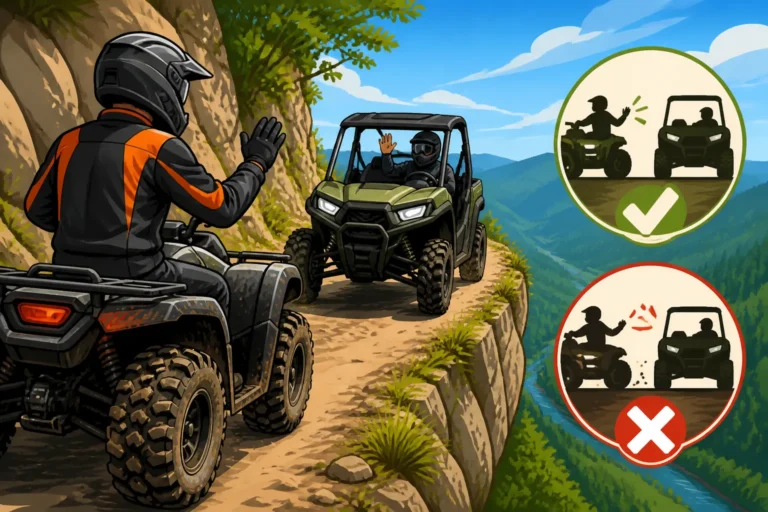
Choose a lead rider who knows the plan and a sweep rider who stays at the back. The lead should set a pace that gives everyone time to react, while the sweep makes sure no one is left behind. Leave enough room between machines to manage dust, braking, and unexpected obstacles. On narrow or uneven sections, avoid bunching up where one rider’s sudden stop could affect the rest.
Stop at safe places to regroup, check on riders, and confirm the route. Don’t stop in a blind corner, on a steep incline, or where another rider may not have room to pass. If someone is struggling, have the group pull over in a suitable spot and decide together whether to continue, choose an easier trail, or head back.
Keep navigation simple. The onX Offroad app can serve as one reference for the planned route, but make sure at least one other person understands the basic way back to the staging area. Avoid having every rider stare at a phone while moving. Check the map when stopped, and follow posted park directions over a route line that appears on a screen.
Make the most of the ride and finish safely
Leave room for breaks and changes of plan
The most enjoyable day is not always the one with the most trail time. Build in breaks for water, food, photos, and checking the group. Fatigue can creep up gradually, especially on uneven terrain or in hot weather. If a rider’s focus slips or they begin making small mistakes, take a break or call it a day rather than pressing on just to finish a route.
Treat the plan as flexible. If the trails are muddier than expected, reduce the distance. If the group is moving comfortably and conditions are good, consider adding another section after checking the time and fuel. Keep the return route in mind before exploring an unfamiliar spur. The onX Offroad app can help you refer back to your planned route, but park signs and current instructions should guide your decisions.
Take a few minutes to check the machine before leaving the riding area. Look for loose parts, tire damage, unusual smells, or leaks that may have appeared during the ride. Clean off mud where appropriate, secure the machine for transport, and make sure all gear and trash are accounted for. A quick inspection can reveal a problem while you are still somewhere you can address it conveniently.
Avoid common day-trip mistakes
One common mistake is arriving without checking current park information. Another is trying to cover too much ground because the group has only one day. Both can turn a fun outing into a stressful one. A better approach is to confirm the essentials in advance, begin with a manageable route, and add distance only when the riders, machine, weather, and time all support it.
It is also easy to underestimate how much fuel, water, and daylight the day requires. Plan for the return rather than using every available resource on the outward leg. If you are unfamiliar with Rush, don’t assume every trail junction will be obvious or that a phone will always have service. Save useful navigation information ahead of time and make sure the group knows the plan.
Finally, respect closures, posted restrictions, other riders, and the land. Stay on authorized routes, keep speed under control, and give other machines space. If you are unsure whether a trail is open or appropriate for your vehicle, stop and verify before proceeding. A conservative choice may feel less exciting in the moment, but it is far better than getting stuck, damaging equipment, or creating a hazard for the group.
Disclaimer
This article is for general informational purposes only and does not constitute professional advice. Laws, prices and regulations vary by location and change over time. Consult a qualified professional for guidance on your specific situation.