Kentucky ATV Trails Near Louisville
A common frustration for Louisville riders is discovering that “nearby trails” may mean a private off-road park, a longer drive to a designated riding area, or land where ATVs are not allowed at all. This guide explains the practical options around Louisville, what to check before loading up, and how to choose a ride that fits your machine and experience.
Where to ride an ATV near Louisville
Dirty Turtle Offroad Park near Bedford
For riders looking for a dedicated off-road destination within reach of Louisville, Dirty Turtle Offroad Park near Bedford is one place to investigate. It is a private riding park rather than an open stretch of public land, so access depends on the park’s operating schedule, rules, and any requirements it sets for riders and machines.
Before you make the drive, check directly with the park about current openings, permitted vehicle types, trail conditions, admission or permit arrangements, and whether reservations are needed. Ask whether its routes suit your machine’s width and ground clearance. A trail that feels manageable on a small ATV may be a very different experience in a wide side-by-side.
It is also worth asking what the park considers a beginner-friendly route. New riders may want a shorter, easier loop to get comfortable with the machine before tackling steep, rocky, or muddy sections. If you’re comparing local options, [Where to Ride an ATV in Kentucky] offers broader context on the different kinds of riding areas across the state.
Turkey Bay OHV Area for a public-land option
Turkey Bay OHV Area is in western Kentucky, within Land Between the Lakes. It is a designated off-highway vehicle riding area, but it is not a quick neighborhood outing from Louisville. Treat it as a trip that needs planning: check the route, the park’s operating information, the riding requirements, and the condition of the ground before you leave.
Public riding areas can be appealing if you want a different setting from a private park, but “public land” does not mean unrestricted access. Riding is generally limited to designated routes and areas, and entry or permit rules may apply. Start with [Turkey Bay OHV Area in Western Kentucky] and confirm current details before hauling your machine.
For riders who want to ride closer to Louisville, the key takeaway is that the nearest suitable place may not be a large public trail system. A private park may be the more practical day trip, while Turkey Bay is an option for a longer outing. If your plans include other parts of the state, [Best Places to Ride an ATV in Kentucky] can help you compare regions.
Why a nearby forest road is not automatically an ATV trail
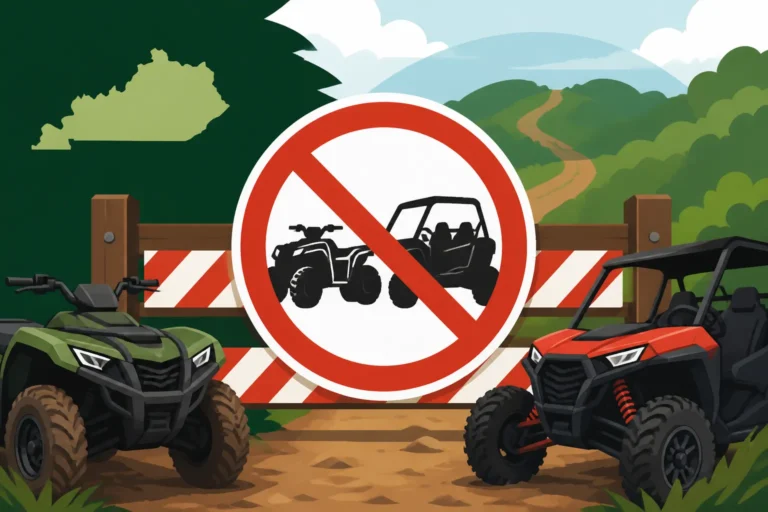
It can be tempting to see a forest road, utility corridor, or unpaved county lane and assume it is open to ATV traffic. That assumption can lead to a trespass problem, a citation, or an unpleasant encounter with a landowner. In Kentucky, the fact that a route is dirt or gravel does not by itself make it a legal ATV trail.
Confirm that the specific area allows your type of machine and that you are permitted to ride there. A road may be open to street traffic but closed to off-highway vehicles; a trail may cross private property; or a route may be closed seasonally or after poor weather. If you are unsure, ask the land manager or property owner rather than relying on a map label or a trail someone mentioned online.
Comparing riding options from Louisville
The best destination depends on how far you want to drive, whether you prefer a managed park or designated public riding area, and what kind of machine you have. Use the table as a starting point, then confirm the details with the operator or land manager before leaving home.
| Riding option | Best fit | What to confirm before you go |
|---|---|---|
| Dirty Turtle Offroad Park near Bedford | Riders seeking a dedicated private off-road park within reach of Louisville | Opening schedule, vehicle eligibility, trail difficulty, fees, reservations, and machine-width limits |
| Turkey Bay OHV Area in Land Between the Lakes | Riders planning a longer trip to a designated public riding area | Current access, required permits, route closures, operating conditions, and rules for your vehicle |
| Other Kentucky trail parks | Riders willing to travel farther for a different trail system or terrain | Distance, trail access, permit rules, seasonal closures, and whether the park accommodates ATVs or UTVs |
Choose based on your machine, not just the park name
An ATV and a side-by-side do not always have the same access. A narrow trail suitable for a single-rider quad may be too tight for a wider UTV. Before booking or towing, ask the park whether it has width restrictions, designated routes for different machine types, or sections that are unsuitable for longer or heavier vehicles.
This matters especially if you have modified your machine. Wider tires, a lift, a roof, or added accessories can change how easily it fits through wooded routes or between obstacles. If you ride a side-by-side, check [Kentucky Trails for a Wide Machine] and confirm the park’s rules directly. A route described as “easy” may still be uncomfortable if it is narrow, heavily rutted, or difficult to turn around on.
Match the terrain to your comfort level
Trail difficulty is not just about how steep a hill looks. Mud, loose rock, sharp turns, water crossings, and limited places to pass can all raise the difficulty. A new rider who is comfortable on an open field may not be ready for a narrow mountain trail, especially when the ground is wet.
Ask what trail choices are available for beginners and whether the park uses a difficulty-rating system. If ratings are posted, learn how the operator defines them; one park’s intermediate route may feel more demanding than another’s. [Kentucky Trails for Beginners] is a useful starting point for thinking through the experience level you want, but the local operator’s current trail guidance should shape your decision.
Account for weather and trail closures
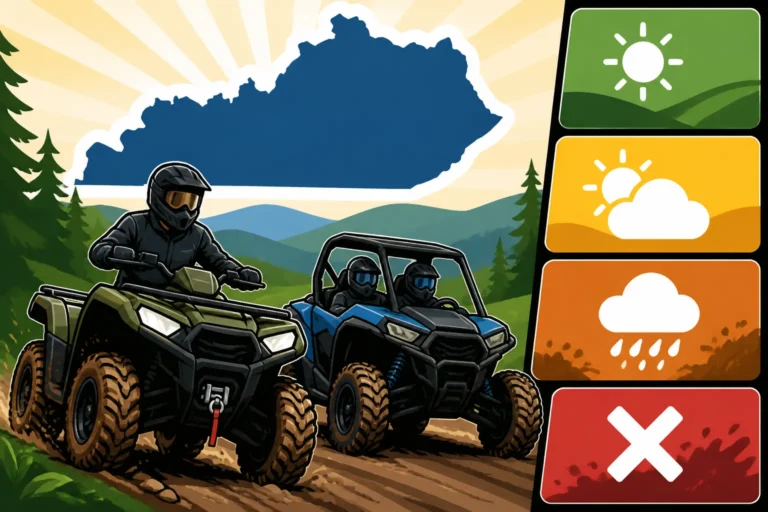
Rain can turn a manageable dirt route into a slippery, deeply rutted trail. It can also lead a park or land manager to close routes to protect the ground or reduce safety risks. Do not assume a trail is open just because it was open on your last visit.
Check the status shortly before you leave, especially after heavy rain or during a season when conditions change quickly. Look for updates from the park or land manager, and call if the information is unclear. [Kentucky Trail Conditions Before You Ride] and [Kentucky Trail Closures to Check First] are useful reminders to make conditions part of the plan, not an afterthought.
Planning a trail trip from Louisville
Check access, permits, and operating details
A little advance checking can prevent the aggravating situation of arriving with a trailer and finding out the park is closed, your machine is not allowed, or you need a permit you do not have. Confirm where to enter, whether the office or gate is open, how check-in works, what paperwork or safety equipment is expected, and whether passengers have separate requirements.
Permit rules vary by riding area. A park’s admission or riding permit is not necessarily interchangeable with a pass for a public land area, and a permit for one destination does not automatically give you access to another. Use [Kentucky Trail Permits Explained] to understand why you should check requirements for each place separately.
If you are renting rather than bringing your own machine, ask the rental company which trails the vehicle may use and whether the park permit is included. Do not assume that a rental agreement gives you permission to ride anywhere. [Kentucky Rules for Riding a Rented Machine] can help you identify questions to ask before you sign.
Plan the drive and trailer logistics
For a day trip, calculate more than the drive time. Allow for loading, fuel stops, parking, check-in, unloading, and the return trip. If you are traveling with a group, agree on a meeting place and make sure every driver knows the destination’s address or entrance instructions. Some trail areas have multiple entrances or staging locations, and a navigation app may not guide a trailer to the correct one.
If you use a phone for directions, download or save what you need before entering areas where cell service may be unreliable. An app such as onX Offroad can help with offline route planning and viewing mapped routes, but treat app data as a planning aid—not proof that a trail is open or legally accessible. Confirm access and closures with the park or land manager.
Bring the machine’s essential paperwork, a charged phone, water, basic tools, and any safety gear required by the riding area. If you are going somewhere unfamiliar, share your plan with someone who is not on the ride. A trail that takes longer than expected can affect your return time, especially if the group is learning the route or stopping often.
Build a simple ride plan
You do not need an elaborate itinerary, but a few decisions made before leaving can make the day calmer:
- Confirm the destination is open and your machine is allowed.
- Check permits, admission requirements, and passenger rules.
- Review the route and identify the correct entrance or staging area.
- Match the planned trail difficulty to the least experienced rider.
- Check weather and ground conditions, then reconsider if the route is likely to be unsafe.
- Set a turnaround time so the group is not rushing back near closing.
- Carry a way to contact help and tell someone where you plan to ride.
If weather turns or the machine begins acting up, changing the plan is sensible, not disappointing. Turning around early is better than pushing into a difficult section simply because it was on the day’s original route.
Riding safely and responsibly
Stay on authorized routes
Stay on marked or otherwise authorized trails. Cutting around a muddy section can widen the route, damage vegetation, or take you onto land where riding is not allowed. If a trail is blocked, closed, or unclear, stop and check rather than creating a new path around the obstacle.
Responsible riding also means watching for other trail users, slowing near staging areas, and following the park’s rules about noise, speed, passengers, and riding direction. On a shared or narrow route, give others room and avoid stopping in a blind corner or on a steep section where another rider may not see you in time.
Prepare for the terrain and the people with you
Wear a properly fitted helmet and the protective gear required by the riding area. Eye protection is especially useful when dust, branches, or flying debris are possible. Choose clothing and footwear that protect you from the weather and from contact with rough terrain, and bring extra water if the ride is long or conditions are hot.
For a group ride, set expectations before the first trail. Keep riders within a reasonable distance of one another, agree on what to do if someone falls behind, and avoid pressuring a less experienced rider to follow a faster group through difficult terrain. Families should check age, passenger, and supervision rules with the park before bringing children; requirements can depend on the riding area and the machine.
Leave room to change plans
A trail can feel very different after a storm, and even a familiar route can become more difficult when visibility drops or a machine develops a problem. Know when to stop, return to an easier section, or end the ride. If a trail is closed because the ground is saturated, respect the closure rather than trying to find a way around it. [Kentucky Trails Closed After Rain] explains why wet-weather restrictions matter to both trail conditions and the riding experience.
For Louisville-area riders, a good trip starts with choosing a destination that actually permits your machine, then checking access and conditions close to departure. A nearby private park may suit a short outing, while Turkey Bay is better approached as a planned trip. Confirm the details, match the terrain to your group, and keep your route within areas where riding is allowed.
Disclaimer
This article is for general informational purposes only and does not constitute professional advice. Laws, prices and regulations vary by location and change over time. Consult a qualified professional for guidance on your specific situation.