Kentucky ATV Title After Moving to the State
Moving to a new state is a huge undertaking, full of unpacking boxes, finding new grocery stores, and figuring out local customs. And if you’ve hauled your trusty ATV with you, you might be in for a surprise when you discover Kentucky’s unique titling requirements. Many states don't title ATVs at all, which can leave new residents scratching their heads. This guide will walk you through everything you need to know about titling your ATV after making Kentucky your new home, smoothing out a potentially bumpy bureaucratic road.
Understanding Kentucky's ATV Titling Laws for New Residents
It's natural to assume that what was true in your old state holds true in your new one, but when it comes to ATVs, Kentucky often plays by a different set of rules. This can be a source of real frustration for folks who've never dealt with an ATV title before.
Why Kentucky Titles ATVs (and Many States Don't)
You're not alone if you're confused. Many states consider ATVs strictly off-road vehicles and don't require them to be titled, much less registered. So, you might have owned your ATV for years, ridden it proudly, and never once thought about a piece of paper proving ownership beyond a bill of sale. Then you land in Kentucky, and suddenly, everyone's asking for a title. Kentucky's law requiring ATV titles came into effect in July 2010, meaning any machine purchased new after that date, or any used machine that changes hands, generally needs a title. This title serves several crucial purposes: it’s the official proof of legal ownership, it helps prevent theft by making it harder to resell stolen machines, and it smooths the process when you eventually decide to sell your ATV down the road. For more on this, you might find [Why Kentucky Titles Machines Bought After July 2010] helpful.
What Kentucky Counts as an ATV
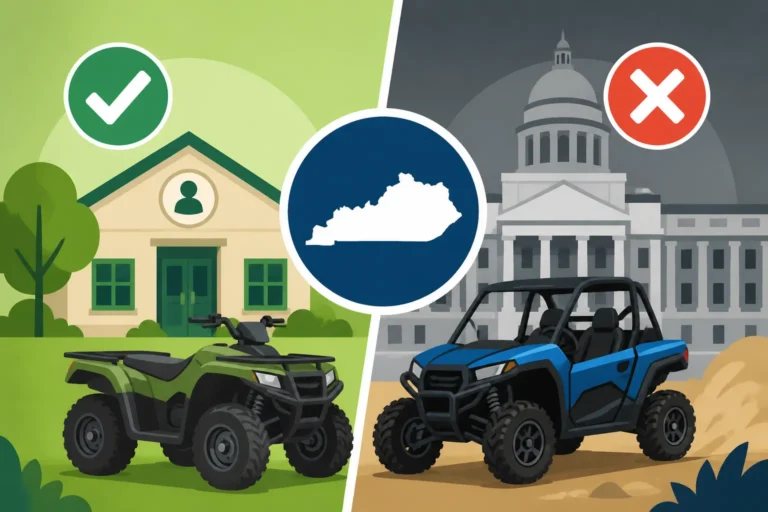
Kentucky has a very specific definition for an ATV, and it's one that can sometimes create awkward situations for owners of certain off-road vehicles. Legally, an ATV in Kentucky is typically defined as a motor vehicle that has four low-pressure tires, a straddle seat for the operator, and handlebars for steering. If your machine fits this description, then it’s generally considered an ATV for titling purposes. However, if you own a side-by-side (UTV), things can get a bit muddy. While many side-by-sides are titled in Kentucky, their multi-passenger seating, steering wheels, and sometimes higher top speeds don't perfectly align with the traditional "ATV" definition. This often means they are titled using the ATV framework, even though they technically sit a bit awkwardly within the exact wording of the law. Understanding [Kentucky's Narrow ATV Definition] can help clarify this nuance.
The Importance of a Valid VIN
Regardless of where your ATV came from, Kentucky will require a valid Vehicle Identification Number (VIN) to title it. This VIN must be a full, 17-character number, which is standard for most vehicles manufactured in recent decades. The VIN is etched onto the frame of your ATV, usually in an easily accessible spot like near the steering column, on the frame rail, or under the seat. The problem sometimes arises with older machines or those that might have been imported from countries where a 17-character VIN wasn't always the standard. If your machine has a VIN that is shorter than 17 characters, or if it only has an engine number and no frame VIN, you could face significant hurdles at the County Clerk's office. This is because the 17-character rule is fairly strict, and a clerk will reject an application lacking this. It's a critical detail, so checking your VIN before you even start the process is a smart move. You can learn more about this by reading [Kentucky's Seventeen-Character VIN Rule].
Gathering Your Documents for a Kentucky Title
Moving to Kentucky with your ATV means you'll need to prove you actually own it, and that usually means paperwork. The specific documents you need can vary slightly depending on where you moved from and how your ATV was previously documented.
Your Out-of-State Ownership Proof
This is where many new Kentucky residents encounter their first big challenge. If your previous state did issue a title for your ATV, great! That original, signed-over title (or one in your name) is your golden ticket. Bring it with you. However, if your previous state did not title ATVs, which is common, you’ll need to rely on other forms of ownership proof. A robust bill of sale, ideally signed by both you and the previous owner (or the dealer you bought it from), is absolutely essential. This document should clearly identify the ATV by make, model, year, and VIN, and state the purchase price and date. If your original bill of sale is missing or less than ideal, or if you need to create a new one to document a private sale or transfer, services like LawDepot can provide customizable templates for a comprehensive bill of sale that meets legal standards. Sometimes, an old registration document from your previous state can serve as supporting evidence of ownership, even if it's not a title. Check out [Using a Bill of Sale From a Non-Titling State] and [An Out-of-State Registration as Kentucky Proof] for more specific guidance on these alternative proofs.
The Kentucky Form TC 96-182
This form is the heart of your titling application in Kentucky. Known as the Application for Kentucky Certificate of Title/Registration, it’s a mandatory document that you’ll need to fill out completely and accurately. It’s where you’ll provide all the details about yourself, your ATV, and its ownership history. Don’t rush through it; any errors or omissions could lead to delays or rejection of your application. The form also includes sections for an odometer reading (if applicable, though usually not for ATVs), an affidavit of ownership, and information related to any liens. You can usually download this form from the Kentucky Transportation Cabinet's website or pick up a copy at your local County Clerk's office. Take your time to understand each section, and if you're ever unsure about how to phrase something, especially when attesting to ownership, remember that resources like LawDepot can also help you understand how to structure affidavits or declarations to support your claim. A thorough explanation of this form can be found in [Kentucky Form TC 96-182 Explained].
Other Necessary Identification and Fees
Beyond your ownership documents and the TC 96-182 form, you’ll need to bring a valid, government-issued photo identification to the County Clerk’s office. This could be your Kentucky driver’s license or another acceptable form of ID. The clerk needs to verify that you are indeed the person applying for the title. You'll also need to be prepared to pay the necessary fees. This includes the titling fee itself, which is a set amount, plus any applicable clerk fees for processing the paperwork. Additionally, if you haven’t already paid Kentucky sales tax on your ATV (for instance, if you bought it from a private seller in a non-titling state, or from a dealer out-of-state that didn't collect Kentucky sales tax), you will likely be assessed sales tax at the time of titling. It’s important to remember that these costs can add up, so it's wise to call your local County Clerk's office beforehand to get an estimate of the total amount you’ll owe. Knowing [What a Kentucky ATV Title Costs] can help you budget accordingly.
The Titling Process at Your County Clerk's Office
Once you have all your ducks in a row – your ownership proof, your completed forms, and your ID – the next step is a visit to your local County Clerk’s office. This is where the magic (or at least, the official processing) happens.
Why the County Clerk and Not a State Office
Unlike some other states where vehicle titling might be handled by a central Department of Motor Vehicles or similar state agency, Kentucky’s system is decentralized. All ATV titling (and vehicle titling in general) is handled at the county level by your local County Clerk. This means you won’t be trekking to Frankfort or calling a state hotline for your ATV title; instead, you’ll visit the clerk’s office in the county where you reside. This local approach often means a more personal touch, but it also means that procedures can sometimes vary slightly from one county to another, even though the underlying laws are the same. It's always a good idea to call ahead to your specific county's clerk office to confirm their hours and any unique local requirements they might have. For more on this, check out [Titling at a Kentucky County Clerk] or [Which Kentucky County Clerk Handles Your ATV Title].
What to Expect at the Counter
When you arrive at the County Clerk's office, you’ll typically take a number and wait your turn. Once called, present all your gathered documents to the clerk. They will carefully review your out-of-state title or bill of sale, inspect your completed TC 96-182 form, and verify your identification. They will also need to verify the VIN on your ATV. Sometimes this is a visual verification based on the VIN plate or sticker; other times, especially if there are discrepancies or if the machine is older, they may require a physical inspection by a law enforcement officer or a designated employee. Be prepared to answer any questions the clerk might have about the ATV's history or your ownership claim. They're not trying to give you a hard time; they're simply ensuring everything is compliant with state law. If your documentation is a bit sparse, they might ask for additional affidavits or statements of fact. In such cases, having pre-prepared forms or knowledge from resources like LawDepot about how to create such affidavits can be very helpful.
The Waiting Game and Temporary Proof
It’s important to manage your expectations: you won’t walk out of the County Clerk’s office with a shiny new Kentucky ATV title in hand. The clerk’s office processes your application, collects the fees, and then forwards the information to the Kentucky Transportation Cabinet, which then prints and mails the official title to you. This process can take anywhere from a few days to several weeks. While you wait for the official title to arrive in the mail, the receipt you get from the County Clerk’s office serves as your temporary proof that you’ve initiated the titling process. It’s vital to keep this receipt in a safe place, as it proves you are in compliance and have applied for your title. If you ever need to demonstrate ownership before your official title arrives, this receipt is what you'll use. For general information on proving ownership, you may also find [Proving Kentucky ATV Ownership] to be a useful resource.
Common Challenges and Solutions for New Kentucky Residents
Bringing an ATV from another state into Kentucky's titling system can sometimes present unique hurdles. But don't despair; many of these challenges have solutions.
Missing or Insufficient Out-of-State Paperwork
This is arguably the most common headache for new residents. If your previous state didn't issue titles for ATVs, and your only proof of ownership is a flimsy handwritten bill of sale, or even worse, no paperwork at all, the Kentucky County Clerk is going to be very hesitant to issue a title.
- Solution 1: Track down the previous owner. If possible, reach out to the person or dealership you bought the ATV from and request a more formal, detailed bill of sale. A good bill of sale should include the full names and addresses of buyer and seller, the date of sale, the purchase price, and a detailed description of the ATV (make, model, year, and especially the full 17-character VIN).
- Solution 2: Utilize affidavits. If tracking down the original seller isn't feasible, you might need to prepare an affidavit of ownership. This is a sworn statement outlining how you acquired the ATV, why you don't have a traditional title, and attesting to your legal ownership. While this isn't a guaranteed fix, it can strengthen your case. Online resources like LawDepot are excellent for creating legally recognized affidavits that you can then have notarized.
- Solution 3: Bonded Title (Rare for ATVs). In some extreme cases for vehicles with absolutely no ownership chain, a bonded title might be an option. However, this is usually reserved for street vehicles and is a complex, often expensive process not commonly used for ATVs. It's usually a last resort after all other avenues have been exhausted.
ATVs Bought Before Kentucky's 2010 Rule
Kentucky's ATV titling law started in July 2010. This means that if you bought your ATV (new or used) in another state before that date, and you're now bringing it into Kentucky, you'll face the same considerations as long-time Kentucky residents who own older machines. The key factor isn't when the machine arrived in Kentucky, but when it was purchased. If it was bought before July 2010, and your previous state didn't title it, then you generally wouldn't have a title for it. Kentucky created a process for these older machines, often involving a strong bill of sale or affidavit. You'll need to clearly demonstrate that the machine predates the titling requirement. You can delve deeper into this specific situation by reading [Machines Bought Before July 2010 in Kentucky].
The VIN Challenge for Older or Imported Machines
We've touched on this before, but it bears repeating because it's a significant roadblock: if your ATV lacks a proper 17-character VIN, you're going to have a hard time getting a title in Kentucky. Older ATVs, especially those manufactured for off-road use before the standardization of VINs, might have shorter VINs or only engine numbers. Similarly, some imported machines might not conform to US VIN standards. The County Clerk is bound by the state law that requires a 17-character VIN for titling.
- The Dilemma: A clerk cannot simply "make an exception" for a non-standard VIN. They will reject your application. [Why a Kentucky Clerk Rejects an Engine Number] explains this in more detail.
- Potential (but difficult) Solution: In some rare instances, for older machines with no VIN or a non-standard VIN, you might be able to apply for a state-assigned VIN from the Kentucky State Police. However, this is typically a lengthy and involved process, often requiring significant documentation and inspections, and it's not always guaranteed, particularly for recreational off-road vehicles. It’s a road less traveled and should be explored only after confirming with your County Clerk that it's a viable option for your specific machine. For more on imported machines, consider [Imported Machines and the Kentucky VIN Rule].
Here's a quick overview of common documents you might need:
| Document Type | Description | Needed If Your Previous State… |
|---|---|---|
| Out-of-State Title | Official proof of ownership from your prior state, signed over if applicable. | Titled ATVs |
| Bill of Sale | Detailed record of sale including VIN, price, and parties involved. | Did NOT title ATVs; or for private sales |
| KY Form TC 96-182 | Kentucky's official application for title/registration. Must be completed. | Always Required |
| Valid Photo ID | Government-issued identification for applicant verification. | Always Required |
| Previous Registration | Old registration from prior state. | Did NOT title ATVs (as support) |
| Affidavit of Ownership | Sworn statement detailing acquisition, if paperwork is missing/insufficient. | Paperwork is sparse |
Disclaimer
This article is for general informational purposes only and does not constitute professional advice. Laws, prices and regulations vary by location and change over time. Consult a qualified professional for guidance on your specific situation.